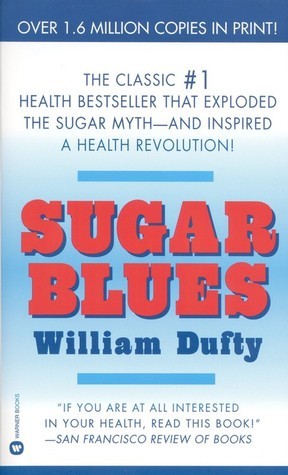
It's a prime ingredient in countless substances from cereal to soup, from cola to coffee. Consumed at the rate of one hundred pounds for every American every year, it's as addictive as nicotine -- and as poisonous. It's sugar. And "Sugar Blues", inspired by the crusade of Hollywood legend Gloria Swanson, is the classic, bestselling expose that unmasks our generation's greatest medical killer and shows how a revitalizing, sugar-free diet can not only change lives, but quite possibly save them.
I would really only recommend this book to someone interested in the history of sugar's refinement and its integration into societies. For that, this book is excellent (or at least appears to be - more on that shortly). Beyond a history lesson though, it falls seriously short. The author is clearly a fanatic, as evidenced by his blaming everything from mental illnesses to the Bubonic plague to freckles on sugar consumption.
I read this book based on a recommendation and the fact that I'm somewhat of a naturalist when it comes to food. In that same vein, I also tend to believe refined carbohydrates are more damaging to our bodies than saturated fat, which has been a staple part of our diets for millennia. I was hoping to expand my knowledge on the subject, specifically regarding sugar, but it's extremely hard to take the author's claims at face value when every so often he throws in a gem like that freckle bit. You never know what you can trust, and that is seriously frustrating.
This book did motivate me to do a little side research, so I'll offer the results of that here for those interested. As Dufty claims, it is true that your typical iodized Morton table salt contains dextrose (I verified this in my own kitchen). However, it amounts to 0.04% by mass, and the only reason it's present is to stabilize the iodine. That amount is completely inconsequential. At that ratio, to get a TEASPOON of sugar, you'd have to eat around a quarter pound of salt. Good luck. Morton standard (non-iodized) table salt does not contain dextrose.
The other thing that really caught my eye was the study Dufty mentioned where a French physiologist named Francois Magendie fed dogs a diet of sugar and water and studied the effects. Because the dogs died, Dufty concluded, and I quote, "As a steady diet, sugar is worse than nothing. Plain water can keep you alive for quite some time. Sugar and water can kill you." (p136-7, his emphasis) I poked around for a while trying to track down this study, and what I found is laughable but interesting. This is a direct quote from Magendie himself (assuming the Journal of Nutrition is to be trusted): "I took a small dog of three years old, fat, and in good health, and put it to feed upon sugar alone, and gave it distilled water to drink: it had as much as it chose of both...[details over time of the dog's diminishing strength, decreasing appetite, and the development of ulcers in the dog's eyes]...It expired the 32nd day of the experiment." [1]
So. What we have here is a single healthy dog, fed nothing but sugar and water, that lived for 32 days. You can actually conclude something useful from this: that sugar (commonly referred to as "empty calories") cannot keep you alive - this dog very clearly starved to death and experienced some nutritional deficiencies along the way. You could then say that sugar is worse than nothing...in the sense that sugar also causes cavities. Concluding that the dog died faster than if it'd had only water, on the other hand, is complete and utter conjecture. It was a single dog of unspecified breed, and there was no control. The other examples Dufty lists to back his claim are simply cases of humans living for a while without food. I wanted to buy the spats of nutritional biochemistry, but I feel as though I'd have to verify everything myself. There are far better sources of information out there, such as Good Calories, Bad Calories.
This book changed my LIFE! I was seriously addicted to sugar, like the little girl in that John Waters film with the dark circles under her eyes, only into adulthood. Would drown my sorrows in half a batch of brownie mix, then wonder why I was even more depressed. Quitting cane sugar (and HFCS) was one of the best things I've ever done. I had to stop completely for a few months, then found that if I ate something with sugar I'd want more, the craving would come back as surely as it does for any addict.
So I stay away from it almost 100%. When I do consume sugar I notice my mood plummets and I get angry much more easily. Not to mention that being off cane sugar and white flour is also a great way to lose weight/stay thin. I was about 160 when I quit and have been about 145 the past 20 years. But I'm naturally thin (6' tall), I know a lot of people who've lost serious weight quitting sugar and gluten.
This is a revolutionary book and by that, I mean it is a book for revolutionaries. Completely over the top, way off the deep end, and so far out there that only a person pre-convinced of its premise (refined sugar is the root of all evil in the world, throughout history) can take it seriously. I am one of those people. I love, love, love this book and will probably read it ten more times before I die, but seriously, it's completely insane and actually does trace the evils in the world through sugar's introduction into civilization. Unless you are furious with sugar, do not read this book.
This book was first published in 1975. And if one wants to know the gist of what it tries to convey all he has to to is to turn to pages 59 to 60 thereof where the author quotes an even older work, that of the Japanese natural healer named Sakurazawa who, in his work entitled "You Are All Sanpaku" said:
"Western medicine and science have only just begun to sound alarm signals over the fantastic increase in its per capita sugar consumption, in the United States especially. Their researches and warnings are, I fear, many decades too late...I am confident that Western medicine will one day admit what has been known to the Orient for years: sugar is without question the number one murderer in the history of humanity--much more lethal than opium or radioactive fallout--especially those people who eat rice as their principal food. Sugar is the greatest evil that modern industrial civilization has visited upon countries of the Far East and Africa. ..Foolish people who give or sell candy to babies will one day discover, to their horror, that they have much to answer for."
Well, the latter part may not be entirely correct. For people (usually parents) who give candies to their babies usually like to eat candies themselves and may be dead of sugar-related diseases long before the grown-up children start suffering from the same maladies.
This book, written in 1975, gives a historical, social, and nutritional survey of sugar, and concludes that it is one of the most unhealthy and pernicious substances around. It's written in a conversational style not out of place for the mid-70s, but that doesn't mean it is without rigor. While Duffy's breezy style initially made me think this was merely pop-culture fare, 35 years of trends since he published it only reinforce what he was saying. My own research also confirms his facts.
This is simply a well-written, engaging, inspiring and frightening book about the effects of sugar: a non-nutritive, historically tragic, politically leveraged, addictive, destructive substance that is central to the Western diet. Just one example: Duffy warns (in 1975!) about the rise of diabetes, and its correlation with soft drinks and sugar in snacks. Today, the epidemic of diabetes simply proves him right. The book is full of data that support the urgency of his warning. One only wonders why this story, and this book specifically, is not getting more attention.
*
WHY I READ THIS BOOK: When my neighbor heard (last year) that I was going off sugar, she asked if it was because I had read this book. I hadn't even heard of it, so she lent it to me. It took a year to get around to reading it, but I'm glad I did. After Thanksgiving I'll be going off sugar again, with (I hope) more resolve than last time.
Dufty's sprawling, inflammatory writ of a rant is disorganized and preachy, with a colloquial tone, liberal manipulation of fact, and touch of fanaticism that tempts the reader to dismiss it entirely.
BUT, it is also a punishing and deserved slap in the face for our socially-selected ignorance about sugar. The historical, economic, and chemical truths about sugar refinement and it's effects on us, the over-consumers, were old news at the time of this book's publication in the mid-70s. Yet somehow, the larger picture of cause and (especially) effect can still seem revelatory today. This is a topic about which we as a larger culture have chosen, dangerously, not to learn.
Read this book, but with the appropriate grain of salt. Laugh when fact gets pulled into the deep end of extreme conjecture, but consider honestly those points rooted in any truth at all - even the crazy-sounding ones.
Morton's table salt really does contain dextrose. Meditate for a moment on that fact and its implications. Then, seek out more and better sources.
This is one man’s saga to explain every single feature about sugar that ought to ensure you never touch the stuff again. It would seem that a whole slew of the world’s problems can be traced to one source of strife: sugar. It is the cheapest fuel to pick up the white man’s burden. Because it is manufactured in such a way that provides an abundant amount of caloric energy for little cost, and its services as a refined crop have so much use in preservation of food—it would seem to be a miracle. Except, according to William Dufty, sugar carries the weight of an insurmountable depth of problems; as well as a corrupt and all but invincible industry driving its projective uses into the future of our dumb, prediabetic world.
Essentially the first half of the book is devoted to how the sugar industry was made into an empire after sugar’s inception into the Western world. As foreign explorers came upon the cane in the New World, they excitedly took to it and transferred it across the oceans, to Europe and Asia, to exploit its possibilities. Dufty goes into how lucrative the sugar trade became, owing its success to mass consumption and production on a fairly easy to manage scale; but details how the health of the entire sugar-consuming world would fall with each scrumptious bite. He essentially calls out a world too stupid to understand that its cheap diet had begun costing everyone their health. I can’t put it in a simpler way. His overall emphasis is on how the powers-that-be killed wise men and "witches" and quack medical experts and nutritionists who attempt to decry the beneficial effects of sugar, because the strength of the industry was so implemental to the growth of progress (like the East India Trading Company and the coming of the FDA), to deny the advent of sugar was to deny the kingdom itself. Sugar grew like a big white orifice and swallowed the whole lot of a natural world ingrained.
The second half of the book goes into even richer detail of how the sugar industry in the last century completely deformed any rudimentary ethical concern it could have for the general public’s health—for the purpose of continual expansion of this trade.
He contends that problems like hypoglycemia, diabetes and obesity were either founded or deeply exacerbated by the refined sugar and that fascinations like vitamin-counts became a craze as a default of its negligence to provide real nutrition. He reflects numerous people not understanding hypoglycemia and the importance of blood sugar levels, trying to control their weakness by eating candy bars. People were just really dumb, and still are, and don't know why they can not control their bodies.
These sugar-pushers will have you believe that sugar is an essential component of the human body, which is true. Dufty explains the difference between glucose (blood sugar), a natural component of how the body makes its own energy, and sucrose (cane or beet sugar), which is refined sugar lacking actual nutrients. When they say it is essential, “how it is oxidized to produce energy, how it is metabolized to produce warmth, and so on. They’re talking about glucose, of course, which is manufactured in our bodies. However, one is led to believe that the manufacturers are talking about the sucrose which is made in their refineries. When the word sugar can mean the glucose in your blood as well as the sucrose in your Coca-Cola, it’s great for the sugar-pushers but it’s rough on everybody else.”
“Pure is a favorite adjective of the sugar pushers because it means one thing to the chemists and another thing to the ordinary mortals. When honey is labeled pure, this means that it is in its natural state (stolen directly from the bees that made it), no adulteration with sucrose to stretch it and no harmful chemical residues which men may have sprayed on the flowers. It does not mean that the honey is free from minerals like iodine, iron, calcium, phosphorus, or multiple vitamins. So effective is the purification process which sugar cane and beets undergo in the refineries, that sugar ends up as chemically pure as the morphine or the heroin a chemist has on his laboratory shelves. What nutritional virtue this abstract chemical purity represents, the sugar pushers never tell us.”
Rather, the refining process of sugar cuts out every potential nutritious value that the raw cane might give. They basically scour the crop for its shell, a carbohydrate whose only value is a caloric intake. Then, all: “excess glycogen is returned to the blood in the form of fatty acids. These are taken to every part of the body and stored in the most inactive areas: the belly, the buttocks, the breasts and the thighs.”
“Incomplete carbohydrate metabolism results in the formation of ‘toxic metabolite’ such as pyruvic acid and abnormal sugars containing 5 carbon atoms. Pyruvic acid accumulates in the brain and nervous system and the abnormal sugars in the red blood cells…interfere with the respiration of cells…[generating] the beginning of degenerative disease,” such as diabetes, obesity, coronary thrombosis, tooth decay, diseases of the gums, stomach trouble, varicose veins, hemorrhoids, peptic ulcers and diverticular disease.
But because the industry is so imbued with its own success, there really is no turning back the fortune. How do they allow a product that should be replaced from our status quo and made obsolete as a food item prosper?
Dufty quotes Paul Hawkens in a rather elegant musing, that “the more you see a product advertised, the more of a ripoff it is.”
Essentially, they have to make it work:
“Coke executives have learned from extensive research that young America is searching for what is real, meaningful in this plastic world, and one bright ad executive comes up with the idea that it is Coke. Yep, Coke is the real thing and this between the age of six and nineteen until their teeth are rotting just like their parents’ did.”
The result: A centuries old game of semantics. A tea-time with the mad-hatter, shoveling lumps of sugar through the logic of twists and turns .
He gives an excerpt from a case proposed against the sugar industry, a Senator Schweiker vs. the American Medical Association. The tale is in effect, a semantics argument over what defines an “antinutrient:” The AMA wants to say that if a food product is not antagonistic to the body, it cannot be considered antinutrient. Sugar is a carbohydrate which the body already processes, with its own glucose.
By saying that carbohydrates are the enemy, it is denying a necessary function of the body. Dufty comments that it is “misleading to talk about natural carbohydrates such as grains interchangeably with refined carbohydrates such as sugar.”
Schweiker, argues that refined sugar, because it is unnatural, works as an antagonistic agent in displacing metabolic energies. The AMA’s defense: “after all, exercise increases the need for certain vitamins. That doesn’t mean that exercise is ‘antinutrient.’
It is a courtship of a mad hatter. They run the dialogue into the ground, until they dismiss for time and the settlement is broken up. The AMA wins.
It is unbelievable to what lengths the pushing of sugar goes. He talks about a man named Dr. Wiley who before the FDA chaired the Bureau of Chemistry. The Bureau of Chemistry championed the Pure Food and Drug Laws by initiating a group called The Poison Squad, a number of volunteers who would test a product before it was put out into the public. Because of lobbyists however, the Bureau of Chemistry was replaced by the FDA and the GRAS list, Generally Regarded As Safe. This list takes substances off the market only after it has been proven unsafe. The process of denying products by proper testing was forfeited to an innocent-until-proven-guilty standoffishness. Because the process of testing proved to be too much for sugar to not buckle under the pressure, they were sacrificed for the sake of a bureau that will allow just about anything to be passed under health code. The sugar industry is so powerful, that even the elements whom we have elected to protect our sanctity are lobbied by a force that has to careen through prospective dangers in order to propitiate the claim that sugar makes on our lives. In other words, let the whole world be dotted in gum-drops. Baby, we're in Candyland!
You have to realize I can not sum up this book so easily in 10,000 letters. There is just too much information. But what is really magnificent about this book is it shows just how ignorant the public is about what they are putting into their bodies. Go look at a label in your kitchen. More than half. Nay, 80% of your food items contain sugar. I bet your sweet ass i'm right! Sugar is everywhere around us and it would be absurd to deny that the health crisis we are experiencing today is not in some part due to a complete divergence from natural food consumption to refined inorganic replacements.
There is a fine section of this book where the same Dr Wiley almost convinces Teddy Roosevelt of the dangers complicated within mass sugar consumption. This would have been a huge step in the right direction, getting an executive decision on repealing some sugar standard. But when he says the wrong thing, telling Roosevelt that saccharin is just as bad as sugar, leveling the president whose huberis could not admit that he himself had been doing anything wrong (Apparently, Roosevelt took to saccharin as a dietary summplement); Roosevelt says, “Anyone who says saccharin is injurious to health is an idiot.” The case was closed.
I wasn't sure if this book would have much new info for me, since it's from the early 80's, but it's actually really great. It's an very informative history of sugar: how the sugar industry increased the slave trade; how no one had cavities in all these traditional cultures that lived off plants and meats and milk, until sugar was introduced into their world; how abundant cavities are in the most sugar-laden cultures; how everything else gets the blame for disease but when any scientists point the finger at sugar they pretty much get ignored. Run on sentence? The book might have a few as well, but still, it's very valuable and made me realize that sugar is probably the major health culprit in my diet. Somehow my definition of "whole foods" always included plenty of sugar (in homemade whole grain cookies, etc) but I've learned that whole fruits are the best way to consume sugar, and I should stick to that whenever possible. Refined stuff wreaks havoc on our systems.
I can't recommend this book enough if you suffer from a chronic health ailment of any kind. While the language is a bit dated (he wrote this in 1975), the overall message endures. People abuse sugar, and sugar can lead to many chronic or fatal illnesses that are 100% avoidable, and reversible. While I approached this book predisposed to agree with the author (I am a certified health coach), I appreciate the extensive research he provides regarding the complex history of what came to be the refined sugar in so many of our foods. This isn't just about health or body weight. This is about the history of slavery. This is about corruption in government. This is about us failing our kids. It's a juicy read! And lest you think I am preaching...despite everything I know about sugar, I still battle a sweet tooth. Sugar is addictive as heck. Read this book to find out why :-).
This book basically outlines the history of sugar and some roles it is thought to have played in some fairly significant historical events. I would classify it more as historical than nutritional. If you are wanting to cut back or eliminate sugar but are lacking the motivation...this book will do it. For me, I personally find that I am much more emotionally stable if I stay away from the stuff...so this book has helped strengthen my resolve.
Fairly well written, at times eloquent, thought-provoking throughout. Some of his "facts" have since been disproven but none are sufficiently germane as to compromise his greater argument. He does make some overly bold and often outright tenuous assertions, but as they invite further discussion they can still be deemed appropriate to have been included at the time this was written. He does commit an absolutely atrocious butchery of Foucault in his analysis of mental illness, or the history thereof, but again this does not compromise the general point he makes.
That general point is this: that sugar (refined as opposed to natural) is not a food but a drug. It confers no nutritional benefit, has myriad anti-nutritive properties and actively harms the body. It contributes to many addictions and harmful habits, such as alcoholism, but nevertheless forms a cornerstone of what is unquestionably a diseased Western society. This may sound extreme but it is convincing to me, has been so far confirmed on all counts by independent research I've been doing on the side- and, from personal experience, having recently cut back drastically on my intake of refined sugar and therefrom having experienced a dramatic improvement in overall well being, his argument rings true on a physical level as well.
Worth considering, at least. But don't follow his recipes! Some of them call for cooking with vegetable oils, thus calling for cooking with polyunsaturated fats that go rancid when exposed to heat. Definite no-no. Look to Nourishing Traditions instead.
This book is fueling my fight. It basically says that sugar is responsible for every personal physical or emotional problem in the U.S. I am sold. Some memorable quotes:
We want to have our health and eat our sugarcake too.
"Let us go to the ignorant savage, consider his way of eating and be wise," Harvard professor Earnest Hooten said in Apes, Men and Morons. "Let us cease pretending that toothbrushes and toothpaste are anymore important than shoebrushes and shoe polish. It is store food that has given us store teeth."
The average American diet is a formula that guarentees bubble, bubble, stomache trouble.
He makes strong arguments for eastern medicine and healing based on diet. See Amy. And strong arguments convincing me that the way of the west is to make people spend money to buy all of these crazy vitamins and cures and vaccines, when they could just buy and eat some brown rice.
Also Vitamin A? was discovered by a man named Casimiro? Funk and the author pretended that vitamins almost got called the funky funks. Or the funky funkies. Or the any variation you choose.
I didn't finish this book, but I am so done. This book is old, the science is old, and most of the "facts" come off as urban myth. The book goes so far as to blame mental illness, learning disabilities, and "emotional disturbances" on "the obvious inability of the human system to handle the stress of sugar dependency".
If you don't have critical reading and thinking skills, you might like this book and believe everything it tells you. But I can't.
Does the book contain some good science? Sure. Sugar is linked to dental decay and obesity. No kidding. You could have condensed all the good and relevant science of this book into a Buzzfeed article. Nothing new is brought to the table. If you want to know more about the effects of sugar and artificial sugars on the body, try reading something this century and written by something with a degree.
emocionada de ter conseguido ler um livro de cabo a rabo depois de tanto tempo sem conseguir terminar nada.
a primeira publicação desse livro é de 1975 e dá aflição de ler pensando que se passaram quase 50 anos e a gente continua sem olhar com seriedade pra essa questão. sobre valores tortos, alimentação, saúde, imperialismo e como matar a população mundial pela barriga.
Seriously. I didn't give this book an F for one reason - it helped me to eat (a little) less sugar than I used to - and to buy unrefined sugar (and flour) at the grocery store now. A little change like that may make a big difference. We'll have to find out.
I was recommended this book by a friend - she told me, "If you read this book, you'll never want to eat sugar again. This book teaches you how to eat correctly and how to get rid of sugar in your life." She was (kinda) partially right. It helped me to give up more sugar than normal... but it didn't teach out to eat correctly at all. I wish that this book would have given more of a guideline about all types of sugars (ie. honey, splenda (which wasn't on the market yet), stevia, unrefined sugar, natural sugar from fruits). It made me wonder do I have to give all of those types of sugar up as well? Or only unrefined sugar? What am I to do?
The first 100 pages was mostly a history of how sugar changed the world (for the worse - not the better). Actually, it was more like the whole book minus the last chapter or two was about that. And then the last chapter told you what to eat - "natural foods" what what he called it - but it was all the unnatural things that are found only in Japan and overseas. What is natural about that? I have to learn to eat the foods that are around me everyday... I have to learn how to adapt to what I am given - I can't go and search out these tiny little specialty stores (especially while I am living in Warsaw) and try to find these weird foods. Eating healthy should be all about baby steps, about finding a way to change habits and make them lifestyle changes - one step at a time... but this book didn't teach ANY of that.
On a side note, the author did state that if you go a week or a month or longer without sugar notice that you don't flagellate. I experimented. It's true. That reason alone earns him a D- instead of an F... I now know how to get rid of unwanted gas.
I can say after I read the book I went off sugar and took my family off sugar for a year. It was the best year of our lives. Some of my children were too young to remember but the older two do and give me a bad time about it but they do say it was a good year. they first thought I was crazy but as adults they try to avoid sugar as much as they can.They feel better when they do avoid sugar. It helps my husband's and my health as we try to avoid it. There is samething to the theory about eating sugar. I appreciate this book and the way he presented it. I wasn't led to feel he had any purpose other than to show us how sugar affects our bodies.
This was a bizarre exercise in viewing the entirety of history through a random lens. In this case the writer explains that everything from the fall of entire empires to schizophrenia were all caused by sugar. I would say it's worth reading, though, if only cause it's always good to be reminded: sugar bad. Healthy stuff good. The end.
1 star because the book rests on the pillars of pseudo science. Another star because I want to believe it.
Sugar is bad. It's probably even as bad as dufty says it is. But after just 70 pages dufty has told me about the superiority of herbal medicine, how effective divining rods are, big earlobes are a sign of strong adrenal glands, sugar causes freckles, and every single malady is caused by the body's inability to handle sugar.
This may all be true I suppose but there is no actual scientific evidence of any of it. He stands by anecdotal evidence and ancient lore. 70 pages is where I make my exit.
Apesar da idade (anos 70), provavelmente ainda é o melhor desenho da história, cultura, política e economia em torno do açúcar. Difícil não repensar o consumo e os meios que a indústria encontrou para normalizar uma substância que, nutricionalmente, é só mais uma droga.
A more accurate title for this book would have been "History of sugar and is myths". Lots of interesting historical data but very little on the everyday applications of removing sugar from your diet. It's all common sense though, so if you flip through the pages, you can find some relevant information.
The information given on sugar was good and convinced me to give it up. I was sugar and grain free for 3 years and when I went back to sugar (due to all the food experiences I was convinced I was depriving myself of) my body deteriorated into a mess. That experience and this book reminded me of what it's so vital I go back to a low sugar lifestyle. I agree with the info he gives on how doctors and medical associations cover up what they know to make money, even though it puts the public at risk. I was also super appreciative of the info I got on all the issues caused by not getting certain vitamins. I have been so preoccupied with getting certain things out of my diet that I haven't been paying enough attention to making sure I get the right things in. The biggest problem I have with this book though is that it's horribly dated. I'm not sure how much of what he says in the book is still true in the present time. I didn't agree with everything he had to say either. I'm leery of his info on better tobacco and I'm not sure tons of dried fruit is where I want to go to decrease sugar. I also don't find that red meat causes sugar cravings. For me it's excess carbohydrate that causes this issue. I was also confused about how he said he stays away from tropical fruit because it's not appropriate for those not of tropical lands, but then recommends the umeboshi from Japan. Then again, maybe those beliefs were true back when this was written. Good book overall, but I think he needs to revise for 2022.
Even though this book was written 40 years ago, much of what the author discusses in his book is just as pertinent today as it was then, if not more. In William Dufty's Sugar Blues, the author goes to great length to discuss the history of sugar and how such a seemingly innocent substance could bring about so much damage. This book is really a wake up call for a lot of people who think that weight gain is simply a matter of gaining pounds instead of a symptom of greater problems that are going on in the body. Although the author's views sometimes seem extreme, the logic and science is inescapably true. This book has proven to be an invaluable asset to me, and I plan to share it with other people.
This is a phenomenal book, filled with unique facts and history difficult to find in one place. Essentially, processed sugar is a drug and has always been a drug. The USA suffers from an obesity epidemic because corporations in the early 1970s discovered and all adopted the "Bliss Point" for their foods, using added sugars and corn syrup to sweeten their product and feed an addiction. The facts in this book will shock you to your core.
First published in the 70s, this book has even more relevance today. Dufty provides a comprehensive look at sugar by tracing its effects on various civilizations--addiction, exploitation, illness, among others. His statistics are shocking, and 40 years later, far worse. A real incentive to get off of sugar. Lots of information, often presented with amusing sarcasm.
A book about the trajectory of sugar in its way to our mouths. Because of its addictive potential and consequently political interests, this substance, that has little from its original plant, made its way to most industrialized products we eat. From ketchup to oatmeal, it is everywhere, regardless of all the negative impacts on our health.
Informative. Learned a lot about sugar and actually, I changed my entire eating plan after reading this book. Not right away, but still. As of now, I do not consume sugar at all anymore. None. Nada.
This is a historically significant book as it is among the first documenting history, medicine and sociology connected with the consumption of sugar. The word "documenting" is a very generous way to say it, because first of all this book is a full on attack, even crusade on sugar. A lot of history on the sugar trade, history of medical opinion on nutrition and health is presented, but even if I agree with the overall thesis of the book, I read it thinking I am reading something extremely biased on one side, never considering any of the oponents best arguments or alternative explanations(such as a particular societal ill being the result of something other then sugar). The notion of correlation=/=causation is lost on Dufty. In the most dammig example he claims that the plague spread in the cities more then the villages, because urban people ate more sugar then people in villages.
But what is so amazing about this book first of all is the zeal of the author in being the one-of-a-very-handfull-lonely-anti-sugar-crusador. He began in a time, where unike today, most people did not think that sugar was at all unhealty. despite this, he describes the overwhelmingness of evidence for this that even in his time was availible, all these doctors who warned agains sugar in the late 19th century and throughout the 20th, who I didn't realise existed, all the field-works of western physicians going into various parts of the worls and observing the rapid effects the changing of the nutrition had on the health of the local population. This was the time when there were many parts of the world still eating their ancestral diets, untouched by the western inluence, making these two diets easy to compare. Of course none of this evedence is of the "controllled bllind study" quality.