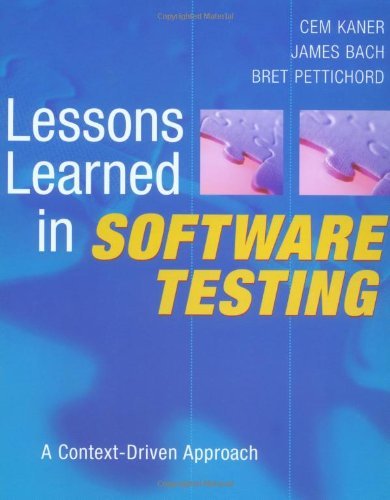
Great software testing teams aren't born, they're made - through a lot of hard work and persuasive communication. Along the way, there is an abundance of traps that one can fall into, which can derail the best-laid plans and put your projects behind schedule.
Cem Kaner, James Bach, and Bret Pettichord know this all too well. Between them, they have over fifty years of testing experience, and know what it takes for successful testing. In this groundbreaking new book, they have compiled 293 pieces of experience-tested advice for you to put to work in your testing projects. They reveal insights on how to do the job well, how to manage it, and how to steer clear of common misunderstandings in software testing. Each lesson is an assertion related to software testing, followed by an explanation or example that shows you the how, when, and why of the testing lesson.
The ultimate resource for software testers, developers, and managers at every level of expertise, this guidebook also features:
- Useful practices and helpful ways of evaluating situations gleaned from over fifty years of combined testing experience from the world's leading software testing experts
- Lessons for all key topic areas including test design, test automation, test management, testing strategies, and bug reporting
- Advice on how to match the selection of practices to the circumstances of your project
Cem Kaner is a Professor of Software Engineering at Florida Institute of Technology, and the Director of Florida Tech's Center for Software Testing Education & Research (CSTER) since 2004. He is perhaps best known outside academia as an advocate of software usability and software testing.
Prior to his professorship, Kaner worked in the software industry beginning in 1983 in Silicon Valley "as a tester, programmer, tech writer, software development manager, product development director, and independent software development consultant." In 1988, he and his co-authors Jack Falk and Hung Quoc Nguyen published what became, at the time, "the best selling book on software testing," Testing Computer Software. He has also worked as a user interface designer.
In 2004 he cofounded the non-profit Association for Software Testing.
Радий, що вирішив прочитати цю книжку вже після 6 років роботи в якості тестувальника. Самі автори зазначають, що її можна читати в будь-якому порядку, а також можна пропускати деякі розділи, залежно від етапу в кар'єрі (наприклад, автоматизацію чи менеджмент).
Розділи поділені на короткі уроки, деякі з них концептуальні або навіть філософські, а інші мають покрокову конкретику (але деякі були дещо нудні для читання).
Автори давали багато рекомендацій по літературі, яка стосується психології, критичного мислення та розв'язання логічних задач. Також було багато посилань на спільноти та інструменти, хоча деякі з них вже не активні.
Для себе я вирішив, що це був корисний матеріал, і планую перечитати його знову. Деякі уроки мене засмутили, а інші надихнули. Було цікаво послухати від досвідчених фахівців, які працюють у цій галузі стільки років, та ознайомитися з їхніми міркуваннями та підходами.