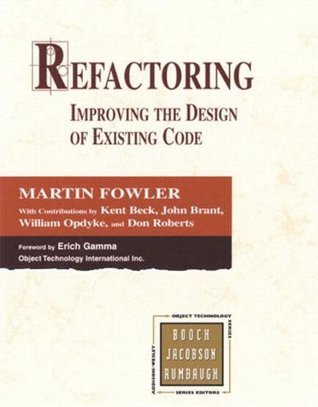
As the application of object technology—particularly the Java programming language—has become commonplace, a new problem has emerged to confront the software development community. Significant numbers of poorly designed programs have been created by less-experienced developers, resulting in applications that are inefficient and hard to maintain and extend. Increasingly, software system professionals are discovering just how difficult it is to work with these inherited, non-optimal applications. For several years, expert-level object programmers have employed a growing collection of techniques to improve the structural integrity and performance of such existing software programs. Referred to as refactoring, these practices have remained in the domain of experts because no attempt has been made to transcribe the lore into a form that all developers could use... until now. In Refactoring: Improving the Design of Existing Software, renowned object technology mentor Martin Fowler breaks new ground, demystifying these master practices and demonstrating how software practitioners can realize the significant benefits of this new process.
Martin Fowler (b. 1963) is a software engineer, Chief Scientist at ThoughtWorks, and an outspoken advocate for best practices in enterprise software design, particularly in regard to agile software development methodologies, including extreme programming.
До прочтения я писал плохой код; теперь я, слегка обновив приоритеты, пишу код чуть лучше. Это настолько радостное осознание собственного прогресса, что я готов простить книге и суховатый стиль, и отсутствие ответов на весьма кмк важные вопросы вроде приоритетов различных видов рефакторинга. Очень, очень хорошо.
Для тех кто более-менее знаком с современными IDE, книжка, скорее всего, покажется скучной. В ней расписываются по шагам основные виды рефакторингов кода. Также есть советы когда и какой рефакторинг применить.
На мой взгляд книга будет наиболее полезна программистам продвинуто-начинающего или начинающе-среднего уровня
Отлично структурированы рефакторинги. Книга подсказывает что делать, когда, и самое важное — когда нужно остановиться. Понравились последние три главы посвященные общим вопросам.