

What do you think?
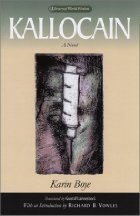
Kallocain
This is a novel of the future, profoundly sinister in its vision of a drab terror. Ironic and detached, the author shows us the totalitarian World-state through the eyes of a product of that state, scientist Leo Kall. Kall has invented a drug, kallocain, which denies the privacy of thought and is the final step towards the transmutation of the individual human being into a "happy, healthy cell in the state organism." For, says Leo, "from thoughts and feelings, words and actions are born. How then could these thoughts and feelings belong to the individual? Doesn't the whole fellow-soldier belong to the state? To whom should his thoughts and feelings belong then, if not to the state?"
As the first-person record of Leo Kall, scientist, fellow-soldier too late disillusioned to undo his previous actions, Kallocain achieves a chilling power and veracity that place it among the finest novels to emerge from the strife-torn Europe of the twentieth century.
As the first-person record of Leo Kall, scientist, fellow-soldier too late disillusioned to undo his previous actions, Kallocain achieves a chilling power and veracity that place it among the finest novels to emerge from the strife-torn Europe of the twentieth century.
193 pages, Paperback
First published January 1, 1940
About the author
Karin Boye
99 books274 followersKarin Boye was a Swedish poet and novelist.
She is perhaps most famous for her poems, of which the most well-known ought to be "Yes, of course it hurts" (Swedish: "Ja visst gör det ont") and "In motion" (Swedish: "I rörelse"). She also wrote a few novels including "Kallocain". Inspired by the rise of National Socialism in Germany, it was a portrayal of a dystopian society in the vein of Orwell's Nineteen Eighty-Four and Huxley's Brave New World (though written almost a decade before Nineteen Eighty-Four). In the novel, an idealistic scientist named Leo Kall invents Kallocain, a kind of truth serum.
Boye died in an apparent suicide when swallowing sleeping-pills after leaving home on April 23, 1941.
She is perhaps most famous for her poems, of which the most well-known ought to be "Yes, of course it hurts" (Swedish: "Ja visst gör det ont") and "In motion" (Swedish: "I rörelse"). She also wrote a few novels including "Kallocain". Inspired by the rise of National Socialism in Germany, it was a portrayal of a dystopian society in the vein of Orwell's Nineteen Eighty-Four and Huxley's Brave New World (though written almost a decade before Nineteen Eighty-Four). In the novel, an idealistic scientist named Leo Kall invents Kallocain, a kind of truth serum.
Boye died in an apparent suicide when swallowing sleeping-pills after leaving home on April 23, 1941.
Ratings & Reviews
Friends & Following
Create a free account to discover what your friends think of this book!
Community Reviews
Displaying 1 - 1 of 1 review

Read
June 5, 2022Dictaturile se mai schimbă, coșmarul totalitarismului rămîne. Dacă la apariția ei (1940), cartea trimitea către Stalin și Hitler, azi poate fi citită în cheia situației curente din imediata noastră apropiere sau poate fi comparată cu totalitarismul trăit pe propria piele. O distopie (presupun) necunoscută în România—n-am găsit nici o informație despre ea—a fost comparată cu 1984, pe care o precede cu mai mulți ani și căreia aș zice că îi e superioară stilistic, Minunata lume nouă sau Noi (pe care n-am citit-o).
Displaying 1 - 1 of 1 review