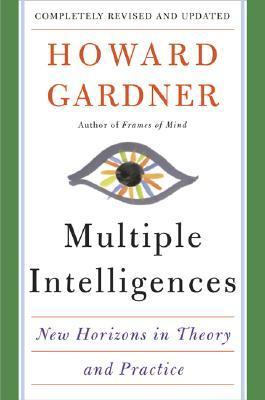
From the author of Frames of Mind, the definitive account of Multiple Intelligences theory and its applications.
“For those of us who suspect that intelligence is too complex a phenomenon to be measured by the single number of I.Q. derived from an ‘intelligence test,’ Gardner’s book is a refreshing experience and an open door into a whole new way of looking at human beings.” ―Isaac Asimov
Howard Gardner’s brilliant conception of individual competence has changed our view of the human mind. Thousands of parents, educators, researchers, and workers all over the world have explored the practical implications and applications of his Multiple Intelligences theory—the powerful notion that there are separate human capacities, ranging from musical intelligence to the intelligence involved in self-understanding. Multiple Intelligences stands as the most thorough and up-to-date account of the theory and application of Multiple Intelligences available anywhere. In this comprehensive book, Gardner explores the role of Multiple Intelligences in the workplace, evidence about brain functioning, the future of Multiple Intelligences practices in an ever-changing educational climate, and more.
Howard Gardner is the John H. and Elisabeth A. Hobbs Professor of Cognition and Education at the Harvard Graduate School of Education. He also holds positions as Adjunct Professor of Psychology at Harvard University and Senior Director of Harvard Project Zero. Among numerous honors, Gardner received a MacArthur Prize Fellowship in 1981. He has received honorary degrees from 26 colleges and universities, including institutions in Bulgaria, Chile, Greece, Ireland, Israel, Italy, and South Korea. In 2005 and again in 2008, he was selected by Foreign Policy and Prospect magazines as one of the 100 most influential public intellectuals in the world. The author of 25 books translated into 28 languages, and several hundred articles, Gardner is best known in educational circles for his theory of multiple intelligences, a critique of the notion that there exists but a single human intelligence that can be adequately assessed by standard psychometric instruments.
During the past two decades, Gardner and colleagues at Project Zero have been involved in the design of performance-based assessments; education for understanding; the use of multiple intelligences to achieve more personalized curriculum, instruction, and pedagogy; and the quality of interdisciplinary efforts in education. Since the middle 1990s, in collaboration with psychologist Mihaly Csikszentmihalyi and William Damon, Gardner has directed the GoodWork Project-- a study of work that is excellent, engaging, and ethical. More recently, with long time Project Zero colleagues Lynn Barendsen and Wendy Fischman, he has conducted reflection sessions designed to enhance the understanding and incidence of good work among young people. With Carrie James and other colleagues at Project Zero, he is also investigating the nature of trust in contemporary society and ethical dimensions entailed in the use of the new digital media. Among new research undertakings are a study of effective collaboration among non-profit institutions in education and a study of conceptions of quality, nationally and internationally, in the contemporary era. In 2008 he delivered a set of three lectures at New York's Museum of Modern Art on the topic "The True, The Beautiful, and The Good: econsiderations in a post-modern, digital era."
Reflexões super interessantes sobre educação. Gostei bastante, porém é uma leitura lenta, um pouco cansativa. Mas vale a pena o esforço, principalmente para quem trabalha com educação ou se interessa pelo assunto.