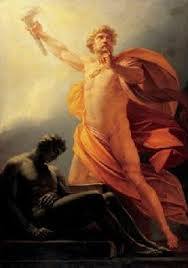
One of the most ambitious dramatic poems ever written, Percy Bysshe Shelley's Prometheus Unbound tells the story of the Titan Prometheus who gave mankind the secret of fire in open defiance to the decrees of Zeus, and who, as punishment for this generosity, was chained to the Caucasus Mountains and exposed to horrible tortures. Inspired by the Prometheus Bound of Aeschylus, Shelley's play serves as a sort of sequel, matching its Greek predecessor in stature and pure poetic power.
It depicts its philanthropist hero's ultimate triumph over the superstition and bigotry of the gods. As Shelley himself stated in his Defence of Poetry, Prometheus Unbound awakens and enlarges the mind.
This is probably what you would consider to be Shelley's Magnus Opus. This would be his most ambitious work and also what he is probably most famous for (though at least one lecturer has suggested that as a poet Shelley is somewhat dwarfed by his wife Mary Shelley, who is also the author of Frankenstein). This is sort of a sequel to the Aeschylan play Prometheus Bound and I say sort of a sequel because we have fragments of the original sequel, but the play itself is lost.
Prometheus Unbound is what you call a lyrical drama, which is in a similar vein to Milton's Samson Agonistes. The idea of a lyrical drama is that it is not written to be performed but rather to be read (and as I have indicated reading a drama without watching it being performed can be a difficult task), the performance, as some have suggested, goes on in the imagination.
The scope of this work is immense and Shelley explores some of the themes that have come out of the original play, and then brings them through to his own conclusion. While Shelley was an atheist, he uses the mythological as a method of criticising his own society, and the conflict that had arose between faith and science. Shelley's Jupiter is representative of God, which, to Shelley, is representative of the church who seeks to hold society in chains and prevent them from being able to examine and question the world in which he lives. His Prometheus is representative of the rational human, the one who questions and explores, but is attacked by the church because of that desire. Demogorgon could be seen as social change, which frees the rational mind from those chains, and pushes blind faith into the background.
The idea behind the original play is that humanity had fallen from grace and was living in a world of suffering, so Prometheus, against the decree of Zeus, teaches them the art of making fire and for doing so he is punished by being chained to a rock and having his liver ripped out on a daily basis by a vulture. The play ends with Prometheus being cast down into the netherworld. The idea that I see in this play is the concept of humanity being given the gift of technology (which is representative of fire) and by having this ability it strengthens them against the power of the deity. In Shelley's mind this is the idea of science, and we see in the past when people began to explore the nature of the world the church would respond in an aggressive manner, for fear that in doing so God would be unseated from his throne. This war continues to this day, with fundamentalist preachers (and I am only speaking of Christianity here) claiming that science unseated God from his throne, and evolution unseated humanity from the pinnacle of creation. In the end though, no matter how much faith we have, the Earth is not the centre of the universe.
Notice though that the original play ends with Prometheus being cast into hell, and that the second play, where Zeus and Promentheus are reconciled, no longer exists. It may be just coincidence, but the play ends with the triumph of faith over reason, and the play in which faith and reason come together in mutual agreement no longer exists. In a way this is very Hegalian in that we have opposites, with the thesis being faith and the anti-thesis being reason (or is it the other way around?), but the reconciling (or the synthesis) of faith and reason never comes about. Even today many a church baulks at the concept of a synthesis between faith and reason, and forces reason, and with it humanism, out of the door. My position is that since God gave us the gift of reason, the ability to be able to think and question, then to deny that gift, and to deny everything that comes from that gift, is to do a disservice to God. However that does not mean that we do not question what comes out of humanism, for to blindly accept what is said without questioning is to once again do a disservice to God.
As for Prometheus Unbound, there is no synthesis of faith and reason. In fact faith comes out as the loser in the struggle, with reason being freed by Demogorgon (and being an atheist we cannot consider that Shelley would necessarily believe in Satan), with represents the complete destruction of faith. In the end reason triumphs, and faith, and the church, are left being in the dark annals of history. Notice though, that it is Demogorgon and not Satan. Shelley is purposeful in this in that he indicates that the character of Satan, as painted by Milton, is a rather poor character in his opinion. Granted, Shelley could have created his own Satan, however he seems to feel bound to Milton's interpretation, and a creature that is fuelled and dominated by revenge would not serve the purposes of his poem. Shelley did not want a character with a chip on his shoulder, but rather a character that frees reason from his chains to allow him to prosper and flourish.
I have also written a blog post on the original play, however I do touch on this poem as well.
All that purpleness has to be accounted for, after all …
Considered by many to be Shelley’s masterpiece, the lyrical drama Prometheus Unbound nevertheless proved a major disappointment to me, even though I started reading it with a lot of sympathy for its premise, namely the fact that it seems to celebrate humans’ independence, based on reason, from whatever form authoritarian mumbo-jumbo might take in order to oppress free thought and the human capacity to improve the world around us to make it more habitable and hospitable to generations of thinking, feeling and creative human beings.
Still, this premise on its own did not suffice to make the reading experience enjoyable to me for there are some things that make Prometheus Unbound an exceedingly dire and gruelling text. The most obvious drawback is the abundance of purple poetry, which is surprising in that there are many instances in which Shelley has proven himself a skilful poet, one who was able to evoke both insight and emotion by his power over words. While there are some passages in this poem, which are true of Shelley’s genius, most of all in Acts I and III, where both Prometheus and Jove wield some impressive monologues, for most of the poem, Shelley’s poetical genius does not shine brightly but is hidden under clouds of esoteric and flowery sound. There may be some meaning in it, but the process of getting at this meaning would require some patient hermeneutical pot hitting, which might end up in the blindfold searcher’s whisking the air in despair and frustration. The form of a lyrical drama may not be the best way of displaying this kind of poetry after all because the extent of flowery language nips the drama in the bud so that it may be no surprise that there are actually no more than two passages which are really and truly interesting and moving, whereas the rest of the whole work serves as rubble to hide these passages.
The second reason why this poem did not work for me was Shelley’s decision to eliminate the ambiguity in his two opponents Prometheus and Jove, a decision which he explicitly claims credit for in his foreword. In Prometheus, we learn, there is none of ”the taints of ambition, envy, revenge, and [no] desire for personal aggrandizement” of Milton’s Satan, which makes the Titan, according to Shelley, a more poetical character than Satan. Actually, I think that the reverse is true: The lack of any darker side in Prometheus and of any redeeming qualities in the deity make these two characters less interesting than they could be, and a drama – even one that was not written with a view to being staged – cannot succeed in carrying its audience away unless there is some inner conflict within its major agents. In Prometheus Unbound therefore the two-dimensional characters are as lively and electrifying as the tepid verse. There two-dimensionality is deplorable with regard to yet another point: Published in 1820, Shelley’s poem might have given some deep insight into the ambiguity of the French Revolution, of the dangers waiting in the wings when people rightfully rise against oppression in the guise of tradition, religion or morality, and it might also have pointed out the stabilizing and sense-giving effects of these, eventually highlighting the dilemma of social and ideological change. As matters stand, however, Prometheus Unbound does not even manage to do this, but remains utterly simplistic.
If you really intend to get into the poetry of Percy Bysshe Shelley, I’d recommend you to start with some of his shorter poems and ignore the praise that Prometheus Unbound commonly harvests.
I finally decided to read this. I think this is truly fantastic. Very inspired by John Milton's Paradise Lost - my favorite all time book; the verse is soaring and heightened in its blank verse, which has an authentic difficulty amid its grandiloquent flights of poetry.
The characterization is quite interesting. Prometheus, Hercules, quite interesting. I also am struck by the "fall of Jove" echo, and the recurrent optimism of a better hope amid the painful sufferings of Prometheus.
In many ways, Shelley writes a very classical work with a Romantic flavor, with its own experimentalism - especially in Act IV, where the verse varies in meter and form, though all in the elevated register.
"Sufrir males que cree la Esperanza infinitos; perdonar las ofensas más negras que la muerte; desafiar el Poder que parece absoluto; amar y soportar; crear desde la ruina de la esperanza todo lo que ésta se propone; no cambiar ni dudar ni arrepentirse nunca."
Percy Shelley terriblemente eclipsado por su esposa si bien no tuvo una importancia tan evidente durante su época sí que marcó a muchos poetas y literatos ingleses posteriores. Se nota claramente un estilo adelantado a su época o precursor de otros movimientos como el surrealismo o existencalismo. Esta obra también me pareció interesante por cómo poder clasificarla. Es un llamado "drama lírico". No es una pieza de teatro en rimas, es más una poesía con arquitectura de teatro. Hay personajes y parlamentos pero éstos no son fáciles de comprender, no son tanto conversaciones como introspecciones y expresión de algo más que simplemente querer transmitir una idea a la otra persona. Es poesía y teatro pero más poesía. La historia debería tratar de la liberación del Titán Prometeo de su terrible castigo tan conocido de estar encadenado y tener un ave que le coma su hígado todos los días para luego regenerarse. Sin embargo es mucho más que eso, es un uso del mito como pocas veces lo he visto antes, pues en realidad es una deformación muy evidente pero claro con el objetivo de plantear problemas existenciales y algunos más pragmáticos pero de manera poética. Zeus por ejemplo vendría a ser en verdad la Religión que enceguece a la humanidad y la tiraniza: "Todo se ha sometido a mi poder; tan sólo el alma humana, como un fuego inextingible, aún arde contra el cielo con dudas y reproches severos, con lamentos y oraciones forzadas, provocando revueltas que pueden socavar nuestro ancestral imperio construido en la fe antigua y en el miedo, coetáneo del infierno." Y Prometeo es el ser humano que quiere algo nuevo. Los demás personajes no son sino casi alegorías de esperanza, cambio, luz, oscuridad y un largo etcétera. Al hacerlo sin embargo Shelley se va mucho por las ramas y hay parlamentos enteros que son poco comprensibles o que afirman situaciones que parecen poco importantes tanto en la trama como en su propio significado. Por eso siendo justo le pongo 3 estrellas. Sobre todo al final es donde creo que más se pierde el sentido de toda la obra. Igual me parece una pieza bien realizada y sobre todo pensada.
I am a huge fan of mythology, particularly Classical mythology. While Shelley is undoubtedly a talented poet, I found his interpretation of the Roman pantheon to be off somehow. I wasn't convinced that the Jupiter and Mercury I was reading about were the deities that I had read about since childhood. The characters were all rather flat, as well, being designated as either wholly good or wholly evil.
Now I know Shelley was a Romantic poet, but I really cannot emphasize enough how flowery and unnecessary 75% of the writing was. It was very melodramatic and made the story hard to understand or picture in my head. All in all, if you're interested in the works of the Romantics, I'd recommend you try Coleridge instead.
So there are a lot of ways to look at Shelley's Prometheus Unbound: as a continuation of Aeschylus's Prometheus Bound, as its own closet drama, or as a framework for Shelley to write poetry on nature and classical mythology. Unfortunately, in my opinion Prometheus Unbound fails no matter which of the three ways you look at it, and I'm actually left scratching my head at how badly Shelley messed up considering that he was handed such an interesting subject on a silver platter.
Aeschylus's Prometheus Bound is a work with amazing potential, the only surviving play in a trilogy that functions as a fascinating introduction to the Prometheus myth. Both Prometheus and Zeus are established as characters with depth, and their conflict is both nuanced and dramatic. It's impossible to say whether the potential of Prometheus Bound was fulfilled by Aeschylus's later plays, but I know for certain that said potential wasn't realized by Shelley. Instead of the fully developed characters of Prometheus Bound Shelley takes Prometheus and makes him a one-dimensional martyr, reassigning the pride that was evident in the Aeschylus version of Prometheus to Zeus. Shelley's Prometheus has no flaws of any consequence, instead he's just a name that undergoes unjust suffering and whose eventual release heralds a new age of peace and prosperity. He's the prophesied chosen one, a role which apparently Shelley doesn't think requires any further characterization. Zeus is also far less interesting here than in Prometheus Bound, as Shelley has made Zeus into a pure tyrant, with no reference to his recent rise to power and subsequent shift in behavior that made him an interesting character when crafted by Aeschylus, despite the fact that Zeus never appeared onstage in Prometheus Bound. Even minor characters like Mercury are made less compelling by Shelley than the ancient source material he had to draw inspiration from. While Prometheus Bound was the beginning of what promised to be a play of both emotional and potentially moral complexity, Shelley's play is one of black-and-white morality and one-dimensional characters. Compared to Prometheus Bound, Prometheus Unbound is banal and unimpressive.
Looking at Prometheus Unbound independent of Prometheus Unbound it still fails to excite. Shelley wrote this as a closet drama, meaning it was not intended to actually be performed, and I have to say that's an excellent decision because I can't imagine any way to stage and perform this play that wouldn't be mind-numbingly boring. All the flat characters only communicate through page long speeches, the actual action of the play occurs solely in the first act and the first few pages of the third, and the fourth act is so superfluous that Shelley didn't even originally include it as part of the play but instead tacked it on later. The ancient tragedians knew how to get to the point, and even more contemporary playwrights to Shelley like Shakespeare knew the art of merging their exquisite language with dramatic and compelling plots. There is no evidence in Prometheus Unbound that Shelley possessed that ability, and the story of Prometheus isn't one that precludes dramatic tension by any means. Shelley's four act play rambles on, brushing the key events out of the way as quickly as possible so as to fit in more passages of Earth and Asia and the Moon and other "characters" either despairing over the fate of Prometheus and the current state of the world, or in the second half of the play praising the changes that have occurred and the new state of things. Jupiter (Zeus) literally appears for all of three pages. The Moon gets more lines than Jupiter does. In sum Prometheus Unbound, even if you aren't comparing it to other plays, is a poorly structured work that fails to be at all compelling, instead continually going off on tangents and focusing on minor occurrences while giving very little attention to major ones.
These failings are why I believe Prometheus Unbound should really be considered a framework for Shelley's poetry instead of as a drama of any sort, closet or otherwise. Seriously, even if Shelley was a complete fool he probably could have written a play with better structure than this if crafting an interesting play was his goal. Instead, if his intention was to use the classical framework established by Aeschylus as a jumping off point for his poetry, then the structure of the play and the characters he chose to focus on makes far more sense. Unfortunately, while more understandable, Prometheus Unbound isn't very good when considered as a poetry framework either. Shelley can write great poetry, no question, the go-to example that almost everyone is familiar with being Ozymandias, and other efforts by Shelley (some included with Prometheus Unbound when it was first published) are also impressive. In Prometheus Unbound there is little of Shelley's best on display when it comes to poetry. For every character's speech that works well as a poem there are a dozen that seem mediocre poetry at best- and I'm probably being generous, as most lines don't even seem to meet the threshold of poetry but merely read as prolix prose. Additionally, reading over a hundred pages of Shelley's second tier poems stapled together isn't the format to appreciate his poetic talents. Especially when the fourth act rolls around and the story has already been completely resolved, the poetic dialogue of the various characters is distinctly underwhelming, more tedious than anything else. There is good Shelley poetry out there, but Prometheus Unbound does not showcase his best work, largely giving us overwritten and unimpressive speeches instead .
Shelley set out to not only complete Aeschylus's play, but to surpass it. Instead, he stripped Prometheus Bound of all its most interesting elements and wrote a bland play that serves more as a funnel for some of Shelley's more mediocre poetry than it does a compelling drama. Where Aeschylus wrote complex characters Shelley gives us mere archetypes of the martyr and the tyrant, not that they even receive much attention. Instead Shelley has the play focus on different nature entities talking amongst themselves, or praising the new dawn brought about by the overthrow of Jupiter, all in the form of some of Shelley's most lackluster poetry (for the most part indistinguishable from too-flowery prose). Based on statements he made to his wife before his death Shelley was actually happy with how Prometheus Unbound turned out. For my part, I can't imagine how Shelley could believe for one second that this mess of a closet drama belonged alongside the works of the great tragedians of antiquity.
Percy B Shelley is a writer and poet, and is lesser known than his wife, Mary Shelley, author of Frankenstein. My knowledge of Percy B Shelley is limited, and what I know of him is through biographies about Mary Shelley.
I’ve been wanting to read Prometheus Rebound as retold by Percy B Shelley for some time. Prometheus, is a titan from Greek mythology, who after giving the secret of fire to humankind is sentenced by Jupiter / Zeus to an eternity of pain.
Having read several of Percy B Shelley’s poems, the poetry here seemed less enigmatic than Queen Mab or Ozymandias, maybe because this is longer, the subtitle in my text reads
A lyrical Drama in Four Acts.
Percy B Shelley’s retell is about how the will of Prometheus gains support to overthrow Jupiter’s omnipotence over all beings on earth, human and animal. The support comes in mostly ethereal forces like Hope (here named Panthea) and Love (here named Asia), spirits and a demogorgon. There’s a battle between Demogorgon and Jupiter – who wins?
Well, Percy B Shelley was an atheist and not a fan of omnipotent rule, so I’ll leave you to join the dots.
"For my part I would rather be damned with Plato and Lord Bacon, than go to Heaven with Paley and Malthus."
In Aeschylus’ Prometheus Bound, we see him by the end of the book being buried under the rocks that crumble, midst thunder and lightning. Prometheus, the god,(unjustly) bound to a rock by other gods, had though made a promise: “I swear in that moment there won’t be no fear “. He had a secret; “there will be a day when my value shall be needed.” The god wanted to give the fire to men...and got punished.
Shelley, maybe inspired by the “bright blue sky” of Rome decides to resurrect Prometheus; now he’ll be unbound. …released by Hercules.
The book starts with him bound to a precipice, morning breaking…Panthea and Ione meeting Prometheus. The voices of the air, the springs and mountains, the whirlwinds…and Earth itself, have kept silent for many years (3,000 years of sleep)….for fear of the Monarch of the Gods and the daemons.
Now, pierced and mocked Prometheus has no more hate, though.
"Да носиш болка, сякаш непомерна, да простиш злоба, от нощта по-черна, да устоиш на неприятел всемогъщ, да се надяваш и самата ти надежда да бликне туй, в което тя се вглежда, да любиш, да си все един и същ — това, Титане, вечно ще остава и свобода, и хубост величава, че то едничко е Живот, Победа, Слава!..." ❤️
What a strange play! Totally very Romantic - loaaads of lush nature imagery which paints pretty pictures in my head! And I love the idea that 'love' and equality can unlock the secrets of the universe and cause a wide-spread party, at the end of this even the moon is celebrating!
This is the most amazing work of Shelley. This play contains a lot of emotions, and political issues which are still valid even today. Not an easy reading, but definitely worth it.
This 1819 epic play by Shelley is far from easy to comprehend. More a poem than a play, its recurrent waves of imagery depicting natural phenomena, sounds, and emotional extremes frequently overcomes whatever thematic basis that he may have intended to present, and when one seems to get close to understanding what he was thinking, one is more often than not carried away by another flood of imagery: beautifully written but maddeningly obscure.
Based on the Prometheus story from Aeschylus of how the hero stole fire from the Gods for mankind and was chained to a rock by Jupiter, Shelley also incorporates the idea that the God demanded Prometheus reveal something about his eventual destiny, which the hero refused to divulge. It seems Shelley carried the story even further, in order to espouse the essential atheistic core of his world view: Prometheus would appear to represent mankind, and Jove both spiritual deities and temporal authorities that man has created out of his imagination and allowed to rule over him. Prometheus’ work allowed man to learn to speak and write, to create buildings and other works, and to get closer to the realization that he, not any universal power, was both responsible for the world’s problems and the source to be looked at for their eventual solution. By becoming ‘unbound’ mankind has achieved the final act of self-realization and assumed the peaceful, loving role which allows him to truly develop his innate powers.
But maybe I’m reading too much thematic underpinning into this work of fantastic natural imagery and passion. Page after page is filled with mountains, thunder, winds, rivers, forests, and assorted flora and fauna. Two fauns actually have speaking roles in Act II, as do the Furies and Spirits who seem to be only vaguely identified. The Earth and the Moon have a lovely exchange of beautiful verses in Act IV. Prometheus is not alone on his cliffside, as Panthea and Ione sit beside him while Mercury comes to demand he give up his secrets. His lover, Asia, dominates the second Act with a surfeit of vivid romantic imagery. In the third Act, Demogorgon brings about the fall of Jove, Hercules released Prometheus and a new world order is initiated:
And behold, thrones were kingless, and men walked one with the other even as spirits do, none fawned, none trampled; hate, disdain, or fear, self-love or self-contempt on human brows no more inscribed.
Natural imagery seemed to work even better for Shelley to describe this wonderous change:
It is the delicate spirit that guides the earth through heaven, from afar the populous constellations call that light the loveliest of the planets; and sometimes it floats, along the spray of the salt sea, or makes its chariot of a foggy cloud, or walks thro’ fields or cities while men sleep, or o’er the mountain-tops, or down the rivers, or through the green waste wilderness, as now, wondering at all it sees.
The play closes with an almost musical chorus around Prometheus, who has gone with his lover Asia to live in a cave, surrounded by Ione, Panthea, a Voice from Above, a Voice from Below, the Earth and the Moon, all of whom chant a pantheon of praise to reborn humanity.
Love, firm from its awful throne of patient power in the risen heart, springs and enfolds over the world its healing wings. Gentleness, Virtue. Wisdom and Endurance: These are the seals of that most firm assurance which bars the pit over Destruction’s strength … This is alone Life, Joy, Empire and Victory.
In other works of his, I’ve felt that Shelley’s thematic conceptions were more critical to his presentation than his literary expression, but that is not the case in this work. It is the emotional rapture of the release of feeling which makes the imagery so critical: the spiritual and temporal powers which had controlled mankind being overthrown to allow a new utopian sense of peace and love had to be celebrated with ecstatic, visionary imagery and verse.
there’s no question whether this is good, ofc it’s good otherwise it wouldn’t still be taught and loved. i enjoyed the celestial imagery and how the voices touched one another. but i just didn’t connect with it and found it so difficult to concentrate on
نخستین نکته ای که باید متذکر شد این است که عدم رضایت من از این اثر تقریبا به طور کامل به ترجمه ی آن مربوط است - اصل اثر شایسته ی سه ستاره یا حتی بیشتر است. ترجمه مطلقا قابل خواندن نیست. به این معنا که بدون مراجعه به متن اصلی ساختار جملات قابل تشخیص نیستند - به دلیل عدم رعایت نقطه گذاری و ... از یک سو و عدم استفاده از "را" و ... که نقش مفعولی و ... را بیان می کنند. مترجم هر خط شعر را گویی مستقل از قبل و بعد آن ترجمه کرده است. افزون بر این ها اشتباهات در ترجمه هم وجود دارد مثلا در جایی آمده است: Thou pitiest them? I speak no more! مترجم بخش اول را به چیزی شبیه این ترجمه کرده است: " تو رقت بارترین ایشانی! " حال آنکه واژه ی دوم نه صفت بلکه فعل است و آن هم به صرف رایج در انگلیسی قدیمی - و ادبی - برای ضمیر کهن تو - اولین کلمه. مثل ضمیر دوم شخص مفرد در آلمانی که در پایان اس و تی می گیرد. پس ترجمه در واقع اینگونه است: " تو بر ایشان دل می سوزانی؟! " البته در جاهای دیگری مترجم این صرف را درست ترجمه کرده است، پس یا باید این غلط را از گیجی مترجم یا گیجی ویراستار دانست.
در جای دیگر آمده است: Mercy! Mercy! و مترجم ترجمه کرده است: " سپاس! سپاس! " حال آنکه معنای آن این است " رحم کن! رحم کن! " !
خلاصه آنکه اگر کسی بخواهد این ترجمه را در دست بگیرد بدون شک باید اصل اثر را در پیش خود داشته باشد و بیشتر برای اینکه معنای کلمات ناشناخته را بداند به ترجمه مراجعه کند.
اما خود اثر هم خالی از دشواری نیست. انبوه استعارات و تشبیه ها اثر را غرق ابهام کرده است. چنانکه می توان گفت اثر اصولا داستانی ندارد. صرفا مکالماتی است سرتاسر تشبیه برای بیان احساس و ... . مثلا آنجا که دموگورگون - خدای نگهبان دوزخ - نزد ژوپیتر می رود تا آن را از جباریت خود به زیر بکشد و به جهان زیرین ببرد، داستان صرفا با گفتن دموگورگون و چند جمله مقاومت ژوپیتر پایان می پذیرد و خواننده که منتظر جدالی طولانی است معطل می ماند! در چند خط کار ژوپیتر تمام می شود! باید اذعان کنم که در این اثر انبوهی از وجه شبه ها و چه بسا مشبه و مشبه به ها را متوجه نشدم!! اما بخش هایی هست از این اثر که شاهکار بودن آن را برملا می سازد. اصولا این اثر اثری است برای بازگشت دوباره و دوباره و خواندن بخش های آن و نه اثری که باید از سر تا ته خواند.
در پایان باید از مترجم بابت یک چیز تشکر کنم و آن اینکه باعث شد بیش از هشتاد درصد اصل اثر را خط به خط بخوانم و آن را در زبان اصلی خود - انگلیسی - تجربه کنم! ( این از مزایای ترجمه های بد است! )
کاملا حیف است که ویراستاری درستی روی این ترجمه انجام نشده است و گرنه چه بسا ترجمه ای قابل استفاده می شد...
Był taki moment w roku 2024, kiedy ogarnięta nagłą inspiracją sięgnęłam po Prometeusza wyzwolonego; w tamtym okresie nie miałam jednak cierpliwości do zawiłych wersetów Shelleya. Zostawiłam je nietknięta i obiecałam sobie, że jeszcze wrócę, wrócę za rok, by z tym autorem podyskutować na poważnie, może się nawet posprzeczać. Mały problem tkwi w tym, że kiedy rzeczywiście stawiłam się z powrotem na samym początku dramatu, chęć dyskusji opadła razem z murami, a ja chciałam tylko dalej słuchać jego głosu ukrytego w kwestiach. Chciałam słuchać, swobodnie wznosząc się na powierzchni poezji, niczym na tafli jeziora.
Shelley posługuje się poematem w taki sposób, przez który zaczynasz kwestionować, jak umysł tak samo ludzki jak twój mógł tak pięknie sklecić ze sobą słowa i zajrzeć głębiej; a potem zostawia cię z inspiracją i marzeniem o pięciu się jak najwyżej. Wykorzystanie postaci i wątków mitologicznych oraz chrześcijańskich sprawia wrażenie, że nigdy nie było to ciebie tak blisko; poczułam się jak prawdziwy świadek historii świata, dziejów, które zaczęły się dawno przed moimi narodzinami, rzeczy, w które wierzę, przesuwały się powoli przed moimi oczami i błyskały rozpoznawczo. Nawet wtedy, kiedy Shelley wspomina o rzeczach i bohaterach, w których nigdy nie uwierzyłam, to w ich obliczu kryje się coś, w co posiadam wiarę. Prometeusza wyzwolonego skończyłam z uczuciem harmonii, ładu, nadziei i wielkiej presji na moim poczuciu człowieczeństwa; gdzieś łagodnie osunęłam się w spokój, a nie było to w ogóle łatwe w tym roku.
Tak, bardzo się cieszę, że postanowiłam wrócić do Shelleya i zastanawiam się, czy spotkamy się w tym samym miejscu kolejny raz; a jego nazwisko krąży ostatnio po mojej głowie, jak coś, co miałam załatwić.
Expressed in outward things; but soon I looked, And behold; thrones were kingless, and men walked One with the other even as spirits do, None frowned, none trampled; hate, disdain, or fear, Self-love or self-contempt, on human brows No more inscribed, as o’er the gate of hell, ‘’All hope abandon ye who enter here’’
Shelly continued Aeschylus’s story and transformed it into a symbolic drama about the origin of evil and its elimination. He wrote in his preface that Prometheus is, ‘’as it were, the type of the highest perfection of moral and intellectual nature.’’ But he also warned that it is a mistake to suppose that the poem contains ‘a reasoned system on the theory of human life.
Prometheus unbound is not a dramatized philosophical essay, nor a normal allegory, but a large and very intricate imaginative construction which involves premises about the nature of man and the springs of morality and creativity. It represented the view that both the origin of evil and the possibility of reform are the moral responsibility of man himself, just as social chaos and wars are gigantic projection of man’s moral disorder and inner division and conflict.
To end up, with the Triumph of Life and some of the longer lyrics, Prometheus Unbound constitutes a weighty claim to rank Shelly as among the major poets.
Hmm. I think that maybe my expectations were a tad too high for Prometheus Unbound. On one hand, it is an interesting follow-up to Aeschylus' Prometheus Bound, but it is actually inferior to the earlier work. I know that Shelley was going for being Romantic but also taking from the style of the Greek dramatists, but I don't think that it worked for me. I usually would praise Shelley's beautiful use of the English language, but in the case of a dramatic work, I think that flowery verse obscures the story, making it hard to understand for anything but its pretty outer shell of description.
Additionally, Shelley has a way of being super philosophical and super metaphorical about everything; while that works okay for his poems, I feel like that can only hurt a drama. Sure, a small dose may be okay. But anyone who has read any Shelley knows that he lays it on thick- there's no such thing as "a little bit" of philosophy for him. Therefore, this play comes off as clunky, pseudo-Greek, and difficult to follow.
I would definitely recommend the original work of Aeschylus over this.
Shelley is a lexical, storytelling boss! Move over Byron, you've been whupped!
The nature imagery is powerful and animates each aspect of nature. It reminds me of Homer's Ancient animist themes from The Iliad but has what I'm guessing is the updated Romantic, idealist themes slant added.
I saw not, heard not, moved not, only felt His presence flow and mingle through my blood Till it became his life, and his grew mine, And I was thus absorbed, until it passed, And like the vapours when the sun sinks down, Gathering again in drops upon the pines, And tremulous as they, in the deep night My being was condensed; and as the rays Of thought were slowly gathered, I could hear His voice, whose accents lingered ere they died Like footsteps of weak melody: thy name Among the many sounds alone I heard Of what might be articulate; though still I listened through the night when sound was none. (Act II, Panthea speaking to Asia, 79-92)
Wow, I have no words. This is it. This is why I study English, this is why I read. I may go as far as to say that this is why I live. Words that tear emotions out of you 200 years after they have been written, about a subject matter as old as time ... this has to be the real thing. I'm completely in love with Prometheus Unbound, and Shelley may just have beaten Keats as my favourite Romantic poet. And this is Romanticism at its finest - I urge everyone to read it.
By far one of the most original, lofty poetic works I have read in a really long time. I wasn't a Shelley fan ever, I don't think I am a fan of his even now, but I certainly found this book Sublime in all senses of the word.
I like how he has morphed the myth that was penned into a play by Aeschylus and given it an alternate ending, more daring and emboldened by tempering it with quintessential Romantic sentiment. The poem is darkly poetic, grandiose and prophetic.
This is perhaps the only work of PB Shelley that I truly love.
In some ways, my first foray into Prometheus Unbound resembles my first listen of the fourth movement of Beethoven's Ninth. I was expecting something larger than life, and I felt it immediately—yet it kept billowing onwards like a raging sea, and I had no idea when it was going to stop and I could start applauding. Eventually, fatigue overcame me, and I wanted to just get it over and done with.
The first Act of Prometheus Unbound is poetic language at its mightiest: Shelley's powers are so vast and expansive, that it's impossible not to gasp at the splendour. It alternates, much like Beethoven's music, between meteor-like darkness and soul-embalming beauty. The subject is immediately appreciable and the drama is palpable: Prometheus has forgiven his ill-treatment yet continues to hope with godlike integrity; he is being tortured and is shown what mankind has stooped to with his fiery gift. This is pure torture from Jupiter's part, and it's impossible not to be moved by it.
But what happens then? We have an exciting exodus to the depths of the Earth to meet Demogorgon, a mysterious figure who seems to embody radiating darkness (?). An epic voyage through the aether ensues, which culminates in the dethroning of Jupiter. All this in Act 2.
And the remaining two Acts? They consist of joy, the joy of being freed. The interminable odes to joy, to joy alone, the joy of finally being free from the yoke of tyranny. An ode to joy, if you will. O joyous joy, rejoice, ye joyous multitudes! (Analogous to hearing "that melody" in the Ninth for the umpteenth time.)
I was violently thrown off by the sudden release of tension. Jupiter is dead and buried, and everything is absolutely fine. The relief of his dethronement took such a massive scope that I couldn't stomach it: I felt like I was missing something big, or at the very least I was expecting something dramatically catastrophic to happen. But... nothing did.
This is why I cannot rate this poem. It is magnificent, so much so that I'm running out of superlatives. But I had to finish it even if I was frustrated at it; only now I can revisit it and have the proper attitude towards it. I've managed to appreciate the Ninth, so I'm sure I can worship at the fane of Prometheus as well.
reading this feels like climbing a mountain with your bare hands: you get excited when your fingers wrap around a sturdy hold on the mountainside, but when you lose that grip (and you will lose it) boy oh boy you fall HARD — so abstract to the point of absurdity, but i cannot deny its beauty
on the creation of an ideal world, for example: “The joy, the triumph, the delight, the madness, / The boundless, overflowing bursting gladness, / The vaporous exultation, not to be confined!”
a cautious 3 stars with the recognition that this will require a reread
i hated reading this in part because my edition was formatted in the most eyebleeding way but also because it's just not good. I guess since this is percy's masterpiece I never need to read anything else by him, which is a relief. anway i have no idea where my copy is so i'm never finishing it
The sheer challenge to attempt to match, to imitate a foundational voice in Aeschylus, is bold. Shelley has created an interesting response, continuation and conjecture on what and where the fragments of Aeschylus’ Prometheia would go if extant. But I think Shelley does a great job. It is wild like Goethe’s Faust, Part I and Part II and covers a lot of ground. This is not at all like Aeschylus. His Oresteia is a masterclass on minimalism. Here, Shelley task in a way is greater. To present the freeing of Prometheus by Heracles, but also to interpret these stories in a way that meets the time. Christianity and notions of evil and sin build atop Milton’s Paradise Lost (then Paradise Found) and his representation of Satan. In Shelley’s “Preface” to Prometheus Unbound Shelley states that Prometheus is closest to Satan. Yet, my take from Aeschylus is not that at all. I saw him as a savior, and together with Heracles has a Christ-like redeeming quality. So, Shelley represents another character, the Demigorgon. This is so bizarre, but wild. I think the amazing thing, and I would need to read this again more carefully, is that this work pairs well with Goethe’s Faust. This work is complex, romantic, ethereal, prodigious, ambitious. Partly this is the work as a lyrical poem, to be read aloud, not a play to be performed and viewed—a modern day Promethean task.