"There can be no doubt that Akutagawa had more individuality than any other writer of his time and has left in Japanese literature a mass of artistic work, often grotesque and curious, that, while it undoubtedly angers the proletarian experimenters who now hold the stage and fight with lusty pens and a highly developed class consciousness against all that he stood for, will continue to live as long as men go on treasuring the fancies their fellows from time to time set down with care on paper."--Glen W. Shaw
Akutagawa Ryūnosuke (芥川 龍之介) was one of the first prewar Japanese writers to achieve a wide foreign readership, partly because of his technical virtuosity, partly because his work seemed to represent imaginative fiction as opposed to the mundane accounts of the I-novelists of the time, partly because of his brilliant joining of traditional material to a modern sensibility, and partly because of film director Kurosawa Akira's masterful adaptation of two of his short stories for the screen.
Akutagawa was born in the Kyōbashi district Tokyo as the eldest son of a dairy operator named Shinbara Toshizō and his wife Fuku. He was named "Ryūnosuke" ("Dragon Offshoot") because he was born in the Year of the Dragon, in the Month of the Dragon, on the Day of the Dragon, and at the Hour of the Dragon (8 a.m.). Seven months after Akutagawa's birth, his mother went insane and he was adopted by her older brother, taking the Akutagawa family name. Despite the shadow this experience cast over Akutagawa's life, he benefited from the traditional literary atmosphere of his uncle's home, located in what had been the "downtown" section of Edo.
At school Akutagawa was an outstanding student, excelling in the Chinese classics. He entered the First High School in 1910, striking up relationships with such classmates as Kikuchi Kan, Kume Masao, Yamamoto Yūzō, and Tsuchiya Bunmei. Immersing himself in Western literature, he increasingly came to look for meaning in art rather than in life. In 1913, he entered Tokyo Imperial University, majoring in English literature. The next year, Akutagawa and his former high school friends revived the journal Shinshichō (New Currents of Thought), publishing translations of William Butler Yeats and Anatole France along with original works of their own. Akutagawa published the story Rashōmon in the magazine Teikoku bungaku (Imperial Literature) in 1915. The story, which went largely unnoticed, grew out of the egoism Akutagawa confronted after experiencing disappointment in love. The same year, Akutagawa started going to the meetings held every Thursday at the house of Natsume Sōseki, and thereafter considered himself Sōseki's disciple.
The lapsed Shinshichō was revived yet again in 1916, and Sōseki lavished praise on Akutagawa's story Hana (The Nose) when it appeared in the first issue of that magazine. After graduating from Tokyo University, Akutagawa earned a reputation as a highly skilled stylist whose stories reinterpreted classical works and historical incidents from a distinctly modern standpoint. His overriding themes became the ugliness of human egoism and the value of art, themes that received expression in a number of brilliant, tightly organized short stories conventionally categorized as Edo-mono (stories set in the Edo period), ōchō-mono (stories set in the Heian period), Kirishitan-mono (stories dealing with premodern Christians in Japan), and kaika-mono (stories of the early Meiji period). The Edo-mono include Gesaku zanmai (A Life Devoted to Gesaku, 1917) and Kareno-shō (Gleanings from a Withered Field, 1918); the ōchō-mono are perhaps best represented by Jigoku hen (Hell Screen, 1918); the Kirishitan-mono include Hokōnin no shi (The Death of a Christian, 1918), and kaika-mono include Butōkai(The Ball, 1920).
Akutagawa married Tsukamoto Fumiko in 1918 and the following year left his post as English instructor at the naval academy in Yokosuka, becoming an employee of the Mainichi Shinbun. This period was a productive one, as has already been noted, and the success of stories like Mikan (Mandarin Oranges, 1919) and Aki (Autumn, 1920) prompted him to turn his attention increasingly to modern materials. This, along with the introspection occasioned by growing health and nervous problems, resulted in a series of autobiographically-based stories known as Yasukichi-mono, after the name of the main character. Works such as Daidōji Shinsuke no hansei(The Early Life of
Son dos historias, una corta y otra cortísima, de como una persona puede perder la cabeza siguiendo su arte y de como otra, en puro sadismo, puede perderla aún más con excusa. Se lee enseguida y parece que fue escrito ayer.
The man’s arrogance simply knew no bounds. He was convinced that he was the greatest human being under heaven.
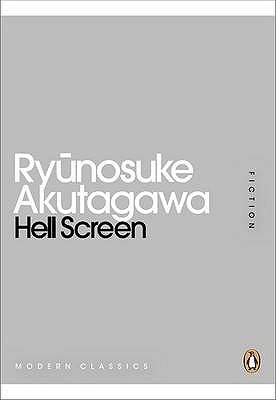
[ESP] Hell Screen es un relato corto de Akutagawa, en el que ilustra hasta qué punto la obsesión puede rozar la perfección en el arte, pero a un costo que muy pocas personas están dispuestas a pagar. Se centra en el artista Yoshihide, un hombre tosco, que le cae mal a todo el mundo pero tiene dos características que parecen humanizarlo: su pasión/destreza en el arte y el amor que le tiene a su hija (completamente contrario a él: una joven delicada y hermosa).
Como encargo, el gran señor de Horikawa le pide que pinte un “biombo” que represente la vida en el infierno, cosa que Yoshihide realiza con demasiada precisión. En lo que se desarrolla la historia vemos los extremos nefastos a los que puede llegar para darle realismo a las personas que sufren en el infierno de su pintura, alegando que solo puede pintar lo que ve en carne propia: . Al final la pintura parece sacada del infierno mismo, justo como lo había imaginado.
La otra historia que se incluyó en esta versión es la de The Spider’s Thread, muchísimo más corta (y que había leído antes), donde a un hombre (llamado Kanada) que toda su vida fue malo, se le da una oportunidad de salir del infierno por una buena acción que hizo en vida… pero su propio egoísmo lo termina destruyendo.
En general un 4/5. Me gusta mucho la estética de Akutagawa.
[ENG] Hell Screen is a short story by Akutagawa, where he illustrates how much perfection can border on obsession when it comes to art, but at a cost that very few people are willing to pay. It focuses on the artist Yoshihide, a rough man who everyone dislikes but has two characteristics that seem to humanize him: his passion/skill in art and the love he has for his daughter (completely opposite to him: a delicate and beautiful young woman).
As a commission, the great lord of Horikawa asks him to make a "screen" that represents life in hell, which Yoshihide complies. As the story unfolds we see the nefarious lengths he are willing to go to give realism to the hell of his painting, claiming that he can only paint what he sees with his own eyes: . In the end the painting seems to be taken from hell itself, just as Yoshihide had imagined it.
The other story that was included in this version is that of The Spider's Thread, much shorter (and that I had read before), where a man who all his life was a bad person is given a chance to get out of hell for a good deed he did once in life... but his own selfishness ends up destroying him.
Overall, a 4/5. I really like the aesthetic of Akutagawa.
"Las puertas del infierno" es una colección de diez cuentos donde, si bien algunos destacan más que otros, la maestría de la prosa de Akutagawa reluce en todo su afilado y dramático esplendor.
De esta colección de cuentos destaco, por encima de todos los demás, "El hilo de araña" y "El biombo del infierno". La elegancia, belleza y crueldad de las imágenes salpicadas con violencia sobre las páginas de este libro fueron un dulce y agudo pinchazo para mi sensibilidad estética. El contraste entre los paisajes arrancados de las profundidades del infierno mismo —agujas plateadas, estanques de sangre, llamas feroces— y los delicados paisajes típicos de la poesía japonesa —pétalos de cerezo, finos kimonos, gotas de lluvia— son fusionados con exquisita destreza por Akutagawa, para dar por resultado estas finísimas piezas de literatura que considero de las mejores que he leído, no sólo en lo que respecta a literatura japonesa, sino universal.
Me gustaría dedicar también un lugar especial a "Las naranjas". Este cuento lo leí por primera vez hace muchos años, y aún habitaban en mí las escenas y sentimientos provocados por esa primera lectura. Es una narración enternecedora y triste, sobre la belleza y la soledad que esconde la aparente vulgaridad de la existencia humana.
Y en cuanto a la línea más sensual de Akutagawa, destaco "Heichu, el genio amoroso" y "La historia de Yonosuke". Ambas piezas relatan la pasión amorosa de estos donjuanes de versión japonesa, pero esta pasión es retratada de forma muy sutil y sensible, donde las fragancias y la evocación erótica gozan del papel principal en estos relatos.
Muchos elementos interesantes: El narrador siendo un testigo de los eventos, abundantes simbolismos religiosos y una historia no narrada paralela a la novela muy interesante.
Me hubiera agradado un final más cerrado pero estoy contento con el desarrollo de eventos hasta llegar a tal final.
Una combinación tanto de relatos biográficos como de historias sobrenaturales. En gran parte de sus relatos menciona a varios escritores reconocidos y hace referencias literarias. Varios de sus relatos me gustaron demasiado, por lo que no tengo uno favorito en concreto