BOOK REVIEW:
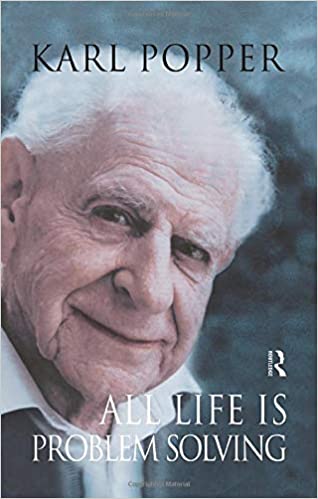
POPPER, Karl, All Life is Problem Solving
ISBN: 978-0415249928
Read June, 30th-July, 3rd, 2017.
A Collection of Essays on Science, Knowledge, Dialogue and Democracy.
“We can be wrong” is the common fundamental epistemological assumption for the fields both of natural sciences and politics. First published in 1994, this collection of writings by Karl Popper (1902, Vienna, Austria - 1994, London, UK), a giant of 20th century philosophy of science, links both fields around that assumption. Four papers of the first German edition are omitted and replaced with other papers originally written in English. This edition therefore contains 15 chapters grouped in 2 parts. Part 1 has 6 chapters on Natural Science and Part 2, 9 chapters on History and Politics.
Chapter 1, Logic and Evolution of Scientific Theory. No scientific theory begins with observations but with the refutation of previous theories or myths. Thus, in truth the scientific process has 3 stages: rise of a problem (a disturbance of expectations); attempted solutions; and elimination of false solutions.
Chapter 2, The Mind-Body Problem. There are three worlds: world 1 is external and natural; world 2, internal and psychological. But world 3 is cultural and comprises collectively shared elements of the Psychological World 2, including perceptions about Natural World 1.
Chapter 3, The Problem of Peace. A critical attitude is needed to get rid of dogmas and preserve peace.
Chapter 4, Evolutionary Epistemology. Even rudimentary forms of life test hypotheses or assumptions about the exterior environment’s characteristics (e.g. temperature or nutrients). The correction of the assumptions can lead to the survival or death of the microbe; we at least can test hypotheses without dying when we are wrong.
Chapter 5, Towards an Evolutionary Theory of Knowledge. Animals are capable of knowledge, albeit not conscious nor scientific; what distinctly qualifies science is the deliberate testing of hypotheses.
Part 1 closes with Chapter 6, Kepler's method superiority over Copernicus', Galileo's and Newton's, thanks to the Kepler’s larger humility and willingness to be proven wrong in order to be able to learn something new.
Part 2 opens with Chapter 7, Freedom and Education. Debate, and therefore political freedom, are essential for true education, the teaching of critical thought or the attitude where being proven wrong by rational arguments is more important than convincing others. Critical thought was invented by Thales of Miletus, subsequently lost, but rediscovered by Galileo Galilei; it can be destroyed again if political freedom is lost.
Chapter 8, On the Theory of Democracy. Popper’s experience of totalitarianism shifted his interests from natural sciences to democracy. The word’s etymology misleads to questioning who should govern, the government or the people. But everywhere it is governments, not peoples, who rule. The true question is how to get rid of bad governments without bloodshed: through elections, after the British and American model.
Chapter 9, All Life is Problem Solving. Technology and Life itself are forms of learning from mistakes. Science and technology deserve critic but not the outright hostility of the Greens. Opposing legislation addressing pollution on grounds of market freedom is nonsensical, as freedom depends on a State legal order restricting some individual liberties; banning armed groups is better than facing warlords. Technology is blamed for problems which are caused by overpopulation.
Chapter 10, Against the Cynical Interpretation of History. The racist, Marxist and “cynical” views of history lead people to shun responsibility for political decisions and to distrust democracy. To these views’ inherent pessimism we must oppose optimism, not towards the future, which we may influence but not predict, nor the past, which we are able to study and judge, but towards the present, which is technologically and morally better than ever, full of enthusiasm for reform and for ethical causes.
Chapter 11, 'Waging wars for peace” is an interview to Der Spiegel. Popper never prophesised the fall of Communism, as prophecies are impossible. Marx’ theory of absolute impoverishment was proven wrong; the paramount objective of international politics must be peace even if wars may be necessary to avoid greater violence; hunger is a distributive problem created by immature leaders of poor countries; climate change is a problem of overpopulation which has to be fought by education; the Church must be convinced to compromise on abortion. Jörg Haider is a threat; Mankind could be wiped out by other threats such as microbes. Optimism is a duty; the grim realities are a reason for vigilance.
Chapter 12, The collapse of communism. Liberal democracies and industrialisation were improving life in the West before the First War. Polarisation was brought by the emerging of Communism, which eventually collapse because of the intellectual barrenness of Marxism, founded on a big lie (the historical inevitability of Revolution) and on small lies supported by brutality. It could be countenanced by a five points program: education to strengthen personal freedom; world peace (made necessary by nuclear weapons); free market regulation, to fight poverty; tackling overpopulation through education and birth control; and education for non-violence.
Chapter 13, The necessity of peace, discusses the political activism of Otto Hahn, a scientist, who wrote about the necessity, created by atomic weapons, of world peace; and Fridtjof Nansen, an explorer with deep theoretical knowledge who invented the Nansen passport and organised aid to a starving Soviet Union. The future is open, not fixed in advance, and can only be predicted by chance. Our responsibility is supporting what may lead to a better future.
Chapter 14, Masaryk and the Open Society. Masaryk made Czechoslovakia the most open society Europe had seen, until its destruction by Hitler with the omission of Britain’s and France’s appeasers. It did suffer from ethnic nationalism; suppression of minorities and dialects was pursued by all the largest countries because a homogenous population speaking a single language is useful for industrial collaboration. These horrors must be faced, but we must not fail prey to the cynical view that violence and greed are inevitable. History begins with Solon’s freeing of Athens’ slaves; Lincoln and his soldiers fell for freedom. These are not mere exceptions. South Africa was a recent success which we must keep in mind, as well as Masaryk’s example of resistance to Hitler.
Final Chapter 15, How I Became a Philosopher Without Trying. Popper’s early-life decision to teach sciences, his doctorate in the psychology of education; childhood philosophical problems; readings, work method, first book, need to study the concept of science to answer whether Marxism was a science; the influence of the First War, his writings, search for teaching positions, and finally the conclusion he never studied philosophy but spent his life searching the solution of problems often philosophical in nature. Popper encourages youngsters to look for a problem which fascinates them and to which they are ready to devote their life to perfecting solutions through the consciousness of their fallibility.
This book is a good introduction to Popper's thought. Even if sometimes Popper is clearly partisan to his friends and acquaintances, and seems to naïvely put more emphasis on great leaders than on the daily struggles of the multitude, as if scientific geniuses could exist without centuries of experiments, trials and errors by the common people, this series of writings does show the way for the construction of concepts that are essential for an open society – and for peace and, in a world where nuclear weapons can often be forgotten, but still exist, for survival. I do not hesitate in recommending it to anybody, and wonder if it should be one of those mandatory readings in every school.