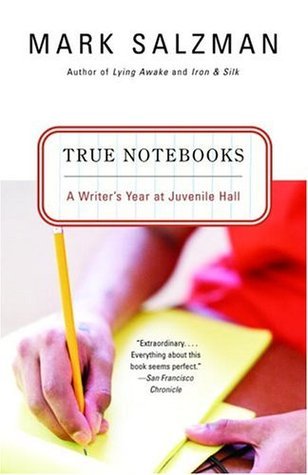
In 1997 Mark Salzman, bestselling author Iron and Silk and Lying Awake, paid a reluctant visit to a writing class at L.A.’s Central Juvenile Hall, a lockup for violent teenage offenders, many of them charged with murder. What he found so moved and astonished him that he began to teach there regularly. In voices of indelible emotional presence, the boys write about what led them to crime and about the lives that stretch ahead of them behind bars. We see them coming to terms with their crime-ridden pasts and searching for a reason to believe in their future selves. Insightful, comic, honest and tragic, True Notebooks is an object lesson in the redemptive power of writing.
Mark Salzman is an award-winning novelist and nonfiction author who has written on a variety of subjects, from a graceful novel about a Carmelite nun’s ecstatic visions and crisis of faith to a compelling memoir about growing up a misfit in a Connecticut suburb – clearly displaying a range that transcends genre. As a boy, all Salzman ever wanted was to be a Kung Fu master, but it was his proficiency on the cello that facilitated his acceptance to Yale at the age of 16. He soon changed his major to Chinese language and philosophy, which took him to mainland China where he taught English for two years and studied martial arts. He never gave up music, though, and Salzman’s cello playing appears on the soundtrack to several films, including the Academy Award-winning documentary Breathing Lessons: The Life and Work of Mark O’Brien. He has also played with Yo-Yo Ma and pianist Emanuel Ax at Lincoln Center. Salzman’s unusual combination of talents – as both a well-known author and a concert-proficient cellist – led to a feature profile about him in The New Yorker magazine. He was also recently presented with the Algonquin West Hollywood Literary Award.
A number of Mark Salzman’s books have been chosen for “book in common” reading programs by more than a few schools and universities for their elegance, humor, and portrayal of our shared humanity. His first memoir, Iron and Silk, inspired by his years in China, was a finalist for the Pulitzer Prize in nonfiction and received the Christopher Award. His book True Notebooks is a fascinating look at his experiences as a writing teacher at Los Angeles Central Juvenile Hall, a lockup for violent teenage offenders. Salzman is also the author of the memoir Lost in Place: Growing Up Absurd in Suburbia, and the novels The Laughing Sutra, The Soloist, and Lying Awake. Common to each of his works is a theme of how people struggle to reach an ideal but often fall short, and the quiet change that takes place in facing the discouragement and the possibility of never achieving their goal. Salzman writes with gut-wrenching honesty and unalloyed warmth, combined with a sharp sense of humor.
Es solle nur ein einmaliger Besuch werden, den der Schriftsteller Mark Salzmann eher widerwillig in der Schreibklasse der Central Juvenile Hall in Los Angeles machte. Daraus wurde ein Jahr, in dem er sich wöchentlich mit den Jugendlichen traf und gemeinsam mit ihnen ihre Texte las. Auch wenn es sich um eine Klasse mit Jugendlichen handelt, darf man nicht vergessen, warum sie dort sind. Die Central Juvenile Hall ist ein Gefängnis für junge Schwerverbrecher und viele Schüler Salzmans sitzen dort wegen Tötungsdelikten. Für Salzman sind es in erster Linie Schüler, denen er beibringen will, sich richtig auszudrücken. Das erfordert von den jungen Männern einen gewissen Mut, denn es kann ihnen als Zeichen von Schwäche ausgelegt werden, wenn sie über ihr Innerstes schreiben. Im Lauf der Zeit wächst nicht nur die Klasse, sondern auch das Vertrauen in den Lehrer. Die Gespräche im Unterricht werden offener, die Texte persönlicher. Die Klasse ist eine der wenigen Abwechslungen, die der Gefängnisalltag bietet. Für die meisten ist es nur eine Zwischenstation. Sie sind noch nicht verurteilt und wenn doch, werden sie in ein Erwachsenengefängnis verlegt, sobald sie volljährig sind. Mark Salzman geht zu einigen der Prozesse seiner Schüler. Dort sieht er das erste Mal das Verbrechen hinter dem Jugendlichen. Das war etwas, von dem ich das Gefühl hatte, dass er es während seiner Besuche oft ausblendete. Aber er sieht auch, wie das System mit den oft farbigen Jugendlichen umgeht, sie direkt abstempelt und ihnen deshalb oft nur unzureichende Rechtsmittel bietet. Es hat sie aufgegeben und deshalb ist der Besuch des Lehrers so wichtig für sie und ihre Familien. Irgendwann ist für Salzman der Kurs vorbei, aber er verlässt ihn mit dem Gefühl, etwas für die jungen Männer bewirkt zu haben. Das macht nicht ungeschehen, was sie getan haben, aber er glaubt daran, dass der Kus für sie eine Veränderung gebracht hat, wie sie über sich und ihr Leben nachdenken.