

What do you think?

A Song of Stone
A European nation not unlike Bosnia: armed forces roam the lawless land where dark columns of smoke rise up from the surrounding farms and houses. The war is ending, perhaps ended. But for the castle and its occupants, a young lord and lady, the trouble is just beginning.
Fearing an invasion of soldiers, the amorous couple takes to the road with the other refugees, disguised in rags. But the brutal female lieutenant of an outlaw band of guerrillas has other ideas. Just hours into their escape, the fleeing aristocrats are delivered back to the castle, where, now prisoners in their own home, they become pawns in the lieutenant's dangerous game of desire, deceit, and death.
A Song of Stone demonstrates Iain Banks's unique ability to combine gripping narrative with a soaring, voyaging imagination. This noir fable confirms his reputation as the master of things dark and debauched. Singular, haunting, and viciously wry, A Song of Stone is a tour de force of contemporary fiction.
Fearing an invasion of soldiers, the amorous couple takes to the road with the other refugees, disguised in rags. But the brutal female lieutenant of an outlaw band of guerrillas has other ideas. Just hours into their escape, the fleeing aristocrats are delivered back to the castle, where, now prisoners in their own home, they become pawns in the lieutenant's dangerous game of desire, deceit, and death.
A Song of Stone demonstrates Iain Banks's unique ability to combine gripping narrative with a soaring, voyaging imagination. This noir fable confirms his reputation as the master of things dark and debauched. Singular, haunting, and viciously wry, A Song of Stone is a tour de force of contemporary fiction.
288 pages, Hardcover
First published August 7, 1997
About the author
Iain Banks
42 books5,039 followersThis author also published science fiction under the pseudonym Iain M. Banks.
Banks's father was an officer in the Admiralty and his mother was once a professional ice skater. Iain Banks was educated at the University of Stirling where he studied English Literature, Philosophy and Psychology. He moved to London and lived in the south of England until 1988 when he returned to Scotland, living in Edinburgh and then Fife.
Banks met his wife Annie in London, before the release of his first book. They married in Hawaii in 1982. However, he announced in early 2007 that, after 25 years together, they had separated. He lived most recently in North Queensferry, a town on the north side of the Firth of Forth near the Forth Bridge and the Forth Road Bridge.
As with his friend Ken MacLeod (another Scottish writer of technical and social science fiction) a strong awareness of left-wing history shows in his writings. The argument that an economy of abundance renders anarchy and adhocracy viable (or even inevitable) attracts many as an interesting potential experiment, were it ever to become testable. He was a signatory to the Declaration of Calton Hill, which calls for Scottish independence.
In late 2004, Banks was a prominent member of a group of British politicians and media figures who campaigned to have Prime Minister Tony Blair impeached following the 2003 invasion of Iraq. In protest he cut up his passport and posted it to 10 Downing Street. In an interview in Socialist Review he claimed he did this after he "abandoned the idea of crashing my Land Rover through the gates of Fife dockyard, after spotting the guys armed with machine guns." He related his concerns about the invasion of Iraq in his book Raw Spirit, and the principal protagonist (Alban McGill) in the novel The Steep Approach to Garbadale confronts another character with arguments in a similar vein.
Interviewed on Mark Lawson's BBC Four series, first broadcast in the UK on 14 November 2006, Banks explained why his novels are published under two different names. His parents wished to name him Iain Menzies Banks but his father made a mistake when registering the birth and he was officially registered as Iain Banks. Despite this he continued to use his unofficial middle name and it was as Iain M. Banks that he submitted The Wasp Factory for publication. However, his editor asked if he would mind dropping the 'M' as it appeared "too fussy". The editor was also concerned about possible confusion with Rosie M. Banks, a minor character in some of P.G. Wodehouse's Jeeves novels who is a romantic novelist. After his first three mainstream novels his publishers agreed to publish his first SF novel, Consider Phlebas. To distinguish between the mainstream and SF novels, Banks suggested the return of the 'M', although at one stage he considered John B. Macallan as his SF pseudonym, the name deriving from his favourite whiskies: Johnnie Walker Black Label and The Macallan single malt.
His latest book was a science fiction (SF) novel in the Culture series, called The Hydrogen Sonata, published in 2012.
Author Iain M. Banks revealed in April 2013 that he had late-stage cancer. He died the following June.
The Scottish writer posted a message on his official website saying his next novel The Quarry, due to be published later this year*, would be his last.
* The Quarry was published in June 2013.
Banks's father was an officer in the Admiralty and his mother was once a professional ice skater. Iain Banks was educated at the University of Stirling where he studied English Literature, Philosophy and Psychology. He moved to London and lived in the south of England until 1988 when he returned to Scotland, living in Edinburgh and then Fife.
Banks met his wife Annie in London, before the release of his first book. They married in Hawaii in 1982. However, he announced in early 2007 that, after 25 years together, they had separated. He lived most recently in North Queensferry, a town on the north side of the Firth of Forth near the Forth Bridge and the Forth Road Bridge.
As with his friend Ken MacLeod (another Scottish writer of technical and social science fiction) a strong awareness of left-wing history shows in his writings. The argument that an economy of abundance renders anarchy and adhocracy viable (or even inevitable) attracts many as an interesting potential experiment, were it ever to become testable. He was a signatory to the Declaration of Calton Hill, which calls for Scottish independence.
In late 2004, Banks was a prominent member of a group of British politicians and media figures who campaigned to have Prime Minister Tony Blair impeached following the 2003 invasion of Iraq. In protest he cut up his passport and posted it to 10 Downing Street. In an interview in Socialist Review he claimed he did this after he "abandoned the idea of crashing my Land Rover through the gates of Fife dockyard, after spotting the guys armed with machine guns." He related his concerns about the invasion of Iraq in his book Raw Spirit, and the principal protagonist (Alban McGill) in the novel The Steep Approach to Garbadale confronts another character with arguments in a similar vein.
Interviewed on Mark Lawson's BBC Four series, first broadcast in the UK on 14 November 2006, Banks explained why his novels are published under two different names. His parents wished to name him Iain Menzies Banks but his father made a mistake when registering the birth and he was officially registered as Iain Banks. Despite this he continued to use his unofficial middle name and it was as Iain M. Banks that he submitted The Wasp Factory for publication. However, his editor asked if he would mind dropping the 'M' as it appeared "too fussy". The editor was also concerned about possible confusion with Rosie M. Banks, a minor character in some of P.G. Wodehouse's Jeeves novels who is a romantic novelist. After his first three mainstream novels his publishers agreed to publish his first SF novel, Consider Phlebas. To distinguish between the mainstream and SF novels, Banks suggested the return of the 'M', although at one stage he considered John B. Macallan as his SF pseudonym, the name deriving from his favourite whiskies: Johnnie Walker Black Label and The Macallan single malt.
His latest book was a science fiction (SF) novel in the Culture series, called The Hydrogen Sonata, published in 2012.
Author Iain M. Banks revealed in April 2013 that he had late-stage cancer. He died the following June.
The Scottish writer posted a message on his official website saying his next novel The Quarry, due to be published later this year*, would be his last.
* The Quarry was published in June 2013.
Ratings & Reviews
Friends & Following
Create a free account to discover what your friends think of this book!
Community Reviews
Displaying 1 - 30 of 305 reviews

May 8, 2022
The unreliable and also unlikeable(!) narrator, the one-time aristocrat Abel and his partner(?) Morgan (with their servants!) are fleeing with many other refugees, from what appears to be a complete breakdown of society with warring factions everywhere. They are accosted by Lieutenant ('Loot') and her band of fighters, who take them back to their castle home to use it as a fortress base of operations of sorts; and it is there, where this breakdown of civil, or indeed any society sees them all slowly but surely heading down dark paths?
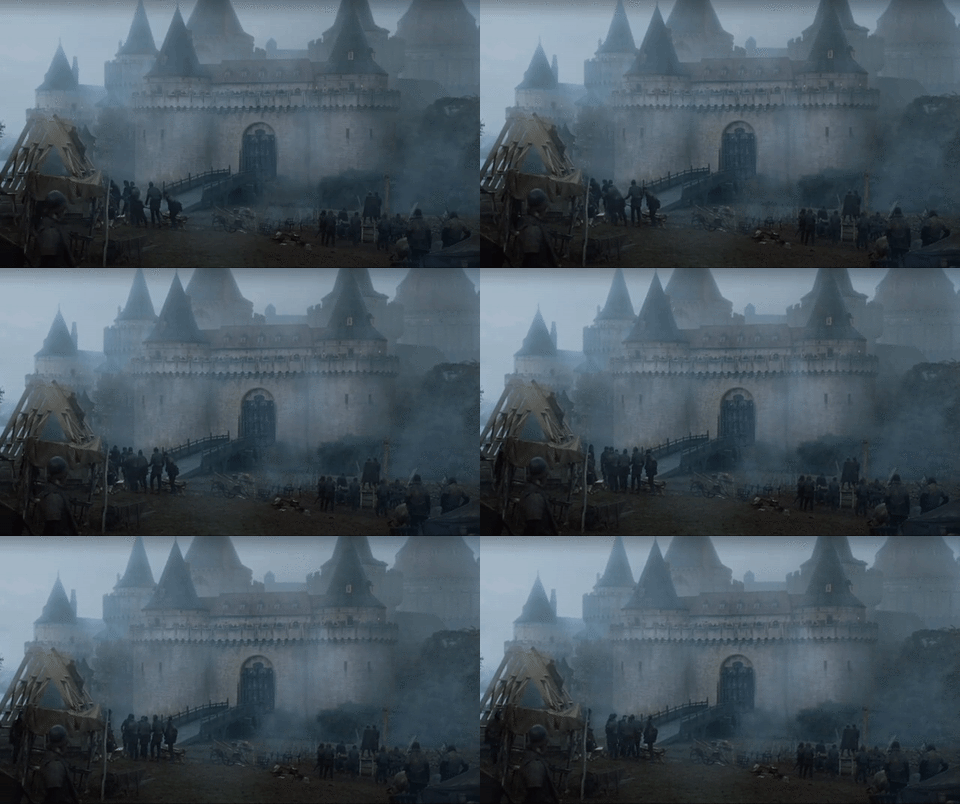
Ultimately, especially with the insular aristocrat narrator, this reads and feels like a literary work that is taking a look at what happens when the constraints of society are removed and we're left to our own devices; rather neatly alongside that we also get a somewhat linear insight into the mind of the ruling classes in such a situation, although he is just one individual, so can't really be asked to represent his entire class? The juxtaposition of the aristocratic, highly educated and highly self absorbed narrator sharing the horrors of unfettered humanity in a time of war, through his lens is pretty neat, and is what makes this book so readable despite its patently nihilistic leanings. 7.5 out of 12, strong Three Star read.

2022 read
Ultimately, especially with the insular aristocrat narrator, this reads and feels like a literary work that is taking a look at what happens when the constraints of society are removed and we're left to our own devices; rather neatly alongside that we also get a somewhat linear insight into the mind of the ruling classes in such a situation, although he is just one individual, so can't really be asked to represent his entire class? The juxtaposition of the aristocratic, highly educated and highly self absorbed narrator sharing the horrors of unfettered humanity in a time of war, through his lens is pretty neat, and is what makes this book so readable despite its patently nihilistic leanings. 7.5 out of 12, strong Three Star read.
2022 read
September 12, 2012
If you're going to read this book, it's best to know that it isn't for everyone.
This is more like a novella or a short story than a novel, and the scope is very narrow, including only a handful of named characters and a setting that hardly spans more than a few miles. It is a post-apocalypse world, but the reason for the apocalypse, nor the state of the rest of civilization are ever even brought up. But that's not what most people might have a problem with.
It's very dark. And by that I mean VERY dark. This is 'The Road' dark. 'The Wasp Factory' dark. Anyone who's read either of those (or seen 'The Road' as it is also a movie) knows what to expect while reading this. There is no happiness, no silver lining, no light at the end of the tunnel. In fact, it actually gets darker and darker.
Despite how dark the story is, the writing is incredibly poetic, probably some of the best I've read by Mr. Banks. It's written in the unique second perspective, and the main character has some beautifully written inner monologues that, you could say, is the silver lining in the cloud. The descriptions are soft at times and hard-hitting and gritty at others, and there are two memorable action scenes that have some of the most intense descriptions I've ever read.
So why did I only give this novel a 3/5? Because even I can only take so much darkness. As powerful as 'The Wasp Factory' and 'The Road' may be, I merely liked them just as I like this book. Would I suggest that the author change his story to add some happiness or even a bittersweet ending? Nope. This is the way he intended it to be, and like I said at the beginning of this review, it is not for everyone.
This is more like a novella or a short story than a novel, and the scope is very narrow, including only a handful of named characters and a setting that hardly spans more than a few miles. It is a post-apocalypse world, but the reason for the apocalypse, nor the state of the rest of civilization are ever even brought up. But that's not what most people might have a problem with.
It's very dark. And by that I mean VERY dark. This is 'The Road' dark. 'The Wasp Factory' dark. Anyone who's read either of those (or seen 'The Road' as it is also a movie) knows what to expect while reading this. There is no happiness, no silver lining, no light at the end of the tunnel. In fact, it actually gets darker and darker.
Despite how dark the story is, the writing is incredibly poetic, probably some of the best I've read by Mr. Banks. It's written in the unique second perspective, and the main character has some beautifully written inner monologues that, you could say, is the silver lining in the cloud. The descriptions are soft at times and hard-hitting and gritty at others, and there are two memorable action scenes that have some of the most intense descriptions I've ever read.
So why did I only give this novel a 3/5? Because even I can only take so much darkness. As powerful as 'The Wasp Factory' and 'The Road' may be, I merely liked them just as I like this book. Would I suggest that the author change his story to add some happiness or even a bittersweet ending? Nope. This is the way he intended it to be, and like I said at the beginning of this review, it is not for everyone.

October 31, 2010
A truly execrable novel, as if Banks had wanted to see how unpleasant he could make a novel before forcing the reader to give up on it.
It's by Iain Banks, rather than Iain M., so it's mainstream, despite being set in a near-future setting where Britain has lapsed into anarchy.
Abel and wife/sister Morgan flee their ancestral seat but are captured by bandits who periodically humiliate them. Abel is a pontificating fop with whom it's hard to empathize, but even he doesn't deserve to be hurled down a well and urinated and defecated upon at the captor's whims.
At the novel's end, I thought so what?
A major disappointment; I loved The Crow Road.
I wouldn't normally waste my time commenting on it, but you deserve a waarning about this dismal novel.
It's by Iain Banks, rather than Iain M., so it's mainstream, despite being set in a near-future setting where Britain has lapsed into anarchy.
Abel and wife/sister Morgan flee their ancestral seat but are captured by bandits who periodically humiliate them. Abel is a pontificating fop with whom it's hard to empathize, but even he doesn't deserve to be hurled down a well and urinated and defecated upon at the captor's whims.
At the novel's end, I thought so what?
A major disappointment; I loved The Crow Road.
I wouldn't normally waste my time commenting on it, but you deserve a waarning about this dismal novel.

November 22, 2008
A few months ago, I recall there was a discussion in some comment thread about who might be the most unpleasant character in any good mainstream novel. I'm pretty sure that the top contenders were Humbert Humbert from Lolita and John Self from Money.
I think that the antihero of Song of Stone is also competitive. He's a bit like Humbert; he writes elegantly and well (it's another first-person narrative), and you don't immediately realize just how creepy he is. But you will. You will.
I think that the antihero of Song of Stone is also competitive. He's a bit like Humbert; he writes elegantly and well (it's another first-person narrative), and you don't immediately realize just how creepy he is. But you will. You will.

September 29, 2016
Description: The war is ending. For the castle and its occupants the troubles are just beginning. Armed gangs roam a lawless land, and taking to the roads seems safer than remaining in the ancient keep. But the captain of an outlaw band has other ideas.
Opening: Winter was always my favourite season. Is this yet winter? I do not know. There is some technical definition, something based on calendars and the position of the sun, but I think one simply becomes aware that the tide of the seasons has irrevocably turned; that the animal in us smells winter.
4* The Wasp Factory
TR A Song of Stone
TR Whit
TR Espedair Street
3* The Business
1* The Steep Approach to Garbadale
2* Stonemouth
As Iain M Banks:
TR Consider Phlebas (Culture #1)
TR The Player of Games (Culture, #2)
3* The State of the Art (Culture, #3)
TR Use of Weapons (Culture, #4)
TR Surface Detail
3* Matter
4* Look to Windward
4* The Algebraist
TR Against a Dark Background
Opening: Winter was always my favourite season. Is this yet winter? I do not know. There is some technical definition, something based on calendars and the position of the sun, but I think one simply becomes aware that the tide of the seasons has irrevocably turned; that the animal in us smells winter.
4* The Wasp Factory
TR A Song of Stone
TR Whit
TR Espedair Street
3* The Business
1* The Steep Approach to Garbadale
2* Stonemouth
As Iain M Banks:
TR Consider Phlebas (Culture #1)
TR The Player of Games (Culture, #2)
3* The State of the Art (Culture, #3)
TR Use of Weapons (Culture, #4)
TR Surface Detail
3* Matter
4* Look to Windward
4* The Algebraist
TR Against a Dark Background

February 9, 2013
You'd be lucky to find any other author who would take such a risk as to publish a novel as vague and philosophical as this one, and then throw in the dark themes that emerge towards the end. I won't say much to avoid spoilers, but this is one of those novels where the plot is the least important part: the inner dialogue of our narrator is how we move forward. It goes to some dark places and leaves much unsaid, but Banks' prose is beautifully written and thematically dense in a way that never feels overwhelming. It left me feeling like I'd tackled something significant, even though it's relatively throwaway even when compared to his other novels. Not essential, by any means, but a pleasure to read

January 3, 2019
This is phenomenal. A Song of Stone returns to the bleak and quite perverse 'The Wasp Factory', but with a much more distressing story. Of all the Iain Banks novels I have read (I have read a lot, and still have a lot more to read), this is so heavy, deep, philosophical and, yes, quite ugly of the ones I have read. It is a post-apocalyptic future; think Mad Max, think Children of Men, think of a fallen society and there is the gist of the book. A Song of Stone deals with a landowner who owned a Castle (estate), and the rampaging bandits take control of it. The narrator, Abel is his name, is the inheritor of this estate, and his musings throughout the book become darker and darker as he watches his property become ravaged by the bandits. Themes, many different themes are contained within the book. Soul searching stuff, touching on his wife/sister, Morgan, (I believe) and how much love he showed for her. I will not give too much away here (you really need to read it), but the ending left me speechless and quite distressed. Quite numb. The prose is first person narrative, and it incredibly dense and literate, dealing with Abels reminiscing about his past which links to the future. There is more reminiscing than actual plot to be honest; the last two chapters I had to wade through, not because it was boring, but because of the narrators philosophising left me re-reading paragraphs. The whole book needs to be re-read. Upsetting and a very tragic ending, which I guess was expected - the whole build up throughout the book leads to a sad, tragic, ugly ending. I will give this 5 stars, but to be honest it really will take another reading to get where Iain Banks is coming from, plus a dictionary at hand too. Going to have a lie down for a moment.

March 26, 2023
To paraphrase Woody Allen in “Annie Hall” this story is about the miserable and the horrible. It starts out miserable and ends truly horrible. So horrible I had to start another book *really late* last night, just to try to scrub the final 3 chapters happenings mulling in my head. A world at war, this is a story of three groups of people falling together by chance and falling out horribly. Not a single sympathetic character in this one either, quite a tough read.

June 9, 2010
Set in a contemporary (or recent-past), vaguely Eastern European country, torn by civil (?) war, this is an insular, even claustrophobic tale which mixes philosophy and perversion.
(In it's non-specificity, it almost feels like a fantasy setting, but there are no supernatural elements in the book.)
Stylistically and even thematically, it reminded me very strongly of Hermann Hesse - but much, much nastier. The writing is also, however, just full of hilariously clever, witty turns of phrase.
The book begins with an aristocratic couple fleeing their castle along with a host of more plebeian refugees. However, escape is not to be. A female military lieutenant stops them and decides to commandeer their services and their home as barracks for her men.
The story is presented solely through the eyes of the lord of the manor - Abel. No other point of view is presented, and he's rather - odd, psychologically, which gives the other characters a strangely 'flat' feel. Some reviewers criticized this as a failure of characterization, but it's definitely an intentional part of the writing - it's not that the people lack character or voice, but that Abel does not perceive them fully.
As might be expected when a number of rag-tag guerilla-type fighters are garrisoned in a beautiful medieval estate - unpleasant things happen. But are the aristocrats innocent victims of a brutal conflict? Are their self-centered and perverse secrets somehow, indirectly responsible? Is the violence and crudity of the soldiers a symbol for the state of the common man?
Or are all these things just incidental, presented for shock value? After a slow build-up of unpleasantness, it ends with a quite entertaining twisted religious allegory...
Lots to think about... but also quite fun.
(In it's non-specificity, it almost feels like a fantasy setting, but there are no supernatural elements in the book.)
Stylistically and even thematically, it reminded me very strongly of Hermann Hesse - but much, much nastier. The writing is also, however, just full of hilariously clever, witty turns of phrase.
The book begins with an aristocratic couple fleeing their castle along with a host of more plebeian refugees. However, escape is not to be. A female military lieutenant stops them and decides to commandeer their services and their home as barracks for her men.
The story is presented solely through the eyes of the lord of the manor - Abel. No other point of view is presented, and he's rather - odd, psychologically, which gives the other characters a strangely 'flat' feel. Some reviewers criticized this as a failure of characterization, but it's definitely an intentional part of the writing - it's not that the people lack character or voice, but that Abel does not perceive them fully.
As might be expected when a number of rag-tag guerilla-type fighters are garrisoned in a beautiful medieval estate - unpleasant things happen. But are the aristocrats innocent victims of a brutal conflict? Are their self-centered and perverse secrets somehow, indirectly responsible? Is the violence and crudity of the soldiers a symbol for the state of the common man?
Or are all these things just incidental, presented for shock value? After a slow build-up of unpleasantness, it ends with a quite entertaining twisted religious allegory...
Lots to think about... but also quite fun.

June 2, 2013
I don't think I'm gonna try reading much more by Iain Banks minus the M. It's well written (perhaps a little florid, in this one), but it just doesn't appeal to me. There's some crossover, even, but... it's just different. The dark moments in his Culture novels just ring differently to the darkness of these books, for me.
It just didn't feel like a story, to me, just unpleasantness for the sake of it.
It just didn't feel like a story, to me, just unpleasantness for the sake of it.
December 13, 2009
Song of Stones has a rather "literary" feel, in that it is more thematically-centered than plot-driven. The story itself is actually quite simple. In fact, the main tug through the story is provided by unraveling the mysterious relationship between the narrator, his lover, and their castle, which functions almost as a character.
Even if the story were completely lacking, though, the language would be compelling. It is rich, poetic, full of striking imagery and intriguing wordplay. Though there are a few sections of philosophical contemplation that get a bit tired.
Even if the story were completely lacking, though, the language would be compelling. It is rich, poetic, full of striking imagery and intriguing wordplay. Though there are a few sections of philosophical contemplation that get a bit tired.

August 11, 2016
Μείον ένα αστέρι λόγω των αντιπαθεστατων εκδόσεων Οξύ.
July 31, 2019
Perhaps the most thoroughly bleak book I've ever read. That's not to say that it's not a good book -- it is, at times, quite good. But the reader must be prepared to deal with the feeling of utter hopelessness in the face of inevitable horrors.
The rest of this review contains significant spoilers!!
Although a story of wartime and the fall of the once powerful to utter ruin, this is no tragedy, no story of a great peoples brought low by a corrupt few, or of huddled masses yearning to breathe freely, united by a great leader. We begin at the end of a devastating war in a vaguely European, vaguely late 20th-century country. The war's causes, its partisans, the outcome -- all are left unknown, indeed, the questions are never even asked. Banks allows us no stories of noble warriors, self-sacrificing heroes, righteous causes, victories against insurmountable odds. To do so would be to give meaning to the violence and destruction, to justify it, to hint at the possibility of redemption, when really, Banks says, all there is is destruction and the horrific pleasure some humans experience and crave from inflicting violence upon others.
The narrator is one of Banks' most thoroughly unlikable and amoral voices -- and that's saying something. He is not the type of person for whom the real-life, socialist Banks had much sympathy or respect. Abel is the last in the line of some minor nobility; he fancies himself a great wit and also a sort of nouveau Marquis de Sade, "bravely" shattering the hypocrisies of conventional morality by leading a life of debauchery with his partner, Morgan. Abel is not a tragic hero, a great man brought down by a fatal flaw. Abel has always been a creature of privilege and appetite: unrepentingly spoiled; bored by anything that does not give him pleasure. To emphasize that his loss of status is no tragedy, the story begins with Abel and Morgan already having quit his ancestral castle, servants in tow, part of a river of refugees, all of whom are fleeing some unknown, now destroyed home, traveling to someplace unknown, probably nowhere. Abel's wealth and privilege is exposed as only exterior accoutrements; at heart, he is no different than the anonymous masses -- he's just used to having a bit of power over the locals and enough wealth to indulge himself openly in high society and get away with it.
Abel & Morgan are taken by a group of former soldiers turned mercenary, whose lieutenant plans to relocate to their erstwhile castle for a new base of operations. We watch through Abel's eyes as he narrates the progressively heightening degradation and violence inflicted upon his home and his self, occasionally broken by memories of his many debaucheries. These vignettes from the past reveal Abel's core sexual obscenity, expressed in a bizarre fetishizing of fluids and solids, liquidity and stone and mud and earth. They also unfold the mysterious nature of Abel's relationship with Morgan, his partner in sexual license. The secret is not especially difficult to figure out -- one can probably guess the general nature pretty quickly -- nor does it radically change the meaning of the events (no hacky M. Night Shamalyan twist here) -- but it does explain a lot about Abel's character: his curious sense of detachment, even when experiencing terrible humiliation; his nihilistic outlook on humanity; his almost sexual acceptance of his fate. It also reinforces his disregard for the concerns of the world around him -- indeed, with any concerns besides those of his own pleasure.
This is not to say that Abel is entirely unsympathetic -- even though he is quite despicable. I, at least, felt an ounce of pity for him, if only for the brutal indignities he suffers throughout. Our ability to sympathize at least somewhat with Abel is encouraged also when we learn that the soldiers who torment him have no tragic backstory, pursue no noble cause, seek no redemption -- they are just as base, cruel, and petty as him, but born to a life of labor, not leisure, and sent to die in a no doubt pointless conflict -- and so filled with a powerful, justifiable resentment.
Even here, Banks does not offer hope: Abel recognizes in others only their shared proclivity for depravity. Also damning is his inability to see any link between his life of privilege and the violence that has shattered his land: he never raises political questions, and Banks provokes them in the reader largely through their pointed absence at certain moments in the narrative. Abel's antagonists also fail to have any epiphanies or deathbed conversions, to offer justifications for themselves or their behavior -- they aren't able to see the political background either.
What are we left with? A tale that begins in darkness and burrows further downward. By the end, any hope of a last minute reprieve -- in the narrative or in the overall mood -- is dashed. There's cruelty and death. Then more cruelty, and more death. Hope is an idea for a different book, a different world -- maybe a different type of creature than the human beings we see in this book.
The rest of this review contains significant spoilers!!
Although a story of wartime and the fall of the once powerful to utter ruin, this is no tragedy, no story of a great peoples brought low by a corrupt few, or of huddled masses yearning to breathe freely, united by a great leader. We begin at the end of a devastating war in a vaguely European, vaguely late 20th-century country. The war's causes, its partisans, the outcome -- all are left unknown, indeed, the questions are never even asked. Banks allows us no stories of noble warriors, self-sacrificing heroes, righteous causes, victories against insurmountable odds. To do so would be to give meaning to the violence and destruction, to justify it, to hint at the possibility of redemption, when really, Banks says, all there is is destruction and the horrific pleasure some humans experience and crave from inflicting violence upon others.
The narrator is one of Banks' most thoroughly unlikable and amoral voices -- and that's saying something. He is not the type of person for whom the real-life, socialist Banks had much sympathy or respect. Abel is the last in the line of some minor nobility; he fancies himself a great wit and also a sort of nouveau Marquis de Sade, "bravely" shattering the hypocrisies of conventional morality by leading a life of debauchery with his partner, Morgan. Abel is not a tragic hero, a great man brought down by a fatal flaw. Abel has always been a creature of privilege and appetite: unrepentingly spoiled; bored by anything that does not give him pleasure. To emphasize that his loss of status is no tragedy, the story begins with Abel and Morgan already having quit his ancestral castle, servants in tow, part of a river of refugees, all of whom are fleeing some unknown, now destroyed home, traveling to someplace unknown, probably nowhere. Abel's wealth and privilege is exposed as only exterior accoutrements; at heart, he is no different than the anonymous masses -- he's just used to having a bit of power over the locals and enough wealth to indulge himself openly in high society and get away with it.
Abel & Morgan are taken by a group of former soldiers turned mercenary, whose lieutenant plans to relocate to their erstwhile castle for a new base of operations. We watch through Abel's eyes as he narrates the progressively heightening degradation and violence inflicted upon his home and his self, occasionally broken by memories of his many debaucheries. These vignettes from the past reveal Abel's core sexual obscenity, expressed in a bizarre fetishizing of fluids and solids, liquidity and stone and mud and earth. They also unfold the mysterious nature of Abel's relationship with Morgan, his partner in sexual license. The secret is not especially difficult to figure out -- one can probably guess the general nature pretty quickly -- nor does it radically change the meaning of the events (no hacky M. Night Shamalyan twist here) -- but it does explain a lot about Abel's character: his curious sense of detachment, even when experiencing terrible humiliation; his nihilistic outlook on humanity; his almost sexual acceptance of his fate. It also reinforces his disregard for the concerns of the world around him -- indeed, with any concerns besides those of his own pleasure.
This is not to say that Abel is entirely unsympathetic -- even though he is quite despicable. I, at least, felt an ounce of pity for him, if only for the brutal indignities he suffers throughout. Our ability to sympathize at least somewhat with Abel is encouraged also when we learn that the soldiers who torment him have no tragic backstory, pursue no noble cause, seek no redemption -- they are just as base, cruel, and petty as him, but born to a life of labor, not leisure, and sent to die in a no doubt pointless conflict -- and so filled with a powerful, justifiable resentment.
Even here, Banks does not offer hope: Abel recognizes in others only their shared proclivity for depravity. Also damning is his inability to see any link between his life of privilege and the violence that has shattered his land: he never raises political questions, and Banks provokes them in the reader largely through their pointed absence at certain moments in the narrative. Abel's antagonists also fail to have any epiphanies or deathbed conversions, to offer justifications for themselves or their behavior -- they aren't able to see the political background either.
What are we left with? A tale that begins in darkness and burrows further downward. By the end, any hope of a last minute reprieve -- in the narrative or in the overall mood -- is dashed. There's cruelty and death. Then more cruelty, and more death. Hope is an idea for a different book, a different world -- maybe a different type of creature than the human beings we see in this book.
This entire review has been hidden because of spoilers.
October 6, 2013
The other reviews here all cover the plot sufficiently well that I have no need to do the same. What I'd like to add is an opinion on what the message of the story is.
To me, this is a tale about the impermanence, the transient nature of all things. We know that life will end; we never admit that love comes to an end, although we should. But above all, even that which seems permanent and impregnable to us will one day cease to be; indeed, once it never even was. This is the castle. This is the song of stone.
I drop a star for the rather obscure nature of the story's underpinning message, which is so easy to miss and leads to the easy sense of dissatisfaction it leaves you with. It gets a star back for having made me contemplate such things unexpectedly some hours later. It got under my skin, but not because of the debauched nature of the content.
The lead character's overly poetic delivery was rather tiresome though and I thought about giving up halfway through, a first for me reading Banks. Another star gone, I'm afraid.
To me, this is a tale about the impermanence, the transient nature of all things. We know that life will end; we never admit that love comes to an end, although we should. But above all, even that which seems permanent and impregnable to us will one day cease to be; indeed, once it never even was. This is the castle. This is the song of stone.
I drop a star for the rather obscure nature of the story's underpinning message, which is so easy to miss and leads to the easy sense of dissatisfaction it leaves you with. It gets a star back for having made me contemplate such things unexpectedly some hours later. It got under my skin, but not because of the debauched nature of the content.
The lead character's overly poetic delivery was rather tiresome though and I thought about giving up halfway through, a first for me reading Banks. Another star gone, I'm afraid.

February 25, 2019
If I had read this before IS and Boko Haram, I would have felt that the cruelty and utter lack of decency/empathy was exaggerated. Now I am not so sure. Humans are the cruelest animals on this planet. Read the last few chapters of this book to get Iain Bank’s take on that.
The slow start makes it feel like we humans aren’t so bad, but that was just a warm up.
The slow start makes it feel like we humans aren’t so bad, but that was just a warm up.

November 8, 2021
This is a very dark and disturbing book - not quite The Wasp Factory level of disturbing, but it's close - written in prose that is clearly carefully vetted, where every other word is carefully considered and placed with great care. It touches on subjects that are very important. It also quickly becomes tedious and very, very dull, almost unbearably so.
Set in an unnamed, war-torn country and taking place in an unspecified time period, A Song of Stone is narrated in the first person by Abel, an aristocrat who flees the fighting armies together with his wife - led by a female soldier known only as the Lieutenant spots them, and commandeers their carriage, ordering them to turn back and guide them to the place they just left - their ancestral castle, where they intend to establish their quarters.
The vagueness of the setting and period, as well as lack of character names - most of the characters Abel describes are never known, and the soldiers he comes in contact with are known only by their nicknames - occasionally reminded me of Anna Kavan's famous novel Ice . However, it is possible to identify definite historical event which occurred around the time of the publication of A Song of Stone, and which might have influenced or even inspired the novel.
The event I speak of is the Bosnian War, the most devastating and deadly conflict in Europe since World War 2, which took place between 1992 and 1995, and in which an estimated 100,000 people lost their lives, and over 2,2 million were displaced from their homes. The war in Bosnia was in itself a part of a larger conflict - the breakup of Yugoslavia, where the collapse of the state and political opportunism rekindled old ethnic hatreds - but it is in Bosnia, and specifically in Srebrenica, where the first case of genocide on European soil since 1945 took place. Millions of Europeans watched the conflict on television; and by the time they finally decided to do something about it, it was already too late.
Still, as mentioned before, A Song of Stone does its very best to be as vague as possible, and at times reads almost like a fable; albeit a rather perverted one, with our narrator providing us with long description of his sexual fantasies or encounters, and there's not much of a story to speak of; the novel plods along slowly, and only gets more and more depraved and dark as it goes on. As poetic and careful as Banks' writing can be, once cannot help but think that he was secretly pulling our leg and playing out a modern version of The Aristocrats!. I'll happily read more Banks, but I wouldn't start with this one.
Set in an unnamed, war-torn country and taking place in an unspecified time period, A Song of Stone is narrated in the first person by Abel, an aristocrat who flees the fighting armies together with his wife - led by a female soldier known only as the Lieutenant spots them, and commandeers their carriage, ordering them to turn back and guide them to the place they just left - their ancestral castle, where they intend to establish their quarters.
The vagueness of the setting and period, as well as lack of character names - most of the characters Abel describes are never known, and the soldiers he comes in contact with are known only by their nicknames - occasionally reminded me of Anna Kavan's famous novel Ice . However, it is possible to identify definite historical event which occurred around the time of the publication of A Song of Stone, and which might have influenced or even inspired the novel.
The event I speak of is the Bosnian War, the most devastating and deadly conflict in Europe since World War 2, which took place between 1992 and 1995, and in which an estimated 100,000 people lost their lives, and over 2,2 million were displaced from their homes. The war in Bosnia was in itself a part of a larger conflict - the breakup of Yugoslavia, where the collapse of the state and political opportunism rekindled old ethnic hatreds - but it is in Bosnia, and specifically in Srebrenica, where the first case of genocide on European soil since 1945 took place. Millions of Europeans watched the conflict on television; and by the time they finally decided to do something about it, it was already too late.
Still, as mentioned before, A Song of Stone does its very best to be as vague as possible, and at times reads almost like a fable; albeit a rather perverted one, with our narrator providing us with long description of his sexual fantasies or encounters, and there's not much of a story to speak of; the novel plods along slowly, and only gets more and more depraved and dark as it goes on. As poetic and careful as Banks' writing can be, once cannot help but think that he was secretly pulling our leg and playing out a modern version of The Aristocrats!. I'll happily read more Banks, but I wouldn't start with this one.

November 25, 2018
While I have read a dozen SF novels by Iain M. Banks, this is the first literary, non SF, one I have read.
My overall impression is that it's really, really hard to believe this is the same author. Bank's literary prose is amazing and often reads like more poetry. My only real criticism of the book in fact, is that sometimes the prose seems to be over indulgent and you can't see the story for the words. And speaking of the story, it's very dark and brutal so I would not read this unless you are okay with the atrocities of modern civil wars.
My overall impression is that it's really, really hard to believe this is the same author. Bank's literary prose is amazing and often reads like more poetry. My only real criticism of the book in fact, is that sometimes the prose seems to be over indulgent and you can't see the story for the words. And speaking of the story, it's very dark and brutal so I would not read this unless you are okay with the atrocities of modern civil wars.

March 22, 2026
A Song of Stone was a bit disappointing as Iain Banks has written some fantastic books. Walking On Glass, The Wasp Factory and Espedair Street remain my top three - probably in that order.
This tale was about the despairs of war, very dark and violent in places, set in a vague dystopian era, centred around a stone castle and its occupants. In truth, there wasn't much of a story - this felt like a single episode from a much larger event, a depressing song from a bleak concept album.
The book was let down by the over-descriptive, poetic thoughts of the main character, Abel, which frequently distracted me from the main plot. At times I felt I was reading Shakespeare with many of the meanings and analogies flying way over my head. That said, I was still very interested to see how the story would unfold and I was compelled to read to the bitter end.
I don't think the author intended this book to be enjoyed. Instead, there are probably messages hidden in its pages that might be more suitable for discussion in an English Literature class.
3 stars.
This tale was about the despairs of war, very dark and violent in places, set in a vague dystopian era, centred around a stone castle and its occupants. In truth, there wasn't much of a story - this felt like a single episode from a much larger event, a depressing song from a bleak concept album.
The book was let down by the over-descriptive, poetic thoughts of the main character, Abel, which frequently distracted me from the main plot. At times I felt I was reading Shakespeare with many of the meanings and analogies flying way over my head. That said, I was still very interested to see how the story would unfold and I was compelled to read to the bitter end.
I don't think the author intended this book to be enjoyed. Instead, there are probably messages hidden in its pages that might be more suitable for discussion in an English Literature class.
3 stars.

December 19, 2019
A spectacularly unsuccessful exercise in miserablism, about a sadistic nobleman caught up in an endless civil war.
2019's been my year of reading terrible books by some of my favourite authors, and this one was probably the worst. Nothing works in this book. The protagonist is a boring, passive, parody of a DeSade ripoff. None of the attempted "twists" are even surprising, let alone shocking. The author's voice is so loud and florid that it drowns any possibility of nuance or emotional connection. The analogy, if there's one buried in there, is so imprecise and unoriginal as to be pointless.
Just a total disaster from start to finish.
2019's been my year of reading terrible books by some of my favourite authors, and this one was probably the worst. Nothing works in this book. The protagonist is a boring, passive, parody of a DeSade ripoff. None of the attempted "twists" are even surprising, let alone shocking. The author's voice is so loud and florid that it drowns any possibility of nuance or emotional connection. The analogy, if there's one buried in there, is so imprecise and unoriginal as to be pointless.
Just a total disaster from start to finish.

December 31, 2019
This book started off so promisingly it seemed so exciting. A believable dystopian future. Amazing depictions of once grand houses & castles, people trying vainly to cling to familiar ways of life. And then somewhere along the way ... in the end I just thought it was a revolting waste of time!
This entire review has been hidden because of spoilers.

December 22, 2025
Velmi pochmurné postapo vlastně bez jediné sympatické postavy a pochopitelně bez jakýchkoliv šťastných konců. Když mám přirovnat, vidím možná kulisy z Malevilu a k tomu beznaděj z Cesty. Celé vám to vypráví v ich formě pán malého panství, žijící v incestním vztahu se svou sestrou.
Je to místy hodně temné a celkově bezútěšné, nechte si to na letní dny.
Je to místy hodně temné a celkově bezútěšné, nechte si to na letní dny.

March 1, 2014
The Song of Stone is Iain Banks 9th novel published in 1997, but he had already written another 8 Science Fiction novels under the name Iain M Banks, so a consistent output of almost two book a year at least over ten years.
As with most of the non-Science Fiction this book is fairly political in tone, and I read it the year of its publication in paperback. It was clear to all that this novel was speaking of the unimaginable brutality and horror which was the Bosnian war of 1992-1995. Due a split in the EU, the germans siding with their historic allies the Serbians and the rest of Europe wanting to help the Bosnian Muslims, this is the war Europe watched each night on its televisions, but did little to intervene except by its absence. The carnage and cruelty was unlike anything Europe had ever seen. Still nothing was done.
In A Song of Stone, Iain Banks reflects on the culpability of Europe by placing a similar conflict this time in his homeland which was the lowlands of Scotland. He puts the spotlight on a crumbling stately home and its useless over educated but under skilled aristocratic yet likeable owners, and then throws them in the way of pure cruelty.
I won't say much about the story, except that it is horrific in its slow paced incremental daily increase in needless violence. the kind of which only goes unchecked when all forms of states have evaporated, and in the end this small castle and its occupants come to represent the entire state of Bosnia, and their cruel needless suffering similarly.
It's hard to recommend this book, Iain Banks is, as always, creative, and the inventive horror stays with you long after you have closed the pages.
Still once you start its unput-downable. You have been warned.
As with most of the non-Science Fiction this book is fairly political in tone, and I read it the year of its publication in paperback. It was clear to all that this novel was speaking of the unimaginable brutality and horror which was the Bosnian war of 1992-1995. Due a split in the EU, the germans siding with their historic allies the Serbians and the rest of Europe wanting to help the Bosnian Muslims, this is the war Europe watched each night on its televisions, but did little to intervene except by its absence. The carnage and cruelty was unlike anything Europe had ever seen. Still nothing was done.
In A Song of Stone, Iain Banks reflects on the culpability of Europe by placing a similar conflict this time in his homeland which was the lowlands of Scotland. He puts the spotlight on a crumbling stately home and its useless over educated but under skilled aristocratic yet likeable owners, and then throws them in the way of pure cruelty.
I won't say much about the story, except that it is horrific in its slow paced incremental daily increase in needless violence. the kind of which only goes unchecked when all forms of states have evaporated, and in the end this small castle and its occupants come to represent the entire state of Bosnia, and their cruel needless suffering similarly.
It's hard to recommend this book, Iain Banks is, as always, creative, and the inventive horror stays with you long after you have closed the pages.
Still once you start its unput-downable. You have been warned.

December 30, 2012
This book is for true connoisseurs of misery...such as myself. Well I like Beckett, Kafka and Lautremont and the music of Nick Cave, Swans and Smog so it may apply to me. In short, if you're looking for a jolly read then turn away now...you'd be better off pouring yourself a G&T, going into the garden and reading some more P.G. Wodehouse.
Although I was prepared for this being a dystopian, post-apocalyptic type of novel I was a bit surprised by the way it was written. The narrator is at times unbelievably vague or indifferent. In fact, the opening sentence is a good example where the narrator seems to be unsure whether it's winter or not and even seems to be unclear on how winter is determined. The narration does tend to be a bit opaque at times, however as the story develops and we find out a bit more about the narrator, his history and the situation he's in then it does make some sort of sense.
At first I wasn't too keen on this book but by about page sixty where the narrator goes hunting with some of the 'soldiers' it started to get interesting for me as the narrator began to make unusual decisions and seem more interesting, though still unlikeable. He seemed to take a perverse pleasure out of his own misery and obstinacy.
It starts badly and gets progressively worse for just about every character in the book. Enjoy!
Although I was prepared for this being a dystopian, post-apocalyptic type of novel I was a bit surprised by the way it was written. The narrator is at times unbelievably vague or indifferent. In fact, the opening sentence is a good example where the narrator seems to be unsure whether it's winter or not and even seems to be unclear on how winter is determined. The narration does tend to be a bit opaque at times, however as the story develops and we find out a bit more about the narrator, his history and the situation he's in then it does make some sort of sense.
At first I wasn't too keen on this book but by about page sixty where the narrator goes hunting with some of the 'soldiers' it started to get interesting for me as the narrator began to make unusual decisions and seem more interesting, though still unlikeable. He seemed to take a perverse pleasure out of his own misery and obstinacy.
It starts badly and gets progressively worse for just about every character in the book. Enjoy!

September 11, 2013
I had been given this book many Christmas' ago, and had sat on the book gathering dust so a holiday in a stone cottage in Normandy gave me the opportunity to finally read this. I did not know much about this book, but as an avid Banks reader, and having read most of the previous books, I was looking forward to it.
I found the book very easy to read, with Banks usual very descriptive style flowing with the story rather than against it. The book is set during the time of war (civil perhaps, but certainly confused and had me thinking this might have been influenced by the Balkan wars) and charts the tale of an aristocratic couple living in their castle as events unfold.
There was not much to this story however, and I found some of the characters and plot a little predictable. That said, it was only towards the end of the book that some of the elements came together to shed light on earlier passages. I found the ending a little unsatisfying, and I found myself rooting for characters that I had perhaps not realized I would empathize with.
I found the book very easy to read, with Banks usual very descriptive style flowing with the story rather than against it. The book is set during the time of war (civil perhaps, but certainly confused and had me thinking this might have been influenced by the Balkan wars) and charts the tale of an aristocratic couple living in their castle as events unfold.
There was not much to this story however, and I found some of the characters and plot a little predictable. That said, it was only towards the end of the book that some of the elements came together to shed light on earlier passages. I found the ending a little unsatisfying, and I found myself rooting for characters that I had perhaps not realized I would empathize with.
July 17, 2011
Not sure what to think about this one. It felt very allegorical, and yet I don't know what the allegory is about. It also felt unduly misogynistic--just because you have a flawed narrator, doesn't mean I want to slog through that shit.

November 6, 2023
Better written than 'Wasp Factory' maybe too clean. It felt like 'Flesh + Blood', slick studio production at odds with an interesting thinker in Banks or Verhoeven. I'm also referencing that movie for the way the last death in the novel happens.
I wonder how 'Canal Dreams' was so caught up in its genre. 'Song of Stone' excelled within its trappings of castle-life, the rich within anarchism. It was much closer to Alasdair Gray’s rustic whimsy perfection where ‘Canal Dreams’ was closer to VHS cinema. I’m gonna ditch my hardback of ‘Stone’ and hope to acquire it for a couple dollars in a smaller format. It’s not good enough. But it is good!
I wonder how 'Canal Dreams' was so caught up in its genre. 'Song of Stone' excelled within its trappings of castle-life, the rich within anarchism. It was much closer to Alasdair Gray’s rustic whimsy perfection where ‘Canal Dreams’ was closer to VHS cinema. I’m gonna ditch my hardback of ‘Stone’ and hope to acquire it for a couple dollars in a smaller format. It’s not good enough. But it is good!

July 25, 2020
Probably a 3.5
I liked large parts of the book but could have done without some of the reminiscing in particular regarding the narrators sexual relationship with his wife. I liked that there wasn’t a great explanation and the castles rich history and the class dynamics played out in a time of no dignity and no social structure
I liked large parts of the book but could have done without some of the reminiscing in particular regarding the narrators sexual relationship with his wife. I liked that there wasn’t a great explanation and the castles rich history and the class dynamics played out in a time of no dignity and no social structure

December 1, 2025
I love Iain Banks and I admit some of his novels took a subsequent read to fully appreciate, sometimes I wasn't in the headspace for his writing and sometimes it just had more depth than I could appreciate... so this may be another instance of this, but it definitely feels like a blip compared to his other works.
I'm a sci-fi nerd, and have read the Culture novels multiple times each, but I've been enjoying his other works greatly too.
This one just felt a little half baked, the small scope and narrator was fine, but it just didn't feel like it came together like his other novels. It isn't bad, but it isn't as triumphant as the rest I've read.
I'm a sci-fi nerd, and have read the Culture novels multiple times each, but I've been enjoying his other works greatly too.
This one just felt a little half baked, the small scope and narrator was fine, but it just didn't feel like it came together like his other novels. It isn't bad, but it isn't as triumphant as the rest I've read.

April 12, 2018
Описания порождают синестезию, вплоть до запахов. Война-ри-на.

Read
September 1, 2019Το 2008 του το διάβασα, δεν ήμουν σίγουρη αν μυ άρεσε ή όχι κι είχα πει πως θα το ξαναδιάβαζα. Δεν έχει έρθει η ώρα ακόμα :P
Displaying 1 - 30 of 305 reviews