

What do you think?

Rabbi Harvey
The Adventures of Rabbi Harvey: A Graphic Novel of Jewish Wisdom and Wit in the Wild West
A fresh look at Jewish folktales--wise, witty, hilarious.
After finishing school in New York, Rabbi Harvey traveled west in search of adventure and, hopefully, work as a rabbi. His journey took him to Elk Spring, Colorado, a small town in the Rocky Mountains. When he managed to outwit the ruthless gang that had been ruling Elk Spring, the people invited Harvey to stay on as the town's rabbi. In Harvey's adventures in Elk Spring, he settles disputes, tricks criminals into confessing, and offers unsolicited bits of Talmudic insight and Hasidic wisdom. Each story presents Harvey with a unique challenge--from convincing a child that he is not actually a chicken, to retrieving stolen money from a sweet-faced bubbe gone bad. Like any good collection of Jewish folktales, these stories contain layers of humor and timeless wisdom that will entertain, teach and, especially, make you laugh.
After finishing school in New York, Rabbi Harvey traveled west in search of adventure and, hopefully, work as a rabbi. His journey took him to Elk Spring, Colorado, a small town in the Rocky Mountains. When he managed to outwit the ruthless gang that had been ruling Elk Spring, the people invited Harvey to stay on as the town's rabbi. In Harvey's adventures in Elk Spring, he settles disputes, tricks criminals into confessing, and offers unsolicited bits of Talmudic insight and Hasidic wisdom. Each story presents Harvey with a unique challenge--from convincing a child that he is not actually a chicken, to retrieving stolen money from a sweet-faced bubbe gone bad. Like any good collection of Jewish folktales, these stories contain layers of humor and timeless wisdom that will entertain, teach and, especially, make you laugh.
144 pages, Paperback
First published August 1, 2006
About the author
Steve Sheinkin
49 books729 followersFrom: http://stevesheinkin.com/about/
I was born in Brooklyn, NY, and my family lived in Mississippi and Colorado before moving back to New York and settling in the suburbs north of New York City. As a kid my favorite books were action stories and outdoor adventures: sea stories, searches for buried treasure, sharks eating people… that kind of thing. Probably my all-time favorite was a book called Mutiny on the Bounty, a novel based on the true story of a famous mutiny aboard a British ship in the late 1700s.
I went to Syracuse University and studied communications and international relations. The highlight of those years was a summer I spent in Central America, where I worked on a documentary on the streets of Nicaragua.
After college I moved to Washington, D.C., and worked for an environmental group called the National Audubon Society. Then, when my brother Ari graduated from college a few years later, we decided to move to Austin, Texas, and make movies together. We lived like paupers in a house with a hole in the floor where bugs crawled in. We wrote some screenplays, and in 1995 made our own feature film, a comedy called A More Perfect Union (filing pictured below), about four young guys who decide to secede from the Union and declare their rented house to be an independent nation. We were sure it was going to be a huge hit; actually we ended up deep in debt.
After that I moved to Brooklyn and decided to find some way to make a living as a writer. I wrote short stories, screenplays, and worked on a comic called The Adventures of Rabbi Harvey. In 2006, after literally hundreds of rejections, my first Rabbi Harvey graphic novel was finally published.
Meanwhile, I started working for an educational publishing company, just for the money. We’d hire people to write history textbooks, and they’d send in their writing, and it was my job to check facts and make little edits to clarify the text. Once in a while I was given the chance to write little pieces of textbooks, like one-page biographies or skills lessons. “Understanding Bar Graphs” was one of my early works. The editors noticed that my writing was pretty good. They started giving me less editing to do, and more writing. Gradually, I began writing chapters for textbooks, and that turned into my full-time job. All the while, I kept working on my own writing projects.
In 2008 I wrote my last textbook. I walked away, and shall never return. My first non-textbook history book was King George: What Was His Problem? – full of all the stories about the American Revolution that I was never allowed to put into textbooks. But looking back, I actually feel pretty lucky to have spent all those years writing textbooks. It forced me to write every day, which is great practice. And I collected hundreds of stories that I can’t wait to tell.
These days, I live with my wife, Rachel, and our two young kids in Saratoga Springs, New York. We’re right down the road from the Saratoga National Historical Park, the site of Benedict Arnold’s greatest – and last – victory in an American uniform. But that’s not why I moved here. Honestly.
I was born in Brooklyn, NY, and my family lived in Mississippi and Colorado before moving back to New York and settling in the suburbs north of New York City. As a kid my favorite books were action stories and outdoor adventures: sea stories, searches for buried treasure, sharks eating people… that kind of thing. Probably my all-time favorite was a book called Mutiny on the Bounty, a novel based on the true story of a famous mutiny aboard a British ship in the late 1700s.
I went to Syracuse University and studied communications and international relations. The highlight of those years was a summer I spent in Central America, where I worked on a documentary on the streets of Nicaragua.
After college I moved to Washington, D.C., and worked for an environmental group called the National Audubon Society. Then, when my brother Ari graduated from college a few years later, we decided to move to Austin, Texas, and make movies together. We lived like paupers in a house with a hole in the floor where bugs crawled in. We wrote some screenplays, and in 1995 made our own feature film, a comedy called A More Perfect Union (filing pictured below), about four young guys who decide to secede from the Union and declare their rented house to be an independent nation. We were sure it was going to be a huge hit; actually we ended up deep in debt.
After that I moved to Brooklyn and decided to find some way to make a living as a writer. I wrote short stories, screenplays, and worked on a comic called The Adventures of Rabbi Harvey. In 2006, after literally hundreds of rejections, my first Rabbi Harvey graphic novel was finally published.
Meanwhile, I started working for an educational publishing company, just for the money. We’d hire people to write history textbooks, and they’d send in their writing, and it was my job to check facts and make little edits to clarify the text. Once in a while I was given the chance to write little pieces of textbooks, like one-page biographies or skills lessons. “Understanding Bar Graphs” was one of my early works. The editors noticed that my writing was pretty good. They started giving me less editing to do, and more writing. Gradually, I began writing chapters for textbooks, and that turned into my full-time job. All the while, I kept working on my own writing projects.
In 2008 I wrote my last textbook. I walked away, and shall never return. My first non-textbook history book was King George: What Was His Problem? – full of all the stories about the American Revolution that I was never allowed to put into textbooks. But looking back, I actually feel pretty lucky to have spent all those years writing textbooks. It forced me to write every day, which is great practice. And I collected hundreds of stories that I can’t wait to tell.
These days, I live with my wife, Rachel, and our two young kids in Saratoga Springs, New York. We’re right down the road from the Saratoga National Historical Park, the site of Benedict Arnold’s greatest – and last – victory in an American uniform. But that’s not why I moved here. Honestly.
Ratings & Reviews
Friends & Following
Create a free account to discover what your friends think of this book!
Community Reviews
Displaying 1 - 30 of 112 reviews

November 1, 2012
"No one gets a bar mitzvah in this town without my say-so. Is that clear?"
"Big Milt" Wasserman
Things were wild in the Western town of Elk Spring.
Merchants were helpless when Daniel "The Lion" Levy demanded new suits, no charge. Restaurant owners cowered at the approach of Moses "Matzah Man" Goldwater and his endless cries for free matzah pot pies and coffee. Then a stranger dressed in black came to town, a stranger with plans to deliver justice using only the weapons of wisdom, kindness, and humor.
It's Rabbi Harvey, the wisest man in the west. He can solve any dispute, answer any question, and even cure a boy who thinks he's a chicken.
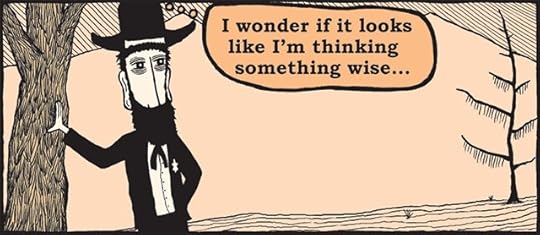
In one of my favorite Rabbi-tales, the wealthy Mr. Katz has lost his wallet. It is found by the town's wheelwright, Will Brown. He is tempted to keep the money inside, but decides instead to return it to its rightful owner. Instead of being grateful, Katz thinks the wheel maker a schmuck for not keeping the money, and plans to have a little fun.
"There's only two hundred dollars in here. I had three hundred dollars when I lost it." he exclaims.
What is there to do besides head to the Rabbi for a ruling?
"Mr. Katz's wallet contained three hundred dollars. Mr. Brown found a wallet with only two hundred. Clearly, we have two different wallets here. No one claimed the wallet with two hundred dollars, so it goes back to its finder, Will Brown." is the Rabbi's decision. Katz goes home empty-handed, but perhaps a little wiser for his shenanigans.
Most of the cartoon tales in the book are humorous, though when the Rabbi sets up his Stump the Rabbi booth at the Spring Fair, things unexpectedly get a little deep. One young man asks him, ". . . say I wanted to carry a card in my pocket. Something that would remind me of what is important. What would I write on the card?"
The Rabbi's answer?
"On one side of the card, write: The universe was created for me. On the other side, write: I was created from dust."
But, the last question of the day proves to be the most perplexing, when a little boy asks, "Slavery, the Civil War, stealing land from Indians . . . How could all these things happen in our country? I don't understand . . . Where was God?"
The Rabbi appears almost stumped for a second before he responds with, "Where were people?"
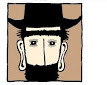
Not bad for a guy with a unibrow.
"Big Milt" Wasserman
Things were wild in the Western town of Elk Spring.
Merchants were helpless when Daniel "The Lion" Levy demanded new suits, no charge. Restaurant owners cowered at the approach of Moses "Matzah Man" Goldwater and his endless cries for free matzah pot pies and coffee. Then a stranger dressed in black came to town, a stranger with plans to deliver justice using only the weapons of wisdom, kindness, and humor.
It's Rabbi Harvey, the wisest man in the west. He can solve any dispute, answer any question, and even cure a boy who thinks he's a chicken.
In one of my favorite Rabbi-tales, the wealthy Mr. Katz has lost his wallet. It is found by the town's wheelwright, Will Brown. He is tempted to keep the money inside, but decides instead to return it to its rightful owner. Instead of being grateful, Katz thinks the wheel maker a schmuck for not keeping the money, and plans to have a little fun.
"There's only two hundred dollars in here. I had three hundred dollars when I lost it." he exclaims.
What is there to do besides head to the Rabbi for a ruling?
"Mr. Katz's wallet contained three hundred dollars. Mr. Brown found a wallet with only two hundred. Clearly, we have two different wallets here. No one claimed the wallet with two hundred dollars, so it goes back to its finder, Will Brown." is the Rabbi's decision. Katz goes home empty-handed, but perhaps a little wiser for his shenanigans.
Most of the cartoon tales in the book are humorous, though when the Rabbi sets up his Stump the Rabbi booth at the Spring Fair, things unexpectedly get a little deep. One young man asks him, ". . . say I wanted to carry a card in my pocket. Something that would remind me of what is important. What would I write on the card?"
The Rabbi's answer?
"On one side of the card, write: The universe was created for me. On the other side, write: I was created from dust."
But, the last question of the day proves to be the most perplexing, when a little boy asks, "Slavery, the Civil War, stealing land from Indians . . . How could all these things happen in our country? I don't understand . . . Where was God?"
The Rabbi appears almost stumped for a second before he responds with, "Where were people?"
Not bad for a guy with a unibrow.

August 11, 2024
When I came across Steve Sheinkin's 2006 graphic novel The Adventures of Rabbi Harvey: A Graphic Novel of Jewish Wisdom and Wit in the Wild West on Open Library, from the book title I was kind of assuming (and indeed also expecting) that The Adventures of Rabbi Harvey: A Graphic Novel of Jewish Wisdom and Wit in the Wild West would be featuring a humorous and filled with lots of Jewish folktales and culture fish-out-of-water type comic book where Rabbi Harvey moves to 19th century Colorado and has to find ways to adjust to and approach his mostly non Jewish neighbours (both White Anglo Saxon Protestants and also Native Americans) and equally so and bien sûr vice versa.
But no, this unfortunately is not at all the case with either Sheinkin's text or with his accompanying cartoons, as despite the obvious Wild West setting of The Adventures of Rabbi Harvey: A Graphic Novel of Jewish Wisdom and Wit in the Wild West (the fictitious town of Elk Spring circa 1875), EVERYONE Rabbi Harvey encounters in Colorado is Jewish like he is, and that the Jewish folktales reset in a very oddly and entirely Jewish Wild West for The Adventures of Rabbi Harvey: A Graphic Novel of Jewish Wisdom and Wit in the Wild West kind of lessens the potential humour that cultural, religious and ethnic contrast would (or at least could) engender and is also (if truth be told) a bit too strange and too far-fetched for both my and also for my inner child's reading pleasure, that I have found needing to suspend my sense of belief regarding any kind of historical reality, accuracy and authenticity in The Adventures of Rabbi Harvey: A Graphic Novel of Jewish Wisdom and Wit in the Wild West for the most part pretty annoyingly frustrating.
For yes, aside from the above mentioned loss of potential humour, social satire and my general but huge frustration with a Wild West where there are absolutely no people who are not Jewish present and in particular no Native Americans making any appearances and seemingly not even existing at all (which personally and emotionally speaking makes me absolutely and totally livid and would likely make Native American reviewers and scholars like Debbie Reese and Beverly Slapin even more livid, even more frustrated, as this kind of plays and disgustingly into the attitude and the tendency of ignoring Native Americans, as well, they are extinct anyhow and thus no longer matter), that Sheinkin also does not really bother to show the original sources for the Jewish folktales he is using (and how I have actually only managed to recognise very few of them from the text proper of The Adventures of Rabbi Harvey: A Graphic Novel of Jewish Wisdom and Wit in the Wild West), all of this has been and is a pretty all-encompassing turn-off for me regarding The Adventures of Rabbi Harvey: A Graphic Novel of Jewish Wisdom and Wit in the Wild West, and not to mention that I also just do not find Steve Sheinkin's illustrations for The Adventures of Rabbi Harvey: A Graphic Novel of Jewish Wisdom and Wit in the Wild West all that visually appealing either, since the mostly black, white and sepia colour schemes feel blurry, feel washed out and that especially the male characters for The Adventures of Rabbi Harvey: A Graphic Novel of Jewish Wisdom and Wit in the Wild West tend to look so similar to one another that I have had a lot of trouble figuring out and keeping abreast of who is who (and that yes, the artwork for The Adventures of Rabbi Harvey: A Graphic Novel of Jewish Wisdom and Wit in the Wild West also feels a trifle visually stereotypical for and to my eyes and sometimes almost a bit uncomfortably and artificially comical).
So finally and indeed also more than a trifle sadly, albeit Rabbi Harvey himself is both textually and visually shown by Steve Sheinkin as being a both genial and very much likeable character, and while his featured escapades in The Adventures of Rabbi Harvey: A Graphic Novel of Jewish Wisdom and Wit in the Wild West are decently engaging and also present some good and positive moral messages humorously and in an easily digestible manner, this unfortunately for me does not really alter the fact that there are far too many issues and bones of contention for me regarding the combination of text and images in The Adventures of Rabbi Harvey: A Graphic Novel of Jewish Wisdom and Wit in the Wild West (see above) to consider a higher than two star rating (that even though I do of course appreciate Steve Sheinkin providing a very nice list of Jewish folklore and culture themed titles for further reading, sorry, but I am just too disappointed textually and illustratively with The Adventures of Rabbi Harvey: A Graphic Novel of Jewish Wisdom and Wit in the Wild West to consider upping my rating to three stars, although I also feel a tad curmudgeonly and guilty regarding this, but on reflection, no, I do not think I should have to).
But just to say that I guess I am also not really all that keen on reading the two Rabbi Harvey sequels either, Rabbi Harvey Rides Again: A Graphic Novel of Jewish Folktales Let Loose in the Wild West and Rabbi Harvey vs. the Wisdom Kid: A Graphic Novel of Dueling Jewish Folktales in the Wild West as I am going to be assuming that I would more than likely be having the same textual and illustrative issues with the sequels as I have had with The Adventures of Rabbi Harvey: A Graphic Novel of Jewish Wisdom and Wit in the Wild West. And although after quickly thumbing through the third Rabbi Harvey graphic novel on Open Library, while for Rabbi Harvey vs. the Wisdom Kid: A Graphic Novel of Dueling Jewish Folktales in the Wild West, Steve Sheinkin does now and fortunately provide detailed folktale sources, the fact that Rabbi Harvey vs. the Wisdom Kid: A Graphic Novel of Dueling Jewish Folktales in the Wild West still features only Jews and no Native Americans inhabiting Sheinkin's Wild West, sorry, but not at all interested in Rabbi Harvey vs. the Wisdom Kid: A Graphic Novel of Dueling Jewish Folktales in the Wild West (but yes, that my star rating for Rabbi Harvey vs. the Wisdom Kid: A Graphic Novel of Dueling Jewish Folktales in the Wild West would likely be the same as with The Adventures of Rabbi Harvey: A Graphic Novel of Jewish Wisdom and Wit in the Wild West, would probably once again be only two stars).
But no, this unfortunately is not at all the case with either Sheinkin's text or with his accompanying cartoons, as despite the obvious Wild West setting of The Adventures of Rabbi Harvey: A Graphic Novel of Jewish Wisdom and Wit in the Wild West (the fictitious town of Elk Spring circa 1875), EVERYONE Rabbi Harvey encounters in Colorado is Jewish like he is, and that the Jewish folktales reset in a very oddly and entirely Jewish Wild West for The Adventures of Rabbi Harvey: A Graphic Novel of Jewish Wisdom and Wit in the Wild West kind of lessens the potential humour that cultural, religious and ethnic contrast would (or at least could) engender and is also (if truth be told) a bit too strange and too far-fetched for both my and also for my inner child's reading pleasure, that I have found needing to suspend my sense of belief regarding any kind of historical reality, accuracy and authenticity in The Adventures of Rabbi Harvey: A Graphic Novel of Jewish Wisdom and Wit in the Wild West for the most part pretty annoyingly frustrating.
For yes, aside from the above mentioned loss of potential humour, social satire and my general but huge frustration with a Wild West where there are absolutely no people who are not Jewish present and in particular no Native Americans making any appearances and seemingly not even existing at all (which personally and emotionally speaking makes me absolutely and totally livid and would likely make Native American reviewers and scholars like Debbie Reese and Beverly Slapin even more livid, even more frustrated, as this kind of plays and disgustingly into the attitude and the tendency of ignoring Native Americans, as well, they are extinct anyhow and thus no longer matter), that Sheinkin also does not really bother to show the original sources for the Jewish folktales he is using (and how I have actually only managed to recognise very few of them from the text proper of The Adventures of Rabbi Harvey: A Graphic Novel of Jewish Wisdom and Wit in the Wild West), all of this has been and is a pretty all-encompassing turn-off for me regarding The Adventures of Rabbi Harvey: A Graphic Novel of Jewish Wisdom and Wit in the Wild West, and not to mention that I also just do not find Steve Sheinkin's illustrations for The Adventures of Rabbi Harvey: A Graphic Novel of Jewish Wisdom and Wit in the Wild West all that visually appealing either, since the mostly black, white and sepia colour schemes feel blurry, feel washed out and that especially the male characters for The Adventures of Rabbi Harvey: A Graphic Novel of Jewish Wisdom and Wit in the Wild West tend to look so similar to one another that I have had a lot of trouble figuring out and keeping abreast of who is who (and that yes, the artwork for The Adventures of Rabbi Harvey: A Graphic Novel of Jewish Wisdom and Wit in the Wild West also feels a trifle visually stereotypical for and to my eyes and sometimes almost a bit uncomfortably and artificially comical).
So finally and indeed also more than a trifle sadly, albeit Rabbi Harvey himself is both textually and visually shown by Steve Sheinkin as being a both genial and very much likeable character, and while his featured escapades in The Adventures of Rabbi Harvey: A Graphic Novel of Jewish Wisdom and Wit in the Wild West are decently engaging and also present some good and positive moral messages humorously and in an easily digestible manner, this unfortunately for me does not really alter the fact that there are far too many issues and bones of contention for me regarding the combination of text and images in The Adventures of Rabbi Harvey: A Graphic Novel of Jewish Wisdom and Wit in the Wild West (see above) to consider a higher than two star rating (that even though I do of course appreciate Steve Sheinkin providing a very nice list of Jewish folklore and culture themed titles for further reading, sorry, but I am just too disappointed textually and illustratively with The Adventures of Rabbi Harvey: A Graphic Novel of Jewish Wisdom and Wit in the Wild West to consider upping my rating to three stars, although I also feel a tad curmudgeonly and guilty regarding this, but on reflection, no, I do not think I should have to).
But just to say that I guess I am also not really all that keen on reading the two Rabbi Harvey sequels either, Rabbi Harvey Rides Again: A Graphic Novel of Jewish Folktales Let Loose in the Wild West and Rabbi Harvey vs. the Wisdom Kid: A Graphic Novel of Dueling Jewish Folktales in the Wild West as I am going to be assuming that I would more than likely be having the same textual and illustrative issues with the sequels as I have had with The Adventures of Rabbi Harvey: A Graphic Novel of Jewish Wisdom and Wit in the Wild West. And although after quickly thumbing through the third Rabbi Harvey graphic novel on Open Library, while for Rabbi Harvey vs. the Wisdom Kid: A Graphic Novel of Dueling Jewish Folktales in the Wild West, Steve Sheinkin does now and fortunately provide detailed folktale sources, the fact that Rabbi Harvey vs. the Wisdom Kid: A Graphic Novel of Dueling Jewish Folktales in the Wild West still features only Jews and no Native Americans inhabiting Sheinkin's Wild West, sorry, but not at all interested in Rabbi Harvey vs. the Wisdom Kid: A Graphic Novel of Dueling Jewish Folktales in the Wild West (but yes, that my star rating for Rabbi Harvey vs. the Wisdom Kid: A Graphic Novel of Dueling Jewish Folktales in the Wild West would likely be the same as with The Adventures of Rabbi Harvey: A Graphic Novel of Jewish Wisdom and Wit in the Wild West, would probably once again be only two stars).

March 8, 2016
An American Western retelling of a bunch of Jewish folktales, set in Elk Spring, Colorado, and featuring the kind of “but what if everyone in [not a traditionally Jewish-dominated setting] were Jewish?” shenanigans that I do in my fantasy novels. I like this kind of gimmick because I like it when we get to be in things. Not just shtetl-things or Shoah things or New York things. Fantasy, westerns, sci-fi, other parts of our history…
As an example: you know the old gag about outlaws taking over a saloon, intimidating all the lawful residents of the town, and then the good guy/sheriff/whoever bursts in and there’s silence, even from the out-of-tune piano? In this book, the leader of the criminals who have taken over the town is at the bar telling a joke, and Rabbi Harvey bursts in and beats him to the punchline. Shock; gasp. The same story also has a matzo=cardboard joke, which as you know from “Aviva and the Aliens” in Tales from Outer Lands is always a portkey to my heart. :P
As an example: you know the old gag about outlaws taking over a saloon, intimidating all the lawful residents of the town, and then the good guy/sheriff/whoever bursts in and there’s silence, even from the out-of-tune piano? In this book, the leader of the criminals who have taken over the town is at the bar telling a joke, and Rabbi Harvey bursts in and beats him to the punchline. Shock; gasp. The same story also has a matzo=cardboard joke, which as you know from “Aviva and the Aliens” in Tales from Outer Lands is always a portkey to my heart. :P

November 11, 2023
Speaking of what it is not, Steve Sheinkin’s The Adventures of Rabbi Harvey, Vol 1 is not a trip into the intricacies of Jewish belief and practice. The intended audience is Jewish and this is Family Friendly writ large. The author gives us a wild west peopled entirely by Jews and imaginative problem solving never relies on a six gun. Light, occasionally humorous and the focus is on wit, wits and witty.
In a world before time, the local Rabbi was likely to be the most educated in the law, and the law was religious and only incidentally civil. The rabbi acted as the local judge and as such adjudicated squabbles and other local disputes.
Enter Rabbi Harvey. Hardly the fastest judge in the wild west town of Elk Springs, Colorado, but give him his time and we will get there. Most often smiling as we expect the good guys to win in a fun, imaginative way.
To be fair, the Rabbi is a tad too fond of the double reverse, but ya gotta give a man credit if he will live naked under the table for long enough to convince a stubborn child that he (the child) is not a chicken. Ok so maybe this are not Hasidic Jews, but they know a good thinking problem solver when they met him.
In a world before time, the local Rabbi was likely to be the most educated in the law, and the law was religious and only incidentally civil. The rabbi acted as the local judge and as such adjudicated squabbles and other local disputes.
Enter Rabbi Harvey. Hardly the fastest judge in the wild west town of Elk Springs, Colorado, but give him his time and we will get there. Most often smiling as we expect the good guys to win in a fun, imaginative way.
To be fair, the Rabbi is a tad too fond of the double reverse, but ya gotta give a man credit if he will live naked under the table for long enough to convince a stubborn child that he (the child) is not a chicken. Ok so maybe this are not Hasidic Jews, but they know a good thinking problem solver when they met him.

January 15, 2015
Whatever your faith or lack thereof, Rabbi Harvey is one of those teachers that we can all benefit from. The wacky antics of his neighbors (and rivals) are no match for his wisdom, adapted from the teachings of Jewish rabbis of the past.
There are moments where my husband and I literally laughed out loud, and there are moments that you need a minute to process because there's so much depth - in so few words! It's a remarkable book with a lot of heart. We bought the whole series after checking the first volume out from the library. The second book is less wacky than the first, the third is a balance between the two, and we enjoy them all just as much on re-reading.
There are moments where my husband and I literally laughed out loud, and there are moments that you need a minute to process because there's so much depth - in so few words! It's a remarkable book with a lot of heart. We bought the whole series after checking the first volume out from the library. The second book is less wacky than the first, the third is a balance between the two, and we enjoy them all just as much on re-reading.

March 15, 2020
Presne takéto niečo som potrebovala na odľahčenie v týchto dňoch...

September 29, 2025
This was a highly enjoyable graphic novel. The mix of Jewish and Wild West was very entertaining and fun! I really liked how Rabbi's Harvey got out of some very iffy situations using his wit and smarts. I look forward to reading the other books in this series.

January 28, 2010
This book was fun!
Jewish folktales reset in a very oddly Jewish Wild West. I really liked the illustration style, the wrinkly eyed oval-headed folks and the brown and grey coloring, and of course the folktales were good -- most of them made me chuckle. Making good and exposing badness through cleverness is often rather pleasant -- Rabbi Harvey's turn as a chicken under a table was particularly good. I thought it was neat too that this book was published by a Jewish religious press. Way to make things hip for the kids guys!
I guess my major complaint was that it didn't really connect the Wild West to the Jewish folk tales in historical way.. it made me reflect a bit on the slightly shtetl-y nature of the West, but silly me picked this up thinking it was a true story. Alas, my disappointment in my naivette lost it a point or two with me.
Jewish folktales reset in a very oddly Jewish Wild West. I really liked the illustration style, the wrinkly eyed oval-headed folks and the brown and grey coloring, and of course the folktales were good -- most of them made me chuckle. Making good and exposing badness through cleverness is often rather pleasant -- Rabbi Harvey's turn as a chicken under a table was particularly good. I thought it was neat too that this book was published by a Jewish religious press. Way to make things hip for the kids guys!
I guess my major complaint was that it didn't really connect the Wild West to the Jewish folk tales in historical way.. it made me reflect a bit on the slightly shtetl-y nature of the West, but silly me picked this up thinking it was a true story. Alas, my disappointment in my naivette lost it a point or two with me.

August 19, 2012
This is only my second graphic novel. As I am used to long paragraphs of descriptions, conversations and the like, this was a quick read for me. But, it was also a joy and delight to read. You want a taste of Jewish humor and wisdom? Read this book. The Rabbi Harvey is witty, forthright and very savvy. Gentile or Jew, you will smile while reading these little tales of the West.
Read
March 8, 2022I guess I just wasn't in the mood for this book, which was too silly and tedious to me. The illustration style is certainly unique, but I didn't like it. I'm glad so many other reviewers enjoyed the book!

March 8, 2016
This was really fun.

September 8, 2022
I chose The Adventures of Rabbi Harvey for summer reading this year (2022). Students read the graphic novel and wrote their own comics on the topic of “advice.”
Steve Sheinkin’s The Adventures of Rabbi Harvey has been on my short list for summer reading for awhile, and one of my seniors requested it. It is a good choice not just because it is light and funny but also because it gives students a glance at a different culture and religion.
Sheinkin retells Jewish folktales in the setting of America’s old West. Rabbi Harvey is the clever protagonist, outwitting everyone and helping to support his community. Part sheriff and part congregational rabbi, he helps solve disputes and teaches people lessons.
In my students' favorite story, "Rabbi Harvey: Bearded Chicken," which is based on “The Turkey Prince,” Rabbi Harvey takes on a boy convinced he is a chicken. It becomes his job to bring the boy back from sitting naked under the table, clucking and pecking at crumbs—which the rabbi does by stripping down and joining him under the table. Hilarity ensues.
One student was irritated by the silliness of the stories. The book is clearly aimed at younger children, but there is plenty for more sophisticated readers to dig into. For example, considering the overlap of the Jewish culture with the culture of the old West. Or how these tales fit in with other folktales or how logic is used (or misused) in the stories.
Would I teach this book? Well, yes, because I did, and I am glad I did. Students appreciated the book for many of the same reasons I did—the humor, yes, but also the depiction of a community that unites around a rabbi and looks to get along and maintain cohesion. They might, on occasion, try to cheat each other, but the threat of being on the outs is enough to make people back down or repent.
By the way—this year’s comics are incredible. Good work, students.
Steve Sheinkin’s The Adventures of Rabbi Harvey has been on my short list for summer reading for awhile, and one of my seniors requested it. It is a good choice not just because it is light and funny but also because it gives students a glance at a different culture and religion.
Sheinkin retells Jewish folktales in the setting of America’s old West. Rabbi Harvey is the clever protagonist, outwitting everyone and helping to support his community. Part sheriff and part congregational rabbi, he helps solve disputes and teaches people lessons.
In my students' favorite story, "Rabbi Harvey: Bearded Chicken," which is based on “The Turkey Prince,” Rabbi Harvey takes on a boy convinced he is a chicken. It becomes his job to bring the boy back from sitting naked under the table, clucking and pecking at crumbs—which the rabbi does by stripping down and joining him under the table. Hilarity ensues.
One student was irritated by the silliness of the stories. The book is clearly aimed at younger children, but there is plenty for more sophisticated readers to dig into. For example, considering the overlap of the Jewish culture with the culture of the old West. Or how these tales fit in with other folktales or how logic is used (or misused) in the stories.
Would I teach this book? Well, yes, because I did, and I am glad I did. Students appreciated the book for many of the same reasons I did—the humor, yes, but also the depiction of a community that unites around a rabbi and looks to get along and maintain cohesion. They might, on occasion, try to cheat each other, but the threat of being on the outs is enough to make people back down or repent.
By the way—this year’s comics are incredible. Good work, students.

November 26, 2017
A Western set in a world where everyone's Jewish. Bonus if you can get your wife to do all the voices.

September 15, 2016
This book definitely has originality and, as the title states, a wittiness to it. Normally I’m not too much into graphic novels, but this worked and thought it was quite well put together. The illustrations were excellent and add an extra dimension to the storytelling. We follow the tales and adventures of Rabbi Harvey, who has a knack for handling dilemmas, riddles and problems, big and small, in Elk Creek, Colorado in the West. He encounters oddball, eccentric characters and seemingly unsolvable situations in his small town; nonetheless, Rabbi Harvey always has an answer for everything. And, let’s face it: he’s just a fun character to follow.
Not only were the episodes quite entertaining and clever, but there is moral aspect to the tales. I probably enjoyed the first in the series, “Meet Rabbi Harvey”, the best, but all were engaging and humorous.
A quick, very enjoyable read and I’ll look for more episodes for Rabbi Harvey from this author in the future.
Not only were the episodes quite entertaining and clever, but there is moral aspect to the tales. I probably enjoyed the first in the series, “Meet Rabbi Harvey”, the best, but all were engaging and humorous.
A quick, very enjoyable read and I’ll look for more episodes for Rabbi Harvey from this author in the future.
June 18, 2016
I picked this up because how could the author/illustrator combine Jewish lore and the Wild West in a graphic novel? Intriguing. I have to say, it did not blow my socks off, and I think it would have a fairly specific readership. I liked the "quick scene"/chapter format to deliver the quips (instead of a full-fledged plot) and Rabbi Harvey is likeable and clever. I recognized some of the stories and jokes from other times in other places, and it was nice to see them again, but I didn't think they would really catch the fancy of a broad kid readership. However, for the right kid at the right time (with the right parents), this book would be lots of fun.

December 31, 2019
Éčko - moje vlastné
Bavila som sa. Sú to skôr príbehy pre väčšie deti, niečo na spôsob Ezopových bájok, vždy vzíde z príbehu poučenie o tom, ako rabi Harvey pomocou svojej múdrej “hlavičky” prišiel na také jednoduché riešenie.
Nemôžem si pomôcť, niekoho mi pripomína a neviem si spomenúť koho. Hmmmm.
Bavila som sa. Sú to skôr príbehy pre väčšie deti, niečo na spôsob Ezopových bájok, vždy vzíde z príbehu poučenie o tom, ako rabi Harvey pomocou svojej múdrej “hlavičky” prišiel na také jednoduché riešenie.
Nemôžem si pomôcť, niekoho mi pripomína a neviem si spomenúť koho. Hmmmm.

September 11, 2012
Cute, but haven't we milked enough of the "Jews In _____" formula? No? Okay...
January 19, 2014
Interesting, but nothing great...

August 7, 2017
(3.5) Clever and enjoyable, but it would have been better with actual illustrations.

October 30, 2023
I love this book, and that is really saying something as I am not usually a fan of graphic novels. They're too short, I often find. But that wasn't the case with this one since it was made up of vignettes and didn't feel like an abbreviated story, and furthermore, I didn't have myself in mind as the primary audience but rather the graphic-novel-reading 8YO in the house. He reviewed it a while ago for the blog and he really enjoyed it. I read it after he did and mentioned how much I liked it. His response? "Yeah. I told you it was good," said in a tone that left the, "Thank you, Captain Obvious," unspoken.
The main things to know are that the folktales are fun, the "villains" are funny, and Rabbi Harvey is a delightfully clever character. The art style is perfect for the setting of the Wild West, making the graphic novel format ideal for these tales. If you like Westerns or folktales or graphic novels or Talmudic wisdom, I expect you'll enjoy The Adventures of Rabbi Harvey. It sure found fans in both Mom and Son!
The main things to know are that the folktales are fun, the "villains" are funny, and Rabbi Harvey is a delightfully clever character. The art style is perfect for the setting of the Wild West, making the graphic novel format ideal for these tales. If you like Westerns or folktales or graphic novels or Talmudic wisdom, I expect you'll enjoy The Adventures of Rabbi Harvey. It sure found fans in both Mom and Son!

September 2, 2024
I love that Sheinkin drew on two of his favorite childhood books to create this. I love his attitude about being an American Jew: "I have the great fortune to have been born with a bond to both Jewish and American traditions and folklore." I love the illustrations - though it's often tricky to tell the people apart, I love the laconic expressions on their faces as they express themselves with pith and wit. And of course I love the tales. I always have loved Rabbi tales, as they cleverly show different perspectives and ways that the harmed & harassed can outwit the more powerful.
I highly recommend this to you, no matter what your position on the current war in Gaza or the millennia of strife preceding it.
Meanwhile I will look for more by the author (looks like a series, actually) and for the books he recommends in the back.
Btw, the author says this is pure invention, but it's not outlandish - there were Jews, including Rabbis, in that setting: https://aish.com/jews-in-the-wild-west/
I highly recommend this to you, no matter what your position on the current war in Gaza or the millennia of strife preceding it.
Meanwhile I will look for more by the author (looks like a series, actually) and for the books he recommends in the back.
Btw, the author says this is pure invention, but it's not outlandish - there were Jews, including Rabbis, in that setting: https://aish.com/jews-in-the-wild-west/

February 9, 2025
This is an old series of Steve Sheinkin's that tickles the funny bone. Sheinkin reminds me of Steven Spielberg here; in that he takes what he knows and enjoys and creates for himself an honest yet stripped down version of a product which showcases his skills and intentions for the long term.
Sheinkin creates a silly and lovable, rambling, Western-inspired series about a hilarious Rabbi named Harvey in the old American West. It sounds wacky, it is wacky, and it totally works. Sheinkin explains in the introduction that he was really into comic books as a child and loved reading about cowboys and the like and took this chance as he began his career as a writer. This will really be a hook for some kids. Loved it!
Sheinkin creates a silly and lovable, rambling, Western-inspired series about a hilarious Rabbi named Harvey in the old American West. It sounds wacky, it is wacky, and it totally works. Sheinkin explains in the introduction that he was really into comic books as a child and loved reading about cowboys and the like and took this chance as he began his career as a writer. This will really be a hook for some kids. Loved it!

August 4, 2018
This was a quick, fun read and I enjoyed it. Highly recommended for fans of Jewish folktales, regular folktales, wisdom tales, and even people who just like a good riddle.
The book is very suitable for YA readers (I'd say 10 and up, really), but I'm so old I remember the Berlin Wall and I loved it too, so don't let that categorization turn you off. Also, while I put this on my "religion" shelf, it's not a particularly religious book--but the main character IS a rabbi, so it comes up.
I will seek out more Rabbi Harvey. What a kind, wise, funny man. :)
The book is very suitable for YA readers (I'd say 10 and up, really), but I'm so old I remember the Berlin Wall and I loved it too, so don't let that categorization turn you off. Also, while I put this on my "religion" shelf, it's not a particularly religious book--but the main character IS a rabbi, so it comes up.
I will seek out more Rabbi Harvey. What a kind, wise, funny man. :)

May 6, 2019
So fun! My 11yo and 15yo and I all loved this and I'm looking forward to reading the next book. Rabbi Harvey is a heartwarming character, and the setting of the "Old West" provides plenty of additional opportunity for humor.
This graphic novel is comprised of a series of short stories. Many of the stories play off of traditional Jewish folktales and teachings, and will be familiar to some readers.
This graphic novel is comprised of a series of short stories. Many of the stories play off of traditional Jewish folktales and teachings, and will be familiar to some readers.

February 11, 2022
Whimsical stories from a rabbi in a wild wild Jewish West. This books is filled with witty laughs, charming jokes, and wholesome life lessons. The real lesson is that culture and religion are boundless and work best when they are kept simple and unstructured. These inspirational lessons can be applied to most human interactions. Very heartwarming.

June 15, 2023
These stories would land very differently with a Jewish audience who would be entertained by the retelling in a western setting. To me, they were novel/new and I was trying to guess the riddles before the characters. Truthfully I didn't find the stories believable because I think the people who were tricked into doing the "right thing" would have responded violently.
January 6, 2024
This was a graphic novel full of masterful wit and dry humor. Rabbi Harvey is a lovable character. In a the Wild West genre where problems are often solved with violence, it was refreshing that Harvey thinks his way out of every problem. However, I do not understand why the tales were not told in order. We met Rabbi Harvey then we learn why he came to Elk Spring in the middle of the book.

August 19, 2019
This book is gobs of fun. It made me laugh out loud more than once, and my oldest child (9 years old) loved it, too. I'd say it imparted bits of valuable wisdom as well. Very clever and entertaining. :)

February 23, 2020
This was loads of fun! If you are familiar with Jewish folklore, these likely won’t surprise you. But I bet you’ve never read them set in the Wild West before! I’ll have to look for the other two in the series!

March 6, 2020
A graphic novel and a fun, quick read. Imagine traditional Jewish folktales set in the Old West. Rabbi Harvey dispenses justice and wisdom. Side comments add extra laughs. This would be appreciated by middle-grader readers -- all the way up to adults.
Displaying 1 - 30 of 112 reviews