

What do you think?

Freddy the Pig #16
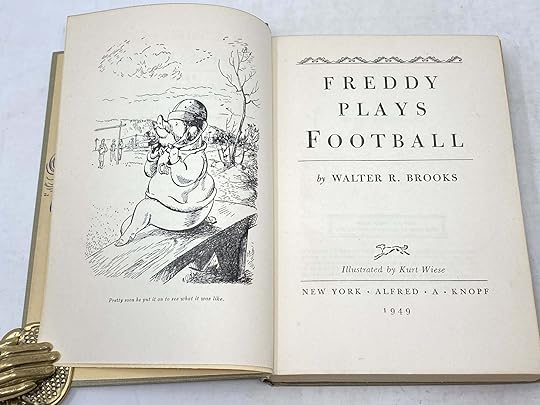
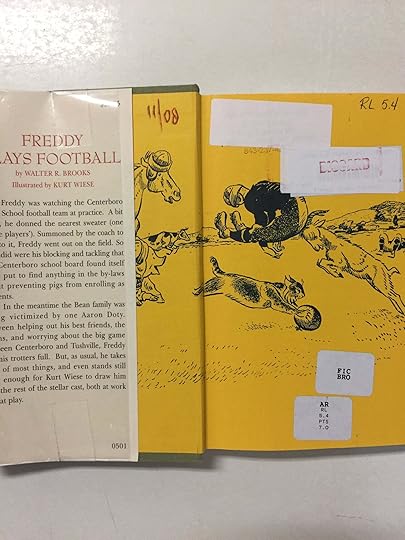
Freddy Plays Football
When the Centerboro High School football coach mistakes Freddy for a player and sends him out on the field, not even the school board can find anything in the rule book about keeping pigs from playing football-as long as they go to school. While Freddy's going to class, trouble's brewing on the Bean farm. Mrs. Bean's long-lost brother, Aaron Doty, has returned home to claim his inheritance-an inheritance that will bankrupt the farm. Freddy will need all the help he can get from his partners in detecting, Jinx the cat and Mrs. Wiggins the cow, if he's going to find out what Doty's really up to, pass Arithmetic, and still make it to the big game.
"Welcome back, Freddy, you paragon of porkers!" (The Washington Post Book World)
"Welcome back, Freddy, you paragon of porkers!" (The Washington Post Book World)
272 pages, Paperback
First published January 1, 1949
About the author
Walter Rollin Brooks
70 books68 followersWalter Rollin Brooks (January 9, 1886 – August 17, 1958) was an American writer best remembered for his short stories and children's books, particularly those about Freddy the Pig and other anthropomorphic animal inhabitants of the "Bean farm" in upstate New York.
Born in Rome, New York, Brooks attended college at the University of Rochester and subsequently studied homeopathic medicine in New York City. He dropped out after two years, however, and returned to Rochester, where he married his first wife, Anne Shepard, in 1909. Brooks found employment with an advertising agency in Utica, and then "retired" in 1911, evidently because he came into a considerable inheritance. His retirement was not permanent: in 1917, he went to work for the American Red Cross and later did editorial work for several magazines, including The New Yorker.
In 1940, Brooks turned to his own writing for his full-time occupation. Walter married his second wife, Dorothy Collins, following the death of Anne in 1952.
The first works Brooks published were poems and short stories. His short story "Ed Takes the Pledge" about a talking horse was the basis for the 1960s television comedy series Mister Ed (credit for creating the characters is given in each episode to "Walter Brooks"). His most enduring works, however, are the 26 books he wrote about Freddy the Pig and his friends.
Source
Born in Rome, New York, Brooks attended college at the University of Rochester and subsequently studied homeopathic medicine in New York City. He dropped out after two years, however, and returned to Rochester, where he married his first wife, Anne Shepard, in 1909. Brooks found employment with an advertising agency in Utica, and then "retired" in 1911, evidently because he came into a considerable inheritance. His retirement was not permanent: in 1917, he went to work for the American Red Cross and later did editorial work for several magazines, including The New Yorker.
In 1940, Brooks turned to his own writing for his full-time occupation. Walter married his second wife, Dorothy Collins, following the death of Anne in 1952.
The first works Brooks published were poems and short stories. His short story "Ed Takes the Pledge" about a talking horse was the basis for the 1960s television comedy series Mister Ed (credit for creating the characters is given in each episode to "Walter Brooks"). His most enduring works, however, are the 26 books he wrote about Freddy the Pig and his friends.
Source
Ratings & Reviews
Friends & Following
Create a free account to discover what your friends think of this book!
Community Reviews
Displaying 1 - 17 of 17 reviews

August 2, 2024
Family, Football, Education, Race, and Bank Robbery
Among the twenty-six Freddy the Pig books by Walter R. Brooks, Freddy Plays Football (1949) was one of the least appealing ones for me to start reading for the first time as an adult, because I imagined absurd American football action, because I couldn’t imagine Brooks writing an engaging plot centering on football, and because, although the pig is protean (being poet, detective, banker, politician, newspaper editor, magician, camper, and so on), I couldn’t imagine Freddy playing football.
How wrong I was!
First, the main plot of the novel doesn’t concern football at all, but rather the sudden appearance of a suspicious man purporting to be Aaron Doty, the long-lost brother of Mrs. Bean, the “snapping-eyed” wife of the man who owns the farm on which Freddy lives and the mother figure for all of the animals there. The animals quickly realize that “Doty” is an imposter (his suitcase has different initials!) angling to get the brother’s half of the inheritance Mrs. Bean’s father left when he died, which will involve Mr. Bean borrowing $5,000 from the local bank, which will involve putting his farm up as collateral and probably losing their rustic and idyllic home. They want to prevent all that from happening but lack the proof to convince the trusting Beans that the man is not Aaron Doty: “It’s pretty easy to believe something when you want to a lot.” Will Freddy and company find that proof in time to save the Beans from their own generosity?
The interconnected sub-plot concerns high school football. The local Centerboro High School team has been getting trounced by Tushville High School, which has been employing three hulking adult ringers called Black Beard, Butcher, and Canny. There’s no hope for CHS unless Freddy can play for them: he can’t catch or pass or carry the ball, not having hands but trotters, but he has a low center of gravity and more weight than the usual high school boy, so is a formidable blocker and tackler. The problem is that CHS wants to play by the rules, and Freddy can’t play unless he’s a student at the high school, and he can’t be a student because he’s a pig, right?
Herein Brooks not for the first time in a Freddy book subtly delves into the fraught topic of American race, using Freddy to represent African Americans denied equality in education and sports. Just two years before this novel’s 1949 publication, Jackie Robinson broke the color barrier in joining the Brooklyn Dodgers of Major League Baseball, and Brooks plays with this controversial change by delineating the mass media and popular reactions across the country after Freddy plays in his first game. And five years before Brown V. Board of Education stopped racial segregation in public schools, Brooks is also referencing integration in education, as some CHS parents are not keen to have their kids going to school with a pig.
Brooks does not overtly do all that! There are no people of color in the novel. Brooks is NOT saying “people of color are pigs.” (If he were, it would be a compliment, because he likes pigs and Freddy is much more intelligent and humane than many of the human beings he meets). Freddy is very much “just” a pig in this novel as in the others. But Brooks is using Freddy and his right to access the same education and sports as human kids as a humorous allegorical commentary on what was happening in America when he was writing his novels—an allegory that it’s perfectly possible to miss while reading the books and that children probably do miss.
Brooks also uses football to satirize rabid sports fans, the potent hold that even (or especially?) high school football can have over entire communities, the hallowed American desire to find ways to cheat in sports and other arenas, and so on.
The novel also features a verboten feline nap, a porcine bank robbery, an arachnid lecture on Hollywood, an animal football game, the punting of a human football, a multi-species courtroom drama, a dip into the dictionary for common male names starting with the letter C, and a cross-dressing imposture (Freddy’s favorite and best disguise is as a little old lady).
The chapter where an owl finishes the lines of Freddy’s poem before he can is hilarious. So is Freddy imagining becoming a lonely wandering outcast gypsy pig and writing a poem about it. So is Freddy’s death speech. So is the parody of heroic football action. The humor often has a bite to it, as when Jinx the black cat tells Freddy, “Boy, is Mr. Bean sore! … It’s the sausage factory for you, kid, if they catch you.”
There are many quirky prime lines, like:
--Like most cats, Jinx enjoyed a spice of danger, even when he was asleep.
--Mrs. Webb’s brain was no bigger than the head of a pin but it was a good one.
--And indeed her voice was very sweet, though of course pretty small, and about two octaves higher than a mosquito’s.
--He had been well brought up, and he knew it was a breach of good manners to throw the furniture at your hostess, or even to knock her down.
--But you can’t just say: “Want to hear my new poem?” because maybe the other person says No, and then you recite anyway and he gets mad.
--“Personally,” said the owl, “I have not found that a multiplicity of relatives is conducive to gaiety.”
I laughed often and well reading this book.
Among the twenty-six Freddy the Pig books by Walter R. Brooks, Freddy Plays Football (1949) was one of the least appealing ones for me to start reading for the first time as an adult, because I imagined absurd American football action, because I couldn’t imagine Brooks writing an engaging plot centering on football, and because, although the pig is protean (being poet, detective, banker, politician, newspaper editor, magician, camper, and so on), I couldn’t imagine Freddy playing football.
How wrong I was!
First, the main plot of the novel doesn’t concern football at all, but rather the sudden appearance of a suspicious man purporting to be Aaron Doty, the long-lost brother of Mrs. Bean, the “snapping-eyed” wife of the man who owns the farm on which Freddy lives and the mother figure for all of the animals there. The animals quickly realize that “Doty” is an imposter (his suitcase has different initials!) angling to get the brother’s half of the inheritance Mrs. Bean’s father left when he died, which will involve Mr. Bean borrowing $5,000 from the local bank, which will involve putting his farm up as collateral and probably losing their rustic and idyllic home. They want to prevent all that from happening but lack the proof to convince the trusting Beans that the man is not Aaron Doty: “It’s pretty easy to believe something when you want to a lot.” Will Freddy and company find that proof in time to save the Beans from their own generosity?
The interconnected sub-plot concerns high school football. The local Centerboro High School team has been getting trounced by Tushville High School, which has been employing three hulking adult ringers called Black Beard, Butcher, and Canny. There’s no hope for CHS unless Freddy can play for them: he can’t catch or pass or carry the ball, not having hands but trotters, but he has a low center of gravity and more weight than the usual high school boy, so is a formidable blocker and tackler. The problem is that CHS wants to play by the rules, and Freddy can’t play unless he’s a student at the high school, and he can’t be a student because he’s a pig, right?
Herein Brooks not for the first time in a Freddy book subtly delves into the fraught topic of American race, using Freddy to represent African Americans denied equality in education and sports. Just two years before this novel’s 1949 publication, Jackie Robinson broke the color barrier in joining the Brooklyn Dodgers of Major League Baseball, and Brooks plays with this controversial change by delineating the mass media and popular reactions across the country after Freddy plays in his first game. And five years before Brown V. Board of Education stopped racial segregation in public schools, Brooks is also referencing integration in education, as some CHS parents are not keen to have their kids going to school with a pig.
Brooks does not overtly do all that! There are no people of color in the novel. Brooks is NOT saying “people of color are pigs.” (If he were, it would be a compliment, because he likes pigs and Freddy is much more intelligent and humane than many of the human beings he meets). Freddy is very much “just” a pig in this novel as in the others. But Brooks is using Freddy and his right to access the same education and sports as human kids as a humorous allegorical commentary on what was happening in America when he was writing his novels—an allegory that it’s perfectly possible to miss while reading the books and that children probably do miss.
Brooks also uses football to satirize rabid sports fans, the potent hold that even (or especially?) high school football can have over entire communities, the hallowed American desire to find ways to cheat in sports and other arenas, and so on.
The novel also features a verboten feline nap, a porcine bank robbery, an arachnid lecture on Hollywood, an animal football game, the punting of a human football, a multi-species courtroom drama, a dip into the dictionary for common male names starting with the letter C, and a cross-dressing imposture (Freddy’s favorite and best disguise is as a little old lady).
The chapter where an owl finishes the lines of Freddy’s poem before he can is hilarious. So is Freddy imagining becoming a lonely wandering outcast gypsy pig and writing a poem about it. So is Freddy’s death speech. So is the parody of heroic football action. The humor often has a bite to it, as when Jinx the black cat tells Freddy, “Boy, is Mr. Bean sore! … It’s the sausage factory for you, kid, if they catch you.”
There are many quirky prime lines, like:
--Like most cats, Jinx enjoyed a spice of danger, even when he was asleep.
--Mrs. Webb’s brain was no bigger than the head of a pin but it was a good one.
--And indeed her voice was very sweet, though of course pretty small, and about two octaves higher than a mosquito’s.
--He had been well brought up, and he knew it was a breach of good manners to throw the furniture at your hostess, or even to knock her down.
--But you can’t just say: “Want to hear my new poem?” because maybe the other person says No, and then you recite anyway and he gets mad.
--“Personally,” said the owl, “I have not found that a multiplicity of relatives is conducive to gaiety.”
I laughed often and well reading this book.
March 17, 2025
I was obsessed with the Freddy the Pig books when I was in elementary school, and I read every one I could find a copy of available from every public library in Maryland. Still, this is one I never managed to find, and I only got to read it now because I came across a copy of one of the reprints that came out after I was in high school. It's definitely not one of my favorites in the series—perhaps partly because I agree with the Centerboro High School principal that high schools shouldn't have football teams—but it was nice to get to see all the old characters again, and they were mostly as I remembered them.

November 29, 2018
My 9 year old absolutely loved this animal detective story as a read-aloud. I think it begs to be read aloud as it has rich vocabulary and poetry sprinkled throughout. It's entertaining enough to be read to a variety of ages.
We have two others in the series but this was the first we read of Freddy the Detective. I am assuming they can be read in any order, like the Pooh books by A.A. Milne.
We have two others in the series but this was the first we read of Freddy the Detective. I am assuming they can be read in any order, like the Pooh books by A.A. Milne.

February 7, 2024
This was a fun read, but definitely not for everyone. Because it devolves into farm animals admitted into high school football games, older kids may roll their eyes; and because of all the football vocabulary and play descriptions, certain kids may find it boring. We found it just right and finished it just before the superbowl!

August 4, 2026
The Freddy the Pig books were among my favorites as a child, though I’m not sure I understood them. As an adult they remind me strongly of the Asey Mayo mysteries—same droll/silly country humor. This books is fun throughout, but my favorite part is Mr. And Mrs. Webb the spiders and their vacation to Hollywood.

November 9, 2022
Very little actual football, weirdly enough, and the plot with Mrs. Bean's alleged brother is handled in a very incoherent way. Not among the top tier of Freddy books, I'd say.

October 27, 2023
I liked how freddy got on the team

July 28, 2026
It’s Freddie the pig. It’s always a good time.
July 29, 2026
One of the best Freddy the Pig stories, with plenty of hilarious characters, old and new.
March 20, 2013
Every book in this series is excellent. Hilarious, dry, old-timey Vermont humor. I especially like the moments of wacky physical comedy, like when Freddy nearly swallows his own false beard. This one's interesting because it has a more complex villain than others I've read; Brooks seems to be moralizing a tiny bit here, having the animals discuss how difficult it is when someone who's fun to be around is also doing something wrong, and reflecting on what it's like when you have to really try to like somebody who is lying and stealing because you feel sort of responsible to them. He veers a tiny bit into telling rather than showing here, but it is still worth five entire stars for the rollicking good fun you'll get from any Freddy novel.
Also, this guy evidently wrote the short story that turned into "Mr. Ed". I'd like to read that!
Also, this guy evidently wrote the short story that turned into "Mr. Ed". I'd like to read that!
December 31, 2015
I liked it. He plays football for the high school in Centerboro. Mrs. Bean's brother joins and he thinks that he's a bad guy. Then they play a game of football with a really good football team and what happens.
October 17, 2016
Freddy's owner has a long-lost "Brother" that is coming to visit. He gets the money that is left over from his dad. If they have to give the money to him, they will lose the farm. Freddy has to find out if the long-lost brother is fake.
September 18, 2010
This is my sixth Freddy in a little over a week - Love them ALL.

June 30, 2011
Braden enjoys all the Freddy books.

January 23, 2015
The grandkids in Brazil and I finished this book this afternoon and we still aren't tired of Freddy and his friends. We are on to book #18 in the series.
December 31, 2015
I liked it. He plays football and a lot of people almost take all their money out of the national bank and put it in Freddy's bank, but then they don't.
This entire review has been hidden because of spoilers.
March 3, 2016
Freddy joins the high school team to play football.
Displaying 1 - 17 of 17 reviews