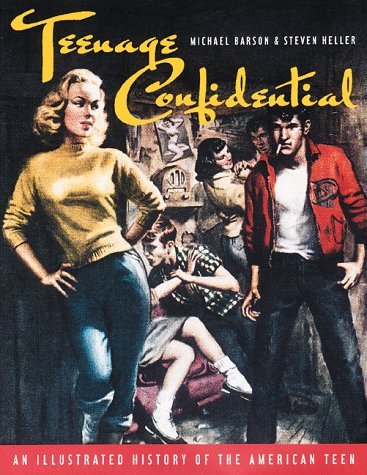
When did those awkward, tormented creatures known as teenagers first crawl out of the primordial ooze and into American culture? Believe it or not, they didn't always exist. It was not until World War II, with grown men off fighting and grown women working in factories, that adolescents were left idle and unsupervised long enough to wreak havoc. In the forties, fifties, and sixties a new breed of youth evolved -- the juvenile delinquent -- and this state of emergency was quickly dramatized in every cultural medium. In Teenage Confidential, Michael Barson and Steve Heller conduct a guided tour through three decades of teen angst, displayed in shocking Technicolor on movie posters, paperbacks, comic books, advertising art, television shows, and Top Forty music paraphernalia. From Father Knows Best to Youth Runs Wild, this unflinching survey spotlights the sordid ways of our rebel youth.
An interesting look at the creation of American pop-teenagerhood from the 1930s-60s, this book will catch the attention of anyone with an interest in pop culture history, early-midcentury gender and social roles, or how current culture can be traced back to the time period.
It's not a deep dive, or even a medium dive, if I'm being honest. It's pretty surface-level, which makes it a good choice for some light reading but might feel frustrating if you want to learn more about almost anything the authors cover. At 130 pages, it reads pretty fast, and its large size (roughly the size of the magazines it cites frequently) provides ample close-ups of movie posters, magazine covers, articles, and other excerpts.
I wish it had gone either deeper, or wider. Its focus felt fairly narrow--it spends most of its time in the 50s-60s-- and focusing primarily on teens in pop culture: their portrayal in movies, the burgeoning magazine and comic book industries that pandered to them. To feel complete, it should've either dived deeper into its chosen topics, or expanded its coverage to include things like school, changing social mores, and other things.
As it is, it was enjoyable to see the pop culture included, but it feels lacking. My impression, without looking up any information about the authors, is that it was created by and primarily for people who were teens during (or maybe immediately after) the ~30-year-span it purports to cover (focusing mostly on the latter 15-ish years, though) and this was more of a retrospective: "remember how adults reacted to us when we thought everything was cool? D'you want a little more context for that now that you have teens of your own?"
Teenagers became a recognizable demographic in the last century. Along with that came marketing targeting them and films and movies catering to them or about them. In the 1930s, they were clean-cut and sweet; by the 1950s, fears of juvenile delinquents justified a stream of exploitative paperbacks and films (High School Hellcats, Reform School Girls) as well as the occasional serious film (The Wild One, Rebel Without a Cause). While not deep, this book gives a good overview of fears and hopes about teens but it's primary focus is media portrayals (which is what I read it for, so cool!).
Although the photos, vintage advertisements, and posters are great, this book's text leaves much to be desired. It's almost as if the book didn't get proofed. While the text offers some interesting facts about the impact of teenage culture on American society, it lacks depth. If you enjoy vintage advertising and fashion history, you will enjoy the images; however, if you are looking for a well-written social history of the topic, read another book.