Jump to ratings and reviews
Rate this book

Venus Plus X

Rate this book
Charlie Johns has been snatched from his home on 61 North 34th Street and delivered to the strange future world of Ledom. Here, violence is a vague and improbable notion. Technology has triumphed over hunger, overpopulation, pollution, even time and space. But there is a change Charlie finds even more gender is a thing of the past. Venus Plus X is Theodore Sturgeon's brilliant evocation of a civilization for whom tensions between male and female and the human preoccupation with sex no longer exist.

As Charlie Johns explores Ledom and its people, he finds that the human precepts he holds dear are profane in this new world. But has Charlie learned all there is to know about this advanced society? And why are the Ledom so intent on gaining Charlie's approval? Unsettling, compelling, and no less than visionary, here is science fiction at its a novel whose wisdom and lyricism make it one of the most original and insightful speculations on gender ever produced.

224 pages, Paperback

First published January 1, 1960

65 people are currently reading
2463 people want to read

About the author

Theodore Sturgeon

720 books767 followers
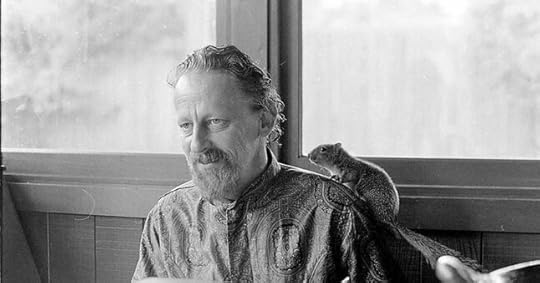
Theodore Sturgeon (1918–1985) is considered one of the godfathers of contemporary science fiction and dark fantasy. The author of numerous acclaimed short stories and novels, among them the classics More Than Human, Venus Plus X, and To Marry Medusa, Sturgeon also wrote for television and holds among his credits two episodes of the original 1960s Star Trek series, for which he created the Vulcan mating ritual and the expression "Live long and prosper." He is also credited as the inspiration for Kurt Vonnegut's recurring fictional character Kilgore Trout.

Sturgeon is the recipient of the Hugo Award, the Nebula Award, and the International Fantasy Award. In 2000, he was posthumously honored with a World Fantasy Award for Life Achievement.

Ratings & Reviews

What do you think?
Rate this book

Friends & Following

Create a free account to discover what your friends think of this book!

Community Reviews

5 stars
484 (23%)
4 stars
766 (36%)
3 stars
657 (31%)
2 stars
146 (6%)
1 star
47 (2%)
Displaying 1 - 30 of 194 reviews
Profile Image for Lyn.
2,009 reviews17.6k followers
October 11, 2017
Theodore Sturgeon published Venus Plus X in 1960, before much of what would be considered the women’s rights movement. Many science fiction books from this era were well written and visionary but the science has grown stale and modern readers wince at technological incongruities or fail to appreciate a novel idea when written when the reality has occurred; like driving past a reference to a cell phone from 1950.

But here, the science has not lost its punch, but rather the social commentary. Sturgeon spends a fair amount of time discussing gender issues that are today somewhat passé.

It’s still a good sci-fi book, well written and entertaining; and his overall message is still relevant and inspiring. The premise is that a Homo sapiens man has been abducted from his time and place and brought to live in a Lodem society. Lodem – “model” spelled backwards – is something of a utopia and our society is compared with the Lodem’s. Interestingly, Sturgeon divides his narrative into two seemingly unconnected plots, one in the Lodem culture and another in the Homo sapiens world.

Reminiscent of his brilliant work More Than Human, I suspect a common theme in Sturgeon’s work is evolutionary man. His theological ramblings were also evocative to Philip K. Dick’s musings in his The Exegesis of Philip K. Dick.

description
Profile Image for J.L.   Sutton.
666 reviews1,247 followers
February 25, 2022
“If you can’t be really good at anything, then the only way to be able to prove you are superior is to make someone else inferior. It is this rampaging need in humanity which has...driven a man to stand on the neck of his neighbor.”

MITAKUYE OYASIN: Theodore Sturgeon

With its focus on a society without gender, Theodore Sturgeon's Venus Plus X feels ahead of its time (1960) and, because of the attitudes of its protagonist, Charlie johns, and a side story about as progressive as a pickup truck, annoyingly stuck in its time (1960). The protagonist feels he has been transported into the future and that the inhabitants of Ledom are perhaps the future of humanity. However, his attitude toward the Ledomites changes dramatically when he learns that it wasn't mutations that led to their change, but choices they deliberately made. The side story bogged this down as did the idea that Charlie Johns was some kind of representative man. And I think it was bogged down by the fact that it was written in 1960 and felt like it was written in 1960.
Profile Image for Franco  Santos.
482 reviews1,524 followers
January 21, 2018
4.5

Mi cuarto libro de Sturgeon, y ¡qué sorpresa! Sin lugar a dudas, mi favorito de él. Conmovedor, visionario, emocionante y esperanzador. Venus más X explora la moralidad, el machismo, el feminismo, la sexualidad y principalmente lo más duro y vergonzoso que reside en nuestra naturaleza como seres humanos, todo aquello sin dejar de lado, agonizantemente, la posibilidad de redención. Me dejó sin palabras.

(No se dejen llevar por la sinopsis, es mucho más que eso).
Profile Image for Kalin.
Author 74 books282 followers
July 31, 2019
A Platonic dialogue exploring the similarities between the sexes and our stereotypes about sex, many of which sadly persist, more than 60 years after the book was first published. As usual, I'm awed by Sturgeon's courage, insight and warmth. (Although this particular story seemed more clinical, colder than his typical writing.)

My reading notes:

~
He remembered a thing he had read somewhere: was it Ruth Benedict? Something about no item of man’s language, or religion, or social organization, being carried in his germ cell. In other words you take a baby, any color, any country, and plank it down anywhere else, and it would grow up to be like the people of the new country. And then there was that article he saw containing the same idea, but extending it throughout the entire course of human history; take an Egyptian baby of the time of Cheops, and plank it down in modern Oslo, and it would grow up to be a Norwegian, able to learn Morse code and maybe even have a prejudice against Swedes. What all this amounted to was that the most careful study by the most unbiased observers of the entire course of human history had been unable to unearth a single example of human evolution.


These ideas create a curious resonance with the questions raised by Mikhail Ancharov, a Russian contemporary (and kindred spirit) of Sturgeon's. (E.g. "What sort of evolutionary pressures produced the human brain, this ginormously complicated organ?")

~ Sturgeon's language makes me question everything I know about English. Oh, how my grammar teachers would wail and pull their hair over the word order in a sentence like "In a box was a dried marigold"! And I just had to check if "There seemed no concept for “payment” or “pass” in the tongue" is a valid expression or a proofreader's mistake. (It is valid: "seem" can also mean "appear to exist." But it's an uncommon use ... I think. But I'm not sure. I ... don't know.)

Yes ... texts like these wreak havoc on my confidence as a translator. :( This is actually the second time I've started reading Venus Plus X; the first time, couple of months ago, I felt so stupid, found most of the phrases so impenetrable, that I just gave up.

On the other hand, it's a glorious (and ever rarer) joy to come upon an author who can teach you something new every other sentence.

~ However, language isn't only extensive vocabularies and Serious Stuff. It's also having fun:

“Hi, bulls!” says Tillie Smith. “What’s bulling?”
“Just man talk,” says Smith.
Herb says, “Hi, bowls. What’s bowling?”
Jeanette says, “Three strikes and I’m out.”
“Herb already used the gag,” Smith says in his leaden way, which isn’t true.
Tillie tops them all: “What’s everybody saying highballs for? Let’s all have a drink.”

Or:
“As Adam said when his wife fell out of the tree—Eve’s-dropping again.”


~ And it's not merely language you can learn from Sturgeon; it's all kinds of fascinating facts:

He went on to show pictures of other species, to give Charlie an idea of how wide a variety there is, in nature, in the reproductive act: the queen bee, copulating high in midair, and thereafter bearing within her a substance capable of fertilizing literally hundreds of thousands of eggs for literally generation after generation; dragon-flies, in their winged love-dance with each slender body bent in a U, forming an almost perfect circle whirling and skimming over the marshes; and certain frogs the female of which lays her eggs in large pores in the male’s back; seahorses whose males give birth to the living young; octopods who, when in the presence of the beloved, wave a tentacle the end of which breaks off and swims by itself over to the female who, if willing, enfolds it and if not, eats it.


~ Haha, Sturgeon also tackled the "Mommy, how are babies made?" story. Starting like this:

“Well then,” says Karen abruptly, “we don’t need daddies then.”
“Whatever do you mean? Who would go to the office and bring back lollipops and lawnmowers and everything?”
“Not for that. I mean for babies. Daddies can’t make babies.”
“Well, darling, they help.”
“How, Mommy?”
“That’s enough bubbles. The water’s getting too hot.” She shuts off the water.
How, Mommy?”


I'll let you find out the ending for yourselves. ;)

~ Sturgeon has the gift of ecstasy, no matter where he turns it. See him dancing about dancing:

It became, for him, a broken series of partial but sharply focussed pictures; the swift turn of a torso; the tense, ecstatic lifting of a fever-blinded head, with the silky hair falling away from the face, and the body trembling; the shrill cry of a little child in transport, running straight through the pattern of the dance, arms outstretched and eyes closed, while the frantic performers, apparently unthinkingly, made way by hairsbreadth after hairsbreadth until a dancer swung about and caught up the infant, threw it, and it was plucked out of the air and whirled up again, and once more, to be set down gently at the edge of the dance.


~ How can you tell a swine from someone just fine?

A pig among people is a pig, he tells himself, but a pig among pigs is people.


~ I can't remember where I first encountered (and embraced) the explanation why power structures (state-endorsed/institutionalized religion being only one example) need to denounce sex and the sexual impulse, but Sturgeon may have been among the earliest writers to highlight it. I'm quoting the following passage as a "historic(al) monument":

There are two direct channels into the unconscious mind. Sex is one, religion is the other; and in pre-Christian times, it was usual to express them together. The Judeo-Christian system put a stop to it, for a very understandable reason. A charitic religion interposes nothing between the worshipper and his Divinity. A suppliant, suffused with worship, speaking in tongues, his whole body in the throes of ecstatic dance, is not splitting doctrinal hairs nor begging intercession from temporal or literary authorities. As to his conduct between times, his guide is simple. He will seek to do that which will make it possible to repeat the experience. If he does what for him is right in this endeavor, he will repeat it; if he is not able to repeat it, that alone is his total and complete punishment.
He is guiltless.
The only conceivable way to use the immense power of innate religiosity—the need to worship—for the acquisition of human power, is to place between worshipper and Divinity a guilt mechanism. The only way to achieve that is to organize and systematize worship, and the obvious way to bring this about is to monitor that other great striving of life—sex.
Homo sapiens is unique among species, extant and extinct, in having devised systems for the suppression of sex.


~ Charlie's change at the "revelation" was abrupt. Too abrupt; to the point of rupturing my reader's credibility. :(
Profile Image for Craig.
6,330 reviews179 followers
August 20, 2024
Venus Plus X is one of Sturgeon's best-known novels, but not necessarily among his best (in my opinion, of course!) It was on the Hugo Award ballot for best novel of the year in 1961, but lost (quite rightly, again in my opinion) to Miller's A Canticle for Leibowitz. It's more of a long fictionalized meditative essay and discussion about sex and religion and gender roles and such weighty philosophical subjects than it is a novel. It was an important work and brought the focus of the field onto those subjects and away from the nutz'n'boltz to which sf readers were accustomed, and Sturgeon (and Philip Jose Farmer as well as a few others) can be credited with doing more to paving the way for the New Wave rebirth of the field than anyone else. It was ground-breaking in its day but is quaintly dated by modern standards, so I'd recommend it for its historical value more than for entertainment purposes.
Profile Image for Jemppu.
514 reviews97 followers
June 11, 2021
"You cannot be objective about it because you have been indoctrinated, sermonized, drenched, imbued, inculcated and policed on the matter since first you wore blue booties. You come from a time and place in which [...] the importance of then- difference, were matters of almost total preoccupation."


An ambitious and commendably independent-thinking exploration on societal roles of gender and sex. Compelling general discussion on the theme - framed in a heartwarming comradery - but which also occasionally tended to veer into speculations on distractingly narrow, or irrelevant-seeming, culturally specific suppositions.

However, what the text most fatally suffers from - with a frustrating consistency - is the severe limitation in keeping it from ever fully comprehending, or properly conveying, the concept of social neutrality it seeks to examine: its strictly gendering language. (Fact which, however, effectively brings focus to this very problem in linguistic culture).

The text discusses with confidence social structures of supposed gender hierarchies, taboos and gendered norms tied to, or excused by, Christian values - all the usual fare on gender roles which dictate much of the Anglocentric discourses. However, with its level of debate still on trying to debunk those extensively caricaturized biases - and with the aforementioned glaringly evident linguistic obstacle - the narrative never feels quite ripe enough to adequately grasp or convey concepts beyond gender/sex evaluated societal arrangements, or individual identity removed from sex altogether.

Though, the book does arrive there in the end - to embracing the fact of individual differences without subjecting them to unnecessarily divisive gender/sex-valued categorizations -, it does so by quite a convoluted route - so as to address even those most sidetracked of principles it allows into the discourse.

That is to say, it is visionary in its own societal and linguistic cultural sphere, demystifying issues with the usual standing point of conservative US values in mind (cultural similarities and values of which are, of course, applicable in varying degrees of accuracy within and beyond national borders).

For me personally, perhaps the most absent aspect (aside the lacking language making the point of gender-neutrality null altogether) was the narrative's general inability to ever clearly enough separate sex/gender from identity.

Given the time and place of its conception, however, the text is inspiringly clear-sighted and thorough in scrutinizing the stagnant norms in the domain it habits, and perhaps more importantly: targets. And, indeed, by what ever method, it satisfyingly arrives to the most important conclusion eventually.

"Humanity has never attained its optimum ability to reason, its maximum objectivity, until now, because it has always plagued itself with its dichotomies. In us, the very concept of any but individual differences has been eliminated."


____

(Further notes in the reading updates below, as per usual).

This left one rather tempted to re-edit the book's text to include the gender-neutral language its narrative most acutely requires, but fails to ever utilize - to see how that alone would work in favor of its message.
Profile Image for Kaisa.
1 review4 followers
July 12, 2015
This is a SF classic I would like to see discussed more often. Written in 1960, it is vitally relevant to the current transformation in constructing gender and sexuality. If nothing else, it serves to remind us that the change has been going on for quite some time.

Venus Plus X takes an everyman observer to a world called Ledom, where gender dichotomy has been made obsolete. The people of Ledom are neither men nor women: they are both. As in Ursula LeGuin's The Left Hand of Darkness and Marge Piercy's Woman on the Edge of Time, removing sexual difference makes room for speculation about a gender-neutral society. Sturgeon also adds religion as a stabilizing and orienting factor, positing two needs as human universals: the need to love and the need to worship. In Ledom, the ultimate object of both those needs is the Child. Ledom is all about future, all about ridding the culture of historical diseases: violence, exploitation, patriarchal authority.

”We keep before us the image of that which is malleable and growing – of that which we have the power to improve. We worship that very power in ourselves, and the sense of responsibility which lives with it. . . . We worship the child because it is inconceivable that we would ever obey one.”

As the everyman observer sees it, all of this functions quite smoothly. Sturgeon does not, however, construct a naturalized Utopia; rather, he explores what techniques and policies are needed to make this culture tick, the ingrained irony within any Utopia. In the end, even the everyman observer is revealed as a construct. This makes Venus Plus X an explicitly political novel.

”We are not a Utopia. A Utopia is something finished, completed. We are transients; custodians; a bridge, if you like.”

The Ledom narrative is constantly contrasted with scenes from the other world, depicting two contemporary suburban families in the throes of what seems like gender equalization. While the mothers discuss business in a bowling alley, the fathers stay at home with the young, comparing home decors and consumer products. From the face of it, it seems like Ledom is not that far away. Old habits die hard, however. The modern father still raises his children to be Men and Women, kissing the daughter goodnight and leaving the son with a handshake and a laconic ”Good night, old man.”

Makes you wonder how slowly these things change – and what are the habits you pass on yourself.

Warmly recommended to all interested in feminist SF, trans issues, and the performative aspects of gender in general. Even with all the philosophy lectures, the book is an enjoyable and engaging read – I only put it down once during the five hours of reading time.
Profile Image for Dave.
3,656 reviews450 followers
September 7, 2023
Venus Plus X (1960) is definitely not the highlight of Sturgeon's science fiction career and doe snot hold a candle to his "More Than Human." It is thin on plot and heavy on filler. It has two contrasting timelines or stories. One, the larger focus, is the adventure of Charlie Johns, who is walking down the street one day, and wakes up and finds himself in Ledom, a small self-sufficient community in the far future which is closer to an alien world society than human society. He is brought there to be an objective independent observer and give the Ledomites an evaluation of what he thinks about their world. He, like Dorothy and Toto, just wants to go home, but they won't just let him click his heels three times. He has to complete his mission amidst a world of people who do not sleep and who are hemaphrodites (people with both sets of genitalia). In this strange new world, there are no men and women. They each have both parts and get pregnant at the same time, always bearing twins, who are then whisked off to incubate for a month alone. Contrasting with this strange world are glimpses of an Ozzie and Harriet society of the Fifties with set roles for men and women which they learn at an early age. It may seem that this story is a blueprint for what some radicals want, but perhaps it is a cautionary tale and merely meant to make people think. In any case, despite the fact that the plotline falters, Sturgeon was early in thinking about gender roles and what they mean.
Profile Image for Gabi.
729 reviews163 followers
May 27, 2020
caveat: I'm biased :D. Sturgeon's 'essay' herein about the role of religion and the change Christianity brought was a trailblazer in my teens and the direct reason for the kind of faith I chose.

At first I wasn't sure if I already had read this novel. I own more than 20 different books by this author, several in two different languages and nearly everything as 'backup' again as ebook. His short stories were the mantra of my youth and my very reason to get into Science Fiction as literature genre. But I wasn't sure if I ever read his novels. So I decided to rectify this (potential) fault and started with "Venus Plus X". My memory always has been bad and my teens are … well … loooooong ago, so I couldn't remember the details. But when I got to the above mentioned speech it all came back. This was written in flamescript upon my teenage heart.

So I can give nothing less than 4 stars here, because of the personal importance and because of the topic of gender identity and social oppression that Sturgeon took on here in 1960 which still doesn't feel that dated today.

In two alternating - never convening - plotlines he describes two different models of social structures and the unconscious behaviour we fall prey to. He poses questions but doesn't deliver all the answers. The reader is called to do their own thinking.
Most striking for me was a good-night scene where a father behaves differently towards his daughter and his son and is flabbergasted by the resulting aftermath.

There is nearly no action in this novel. It is written as a thought experiment, more in terms of an essay. This is important to know before going into it - and it has been written somewhen in the 1950ies, so of course there are parts that feel dated.

I was inclined to give this 5 stars, but there is a quirky behaviour at the end that even my Sturgeon-fan-soul can't overlook. Still a great read, even 60 years later.
Profile Image for Jim.
Author 7 books2,089 followers
March 18, 2021
Published in 1960, I found this a far better look at gender fluidity & sexism than The Left Hand of Darkness which was published almost a decade later & gets all the love. Sturgeon contrasts the height of the 1950s "Father Knows Best" against something resembling a utopia where the inhabitants are truly androgynous. Even better, he tosses in some rather subtle, discordant notes that kept me on my toes.

There's also a great thread on secrecy which runs through the entire story & leads to a wonderful conclusion. I wish there was a bit more show rather than tell. He has always tended to lecture, but I find those fascinating. His quick overview of religion & sex is absolutely wonderful.

I listened to this narrated by Stefan Rudnicki. Fantastic, as expected.
Profile Image for RJ - Slayer of Trolls.
990 reviews191 followers
June 12, 2021
This 160-page science-fiction novel is really more of an meditation on social attitudes and gender identities as well as a philosophical exploration of how a future genderless society might work. Like many other SF books of the era, the exposition is lengthy and, frankly, quite dull as the vast majority of the plot is devoted to explaining the society of "Ledom," how it functions and how different it is from men and women of the "modern era" (approximately 1960, when the novel was first published), who are illustrated through a running side story that is not much more progressive than a typical "I Love Lucy" episode. A couple late plot twists aren't enough to recommend this to a modern reader as anything other than a curiosity.
Profile Image for David.
39 reviews10 followers
July 10, 2012
This is, by any standard, a novel of ideas that pushes the boundaries of what was acceptable in old-style pulp sf. The central premise (a very unlikely one, it must be said) is that someone with a lot of wealth and influence creates a model society (Ledom, get it?) in secret. Ledom keeps the outside world at bay thanks to super-science, like many a Utopia before it. But Sturgeon's basic premise is radical to say the least - that if we eliminate sexual difference by making everyone hermaphrodite, we remove most of the things that mar human affairs.

This is the sort of idea that led to the author being nicknamed 'Steamy Ted', though to be fair there's no actual sex here - probably because no mainstream publisher would have dared print it. Instead there is a lot of philosophising and some fair-to-interesting exposition about Ledom history, culture, education etc. But, as other reviewers have noticed, if you want an actual novel, drama only kicks in towards the end when some cracks in the seemingly flawless system start to show.

Overall, Venus Plus X is a weird, memorable but unsatisfying read. It's proto-feminist in its assumption that eliminating macho aggression would make a better world, but relies heavily on the 'there's a ray for everything' gadgetry of Golden Age sci-fi. It sits uncomfortably between two worlds and ends in ambiguity.
Profile Image for Jurica Ranj.
Author 15 books20 followers
August 25, 2016
3.5/5 ali zbog Sturgeonovog stila pisanja, prevalit ću na 4.

Interesantna knjiga koja ima svojih dobrih i loših strana. Vječna tema razlika spolova i neumorne čovjekove prirode da dominira nad svim. Postoji glavna priča o junaku u utopijskom Ledomu i sekundarna koja više služi kao ilustracija određenih konflikta i problema, poput svojevrsne nadopune osnovne priče koja mi je jasna ali u nekim dijelovima i nepotrebna.

Radnja je spora i pretežno se vrti oko ideja i koncepta do samog kraja, kad dolazi do interesantnih obrata i rješavanja osnovnih pitanja sa samog početka priče.
Profile Image for Lizz.
434 reviews116 followers
January 7, 2021
I don’t write reviews.

Sturgeon is a solid writer. He crafts fine stories and I’ve found all of them interesting. This one felt a bit heavy-handed and preachy. I understand his goal and appreciate his exploration of the themes. I guess in this day and age I’m tired of hearing about sex and gender. Being human has been politicized which is dangerous. Mostly to ourselves. And definitely to those who don’t jump on narrative bandwagons.
Profile Image for Roddy Williams.
862 reviews41 followers
July 23, 2016
‘HE WAS A STRANGER IN THE STRANGEST NEW WORLD EVER…

He awoke to terror. He was in a silver cell and all he could remember was his name: Charlie Johns.

Later they told him he was in Ledom – a country where the people were wise and gentle and kind. They tried to help Charlie Johns but they were… strange. He could see it in many ways – their clothes, their over-developed pectoral muscles, the odd silky sporrans they all wore. But it wasn’t until he noticed two of their men pregnant that he realised just how alien a land Ledom was…’

‘In a postscript to the original American edition of VENUS PLUS X, Theodore Sturgeon wrote that his aim had been to write ‘a decent book about sex.’ In a genre of writing where a genuinely adult approach to human sexuality has usually been conspicuous by its absence, Sturgeon’s novel is a triumphant demonstration that science fiction can extend the boundaries of human awareness in this problematic area just as it has done for decades in the less ‘personal’ areas of time, space and other cosmological topics.
VENUS PLUS X may very well shock and even disturb readers who are not prepared to face up to the complex nature of sexuality and human psycho-biology. That is their bad luck. For the reader with an open mind and questing intelligence, this haunting stimulating and novel moving novel offers richer rewards than most other fiction currently available’

Back cover and interior blurbs from the 1978 Sphere paperback edition

It’s hard to imagine what it would have been like, reading this novel in Nineteen Sixty when it was first published. This would have been shortly after I was born and consequently I didn’t get round to reading it until some twenty years later, by which time the world had changed.
Its message remains an important one, and I feel it is a classic that will be rediscovered by future generations, but the shock value of its original release has been somewhat diluted.
Charlie Johns is a young American of the late Nineteen Fifties, in love with his beloved Laura and with all his life ahead of him.
Suddenly Charlie is transported through time and space to the far future and the society of Ledom. Astute readers and most people over twelve years old will realise that this is the word ‘Model’ written backwards. Charlie is told that he can be transported back where he came from, but in return the people of Ledom expect him to study their culture and report on it objectively.
From the outset Charlie is confused by the androgynous look of the Ledomians and eventually discovers that they are a race of human hermaphrodites, each having the sexual organs of both sexes. They are intelligent, peaceful and wise.
The whole idea of Ledom is that Humanity throughout its history has had a legacy, ‘baggage’ if you like, of teaching its children that they have to conform to stereotypes of male and female roles. Ledom provides a slate wiped clean of any historical contamination and and a family life where the parents are essentially the same.
Likewise, Ledom realises the need for a spiritual and moral side to society and so a religion had been devised where what is worshipped is one’s own children or The Child as an ***** embodiment of the future.
The narrative is intercut with the lives of two couples from Sturgeon’s US of the time, where lives and attitudes both illustrate the ingrained attitudes that Ledom is seeking to wipe away and simultaneously demonstrate how the seeds of Ledom are already at work.
In one scene, for instance, a father hugs and kisses his young daughter as a goodnight ritual while merely shaking hands with his son, and cannot understand why the son subsequently bullies his sister.
There is also discussion of a contemporary cartoon strip which asks the question of how to tell boys and girls apart when they both have long hair. The answer is that the boys are the pretty ones.
The contrast between realistic life and Ledom life is a clever one, since although Sturgeon is painting a contemporary domestic scene, in comparison with Ledom society it comes over as being somewhat primitive and barbaric, which was no doubt the aim.
The novel does have a twist in its tail, however, and although Venus Plus X would have been considered a classic even without the surprise ending, this certainly pushes the book onto another level.
This is an important SF novel since its message is timeless and addresses some of the most fundamental aspects of human society. Sturgeon manages to make us take a long look at ourselves and employ some basic common sense, which at times borders on the profound.
Profile Image for Jack (Sci-Fi Finds).
152 reviews54 followers
July 9, 2025
This book follows a man named Charlie Johns, who wakes up in a bizarre cell at the top of a conical tower overlooking a domed valley. He meets some people called the Ledom, who appear to be androgynous in nature. He begins to query where he is, how he got there and why. This is a speculative tale about gender and the societal roles of men and women, which feels very forward-thinking from Sturgeon.

There are interstitial chapters that follow a couple who are developing unconventional ideas about how to raise their children. This doesn't immediately make sense in relation to the main plotline, but it does eventually become clear. The point where it falls down is when Sturgeon drops the act and lays all of his cards on the table, in an extended exposition dump toward the end of the book. I didn't think that it was necessary and could have been omitted or shortened to deliver a more punchy experience.

Venus Plus X has a great ending and is a short enough read to blast through in a day or two, made even quicker since the author's writing ushers you along with ease. Probably another one of those 3.5* feeling books.
Profile Image for Bill.
414 reviews104 followers
November 10, 2018
Venus Plus X is a 1960 SciFi novel by one of the fathers of modern Science Fiction. It introduced feminism and gender fluidity and equality to the fans of SF. Recommended.
Profile Image for Stuart.
722 reviews341 followers
February 28, 2022
Painfully Dated, Tedious Lectures Without Even Pretense of a Real Plot
This book was also selected by David Pringle in his Science Fiction: The 100 Best Novels : An English-Language Selection, 1949-1984, so I had some degree of expectations.

That being said, I've revisited the list recently and ticking off some of the remaining ones via audiobook and know his list is extremely hit-or-miss, which is hardly a surprise as it is 1) extremely eclectic, including many books that are borderline SF, lean towards literary style with mainstream authors making forays into SFF, and 2) covers some very dated books from the 1950s that were seminal but don't hold up well at all.

Still, I liked More Than Human and The Dreaming Jewels, and have recently read some very good stuff by Angela Carter that explores gender fluidity in incredible ways such as The Passion of New Eve (1977), and also time travel to a very dull utopian society used as a vehicle for the author to explore their ideas about ideal social/political systems, and also critique the social mores of their day, such as Robert Graves' Watch the North Wind Rise (1949). Both of those books were really interesting, had a lot to say, and said it with style. The latter in particular has an almost identical conceit as Venus Plus X - a man from the contemporary world is mysteriously transported through time to a distant future utopia that is totally alien to him, and both sides are baffled by each other's ways.

But my god this was one of the weakest excuses for a story I've read in ages - the plot is so flimsy it makes balsa wood seem like granite, McDonalds taste like filet mignon, and reality TV feel like great art. I've never encountered any author that made less effort to clothe his info-dumps and ideas on gender and social utopias with even the barest of narrative tension or character drama. At least the main character in Robert Graves' book fell in love with two women and had a sense of British middle-class irony. This book started out dull, and proceeded straight to highly annoying before ending with an extended college lecture on gender and society that would put anyone to sleep. What a disaster - it clearly must have been more impressive back in 1960, but it's fatally flawed for a modern reader. Candidate for biggest disappointment of 2022 so far!
Profile Image for Joachim Boaz.
483 reviews74 followers
July 11, 2020
Full review: https://sciencefictionruminations.com...

"I have long maintained an ambivalence towards Theodore Sturgeon’s short fiction which shifts from the “silly puppy” variety i.e. “The Hurkle Is a Happy Beast” (1949), to more serious literary experiments that tend to fall short, such as “Slow Sculpture” (1970)… I have had more success with his novels: I have fond but fuzzy memories of More than Human (1951) which I read as a young teen and found The Cosmic Rape (1958) downright terrifying.

Venus Plus X (1960), nominated for the 1961 Hugo and apparently promptly forgotten, is the best Sturgeon novel I have encountered yet. A thought experiment characterized [...]"
Profile Image for Adam.
36 reviews3 followers
August 2, 2011
Sturgeon is a skilled writer and he has lots of interesting ideas. The problem with this book is its lack of plot. Nothing really happens until the last 40 pages or so. We just get a description of Ledom and some musings on gender issues. It would have been better if he actually put together a story around them.
Profile Image for Sheryl.
333 reviews9 followers
February 20, 2023
Wow.
This was one of those books for me that I couldn't put down, but I never wanted to end. In fact, I went back and re-listened to whole chapters over the course of reading it, just to stay immersed in the world a little longer.
Theodore Sturgeon is often credited with birthing sci-fi as literature, and this book is a prime example. The writing is clever and gorgeous and funny, while telling a seriously compelling story.
It's about gender and sexuality and the uses of both. It's about religion and morality and the limitations of them. There are two parallel storylines: one about an "alien race" of people who have literally/biologically "evolved" beyond gender differences, and one about the late 50s modern "homosap" men and women redefining gender norms in their own ways. It was downright eerie to read this book from 1960 at the current moment of struggle for transgender identity.
As a few other reviewers have said---it feels incredibly contemporary (I agree with those people much more than the ones who call it outdated---I think those folks missed the heavy satire)
Like a couple other novels I've read by Sturgeon, there are a few passages that verge on didactic essay, but I've come to accept this from him and did not deduct a star for it (as I have previously)
I'm truly in love with this book. Can't wait to read it again.
Profile Image for Oleksandr Zholud.
1,541 reviews155 followers
July 7, 2021
This is a SF that questions gender roles, written in 1960. It was nominated for Hugo best novel in 1961 but lost to A Canticle for Leibowitz. I read is as a part of monthly reading for July 2021 at The Evolution of Science Fiction group.

The story starts with the protagonist, Charlie Johns, waking up in some strange place with no memory of how he got there and why, but overwhelmed my remembering women he loved or liked, from his school teacher to his bride. He is approached by an anthropomorphic being, whom he has problem to definitely place as a male of female. His story is interrupted from time to time with short pieces about several couples from Johns’ period Earth or its near future, where gender roles of the 50s are questioned e.g. with a man nursing his baby or discussing where to buy underwear ‘Like a bikini only less. Knit.’

As story goes on, readers discover that anthropomorphic beings are in our future and they are both sexes in one, so conflicts based on e.g. patriarchy are absent here. Moreover, their true love is when ‘a Ledom and his mate mutually conceive, and each bears twins’. There is also some wonderful tech that makes life easier and a new form of religion, which deifies children.

The novel is definitely an important step in discussing gender in SF. While in details our present is sometimes further away than the wildest dreams of 50s SF authors, he seen the destination quite well. And, as the narrator notes, ‘He remembered reading an ad in a magazine listing ten quite common items on a shopping list, aluminum foil, an anti-biotic ointment, milk in cartons, and the like, and pointing out that not a single one of these things could be had twenty years ago. … Maybe he was as funny as the West Indian lady on the escalator, but he shouldn’t overlook the fact that her first escalator, strange as it was to her, wasn’t even a product of her future.’

The downside of the later part of the book is that the author starts to preach his ideas about how gender issues of his times are bad, for this sound quite out of date.
Profile Image for Jim  Davis.
415 reviews26 followers
August 4, 2025
Unlike most of the reviewers I've read here I didn't like the story very much. I'm a big Sturgeon fan, especially his short stories. I think that "More Than Human" was one of the greatest classic SF novels ever written. But that was even a fix-up of three shorter stories. He didn't write many novels and I did like "The Dreaming Jewels" and "The Cosmic Rape" more than this novel. I haven't read "Godbody" but his first four novels cover a very wide range of topics. There aren't any trilogies or "known universes" to work in here. Each one is a unique, original idea.

My problems with "Venus Plus X" was that the two supposedly complimentary narratives didn't mesh very well. I realize that the Herb and Smitty story was suppose to show the roots of what Ledom became but it seemed awkward and didn't really do the job very well. Then the Ledom story spent too much time exposing Charlie to their unique society where humans have become hermaphrodites to get his opinion instead of showing very much of it's effects on the members of the society.

The Ledom part of the story follow it's basic plot to a mildly surprising ending but took too long to get there. I don't think the novel was saying anything too mind boggling about sexual roles, even considering it was written in 1960. The novel doesn't even seem to be sure if Ledom's physical form and culture will result in a Utopia or even a better form of humanity. At least it didn't convince me. I would have just considered it an interesting read of an idea not addressed very often 47 years ago if it had been shorter and better written. Sturgeon's prose is usually much better than this.

Since I can't rate it it 2.5 stars i will round it up to 3.

6/1/25
I read it again and I liked it even worse and will change it to 2 stars.
Profile Image for Jason.
111 reviews10 followers
July 28, 2017
I honestly don’t know how I feel about Sturgeon’s novel. I’ve been trying to think of it in context. In 1960, the sexual revolution hadn’t happened yet. Science fiction novels were often still boring boys adventure fantasies. And the complex unraveling of sex and gender in sf that came with the New Wave and Ursula K. LeGuin’s masterpiece "The Left Hand of Darkness" was still a few years away. So I applaud Sturgeon for his adventurous storytelling relative to the time. I also found the novel to be extremely readable, and it only took me a couple of sittings to read it from cover to cover. On the other hand, I found something lacking in the book, and I haven’t been able to put my finger on it. Somehow, I just wanted it to be more.
Profile Image for Xabi1990.
2,126 reviews1,386 followers
January 22, 2018
Lo leí antes del 92, mis primeros libros apuntados con fecha. Y le cayó 9/10, la mejor nota de los 6 que leí en su día de Sturgeon. A reseñar tb Violación cósmica y Más que humano. Ambos de notable, cuatro estrellas un poco justas.

Sin embargo los afamados Caviar, Las estrellas son la Estigia o Las invasiones jubilosas no me gustaron apenas (5/10).

Jo, ya casi ni me acordaba de este autor. Gracias por recordármelo....
10 reviews
Read
December 7, 2025
Fellas, why are we not all reading this book? Published more than a decade before the big feminist utopias of the 70s this is a story about a world of intersex people who live in a gender free society and collectively worship children. It has some great stuff about the unreality of binary, biological sex, how we socialise children into their assigned genders, and how deep rooted misogyny is in how current society is structured. Lots of people seem to think the gender politics are dated but I actually think that Sturgeon's total lack of affinity with a nature worshipping brand of trans exclusionary feminism makes this novel feel more compelling now than a lot of later feminist work. The ending went a bit off the rails for me but all in all big recommend.
Profile Image for Kerry.
543 reviews82 followers
September 30, 2015
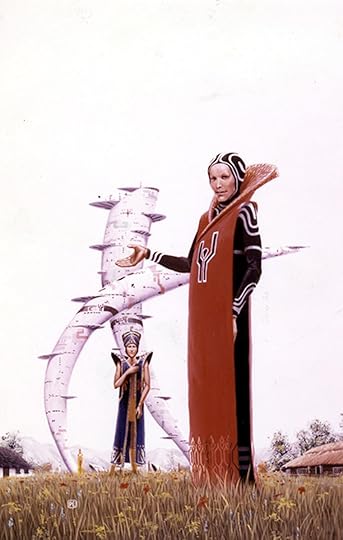
This book surprised the hell out of me. The cover makes it look like it's going to be some pulp scifi and it turns out to be EXACTLY THE OPPOSITE. (Seriously, whomever painted this cover should be sacked, and then the person who hired that person should be sacked.) This book is feminist as all get-out. It suggests the radical notion that men and women have many more similarities than differences -- and it just kind of says this, like, you know, it's probably right, right? And I'm like "!!!" Because it was written in 1960! Which is basically still the '50s! (The Feminine Mystique didn't come out until 1963, I just looked it up!) But also "fuck yeah!" But then at the end

I don't think it sound all that dated, to be honest. I think people STILL haven't come to terms with the basic premise of the book. (Well, men haven't, anyway.)

Anyway, yeah. This guy. Theodore Sturgeon. I can't decide if I should give this book 3 or 4 stars because on the one hand, there's no plot at all (two storylines, but no plot!) and I give Asimov shit for just spitting his ideas at me with no semblance of a story. But I was SO EXCITED as I was reading this and also his prose can be gorgeous sometimes. So I dunno. Man, Theodore Sturgeon. Why is he not more famous. I was talking to Mordicai about this the other day at Book Club and he was like, "he IS one of the greats," and I'm like "yeah, but only among, like, people who know things about science fiction." I think he should be famous to people who don't know shit about shit. He should be up there with Clarke and Dick and Asimov and LeGuin! I don't know, this is only the second thing I've read by him, I should probably slow my roll. But I like the cut of this guy's jib.

Also it cracks me up that the blurb from the front is from Vonnegut, because I can't ever see "Theodore Sturgeon" and not think "Kilgore Trout."
Profile Image for N. M. D..
181 reviews7 followers
April 5, 2023
I had a long thing written up on how this book is the only instance were I've seen my views on gender roles, sex-based identity, and societal structures fully represented and how thrilling of a thing that is. Instead, I'll say this:

Sometimes I walk my dog at 4 a.m. I dread these walks just a little bit and make them very quick. Occasionally, I encounter another late night wanderer. If it's another woman, I feel nothing more than the slight bit of extra awareness of another being. If it's a man, my feelings range from small spikes of nerves (for distantly-viewed men) and a sharp stab of well hidden but utter terror (for men who materialize near me very quickly). I live in fear. I was raised that way. Fear is what keeps women alive. Because every man is a potential threat.

I like to think that sexual equality is obvious. Humans are humans. But just because it's obvious to me doesn't mean it is to others. I also like to think I'm generally unaffected by sexism. I'm not though, and this book really made me think about all those small instances that I'm constantly compartmentalizing.

The idea of this book is that if you eliminated the two sexes and had only one, all other hatreds would dissolve with sexism. Because sexism is the root hatred. Before tiny, insecure men had other ethnicities, nationalities, and religions to feel superior over, they had women.

It's amazing to find a book that not only agrees with you, but drudges up the feelings under the murk that you never really let into the light. I was thinking about this book while driving and I started crying. It forced me to take all the hatred I carry in my heart for humanity and this world we've made and, just briefly, it turned it into sorrow for what could be if we weren't what we are.

The story takes a distant second to the ideas. If this were written now, it would have to be less essay and more plot to get published. Most of the story happens at the end, when you are hit fast and hard with a lot of surprises that leave you reeling from an onslaught of feelings you barely have time to fully process.
Profile Image for Kat  Hooper.
1,590 reviews430 followers
August 19, 2013
3.5 stars. Originally posted at FanLit.

Charlie Johns has woken up in a strange place called Ledom (that’s “model” spelled backwards) in what appears to be a future where human beings have evolved. These future humans have some really amazing technology, there’s no night, they don’t require sleep, they’ve cured many diseases, and there’s no pollution, poverty, or war.

But what’s most significant is that they’ve abolished gender — humans are now hermaphrodites. Charlie sees men who are pregnant, taking care of babies, and wearing pink bikini underwear. As he lives among these people who have no differentiated gender roles, he considers where he came from and realizes how the little biological detail of sex has had such a powerful affect on human history, society and culture.

If one purpose of science fiction is to speculate about possible futures by anticipating how advances in technology and culture might affect ... Read More:
http://www.fantasyliterature.com/revi...
Displaying 1 - 30 of 194 reviews

Join the discussion

Can't find what you're looking for?

Get help and learn more about the design.