Eine Müllerstochter steht vor einer unlösbaren Aufgabe. Sie soll für den König Stroh zu Gold spinnen. Unerwartet bekommt die Müllerstochter Hilfe von einem seltsamen, kleinen Männlein, doch sie muss ihn bezahlen. Als sie nichts mehr hat, verspricht sie dem Männlein in ihrer Not ihr noch ungeborenes erstes Kind. Als es dann soweit ist, kann sie sich aus ihrer Not nur befreien, wenn sie den Namen des Männleins errät... 💜 Ich mag dieses alte Märchen. Es ist nicht mein Lieblingsmärchen von den Gebrüdern Grimm, doch ich lese oder höre es immer mal wieder gerne.
This one was creepy. I did not like the protagonist at all, because she became the queen through a lie. As regards her promise to Rumpelstiltskin, I was pissed off with her for not keeping her promise - but did not want the dwarf to take away the baby, too.
There was only a vague suggestion what he was going to do with the child. I assumed that he wanted to eat it: but going by the fairy tradition in Europe, maybe he wanted to raise it as a changeling.
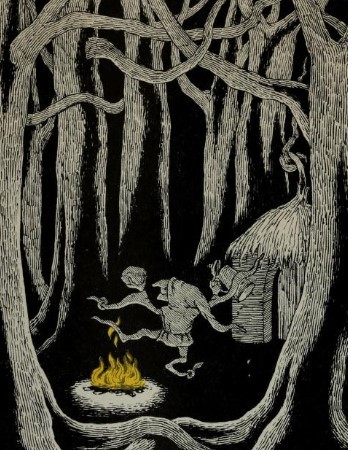
There was a panel of Rumpelstiltskin dancing which covered a whole page. It was a bit eerie, as was the poem he recited.
"Tonight I brew, tomorrow I bake, Then away the child I will take. For little knows the royal dame That Rumpelstiltskin is my name."
The ending was edited to make it comic - Rumpelstiltskin just breaks through the floor due to his angry stamping. None of the real endings of the story (there are various gruesome ones), of course, could be shown in children's comics in those days.
Tonight my cakes I bake. Tonight my beer I make. Tomorrow, tomorrow, tomorrow. The queen's little baby I take!
This year was Gorey's, apparently. I can't get enough of his eerily delicious artwork, which is excellent to forget - for a couple of minutes - about everything relating life itself. It's been so long since I last read "Once upon a time...", a line that used to make me believe that everything was possible. This little book tells the story of a miller who wanted to say something interesting to the king and stated that his daughter could spin straw into gold. Of course, she couldn't; an adorable fact that proves why some people should never have kids. And I can't think of a better artist to illustrate this tale than Gorey, despite Robert Carlyle's image hovering around.
Rabbit Ears Productions is widely known for their celebrity narrated stories. The production also many stories that were highlights of the 1990s. “Rumpelstiltskin” is a popular story from Rabbit Ears “We All Have Tales” series and is greatly enhanced by Kathleen Turner’s narration, Tangerine Dream’s haunting music and Peter Sis’s delicate drawings.
Kathleen Turner’s narration is extremely brilliant as she uses a somewhat menacing voice foreshadowing Rumpelstiltskin’s ulterior motives. Also, Turner does an excellent job at being brilliantly scary towards the end of the story when Rumpelstiltskin meets his demise. Tangerine Dream’s haunting music provided the perfect mysterious atmosphere to the appearance of the little man to enacting Rumpelstiltskin’s frightening dance number when the queen searches for him. Peter Sis’s drawings are delicate yet haunting, especially of the image of Rumpelstiltskin pulling off his mask, revealing a skeleton face.
[image error]
Parents should know that younger viewers may be frightened by the theme of Rumpelstiltskin trying to take the child away from the queen. Since, many children are getting kidnapped in the world today; many young viewers may worry about being kidnapped by a little man. Also, since Rumpelstiltskin’s reasons for wanting the child is made unclear, children may fear that Rumpelstiltskin may hurt the baby boy.
“Rumpelstiltskin” is another Rabbit Ears story that is mysterious and haunting, just like “The Fisherman and his Wife,” and is full of engaging music and images that create a wondrous world full of mystery and enchantment. This is a great film for the whole family watch, but parents must warn their children about the theme of child-kidnapping before letting them watch this video.
Peter Sis's illustrations make this traditional version of Rumpelstiltskin more enjoyable than others. His characters are almost graphic; their features are simple and bold. These characters contrast with more textured settings and rounded settings, producing an effect that is like folk art, but with an almost abstract treatment of negative space. The illustrations alternate between close-up views of characters (which often hint at what is to come in the story), and wide landscapes. This version is a wonderful example of a more traditional telling of Rumpelstiltskin, and is appropriate for a child's first exposure to the tale as well as a point of comparison for older readers exploring derivatives.
Am totally in love with Goreys artwork. They are repulsive, but are wondrous at the same time. The King wants the Millers daughter to spin gold out of straw and if she doesnt... shes dead. It happens again and again. Finally the King will make her his wife if she spins more gold. The little man wants her first born if he helps and she agrees. Gold is spun, married bliss takes over and out pops a baby. Now its time to pay up. No, nope not my baby. If she can guess his name, she can keep the precious.....
Summary- Rumpelstiltskin, the Classics Illustrated Junior version, is a graphic novel written for students in 4th to 8th grade. It is a fairly accurate version of the fairy tale. It begins with a poor miller who has a beautiful daughter. The miller wants to get his daughter a better life so he decides to talk to the king. When he is refused entry into the castle because he isn’t “important” enough, he lies and says that his daughter can spin straw into gold. Once the king finds this information out he challenges the daughter to spin a room full of straw into gold in one night or die. The girl begins to cry in the room full of straw until a little man climbs in the window. The little man agrees to turn the straw into gold for her if she gives him her necklace. After the king finds a room full of gold he moves the girl into a bigger room full of straw and challenges her to spin it into gold again or die the next day. The little man interrupts her crying again and spins it all into gold for her ring. The next day the king decides to move the girl into the biggest room in the palace filled with straw. He says that if she can spin the straw into gold that he will marry her but if she can’t do it then she will die. The little man returns and spins all of the straw into gold, but the girl does not have anything to give him. He asks for her first born child in return. She agrees because she doesn’t have anything else to give and she doesn’t want to die. Later in the book the king marries her and they have a happy year together. She forgets all about her promise to the little man and she gives birth to a son. When the little man comes back to get the baby she cries and begs him to reconsider. He says that she must guess his name within three days in order to keep her son. She has messengers find all of the names in her kingdom which she guesses unsuccessfully. On the second night a jester (who was a background character throughout the book) follows the little man, hears him say his name (which is Rumoelstiltskin), and tells the queen. She guesses correctly, gets to keep her child, and Rumpelstiltskin goes back to the woods. After this story there is a 2 page illustrated fable, 2 funny rhymes with illustrations, and an informational 1 page spread about giraffes. The parts after the story are unrelated to the story of Rumpelstiltskin but they are interesting and entertaining. Response- I liked this presentation of Runpelstiltskin. I believe that this kind of a book would hold the interest of a student better than a picture book or chapter book. It also made the fairy tale seem more mature, even though it was the same story that primary children read. The story elements are illustrated well, and the layout of the book is clear. Some graphic novels can be a little confusing, but this book’s text is laid out in an organized way that would make sense to any reader. I would present this book to a poor reader. I think that it would be motivating to read because it looks like a comic book and it is a familiar story (to most children that grew up in North America). Poor comprehenders and struggling readers could understand this book better because they already know the structure, characters, and the problem of the story. I also enjoyed the entertaining/ educational features in the back of the book. I think that they were irrelevant to the topic of the book, however they were enjoyable. These features are part of the book’s comic theme. They are random but students don’t need things to be structured, so I don’t mind them. Overall, this was a nice book for intermediate students to read.
We had this book from the school book order when I was a kid. Gorey's illustrations compelled and repelled me at the same time. I remember being disturbed by how he did the noses and round faces to make them purposefully not pretty, even when they were supposed to be (the miller's daughter). I had to buy it years later, because it always came to mind when I thought about picturebooks. Still one of my favorites, because Tarcov does not dumb the story down.
Philosophisch gelesen zeigt sich hier die Dialektik von Schöpfung, Macht und Identität: „Heute back ich, morgen brau ich“ – der Satz beschreibt produktives, schöpferisches Tun, eine Art Selbstermächtigung durch Arbeit. Doch das Ziel, „der Königin ihr Kind“, offenbart die dunkle Seite der Produktion: das Werk wird zum Besitzanspruch, das Kreative zur Machtgeste. Die zweite Zeile – „Ach, wie gut ist, dass niemand weiß, dass ich Rumpelstilzchen heiß“ – enthüllt schließlich die Angst des Subjekts vor Erkenntnis: Der Name ist hier das Symbol des Wissens, und wer ihn kennt, durchbricht das magische Verhältnis von Herr und Knecht. In der Enthüllung des Namens liegt also der Übergang von mythischer Macht zu rationaler Ordnung – Rumpelstilzchen verliert, weil das Geheimnis der Sprache gelüftet ist.
Rumpelstiltskin is the story of an old miller who tells the King that his daughter has the gift of spinning straw into gold. As the King hears such a marvelous art, he takes the miller’s daughter into his palace and locks her in a room to spin all the straw into gold. The poor miller’s daughter has not idea how the straw could be possibly be spun into gold, she feels so sad and starts crying. Suddenly, a small man comes to the rescue but he asks something in return. The first time she gives him her necklace, then her ring but the third time she doesn’t have anything else. The King has promised to marry her if she turns the third room into gold; the little man accepts to help her for the last time if she gives him her first child when she becomes Queen. The miller’s daughter marries the King and after a year she has a beautiful baby. The Queen has forgotten about the little man, until he reappears to take the Queen’s child. The Queen starts begging and crying that the little man takes pity on her. He gives her three days to guess his name, if the Queen does not guess the little man will take the child. After three days of saying all the names she knew, the Queen’s despair grows bigger and send one of her helpers to search for more name. When the helper was walking through the woods, the helper hears the little man sing and saying his name…Rumpelstiltskin! At the end the Queen tells the little man his name he disappears and the Queen keeps her baby. This particular version by the Brothers Grimm and illustrated by Donna Diamond of 1983 has some full-page illustrations with realistic details and characters. Other pages just show objects or a single character providing more attention to the text. These paintings look almost like black and white photographs but they are actually pencil drawings. They represent clearly character’s expressions. All versions I have read are very similar throughout the plot of the story and few discrepancies could be found between them. In this version the messenger that Queen sends to the woods is a man, the Queen has a child but they don’t say if it is a boy or a girl. All the names that the Queen tells the little man are different from other stories. Rumpelstiltskin song says: " Today I brew, tomorrow bake, after that, the child I’ll take. The Queen will have to play my game, for Rumpelstiltskin is my name!" Also, Rumpelstiltskin complains about the Devil telling his name to Queen and at the end, Rumpelstiltskin stamps his foot so hard that his right leg went deep into the ground and then he pulled his left leg with both hands so that in his fury, he tore himself in two. (I am really glad that they did not illustrate that part of the end!) This ending was the most gruesome of all and the least child friendly. For a traditional literature book for children some of the language is violent and some of the scenes are cruel. For example, the miller gives his daughter away by lying, the King locks the miller’s daughter and threatens her to kill her, the greediness of the King is obsessive and no one ask the miller’s daughter if she actually wanted to marry the King! It is a entertaining story although I found this to be the least engaging since the illustrations are probably not very appealing to children. In my opinion I think this story does not portrait a good message at all.
The miller's daughter has a problem; the local Highness has an itch for more gold for his coffers, and the miller's daughter can spin straw into gold. What's a miller to do but acquiesce to this powerful noble, and require his duaghter to perform miracles from her spinning wheel. If she doesn't spin all this straw into gold by morning his Highness has proclaimed- "Else you will die!" She is now bolted in her room full of straw and expected thanks to her father to do the impossible. Crying, despairing, and without help, a little troll imp comes through a trap door in the ceiling and descends to the spinning wheel. The jester troll offers to spin the straw into gold, but asks "What will you give me if I spin it for you? She responds her necklace. The troll has many skills and amazingly spins all the straw into gold, but he keeps demanding more from the miller's daughter with each impossible feat. The king keeps wanting more gold, the maiden keeps making impossible things come true, and of course the impish troll keeps hiking his demands for rings and other priceless things. The troll finally demands that the milller's duaghter give him her first child. She believes that her first child won't be born since she is so young for years, so she gives in and hopes the troll will forget. The jester troll does his job, and everyone is happy for many years. The miller's daughter gives birth to her first child, and the troll comes to her prison home to be repaid. The little imp returns to her window to claim his prize, but the Miller's daughter is wise enough to catch on to his riddle about his name, and guess tricks him into telling his name- Rumpelstitltskin. The trickster is tricked by the miller's daughter and spins himself round and round back into the cracks of the stone of the castle where he came from.
What makes this classic medieval tale about not making promises you can't keep, greed, and trickery work is that the miller's daughter realizes at the end that the best way to beat the jester is to trick him as his own game of riddles. The troll's own vain glory at creating gold from straw convinces him that his name can never be guessed at, but the miller's duaghter uses his pride and arrogance to say his name. The miller's daughter is a victim of her father and king, but in the end her own quick wit saves her life and the day. The illustrations have the very small details and flat appearance that readers see at musuems when looking at original medieval paintings from the period, and the readers are drawn into this tale by reknown illustrator Peter Sis's ability to recreate these depictions of settings and people from the Medieval Age. The story telling is straightforward, scary, and suspensful, and 4th graders should have no problem relating to the miller's duaghter's plight and woes. Many themes here about evils surrounding greed, making impossible promises, advantages of trickery for imp and miller's daughter alike, and the prices paid to those who do greed's (symbolized in the troll's?) bidding
I liked the illustrations by Donna Diamond ...very pretty pencil drawings. I don't however like this edition's ending! Oh my, that was disturbing. If I read that when I was a kid I'd sure to have nightmares! Other than, this was an interesting folk tale. It gives room for moral interpretations.
What morals can you find in the tale's events?:
•The miller boasted to the king that his daughter can spin straw into gold so he would look important. •The miller's daughter really couldn't spin straw into gold. •However the king believed the miller and had the miller's daughter locked in a room to do the task or she shall be killed. •Rumpelstiltskin, the fairy, comes to the rescue and spun the straws into gold in exchange for the miller's jewelry. •The king was happy and had her do it again, but in a much bigger room with much more straws. •The miller's daughter was out of jewelry so Rumpelstiltskin made a deal to spin the straw into gold for the miller's daughter's once again but this time for her first born child to be. •The miller's daughter agreed in order to save her life. •The king married the miller's daughter. •Later they have a baby so Rumpelstiltskin came to the queen to claim the child. The queen pleads to keep the child. •Rumpelstiltskin offers her a chance to keep her child if within 3 days she can guess his name. •The queen seeks help from servants to figure out the name. •Rumpelstiltskin in a stroll sings a song that tells his name. •It happens that he was overheard by the queen's servants. •The queen was then able to correctly give Rumpelstiltskin when he asked so the queen got to keep her baby. •Upset, Rumpelstiltskin drove one foot into the ground until it sank to his waist and tears himself into two when he pulled his other foot.
Perhaps: •Don't lie •Be happy with what you have •Don't be greedy •Be careful what you say •Think about consequences
The title of this book is Rumpelstiltskin. This book is retold from the Brothers Grimm and illustrated by Donna Diamond. The publisher is the Holiday House and was copyrighted in 1983. This book is about a poor miller who tells the king that his daughter can spin straw into gold. The king then forces the daughter into a little room and says that if by morning she does not have the straw into gold, she will die. The woman does not know what to do. This little fairy of a man, Rumpelstiltskin comes to the woman's rescue and spins the straw into gold. The king moves the woman into a bigger room to spin more straw and once more the woman relies on Rumpelstiltskin to do the job for her. He does but makes the girl promise to give him his first child. The woman has a child with the king and Rumpelstiltskin gives the woman three days to guess his name. She finally does and that is the story. I kind of remember this book as a kid, but I hope I never have to read it again. Activities: 1.) You could first show the pictures to younger students and see if they could guess the story. This would get them visually in-tuned with the book and then the teacher could read it to them and see if they got it right, or came close.
2.)Teacher could go through the book and have the students discuss the characters' emotions. (Happy,Sad,in love,frustrated,etc...)
Rumpelstiltskin has never been my favorite Fairy Tale. The miller was a braggart, the daughter was kind of whiney, and the king was horrible. The only person who seemed halfway decent was Rumpel. And he didn't fare very well. Although in the daughter's defense, I would have schemed to keep my firstborn, too.
This telling of the fairy tale is quite good. I was very amused by the William Morris reference. The illustrations for this version of Rumpelstiltskin are quite lovely and make the story worth the re-read.
This is a classic tale of mischief and magic. We are drawn to the miller’s daughter’s plight and even though she is in the wrong we cheer for her happy ending.
Classroom Use: Consequences: The foolish bargain of a desperate girl has serious consequences down the road. Greed: Each character in the story was motivated by greed.
Writing Traits: Ideas: We are carried through this story by the suspense of the Queen’s predicament. Voice: The author cleverly puts us on the side of the Queen and pits us against Rumpelstitskin.
Okay. This was my favorite book when I was little. Now that I am a bit wiser…. Father is a liar, King is greedy gold digger, Daughter needed to tell them all where to stuff the straw, and Rumpelstiltskin….don’t even ask what I think of him. Still I do like this old time fairy tale, and how she got Rumpelstiltskin in the end…thanks to the servant’s perseverance, which he should have been given a big reward for. Reminds me how Chewbacca didn’t get a medal at the end of “A New Hope”. Feel your pain dude!
This 1983 version of Rupelstiltskin has some interesting back and white drawings. The drawings were done with pencil on Herculean Mylar. The story line is true to the original story. Instead of the little man disappearing into the ground after he stomps his feet, he stomp one feet into the ground and he then tears himself into two by pulling his other leg. I was a bit gruesome. This was not one of my favorite versions.
Desde niña, este cuento de los hermanos Grimm me ha fascinado. Rumpelstiltskin generaba (y actualmente aún lo hace) en mi una sensación perturbadora pero también de curiosidad, sin embargo, hasta el momento nunca había leído el original. Ahora que lo acabo de terminar debo mencionar que entre las dos versiones casi no hay variaciones manteniéndose la esencia. El final vendría a ser una de esas diferencias, el cual es más violento respecto a la versión que leí.
This was the basic story of Rumpelstiltskin(32 pages). The drawing were done by hand and very percise. The only negative part that I did not prefer was the ending, it's told in a grime way and the last picture looks rather diturbing because of the look on his face and is movement. I would probably use it as a compare and contrast to other versions of this tale.
Teaching children to break promises you made to those who helped you (after you said you'd give them anything to be Queen)? Then using trickery to get out of the promise once that person gives you a chance to get out of it. Teaching kids to root for the human because Rumpelstiltskin looks ugly and/or different. Nah, thanks, not for me.
This is about a beautiful girl that is locked in in stone room to spin hay into gold. She can't, but Rumpelstiltskin can and does for the girl as long as she promises her first born child to him. Now during all of this the girl doesn't know his name, so he gives her three days to guess his name and she can keep her baby.
One of my favorite childhood story which I will never get tired of rereading. This time, it hit a note because I am now a mother and just like the queen, I made difficult decisions and compromises which I didn't think of until the consequences came. And just like the queen, I will do anything to protect my child.