Winner of FC2’s American Book Review/Ronald Sukenick Innovative Fiction Prize A monogrammed cube appears in your town. Your landlord cheats you out of first place in the annual Christmas decorating contest. You need to learn how to love and care for your mate—a paring knife. These situations and more reveal the wondrous play and surreal humor that make up the stories in Amelia Gray’s stunning collection of stories: Museum of the Weird. Acerbic wit and luminous prose mark these shorts, while sickness and death lurk amidst the humor. Characters find their footing in these bizarre scenarios and manage to fall into redemption and rebirth. Museum of the Weirdinvites you into its hallways, then beguiles, bewitches, and reveals a writer who has discovered a manner of storytelling all her own.
Amelia Gray is a writer living in Los Angeles, CA. She is the author of five books, most recently ISADORA. Her writing has appeared in The New Yorker and VICE.
This collection is a strong shot of creativity. Gray has mastered the art of perfect phrasing and tone, and frames these strange and inventive tales in flawless language, using just the minimum amount of space to deliver the maximum effect. It is astonishing what she can do in just a few short pages. These stories, ranging from the funny or sad to the downright bizarre, will make anyone who has tried there hand at creative writing glow with admiration.
It is difficult to put into words how I feel about this collection, although I feel quite attached to it. It may be that these short, emphasis on short for many of them, are a bit like a storm cloud. They can pelt you with emotion and feeling, but when you reach for it, there is nothing to hold as many of these stories reside just beyond any true resolution or solid comprehension. It is the vagueness of them that is what makes them so infectious however; you will want to know what roads these quirky tales will lead to beyond the final word and will ponder just what collection of choices brought these characters to where they are. Often, Gray manages to pack a fist-full of depth into these short premises, making one feel envious that she could deliver such impact and thoughtfulness in something that simply exists in a few short instances before switching to something totally different - she must have an endless supply of brilliant ideas spewing forth that she can afford to shock and awe and move on. While her shortest pieces are the most direct and entertaining, such as Babies, the parable-like Picture Window, or the hilariously irreverent The Former Boyhood Home of President Ronald Reagan, I found her most engrossing stories to be the longer ones where she really stretches her legs and runs with an idea. Also, she expands upon a a shorter piece from the fabulous AM/PM in The Cube, giving much food for thought as picnic folk began to realize that, yes, everything eventually sinks, and Waste offers a lesson of food and the conversion of pig to pork as opposed to life/death that will later be expanded on in her first full-length Threats: A Novel.
Despite its modest size, this is not a collection to be taken lightly. These stories are fascinating and funny, ponderous and nearly preposterous, and have a big heart in a small word count. While I preferred AM/PM, mostly for it's cohesiveness and innovative form (because honestly, how often does someone get to do something totally new nowadays), this collection is just as strong and pushes the boundaries of the modern quirky style to new limits, all done with flawless sentences. Pick this up, and spread the love of Amelia Gray. You will not be disappointed. 4/5
i think this is the kind of collection that it is best not to read all at once. i should have set a limit on them - three a day or something. i think they are too short to read all at one go - they are so short that it is hard not to read them all at once, but i think i would have enjoyed them more had i read them in tinier gulps.
the vanished was by far my favorite. to me, it read like an outtake from her full-length novel, threats, which i loved loved loved. this collection was what i expected her stuff to be like before i read threats, and why i had never gone out of my way to read her before. they are short (have i mentioned that they are short??) and imagistic, and i feel like reading them too quickly blurred them in my mind, creating a gloppy stew of scenes that never firmed into stories for me.
there isn't anything wrong with them, i just didn't feel there were many that i made a connection with, as a reader. maybe if i were to go back and reread some of them, and then STOP, i would enjoy them more.
as it is, i feel like a failure for not loving them unconditionally as so many other people have. i can no longer write this review, because my head is hanging too far down in shame.
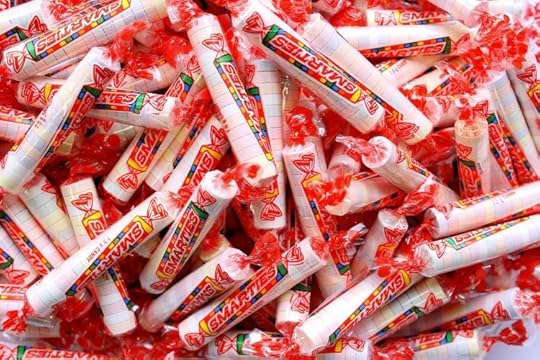
candy comparison for maureen
american smarties, not those british jokers.
we have a candy drawer at work, and usually, when there are only smarties, i just stare at them, thinking "do i want these??" and usually i say "no, i do not." sometimes, though, i really need that burnt coffee taste out of my mouth, and i will reluctantly grab a package and stalk back to my desk. and i eat them, and usually after four or five, i think to myself, "why am i still eating these?? they are kind of making my stomach unhappy..." but once the package is open, you gotta keep eating them even though you know that you aren't really enjoying them anymore, and even though you know you might enjoy them later on. but like a robot, i will keep eating them far past any actual enjoyment. and then i will feel a sense of accomplishment when the package is finished.
When you pack 24 short stories into just 170 pages (an average of about seven pages each), you really put your inventiveness on the line.
Amelia Gray doesn’t adhere to any beginning, middle and end conventions. Instead, she drops us into a situation, lets us look around, and pulls us out as quickly as possible, as if it was a rescue operation for a moment of invention.
Wunderkammer
The title refers to the collection as a “museum”. There is, indeed, a sense that readers are visiting an exhibition of some sort. While it’s conveyed verbally, there’s an overwhelming sense of the visual, as if we are inspecting the contents of a cabinet, a wunderkammer or cabinet of curiosities. Each story is definitely a curiosity, even if it doesn’t always live up to the claim that it is “weird”. Some are bizarre, some merely zany, but most are idiosyncratic, unconventional. When it comes to relationships, they aren’t so much morally transgressive as “nice, different, unusual”. They don’t really force you to think about the world of relationships, as opposed to the world of writing. Gray keeps us in her world, or at least in the madcap museum she has created for us.
Innovation Gallery
Reading 24 stories in the space of a day made me feel a bit like visiting a gallery, in which you are particularly attentive at the beginning, taking separate moments to inspect the work itself and read the wall-label meticulously, while midway through your visit you notice guiltily that you’re being more selective about what you devote your time to. At least here, I didn’t feel that Gray’s imagination was failing or waning, just my ability to process it. Even as you start to question “where does she get all of these ideas from”, she introduces aspects of formal innovation to the mix - one sentence stories, stories written in the form of a diary, letter or film script. No matter what the hook, she works hard to maintain our interest. She is always trying to hit us with the sweet spot of her bat. If occasionally she misses or mishits, it’s only a short time and space before she’s swinging again. It doesn’t affect our judgment of the innings as a whole.
Playful Innovation
It’s this ability that argues persuasively that literary innovation or experimentalism is better suited to shorter forms of writing - e.g., short stories, novellas and verse. Few writers are able to carry off such experiments over extended passages of writing. In many cases, the experiments (to the extent that they’re in any way original) are mere set-pieces placed within the studied mediocrity of waffle, wastage, cruft, roughage, fluff and bunkum. When mega-novelists proclaim their resistance to being edited, it’s this (latter) stuff they’re trying to protect, e.g., the research to which they devoted the whole of last winter. (It was so cold in that library, and if they suffered so long for their art, surely so too must we readers.)
If it’s innovation and experimentalism you want, you’ll find more playful and better use of it in these 170 pages. Essence is the product of distillation. And each of these stories is nothing if not essential. A deserved winner of her second publisher FC2’s American Book Review/Ronald Sukenick Innovative Fiction Prize 2010.
Things You Don’t Often Read About in Books
Cubes and jewel-encrusted skulls Termites and vultures Golf umbrellas and High Life Millers Tostadas and tortillas. Knots, moss, dust and mold Cottage cheese, bologna and tilapia Snake farms and ten-pound hair-balls Replica pennies and Easter lilies.
"...Then the Charm is Firm and Good"
...Toil and Trouble would take over their lives, if they pursued their idea to the end. Circus life isn't all beer and skittles. They figured they could manage the risks because their parents came from circus families, but their parents weren't twins, just illusionists. Imagine being both! Imagine two sets of identical twins falling in love with each other and getting married, two boys and two girls. Not just that, but they wanted to stay at home and join the circus. First, Matthew and Danielle fell in love with each other, then within minutes, Gilbert and Esmeralda, but they all loved each other so much that they could barely tell one another apart. Even their own twins. When each set of twins stood in front of a mirror, they each saw two reflections of themselves. So the girls made a pact with each other. Without telling the boys, they would both get a fenny snake tattooed on their left shoulder. When the deed was done, each sister told their lover what she (and she alone) had done, and both brothers were confident for a time that they would be able to tell the difference. The girls secretly hoped that their boys would be able to differentiate them without the need for the tattoo, so they devised a test. But they were wrong. That night, each alternate couple made love more passionately than the real ones had ever done. Then they resolved to remain in this configuration, notwithstanding their former love. Occasionally, each alternate couple would argue (as couples do), and they would revert to their original configuration for a few weeks at a time. This is how they decided on the name of their circus act. Their friends (who knew nothing of their pairings - it made no difference to them; they couldn't tell either set of twins apart anyway) warned them in the nicest possible way that Double Double...
There isn’t a bad story in this collection, and my innate hypergraphia is taking a nap at the moment, so I will just focus on the best of the bunch.
Let’s begin with “Waste.” This was one of those stories that, as I read it, made me feel like I was going a little insane. It’s a strange piece that I found compelling despite the fact that I find eating pig horrifying. Perhaps I liked the story because Gray’s characters explore the whole, “when does it stop being pig and become pork.” A man who works collecting medical waste from doctors’ offices shares odd culinary experiences with his neighbor, a woman with lovely collarbones who works as a line cook in a vegetarian restaurant. Olive is an exotic foodie, creating culinary experiences out of the strangest meats, making a sickening but sweet sacrifice that Roger may not wholly appreciate but at least his experiences with medical waste gave him the stomach to cope. As a woman who loves to cook, is meat-shy, and given to feeling deep disgust for any body process that would require a medical waste pick-up, it was unusual how much I enjoyed this story. Sometimes I enjoy having my disgust pinged, I guess.
This book suffers from a common problem of second books read. It isn't as good as the first book.
If this book had been written by nick hornby it would have been 4 stars, if it had been debut collection it would have been a high 4 stars perhaps a low five. But compared to Gray's other book this one just wasn't quite as enjoyable for me it's definitely like a 3.4 comparatively. On some level this is unfair, I'm expecting a level of perfection or an approach that I saw before and not judging this book objectively on it's own merits, but the world isn't an objective place.
This is not to say this book doesn't have it's good points. A lot of the stories in this book push the boundaries of conventional reality. One asks what is pork? and if we eat that where do we draw the line on what we can eat? These stories not only question our values but they do it in a way that we have no choice but to stand back and say, gosh that is true.
These are beautiful stories and well worth a read.
Every so often, as I read through the stories in Amelia Gray’s Museum of the Weird, I flipped the book closed and stared at the photo of the author on the back cover. She sits with a half-smile on her face in a white, long-sleeved button-down, her left arm resting casually on a table or something conveniently table-sized that sits just out of the picture. I wouldn’t be surprised if I saw her in a J. Crew ad or on a sailboat. Reassured, I turn back to the innards of the book and continue reading. I am not sure why I need this. I have no idea why I am drawn back to her image, maybe it is because I need to keep some kind of base with the person who would write these stories, and maybe Museum of the Weird is just so very, very weird that I am sure my eyes have been fooling me and someone much more unusual will be there staring back at me from the cover of the book.
Her Museum is a display of shorts with no particular commonality. They are strange, sometimes gruesome, occasionally horrifying, and always just slightly out of the ordinary. Take, for instance, the man and his friend who are married, respectively, to a pairing knife and a bag of frozen tilapia. Then, we are graced with absurd images like the girl who eats gourmet human tongue, the girl who is served a plate of hair on a first date, and the police force that tries to distill a hostage situation with javelinas (medium-sized South American rodents). Sometimes they are truly horrifying, like the woman who grows rather attached to a piece of food lodged in her throat, leaving it be until she decides to let it free with a spoon, and at other times they are humorous oddities, like her business plan for a SNAKE FARM (always emphasized in capitals) or the letter from a obsessive compulsive tenant to her landlady.
The shorts truly read as if you are walking through a museum of scenes of unabashed strangeness. All are fascinating and they allow for quite a bit of reflection as the reader is in the midst of them, but once finished there is little to do but move to the next exhibit. One does not walk through Gray’s Museum for depth of story, but instead for spectacle. Often, a three-page short will induce a quick head-shake, as if re-shuffling the story will make it easier to mentally swallow. Eyes widen often through other stories, the uniqueness of the exhibits Gray is leading us through is usually fascinating and shocking. The everyday quickly becomes ridiculous, and the ridiculous is nestled nicely into the normal. The way in which she is able to do this is refreshing, if you’ve had the chance to climb out of the pit she often digs into your stomach.
Gray dances through each tale of peculiarity casual and reserved, as if they were as commonplace as waking from a mid-afternoon nap. She proves her versatility by avoiding sticking with one medium. We read a script as one story and a letter for the next. One is a journal and the other a business plan. Each of these Gray explores with aplomb. Both the stories and her style are reminiscent of the shorts of Gabriel Garcia Marquez, with that particular flair for presenting the absurd and slightly (or more than slightly) morbid as though it were no more unusual or unexpected than any other everyday occurrence. It is her writing that is the highlight of her Museum. It is her Tyrannosaur in the foyer.
Museum of the Weird is a peculiar set of stories that is best for a peculiar taste. Gray’s dark, dark humor and casually dry style will be thoroughly enjoyed by those who, well, enjoy those kinds of things. If you are not one of those people, then these stories probably won’t tickle your fancy, or anything else about you which you might feel needs tickling. Yet if you are one of those people, grab this book up quick. Gray is a spectacular writer, if you can stomach her stories.
This was Gray’s first book of stories, and at times they read like exercises written for a MFA level creative writing class. Their brevity is admirable, but at times slight. They are unfailingly clever, but at times coy.
If Gray has an ongoing theme, it is the complications of dating and relationships among her protagonists. One young woman begins giving birth to a new child every night. Her boyfriend tries to be supportive but the situation becomes stressful. Beth is on a date to a fancy restaurant with a man she badly wants to impress, Her discomfort is greatly increased when she is served a plate of hair. She knows she did not intentionally order it. Dale and Howard are married to a penknife and a bag of frozen tilapia, respectively. On a fishing trip they have an awkward encounter with a live woman. An armadillo puts the moves on a penguin in a bar. Claire’s husband Alex strips down and moves into his suitcase.
I could have used more moments of truly off-the-wall weirdness. Like the time a clerical error sends a cage of javelinas to handle a hostage negotiation. As in most of Gray’s ficition, things do not go well.
I like Amelia Gray and I like weird stories, but this one just didn't deliver the panache I was looking for and had come to expect after reading AM/PM.
The stories that I liked which made this collection of short stories worth reading were:
1. Babies 2. Fish 3. There Will Be Sense
The things that all these stories had that made them more enjoyable than the rest of the collection was that they weren't weird for the sake of weirdness. They had a point and left me pondering some interesting nuances. Plus, they were all in the first half of the book, which seemed more put together, than the second half, that at least to me, just seemed to lose steam quickly.
All in all, worth a skim, but if you haven't readAM/PM I would recommend spending your money on that one first.
Probably the least substantial or emotionally resonant or however you want to call it of Amelia Gray's books so far, but also probably the most fun. I've read "The Darkness" three or four times this month, because how do you say no to a story about a shy armadillo who meets a Miller Highlife-swigging penguin with an inferiority complex at a bar?
I'm a big fan of short stories, and this one takes short stories to a whole new level. Amelia Gray is an artist. Her sentences flow effortlessly. The structures she builds will remain standing after this world perishes. I'm deeply in love.
Amelia Gray never disappoints. A wild collection of surreal tales, that will haunt you, while at the same time, bring you in close and give you a hug, all the while whistling a tune that is kind of creepy and yet kind of innocent. Expect the unexpected.
I read Amelia Gray's Museum of the Weird in about 5 hours. It was a collection of short stories about things that don't really happen, but I'm not sure if that makes them weird. What was weird was her obsession with food. Here is a partial list of things eaten: pieces of chocolate human tongue toes fish sticks hair tomato-cream bisque prickly pears packet of sunflower seeds cottage cheese banana bread hair (again) even more hair lemon bars 2 goldfish porterhouse steak creamed peas strawberry warm bread gelatin balogna sandwiches tostadas king ranch chicken sloppy joes a mint meatloaf spaghetti and meatballs pork barbecue and french fries breakfast tacos fajitas onion soup quesadillas chicken fried steak grilled cheese sandwiches steak and eggs baked potato tomato soup pork chops cheese crisp ham and cheese fish sandwiches chicken salad corn dogs tamale pie vegetable soup macaroni chili hamburger tomato corn chips yogurt some more cottage cheese protein shake jelly beans bread crumbs slices of meat grilled onions milkshakes cheeseburger no lettuce tater tots english muffins mustard peanuts animal crackers crab cake tuna summer squash cinnamon leaves off a tree cat food tiny screws pages of a book baking soda the number 2 from a telephone keypad love bread eggs
wow. burned through this one. i'll be honest, there were two shorter pieces where i thought, that's clever but the conceits felt more weighty than the actual stories. HOWEVER, that's two out of twenty-four. that's way better odds than most story collections with their filler patties.
and no, if you're guessing, it's not the cottage cheese one. that one killed me. as did almost every story in here. amelia has this deft, careful hand where the craft (people cringe at this word, but c'mon, seriously, grow up) is evident but the stories feel organic and true. and even though she's not doing the weird syntactic sentential stuff, her sentences still have a way of surprising. as do her story progressions.
the range in this is absurd and knowing that amelia writes under constraints, i wonder what, if any, she worked under while beating out this one. the cover is a fucking knockout (z. dodson from featherproof fame) and mostly, after the quick read, i want to let it sit awhile before revisiting it. going to try re-reading it piecemeal, letting the individual stories sink in. it's hard, it's too good to not want to page turn.
In Calliope, a story in Neil Gaiman's Dream Country, Dream dicovers that the muse of the same name, his former lover and mother of his son, has been imprisoned and brutalized by a writer, Richard Madoc. When he insists that Richard free her and his lame excuse is that he can't yet because he needs the ideas, Dream scoffs, "You want ideas? You want dreams? Here they are." Cue Richard several hours later, scratching his hands bloody on the wall, trying desperately to write down the immense flood of idea fragments that he's being inundated with. Dream is a bit of a badass.
This book is kind of like that, minus the bloody hands. Idea fragments that sound cool. In many cases, this works out great - The Darkness, about the penguin and the armadillo in a bar, really cannot be expounded on anymore and would be tedious if longer. It's short & sweet and perfect the way it is. However, stories like Babies & Unsolved Mystery need more development. They start going somewhere dark and weird and awesome - and then they stop. Three stars because the stories that are good are good and I appreciate the effort, but I want more.
I finished this book last weekend but I've been away from the computer this week and am just getting around to updating.
This was my first time reading Amelia Gray, and I'm quite taken with her. Not swept off of my feet and breathless like I was when I read my first Aimee Bender collection (Willful Creatures: Stories), but definitely in the same ballpark. Many of the stories are flash fiction length; some I wished were longer (Babies), while others were perfect in their brevity (Unsolved Mystery, The Quiet Complex). And one story (The Movement) inadvertently made me think of Radiohead, so extra thumbs up for that one. It seems kind of ridiculous to list my favorites here since it will probably consist of 2/3 of the stories in the book, but here they are anyway:
Babies Waste Unsolved Mystery The Darkness Trip Advisory: The Former Boyhood Home of President Ronald Reagan Fish The Cube The Quiet Complex Vultures The Picture Window The Movement
I am ecstatic to see that all the exciting writing out there isn't just the province of overseas authors, that Americans are still in the mix and still doing exciting things. I adored this collection. Gray is definitely unique as a writer, but in her own way her writing shares some of the elements that most fascinate me about authors like Keret and Murakami. This collection is marvelously strange, turning the world on its head and finding wonders in places too familiar to ordinarily look. In the routine of our lives we sometimes forget how wondrous the world is and cease to try to find the meaning that is to be found out there in just contemplating how absurd life really is. Gray's stories bring us to do just that and get us to see the world in a delightful, off-kilter sort of way. This is my first encounter with Gray's writing and I can't wait to go find more.
I adored AM/PM and the stories in this collection are even better. More fleshed out, more wild. A date with a plate of hair, plans to craft a snake farm, birthing overnight babies, eating tongues and toes. It's apocalyptic, surreal, radical, and entertaining as hell. Exactly what I look for in short stories. "Diary of the Blockage" might be my favorite in this bunch. My mouth was wide open the whole time.
Funny, strange, irreverent, sad, etc. One of the most interesting threads that united these stories for me is what it means to be compelled, and how what compels is usually stranger than what's visible on the surface.
Reading this book feels a lot like when you're engaged in small talk with someone who seems perfectly normal and pleasant enough, maybe you're at a bar or a party or whatever, and you find yourself nodding along before it slowly dawns on you that they're probably-but-almost-definitely insane, and then they leave to get another drink and you're all "holy shit what WAS that?" and you maybe feel a little off yourself for a moment because they really were making sense for a bit there.
These stories are gleefully batshit, and they're told in a bunch of different ways: a letter, a play, they sound like fables or confessions or are stretched across the page in weird blocky fragments. Two of them made me audibly yelp on a crowded train, one I finished and immediately took a picture of it (only two pages- only slight theft?) and texted them to my favorite weirdos. The stories aren't gross for the sake of being gross, they're not excessive or gory, they're just OFF and I LOVED it.
This is an interesting book - the short-short stories are all very inventive and clever, many of them hilarious, but something about them seems clipped off just before they're about to bloom. Too many times I found a big chunk of white space at the bottom of the facing page, letting me know that the story doesn't have time to do what it might have otherwise done.
That, and the eating. So much stuff about food - my wife is right to suggest that Ms. Gray may well be working through some serious food issues with these stories. Still, they're all inventive little stories, and very funny at that.
The book title does not lie. This story collection runs the gamut of weird, but in a good way. The story about the penguin and the armadillo drinking at the bar makes me want to start a short story anthology that revolves around animals acting like humans (there's a term for that, isn't there? I've forgotten what it is). So far, I want to include Amelia's story and "Tim, the Immortal Giraffe: True Story" from issue 47 of American Short Fiction.
Gray’s follow-up to her short fiction debut, AM/PM, couldn’t be more different—24 stories that demonstrate a wide range of strange. From the tale of two men who live in a gravel pit to women who write long rambling letters to their homeowners association, Gray’s stories cozy up to the unusual and get comfortable, offering up unsettlingly intimate portraits of people whose lives have gone irreparably awry.
Quote: “I want to get so close to God that God has to file a restraining order.”
This book was full of weird stories (bordering on creepy) and honestly, some of them totally confused me, some I simply didn't like. And the rest well, you know what the two stars are for now.
More of a 2.5 than a 2, but not the kind of 2.5 I would round up.
Not an unenjoyable collection of short fiction per say, but for every story that resonated one or two that missed the boat. "Thoughts While Strolling" and "Fish" were wonderful; a lot of the others weren't. Some of the stories like "A Javelina Story" and "Code of Operation: Snake Farm" were enjoyable but for their humor rather than depth. Many of the stories gesture at compelling themes (relationship to the body, food, or both, deviance, perception) but aren't fully realized. Gray also overuses shock value mutilation/violence in a way that's sort of reminiscent of Chuck Palahniuk's later works: by the third story where someone is doing something gross with food, it felt like a smoke screen for substance. If I'd read the stories individually I likely wouldn't have the latter complaint.
The creative writing instructor who recommended Gray to me said her later work "shows a lot of growth," so I'm interested in picking up her more recent collection.
Reading I consider personally profitable these days has varied in "objective" quality, from George Saunders' dystopias ("Civilwarland in Bad Decline") on the high end to Barry Yourgrau's flights of fancy ("Wearing Dad's Head") on the low end. Yourgrau isn't much of a writer but I found his imagination liberating to my own, no small feat, I guess. Gray's work may fall somewhere in between on the quality scale, or at least consistency scale. Her prose is more solid than Yourgrau's, her stories more structurally cogent, and her imagination even more warped, strange, sourish. Yet there is a lightness to her touch. Edgar Allan Poe meets magic realism? I enjoy that she's quite young, located in Austin, Texas, and seems very much her own person. Am reading another of hers, "Gutshot." BTW she, as with many of the more interesting writers, makes "star" ranking systems impossible, at least for me.
My friend Faith created the perfect review for this book. I'm going to badly paraphrase it here: It's as though you are at a bar speaking to someone who is telling you a story, then that story takes a turn and goes completely off the rails. That person goes to get another drink and you are left thinking, "What the fuck just happened?!"
Each of these stories are quite short. I think the longest is... 12 pages? Many are just a couple of pages. All of them are weird as hell, and all of them are truly enjoyable!
I was optimistic about this collection, as I’m generally a fan of short stories. Unfortunately, I only found a few of them at all compelling. It felt like most of them were like ‘here is a weird thing. Boy, isn’t that weird?’ And then it was over.
When I read short stories, I’m looking for high emotional impact and/or insight into characters. These really didn’t do it for me. Exceptions: Dinner, Thoughts While Strolling, A Javelina Story, and Love, Mortar.
Amelia Gray fucking kicks ass. these stories kick ass. they are weird and full of viscera and bizarre human interactions. they are extremely fun & funny.
read Amelia Gray. read this book. read all of her books.




 come to my blog!
 ![Profile Image for s.penkevich [hiatus-will return-miss you all].](/_next/image?url=https%3A%2F%2Fi.gr-assets.com%2Fimages%2FS%2Fcompressed.photo.goodreads.com%2Fusers%2F1735525095i%2F6431467._UX200_CR0%2C11%2C200%2C200_.jpg&w=128&q=75)


