Jump to ratings and reviews
Rate this book

The Sherlockian

Rate this book
In December 1893, Sherlock Holmes-adoring Londoners eagerly opened their Strand magazines, anticipating the detective's next adventure, only to find the unthinkable: his creator, Arthur Conan Doyle, had killed their hero off. London spiraled into mourning -- crowds sported black armbands in grief -- and railed against Conan Doyle as his assassin.

Then in 1901, just as abruptly as Conan Doyle had "murdered" Holmes in "The Final Problem," he resurrected him. Though the writer kept detailed diaries of his days and work, Conan Doyle never explained this sudden change of heart. After his death, one of his journals from the interim period was discovered to be missing, and in the decades since, has never been found.

Or has it?

When literary researcher Harold White is inducted into the preeminent Sherlock Holmes enthusiast society, The Baker Street Irregulars, he never imagines he's about to be thrust onto the hunt for the holy grail of Holmes-ophiles: the missing diary. But when the world's leading Doylean scholar is found murdered in his hotel room, it is Harold - using wisdom and methods gleaned from countless detective stories - who takes up the search, both for the diary and for the killer.

350 pages, Hardcover

First published November 30, 2010

593 people are currently reading
10062 people want to read

About the author

Graham Moore

42 books1,366 followers
Graham Moore is a New York Times bestselling novelist and Academy Award-winning screenwriter.

His screenplay for THE IMITATION GAME won the Academy Award and WGA Award for Best Adapted Screenplay in 2015 and was nominated for a BAFTA and a Golden Globe.

His first two novels, THE LAST DAYS OF NIGHT (2016) and THE SHERLOCKIAN (2010), were published in 24 countries and translated into 19 languages. THE LAST DAYS OF NIGHT was named one of the best books of the year by the Washington Post, the Philadelphia Inquirer, and the American Library Association. THE SHERLOCKIAN was nominated for an Anthony Award. His third novel, THE HOLDOUT, will be published by Random House on February 18, 2020.

Graham lives in Los Angeles with his wife, Caitlin, and their dog, Janet.

Ratings & Reviews

What do you think?
Rate this book

Friends & Following

Create a free account to discover what your friends think of this book!

Community Reviews

5 stars
2,839 (18%)
4 stars
6,050 (40%)
3 stars
4,611 (30%)
2 stars
1,147 (7%)
1 star
329 (2%)
Displaying 1 - 30 of 2,099 reviews
Profile Image for Grace Tjan.
187 reviews623 followers
August 23, 2011
THE ADVENTURE OF THE SHOELACE STRANGLER

For several months, preoccupied with my recent marriage and my taking over the practice in Kensington, I had not the opportunity to see my friend Mr. Sherlock Holmes. One winter evening, after spending a largely idle day at my desk, I decided to lock up the door early and visit my old comrade. I did not relish the notion of enduring a lonely night at home --- Mary had gone away to visit her parents --- and I had with me something that I knew would amuse him. Soon enough, I found myself treading the familiar steps to 221b Baker Street. Holmes opened the door himself.

“Ah my dear Watson! What brings you here on this foggy and blustery evening?” said he. He was just about to put the violin on the desperately cluttered sideboard, long nervous fingers smoothing his mouse-coloured dressing gown.The tips of the fingers were stained with something purplish, and a faint ether-like odour lingered about his person. Judging from the remnants of the chemical experiments that I espied on the working table and the numerous copies of the Times that were strewn all over the sitting room, he had been holed up in Baker Street for quite a number of days. I surreptitiously stole a glance at his exposed wrist, and was secretly relieved to find it free of fresh puncture marks.

His slate-grey eyes followed my gaze, obviously aware of my apparently not-so-secret concern, and then swiftly turned to focus on me. “I’ve been keeping well, Watson. How are you? Mary away? Have been so for several days, I see. And quiet days at the office too. You have been somewhere in the vicinity of --- ah, perhaps Charing Cross Road earlier in the day. Browsing the book stalls, most likely. And am I correct to surmise that the parcel that you have under your arm is a new, hardbound book that you thought would be of interest to me?”

I cried in amazement, “How do you ---?”

“Elementary, my dear Watson. You know my methods.” He shrugged, took the parcel from me, and opened it.

“It’s a new novel by a young writer called Graham Moore about Arthur Conan Doyle ---“

“Your literary agent?”

“The very same. The publisher, aware of my own efforts to chronicle your adventures, asked me to read and comment on it.”

“A rather eye-catching cover. Although I actually tend to prefer smaller pipes than the Meerschaum. And I wish that you would cease referring to my cases as adventures, Watson. The aim of these little tales that you penned about me should be to instruct, not titillate. The public needs to be educated about the scientific method of crime detection, not being merely thrilled by the more sensational, wildly romanticized aspects of my cases.”

“But your cases are sensational, Holmes! That devil hound! That other hound that didn’t bark in the night! The Sussex Vampire! The Giant Rat of Sumatra!”

“Ah, never mind.” He began to leaf through the crisp, freshly bound pages. “So tell me, why do you think a piece of fiction about your literary agent should be of interest to me?”

“Because it’s also about you, and because I thought that it’s quite a neat bit of mystery.”

For the first time that evening, Holmes’ grey eyes twinkled. “A mystery!” He rubbed his hands together with exaggerated glee. “These last few days have been exceedingly dull, Watson. No crime worth mentioning whatsoever. The criminal classes of London seem to have hunkered down with the abominable weather. Even the agony columns are devoid of interest altogether. Humor me, my friend. Treat the novelistic mystery as if it is a real one and feed me the data. I am curious to see whether I am as good at devising solutions to artificial puzzles as I am in solving real life ones.”

“Well, if you insist.” I threw myself upon the familiar armchair that used to be mine when we roomed together. “The main character is a young chap called Harold White, 29 years of age, who had just been inducted into the Baker Street Irregulars.”

“Nothing to do with Billy and my other street Arabs, I assume?”

“No. Nothing to do with Billy at all”, I concurred. “The book is set in the future, the 21st century to be exact, and apparently in those far off days, your numerous admirers organize themselves into societies exclusively devoted to the study of you and your methods. The Baker Street Irregulars is one of the most prominent of those societies. One of its more senior members, a Mr. Alex Cale, claimed that he had found Doyle’s long lost diary, the one that he purportedly wrote during the time you were presumed dead at the hands of Moriarty. I must forewarn you that for the purposes of this story, your status has been relegated to a mere figment of Doyle’s imagination.”

Holmes’ thin lips twisted in a crooked smile. “How amusing. This sounds like a long, tall story indeed.” He reached for his pipe, filled it to the brim with pungent tobacco from the Persian slipper, lit it, and stretched his long frame on the armchair by the fire. “Pray continue.”

“As you might have surmised, the other strand of the story follows Mr. Doyle in our own times. He is a successful writer, having penned numerous stories about you in the Strand that brought him quite a degree of notoriety, as well as ample pecuniary rewards. You have became larger than life, an albatross around his serious author’s neck, and in a fit of pique, he killed you off at the Reichenbach Falls.”

“A fit of pique, eh?”

“You may pretend otherwise, Holmes, but I know that you derive quite a bit of satisfaction from my narrative.”

He puffed at his pipe, sending rings of aromatic smoke to the ceiling. “That I may be, my friend. After all, I have never been a larger than life fictional character before. I must admit that the novelty has not worn off. Proceed.”

“The public vilified him for killing their beloved character. Doyle received mailed threats, and even a bomb, that mercifully, he was able to defuse. Exasperated by the Yard’s incompetence, Doyle decided to investigate the matter himself, aided by his friend, a certain Mr. Bram Stoker.”

“I get the impression that it is a name that I should have recognized. Who is he?

I looked at him in silent exasperation. He might be an unrivaled genius in his chosen profession, but of contemporary literature --- and God forbid --- popular culture, he had always been willfully ignorant.

“He is the author of Dracula, the sensation novel of the season.”

Holmes waved his hand dismissively, “another popular writer. Go on.”

“Meanwhile, in the 21st century, Cale was found to be murdered in his hotel room, strangled with a shoelace, the mysterious diary nowhere to be found. Harold, aided by Sarah Lindsay, a girl reporter --- “

“The gentler sex --- always excellent for providing motives for men’s actions, both in fiction and in real life.”

“ --- is hired by a Doyle heir to investigate the murder and find the diary. After a while, it transpires that the clues to the murder are to be found in certain tales of your cases.”

“That you so affectingly wrote,” he smiled. “Pray tell me all the pertinent details of the case, Watson.”

That I did, over a pipe of strong shag tobacco and even stronger glass of Scotch. Just after I finished my lengthy recitation, Holmes rose from his chair, took a random piece of paper from his desk, scribbled on it, and handed it to me with a soft chuckle.

“This is exactly right! How did you ---?” I cried, spilling the contents of my half empty tumbler.

“Isn’t it rather obvious, Watson? As your good self had so eloquently wrote in one of your tales --- when you have eliminated the impossible, whatever remains, however improbable, must be the truth?”

“I must confess that the mystery eluded me, up until the last chapters, that is.”

“But what of the literary merits, Watson? As a man of letters, what is your opinion of the story?”

“The mystery is actually quite intriguing, especially the one that occurs in the 21st century, and is presented in a linear, easy to follow manner. That said, I must say that there is certainly room for improvement in the writing department. The plot contains plenty of incidents that should be exciting, but are presented in such a way that fails to hold the reader’s interest. The effect is further amplified by the blandness of the central characters. But the author is a young fellow, and I am certain, is bound to improve with experience. And he is obviously a devotee of your methods and of crime fiction in general, so his heart is clearly in the right place. Why don’t you indulge yourself, and spend a few hours by the fire with the book? Judge for yourself.”

He looked at me and chuckled heartily. And for the briefest of moment I fancy that I saw something akin to affection in his eyes. “I prefer real crimes to fictional ones, Watson. You know that. What say you to supper at Simpson’s? The snow has stopped falling, and after solving two mysteries in one sitting, I’m a famished man.”


Profile Image for Sonja Rosa Lisa ♡  .
5,064 reviews639 followers
May 18, 2021
Als Sherlock Holmes- und Krimi-Fan hat mich diese Geschichte natürlich gleich angesprochen.
Wir haben hier zwei Zeitebenen. Einmal sind wir mit Arthur Conan Doyle und seinem Freund Bram Stoker im viktorianischen London um 1900. Die beiden ermitteln in einem Mordfall bzw. einer Mordserie.

Dann sind wir im zweiten Erzählstrang in der Gegenwart mit Harold White, einem Sherlock Holmes- Fan. Auch hier geschieht ein Mord, der in Zusammenhang steht mit dem bisher verschwundenen Tagebuch von Arthur Conan Doyle. Und auch Harold betätigt sich an den Mordermittlungen...

Mir haben beide Erzählstränge sehr gut gefallen. Spannend, gut durchdacht und teilweise ganz schön knifflig.
So mag ich Krimis!
Profile Image for Kathy .
708 reviews277 followers
December 25, 2010
When after finishing a book, including the author's notes at the end, you find yourself reading every little scrap of print left that you haven't yet read, then you know you just finished reading a fascinating book. The Christmas season was the appropriate time for reading this book because as a lover of historical fiction, mystery, and literature-related fiction, it was indeed an unexpected present from which I derived immense pleasure. I think Matthew Pearl, in his endorsement of the book, succinctly summed it up by saying, "It's difficult to find a new spin on Sherlock Holmes, but Graham Moore has pulled it off with flying colors." With alternating chapters of mystery in the beginning of the 20th century with Conan Doyle and the "Sherlockians" in 2010, a riveting connection is spun. Add Conan Doyle's friend, Bram Stoker, to the mix, and it's a literary, historical love fest of reading. What was in the missing diary of Conan Doyle that is purported to have been found in present time? What was going on during the time period covered in the chapters covering the activities of Conan Doyle and Stoker? The game's afoot!
Profile Image for Matt.
4,812 reviews13.1k followers
February 5, 2020
A recent discovery of Graham Moore and the historical fiction he pens drew me to this book, which mixes mysteries of a similar nature from two time periods. Harold White is a Sherlockian, someone with a vast knowledge and interest in all things relating to the famous fictional detective, Sherlock Holmes. Gathering with a number of his fellow Sherlockians at an event in New York City, Harold has come to hear news about a recently uncovered diary belonging to Sir Arthur Conan Doyle. The purported owner of this diary, Alex Cale, has been hinting at what he’s discovered and will publish in a new biography of the author. When Harold attends Alex’s hotel room, the discovery of the man’s body opens a mystery of epic proportions. Someone appears to have murdered Alex and taken the diary, but for what reason? As Harold works with a local reporter, they travel on both sides of the Atlantic to uncover clues and seek to assemble a motive for the murder. In a parallel narrative, Sir Arthur Conan Doyle has decided to stop writing about his popular detective in 1893, feeling that Holmes has taken on too factual a presence in the minds of many. This hiatus leads into the autumn of 1900, as Doyle trips upon the body of a young woman. His skills at writing mysteries seem to complement his becoming a sleuth nicely, as Doyle cannot get anyone at Scotland Yard to take notice of the woman’s murder. Doyle works alongside his friend, Bram Stoker, as they uncover a series of young women whose are all marked with an odd tattoo. While the mystery thickens, so does the tension between these two men. With two mysteries to solve and the contents of the diary likely to tell an as-yet unknown truth about Doyle’s life, the reader is taken on a wonderful mystery that only those with a love of Sherlock Holmes could solve! A well-crafted piece that will keep the reader interested until the final reveal. Recommended to those who love historical fiction, as well as the reader who finds solace in cracking cases wrapped in nuanced clues.

There is something about a developed mystery that is sure to pique the interest of the reader. Admittedly, I have not delved into the world of Sherlock Holmes, but I may want to do so now. Moore is able to tell quite the story in this novel, keeping the reader busy with two plot lines that develop in tandem, even though they are over a century apart. Harold White serves as the modern protagonist and uses his skills to discover some of the more subtle aspects of the crime before him, which pull on pieces from a variety of Holmes stories. Working meticulously, he uncovers some truths that turn the case on its head, all while trying to stay one step ahead of those who are racing to find the journal as well. Sir Arthur Conan Doyle is the quintessential protagonist, following the same steps his own Holmes might to uncover the truth about the murdered women that keep appearing. Working with the clues before him and using his deductive reasoning, Doyle seeks to keep his head while doing all he can to reveal the murderer. Others in both time periods work well to enrich the story, which is a classic tale of whodunit and why. With a strong narrative and developed plots in two time periods, Moore shows readers that there is a way to keep them entertained without all the gadgets of modern crime detection, as long as focus and reasoning are utilized. The reader will find themselves trying to solve both cases and tie aspects from each to solve the larger, journal-based puzzle. I thoroughly enjoyed this piece and will have to see what else Moore has to offer the fan of a historical mystery.

Kudos, Mr. Moore, for another strong tale of action and suspense. I hope others find this piece and take the time to enjoy it as well.

Like/hate the review? An ever-growing collection of others appears at:
http://pecheyponderings.wordpress.com/

A Book for All Seasons, a different sort of Book Challenge: https://www.goodreads.com/group/show/...
Profile Image for Barbara.
1,773 reviews5,295 followers
January 5, 2024


3.5 stars

This dual-timeline mystery was inspired by real life events. When Sherlock Holmes' creator - Sir Arthur Conan Doyle - died in 1930, some of his papers vanished. The missing items included letters, incomplete stories, and a volume of his diary - in which he was wont to record details of his life.


Example of a page from Sir Arthur Conan Doyle's diary

'The Sherlockian' alternates between 2010 - when a Sherlock Holmes expert claims to have discovered the lost diary, and the late 1800s - when Arthur Conan Doyle got involved in a couple of real life mysteries.


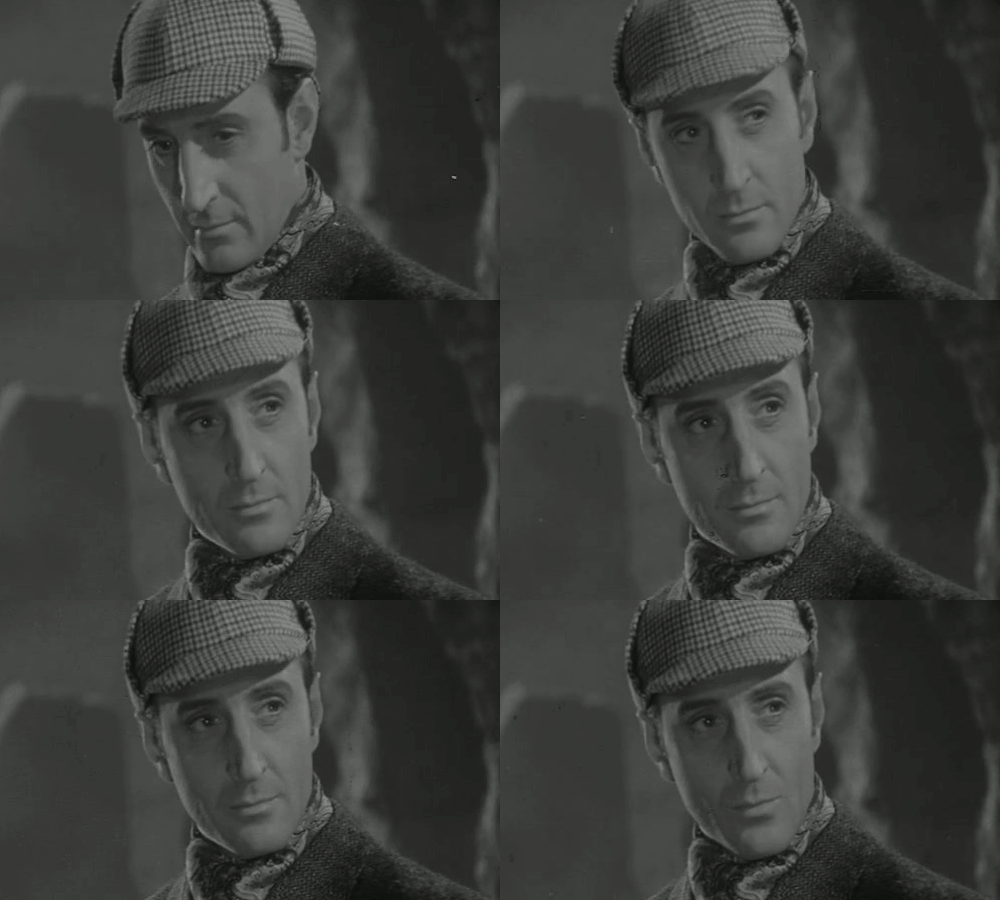
Arthur Conan Doyle

*****

The book opens on January 5, 2010, when 29-year-old Harold White is attending his first meeting of 'The Baker Street Irregulars' - the world's preeminent organization devoted to the study of Sherlock Holmes.


Only the most worthy fans are allowed to join the Irregulars, and Harold is thrilled to have been accepted and excited to be at the society's four-day convention, being held at New York's Algonquin Hotel.


Sherlock Holmes Convention

What's most eventful about the Irregulars symposium is the announcement by long-time member Alex Cale that he found Sir Arthur Conan Doyle's missing diary. Cale is being cagy and mysterious, but promises to present the journal on January 6 - Sherlock Holmes birthday.


Unfortunately, Cale is murdered before he exhibits the diary, and it disappears once again.

Harold is present when Cale's body is discovered, and decides to investigate the crime like Sherlock Holmes would. So - before the police arrive - Harold quickly looks over the body, studies the carpet, examines the walls, and so on.


Harold discovers the word 'ELEMENTARY' scrawled on the wall in blood and deduces that the murderer must be a Sherlockian - a person familiar with the Sherlock Holmes canon. Moreover, Harold believes the killer is leaving a string of clues, which he'll follow to find the perpetrator AND the diary.

As it happens, an attractive journalist named Sarah Lindsay wants to write an article about the diary, and she decides to tag along with Harold.


Thus the pair are reminiscent of Holmes and Watson.....except that Harold fancies Sarah. 😍

Harold and Sarah aren't alone in their hunt for the journal. Other Holmes aficionados want to find it as well, as does Sebastian Conan Doyle - Arthur's great-grandson - who believes the diary rightfully belongs to him.


Sebastian offers to finance Harold's search for the journal, which takes Harold and Sarah from New York to England to the continent. The duo's lives are endangered by people following them, and there's plenty of angst and excitement.


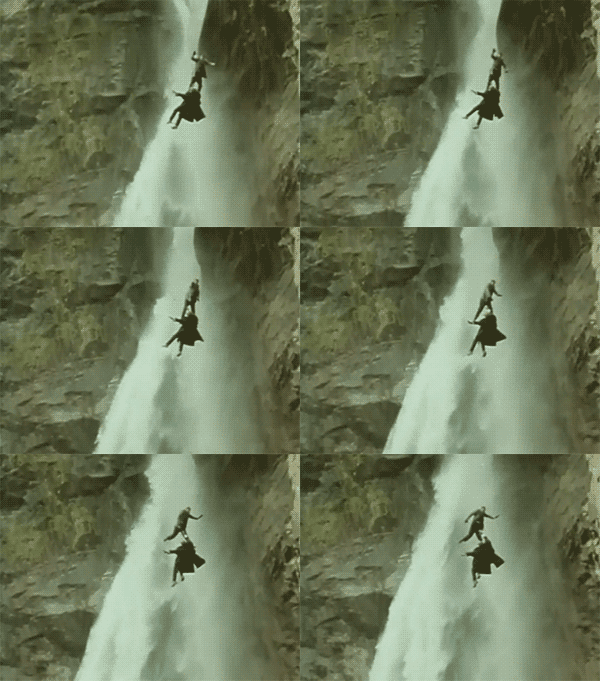
Developments in 2010 alternate with Sir Arthur Conan Doyle's activities in the 1890s, starting with his decision to 'kill off' Sherlock Holmes at the Reichenbach Falls.


Sherlock Holmes struggling with Professor Moriarity at the Reichenbach Falls

Fans were devastated and angry about Holmes' demise, and Conan Doyle was lambasted.....and even assailed in the streets.


Conan Doyle was also unpopular with progressive women because he was a vocal anti-suffragist and had a decidedly backward view of women's place in the world. Thus, when a letter bomb blew up Conan Doyle's office there were plenty of suspects.....from fans of Sherlock Holmes, to angry females, to terrorists protesting Arthur's military service during the Boer War.


Arthur Conan Doyle in his military uniform

Conan Doyle reported the bombing to Scotland Yard, but found the lead Inspector to be an ineffectual boob.


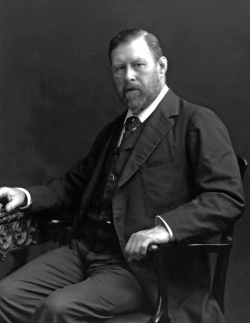
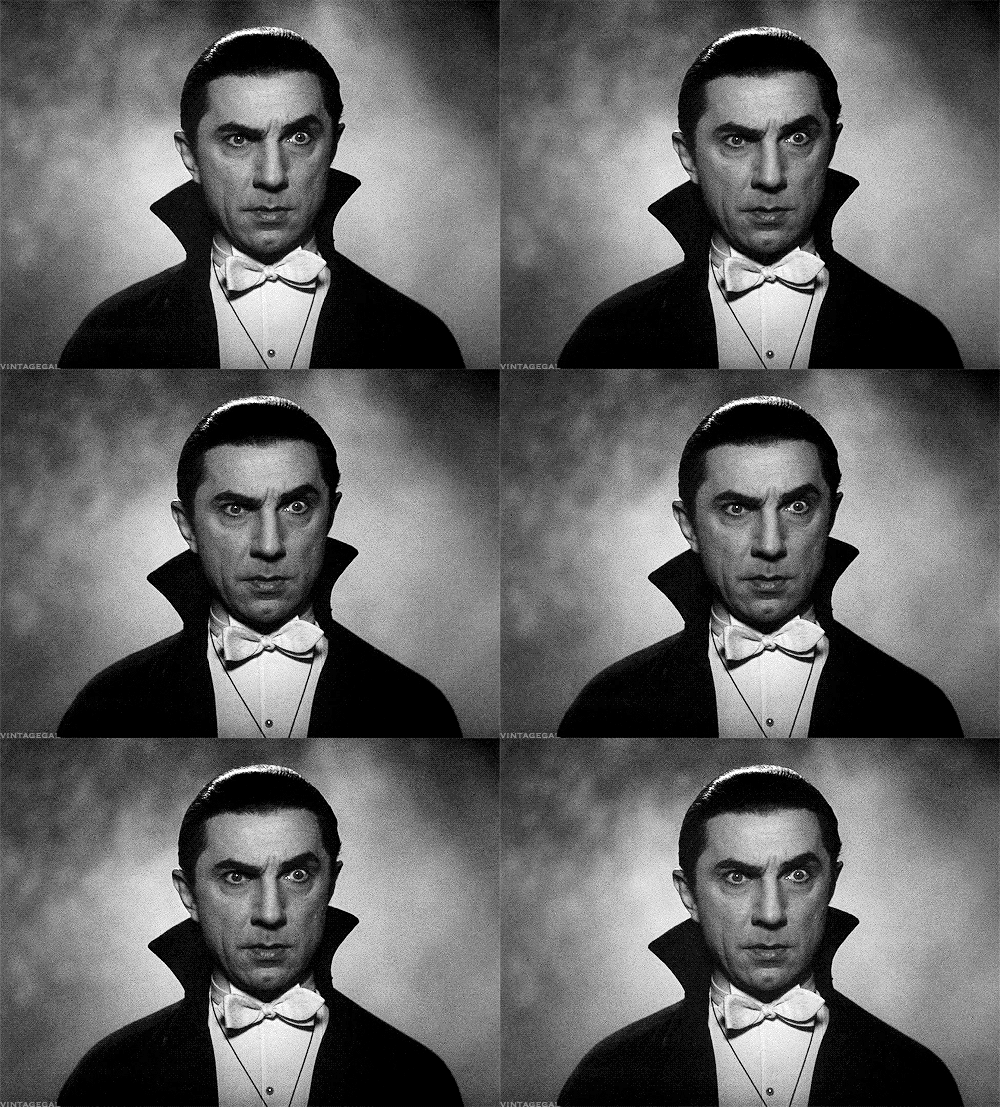
Thus the writer decided to investigate the bombing incident himself, with the help of his friend Bram Stoker.....who wasn't yet famous for creating Dracula.


Bram Stoker

During Conan Doyle and Stoker's search for the bomber they became aware that a serial killer was brutally murdering women in London. Once again Scotland Yard was sluggish and impotent, so the amateur sleuths decided to go after the serial murderer as well, using Sherlockian deductive reasoning.

As was Conan Doyle's habit, he faithfully recorded everything in his diary, including particulars of his detective work. And this is the volume of the journal that's missing!!

So what happened? You'll have to read the book to find out.

The story is an entertaining take off on Sherlock-mania, with the amateur detectives in both timelines 'doing what Sherlock Holmes would do.' In addition, Graham Moore's chapter headings - most of which are quotes form Sherlock Holmes stories - add an additional fun element to the novel.


I enjoyed the book and recommend it to fans of the legendary fictional detective.


You can follow my reviews at https://reviewsbybarbsaffer.blogspot....
Profile Image for James Thane.
Author 10 books7,069 followers
January 9, 2013
This is a cleverly done work of historical fiction in which Arthur Conan Doyle, the creator of Sherlock Holmes, attempts to solve a series of murders at the turn of the Twentieth Century while at the same time a devoted Sherlockian named Harold White attempts to solve two baffling mysteries at the turn of the Twenty-First.

As the book opens, all of England and most of the English-speaking world is in mourning because Doyle has killed off Holmes, the world's most popular detective, so that Doyle can concentrate on more serious writing. After sending Holmes over the falls, Doyle is then drawn into the murder of a young woman who has been strangled and left in a bathtub in a house known for illicit sexual behavior. The police assume that the victim is a common prostitute and have little interest in attempting to solve the crime. Doyle believes that the police are wrong and doggedly pursues the case, believing he is on the trail of a serial killer.

One hundred and seventeen years later, Harold White is initiated into the Baker Street Irregulars, the most prestigious of the groups devoted to Sherlock Holmes. This happens at a special meeting of the group in which a long-running mystery relating to Arthur Conan Doyle is about to be resolved. Doyle faithfully kept a series of diaries, but one volume has long been missing and presumed lost.

For Sherlockians, this lost volume is the Holy Grail and now one of the formost authorities on Doyle and Holmes claims to have found the diary and is going to reveal its secrets at the meeting. But then the scholar, Alex Cale, turns up murdered and the diary has disappeared again. Harold White joins forces with a beautiful reporter in an effort to solve the murder and recover the diary.

What follows is a very entertaining book that alternates chapters between Doyle's search for the serial killer and Harold's efforts to solve his twin mysteries. There are a variety of cleverly-drawn scenes involving people like Doyle's friend, Bram Stoker, who frets that no one will ever remember his name or that of his own famous creation, a certain Count from Eastern Europe.

This book should certainly appeal to fans of Sherlock Holmes and they will doubtless get even more out of the book than will the casual reader who has not spent a lifetime immersed in the Holmes stories. But even the latter should find the book very entertaining.
Profile Image for Rodrigo.
1,550 reviews863 followers
September 24, 2023
No ha estado mal, aunque el ritmo me ha parecido irregular.
La parte que mas me ha gustado ha sido la antigua, la de la época de Arthur Conan Doyle, la moderna me ha parecido algo mas floja.
2º libro que leo de este autor en poco tiempo y lo que me gusta de este autor, es que en el final de sus libros nos explica las partes que fueron verdad y las partes que son ficción.
Valoración: 6.5/10

Sinopsis: El caso del detective que no se dejaba asesinar¿Qué esconde el diario perdido de Arthur Conan Doyle? Harold White, un recién llegado al círculo de los especialistas sherlockianos, es tan experto –y fanático– como el que más. Para todos ellos, reunidos en un acto exclusivo, es un momento histórico: va a salir a la luz el diario inédito de Conan Doyle. Pero, como en los relatos clásicos de misterio, el encargado de anunciar el hallazgo aparece muerto en su hotel. Del diario no hay ni rastro. La única pista es un mensaje escrito con sangre en la pared: «Elemental».Londres, 1893. Conan Doyle liquida a Sherlock Holmes en El problema final y los lectores no se lo perdonan. Poco después el propio Arthur se ve envuelto en la investigación de un caso real: un asesino de mujeres anda suelto por la ciudad. En sus pesquisas cuenta con la ayuda de su colega Bram Stoker pero, por una ironía del destino, Conan Doyle acaba siendo el principal sospechoso de los crímenes. Quizá la verdad se encuentre en su codiciado diario: más de un siglo después, alguien parece dispuesto a matar por conseguirlo. Quien quiera resolver este enigma deberá tener en cuenta que en el mundo de la ficción puedes, por voluntad del autor, regresar de entre los muertos y resolver el caso de El sabueso de los Baskerville. Pero en la vida real solo se muere una vez.
# 11. El primer libro que cojas con los ojos cerrados de tu estantería. Reto literario lecturas pendientes 2023.
Profile Image for Elisha Condie.
667 reviews24 followers
August 22, 2011
First of all, I only read this after reading through the reviews here on GoodReads and I can't believe how lame this book turned out to be! Blast you, GoodReads reviewers.

This book tells two stories. One about Harold White, the newest and youngest member of the elite Sherlock Holmes fan club the Irregulars; the other about Arthur Conan Doyle himself, looking into a mystery after he has killed off Sherlock in his writing.

Having each chapter switch back and forth between stories was unbelievably annoying. And Harold White was unbelievably annoying. He wants to solve the mystery of the murdered Irregular Alex Cale, who supposedly found Doyle's missing diary and was killed just before he could unveil it. I started out liking it ok, but then it just got worse and worse. Harold and his sidekick Sarah toodle around London looking for clues which Harold discovers because he just sits down and thinks really hard about where they could be. Shucks! If that's all it takes, whats everyone else's problem??

It's boooring. And the writing felt so awkward - not helped by the fact each story kept interrupting the other. I like mysteries, and Sherlock Holmes and all that - but just not this book. Look elsewhere for a good mystery.
Profile Image for Quirkyreader.
1,629 reviews10 followers
December 21, 2017
Apparently this is the second time I have read this. I vaguely remember reading it the first time.

I enjoyed Moore's writing style. Especially how he seamlessly jumped between the early 20th Century and the second decade of the 21st Century.

If you are a fan of Arthur Conan Doyle it is a fun read based on facts from his life. Also, Bram Stoker makes an appearance in this story.

It is a wonderful read and worth re-visiting as my reading record shows.
Profile Image for Gianfranco Mancini.
2,337 reviews1,071 followers
May 7, 2021


Chi ha ucciso nella sua stanza d'albergo il massimo studioso Doyleano al mondo? Che fine ha fatto il diario perduto di sir Arthur Conan Doyle? Perché il più famoso investigatore della letteratura poliziesca è tanto cambiato al suo ritorno dopo il "Grande Iato" (1891/1894)? Chi è l'assassino di giovani donne nella Londra Vittoriana ormai vicina al volgere del nuovo secolo?


Quattro appassionanti misteri al prezzo di uno in un libro che mescola romanzo storico, mistery e thriller moderno, e che si legge quasi tutto di un fiato.


Delle due linee temporali su cui si alternano le vicende ad ogni capitolo ho però apprezzato di gran lunga quella ambientata nel passato, ed il duo di investigatori moderni Harold e Sarah esce schiacciato impietosamente dal confronto con l'altra coppia formata da sir Arthur Conan Doyle in persona e dal suo amico Bram Stoker nel ruolo di Dr. Watson.


Elementare
Profile Image for Carmen.
2,025 reviews2,425 followers
March 29, 2016
This book alternates between Arthur Conan Doyle's world of 1900 and Harold White's world of 2010. There is a murder mystery in each. Harold is dealing with a missing Doyle diary and a Sherlockian strangled to death with his own shoestring. Arthur is dealing with his hatred of Sherlock Holmes, and consequently, his public's hatred of himself (ACD) for killing off Sherlock in "The Final Problem". Arthur is very reluctantly pulled into a real-life mystery of a serial killer and starts to realize the bitter truths about the English justice system and the plight of women in 1900.

I found Harold to be rather dull, not as in "boring" but as in "dense, thick-witted." Even though he is supposed to be "the smartest, most deserving Sherlockian" or whatever, he is a bit of a dunce. His problem is that he tunes out "real life" in order to focus on/live in the world of Sherlock Holmes. Not even the world of ACD, which was real, but the world of a FICTIONAL CHARACTER. Sherlockians are just extreme fans of Sherlock, as dorky and deluded as extreme fans of any fiction (Star Trek, Buffy, anime, etc.). However, I think showing Harold's dorkiness and separation from reality was Moore's intent, so I'm not docking any points.

Arthur Conan Doyle himself (as a character in this book) comes off as separated from reality and wrapped up in his own self-importance. He just can't seem to understand WHY readers are upset that he killed off Sherlock Holmes, and he's petulant and childish about the topic. He is also petulant and childish when dealing with murder and real people's lives being in danger. He definitely wasn't someone to look up to or be in awe of (in this fictional portrayal of him). I liked Bram Stoker's character better, as he was a true and loyal friend of ACD's.

I liked the story but was not on the edge of my seat. I was not eager to "solve" the mysteries, and I wasn't terribly invested in the characters. But it was very well-written. And it was enjoyable.
Profile Image for Amy.
3,050 reviews620 followers
January 30, 2020
I acknowledge my rating might come from a place of disappointed expectations...but seriously, y'all. WHAT IS WITH ALL THE HIGH RATINGS ON THIS BOOK?!
The characters are universally unlikable, the intertwining plots rather boring, and the solution downright disappointing.
In timeline one, Harold tries to solve the murder of a well-known Sherlockian and discover the location of Arthur Conan Doyle's missing journal. I rather despised Harold. He has a habit of making comments I find cringe-worthy. For example:

"The woman turned, her tight gray hair spinning round to reveal glasses thicker than one would think a woman could get away with wearing." ???????

"She wore a pink and yellow banded scarf around her neck, making her look, for a second, like an unwrapped bonbon."

Harold is the type of young man who has an inferiority complex and yet thinks that if a girl smiles at him, she must like him. As I have enough problems with the type in real life, I do not go looking for it in my literature and it just made me cringe. Because of course, Harold is joined by a Female. She's perky and wide-eyed and you seriously hope she will prove villainous because no one should show that kind of interest in Harold. He demonstrates no social skills or natural grace or other charm except an ability to speed read. And while that might prove useful in some circumstances, his habit of destroying crime scenes and snooping through his partner's phone would have me going 'GET ME OUT OF HERE' faster than you can say Reichenbach Falls.

The mystery of the missing diary and dead man proved disappointingly mundane. It does not take much puzzling to find the solution. And the villain was both predictable and so obvious as to almost be unpredictable because you think 'it cannot be that easy.'

The other story line follows Sir Arthur Conan Doyle (joined by Bram Stoker) with frequent references to Oscar Wilde (who plays no role in this book and yet somehow manages to get a surprisingly significant amount of screen time.) When not name-dropping, Doyle's plot held more interest but never quite salvaged the story. Partially the problem is because the story is so busy trying to show off trivia about Doyle's life that it often loses its own thread. And the fact that Doyle is quite unlikable. No one likes Doyle in this book. Not even his friends like him. Why should the reader?

The murder mystery was okay but because the plot holds back evidence, the serial killer remains fairly unknowable because of information kept from the reader which takes away any sense that the reader is solving a puzzle.

An interesting premise but the unlikable characters and lack of a puzzle means this mystery falls rather flat.
Profile Image for Tristram Shandy.
875 reviews264 followers
December 22, 2021
“He’d read thousands upon thousands of moments of revelation, of grand gestures of explanation in which the torn fabric of life had been stitched tightly shut and patted over. He’d read thousands of happy endings and thousands of sad ones, and he had found himself satisfied with both. What he had not read, he now realized, where the moments after the endings. If Harold believed in the stories, because they presented an understandable world … well, what happens when the world is understood and that understanding means nothing to anyone but you and the empty tumbler of bourbon nestled in your palm?”

Unlike millions of readers through more than a hundred years, Arthur Conan Doyle was no fan of Sherlock Holmes’s. Indeed, he rather hated the papery guts of this figment of his imagination, which he felt being responsible for outshining all his more serious efforts at writing fiction even though this “penny dreadful” investigator established the writer’s material fortune. Whatever he undertook and achieved, people not only kept asking for the return of the master sleuth in more of his adventures, they even wanted Conan Doyle to sign Holmes’s books not in the author’s own name but in that of his creation. I can hear the man gnashing his teeth, fidgeting on his last nerve.

What is it that makes so many people turn to mystery fiction and hunger for puzzles and whodunnits? Is it just gory curiosity, or is there something more to it? Harold Winter, the protagonist of one strand of Graham Moore’s The Sherlockian, is a Holmes zealot and as such can quote ad lib from any of the stories, and when an eminent member of the Baker Street Irregulars, the well-known Holmes fan club, is found strangled with his own shoelace in a hotel room after claiming to have found the lost Doyle diary from November to December 1900, he embarks on a quest for the missing book that might cast some new light on the life of Holmes’s creator and also on the question why Doyle, after so many years of abstention, gave in to public demand and decided to resurrect his bosom foe for another long series of adventures, indeed the entire second half of the canon. But Harold also goes on a quest for the reasons why he is so fond of Holmes and of detective fiction in general. As Harold’s research unfolds, Moore also opens up another thread in his novel, following Arthur Conan Doyle, who is assisted by Bram Stoker, the creator of the most famous vampire, Dracula, through his own investigations into a series of murders committed on young women, and this quest, too, will end in some inner truth about the person who conducts it, which might also help understand why the Holmes of the second half of the canon has grown somewhat more ruthless and more high-handed in his dealings.

The Sherlockian may start a little bit heavy-handedly, but it will soon evolve into a first-class mystery novel which does well stand its ground next to anything that has ever been written about Sherlock Holmes, either by Conan Doyle himself or by his countless adepts. What is more, if you read it carefully and don’t just focus on the plot, you will get quite some impulses to think about the romanticism in the Holmes universe and about the reassuring effects of fiction as such. In a world, where everything seems to be out of joint or where, as Stoker put it, we live under the constant threat of “wak[ing] to sanity in straight-waistcoats”, literature may fill our lives with sense and meaning, providing beginnings and endings, or even ends, to things that, without it, would just be stuff that is happening. In this context, it will not even matter whether these endings are happy or sad – as long as they provide structure and purpose to our very existence.

In short, literature is more of a beacon than a gaslight and it reassures us in our hopes that eventually, it will all fall into place, or, as the poet and Holmes aficionado Vincent Starrett put it:

”Here dwell together still two men of note
Who never lived and so can never die:
[…]
Here, though the world explode, these two survive,
And it is always eighteen ninety-five.”

Profile Image for Avishek Bhattacharjee.
370 reviews79 followers
October 27, 2022
ভয়ংকর কষ্টকর অভিজ্ঞতার মাধ্যমে অবশেষে আমি বইটা শেষ করতে পারলাম। আমার জীবনে কোন বই পড়তে এতটা সময় লাগে নাই। কিন্তু এক্ষেত্রে নিজস্ব অবসর সময়ের অভাবের সাথে সাথে অনুবাদও বহুলাংশে দায়ী।

বইয়ের ঘটনা এগিয়ে গিয়েছে দুইটা টাইমলাইন নিয়ে। এক টাইমলাইন হল শার্লোকিয়ান ক্লাব নিয়ে। এই ক্লাবের কাজই হল শার্লোক হোমসকে নিয়ে পাঁড় ভক্তদের নিয়ে। এই ভক্তদের নিয়ে এক সম্মেলনে স্যার আর্থার কোনান ডয়েলের একটা হারানো ডায়েরির উপস্থাপন করার কথা। কিন্তু উপস্থাপনকারী হোটেলে মারা যান। এই মৃত্যুরহস্যের পেছনেই লেগে যায় এক শার্লোকিয়ান হ্যারল্ড। অন্যদিকে স্যার আর্থার কোনান ডয়েল তিন নারীর মৃত্যুরহস্যের তদন্ত করতে নামেন। কথা হচ্ছে ওই ডায়রির মধ্যে কি লিখা ছিল? আর কোনান ডয়েল কেনই বা দুনিয়ার এত কিছু থাকতে এই তিনজন নারীর মৃত্যুর পেছনে কেন লাগলেন? আর এই ডায়েরি এতদিন কোথায় ছিল?

বই পড়ে আমি সব ক্লিয়ার। কিন্তু অনুবাদের জন্য অনেক কিছুই মনে হচ্ছে বুঝি নাই। তবে বইটা আহামরি কিছু মনে হইল না। আসলে শার্লোক হোমসের স্রষ্টাকে নিয়ে আমার প্রত্যাশা অনেক বেশীই ছিল।
Profile Image for Cynthia.
186 reviews32 followers
April 11, 2020
4.5 rounding up.
All I'll say is don't go into this thinking that Arthur Conan Doyle is a super great guy and that he'll be a total hero. He'll be a semi-good hero when it finally motivates him.
Profile Image for Susan.
359 reviews32 followers
July 31, 2016
I cannot believe how long it took me to finish this book. I love Sherlock Holmes - I read most of his stories when I was very young and "The Complete Sherlock Holmes" was my first introduction to the detective novel. I've loved them ever since. I had no idea however that there are are whole societies of readers and scholars who are obsessed with Holmes and kind of think he was a real person. It's just one person's opinion, but I think it's...not odd, but "interesting."

Whatever - to the book. It was just draggy until the end - and I knew how it was going to end. I had the story figured out way too soon, and that's the cardinal sin of any great detective novel. But this was historical fiction, and it went back and forth between 1900 and today. This seems to be a very common device in novels I've been reading and it is difficult to pull off and it often just makes a novel much longer than it needs to be. I didn't dislike this at all, I just wanted it to end. Didn't much care about the characters from the present day story all - was just indifferent. On to next read!
Profile Image for Lieblingsleseplatz .
233 reviews43 followers
August 13, 2019
„Arthur ermordete Sherlock Holmes im Schein einer einsamen Schreibtischlampe.“
S.21

Ich bin seit meiner Grundschulzeit ein großer Sherlock Holmes Fan! Ich war schon immer eine Leseratte und da ich bald alle Kinder- und Jugendbücher in unserer Dorfbücherei durch hatte, durfte ich in die „verbotene Abteilung“ – da standen leider keine gefährlichen magischen Bücher wie bei Harry Potter, sondern die Bücher für Erwachsene. Der exzentrische Detektiv hat es mir sofort angetan. Das war mein großer Aha-Moment – ich liebte die Bücher über alles!

Und wie heute wahrscheinlich alle Game of Thrones Fans trauern, dass die Serie, die sie so viele Jahre begleitet hat nun zu Ende ist, so habe ich tatsächlich geweint, als Sherlock Holmes am Reichenbachfall damals sein grausames (wenn auch nur vorläufiges) Ende fand…

Graham Moore beleuchtet in Der Mann der Sherlock Holmes tötete aber mal eine ganz andere Seite… Was hat sich Sir Arthur Conan Doyle wohl dabei gedacht seinen Geldesel „unzubringen“? Da er akribisch Tagebuch geführt hat, lässt sch das prima nachvollziehen. Der Schriftsteller war schlichtweg genervt!!! Er hasste seine Schöpfung! Doch was er damit lostreten würde, welch Beschimpfungen und Drohungen er und seine Familie erdulden müssten nachdem er sich seines Protagonisten entledigt hatte, das hat er sicher nicht geahnt…

Die Handlung in diesem Buch ist zweigeteilt und wechselt sich ab. Einmal spielt das Buch zur Zeit von Sir Arthur Conan Doyle und erzählt sein Leben „nach Sherlock“ in dem er selbst zum Detektiv wird.
Der andere Handlungsstrang spielt in der Gegenwart, wo bei einer Zusammenkunft der weltweit größten Sherlock Holmes Experten ein grausamer Mord geschieht.

Ich liebe beide Handlungsstränge! Und die Mischung ist genial. Ich bin nur so durch das Buch geflogen (naja, gefahren… habe es im Zug zur Buchmesse gelesen) Ein ganz großes Kompliment an den Autor, der es geschafft hat auch durch Sprache und Stil auf den Spuren von Sir Arthur Conan Doyle zu wandeln.
Ich vergebe volle 5 von 5 Lieblingslesesessel!

Profile Image for Célia | Estante de Livros.
1,188 reviews275 followers
August 22, 2016
Sherlock Holmes é, provavelmente, o detetive mais famoso do mundo. Criado por Sir Arthur Conan Doyle, apareceu pela primeira vez na revista Strand, em 1887, com Um Estudo em Vermelho, e o sucesso foi tal que a personagem extravasou há muito as páginas onde apareceu. e tornou-se, por direito próprio, umas das figuras centrais do imaginário coletivo no que respeita à literatura. Não é o meu detetive famoso preferido (esse lugar é ocupado pelo Poirot de Agatha Christie), mas gostei bastante das histórias que li dele e da sua personalidade peculiar. Ainda me resta alguma coisa por ler e este O Homem que Matou Sherlock Holmes renovou, sem dúvida, o meu interesse pela personagem, para além de me ter dado a conhecer mais sobre a vida do seu criador.

Este livro segue duas linhas temporais, com alguns pontos de contacto: no final do século XIX, encontramos Arthur Conan Doyle no “Grande Hiato”, o período posterior à publicação de O Problema Final, em que o autor matou Sherlock Holmes e este seria aparentemente o final do detetive. Conan Doyle estava com dificuldades em lidar com a fama da sua personagem e tinha vontade de se dedicar a outros temas na escrita, mas viu-se envolvido na investigação de alguns casos policiais relacionados com a morte de algumas jovens, aparentemente às mãos do mesmo perpetrador. A outra linha temporal situa-se em 2010, quando Harold White consegue, finalmente, entrar no restrito clube “Maltrapilhos de Baker Street” (que existe na realidade e foi fundado em 1934), um grupo de entusiastas do detetive fictício e onde só se entra por convite. Pouco tempo depois, um dos membros do clube anuncia que descobriu o diário perdido de Arthur Conan Doyle, que cobriu o outono-inverno de 1900 (precisamente a época que acompanhamos na outra linha temporal), mas aparece morto pouco tempo depois, antes de anunciar o conteúdo do documento perdido.

Os dois enredos que compõem o livro avançam movidos pelos dois casos policiais, com capítulos intercalados que normalmente terminam num ponto que deixa o leitor curioso para saber o que acontecerá de seguida. Confesso que gostei mais da linha temporal de Sir Arthur Conan Doyle, pelo interesse dos factos que Graham Moore revela sobre o escritor e sobre a sua relação com Bram Stoker, ainda que admita que a busca pelo diário perdido e a morte do “maltrapilho” que o tivessem em seu poder tinham maior interesse a nível de caso policial – o que confirmei pela sua resolução. Harold White, o exímio connaisseur de Sherlock Holmes e da literatura em geral, é o anti-herói da linha temporal mais recente que, quanto a mim, peca um pouco por parecer uma personagem com imenso potencial, cujo desenvolvimento deixa algo a desejar.

Na parte do enredo que acompanha Arthur Conan Doyle foi muito interessante, para além de saber mais sobre a vida pessoal do autor, a questão da separação entre realidade e ficção e a “confusão” entre autores e personagens. Mais: a aversão de Conan Doyle a Sherlock Holmes, por contraposição ao amor dos seus leitoras à personagem, fez-me refletir sobre a responsabilidade do autor perante quem o lê.

Finda a leitura, e ainda que não se tenha revelado marcante, ficam as agradáveis horas de entretenimento que o livro me proporcinou e a vontade não só de regressar às histórias de Sherlock Holmes, mas também de saber mais sobre a aparentemente fascinante figura do escritor Arthur Conan Doyle.
Profile Image for Cherie.
1,343 reviews139 followers
August 4, 2014
I love Sherlock Holmes. How could I pass up a book with this title? I barely read the summary before I pressed the button on my iPOD to download the MP3 files from my library. The only thing I really wanted to know was who was the narrator. I didn't find this out until the end, and by then, I didn't want the book to be over. I did not want to stop listening to James Langton telling me about Arthur Doyle, Bram Stoker, Harold White, Sara Linsey or the Baker Street Irregulars and the Sherlockian Society people.

But, all stories come to an end. What a story! Actually two stories, on two different time lines.
First we come to know Harold and Sara at a Baker Street Irregulars meeting in 2010. They are awaiting Alex Kale's report of his finding a long lost, missing diary belonging to Sir Arthur Conan Doyle. I thought really? Cool. This is going to be interesting. Interesting? Was I wrong!

The second time line is set in 1893 and we get to know Arthur Doyle, just after he has killed off our favorite hero, Sherlock Holmes. The public is totally upset! People are wearing black arm bands, in mourning. An old lady, passing him on the street, stops to whack him with her handbag and saying "Shame on you!" Facinating! Bram Stoker is introduced as Doyle's friend. I loved this part of the story and their conversations. There is a murder mystrey in this time line, that Doyle decides to solve. Should I tell more? Okay - one thing. He gets arrested. Yep. Surprise!

Each chapter or two, the stories go back and forth into their respective time line. I found myself not caring about the "present" story because I wanted to hear more about ACD, in his time. It was so much MORE. Then, something happened and the story in 2010 got better. I finally began to like the characters although I thought Harold kind of whiney. He was smart. He was figuring things out. He was a little sad, but funny.

So, what else should I say? This was a beautiful idea of a story and I found out that I did not miss Sherlock Holmes at all. There is just enough of him in the story to make it seem like he is present because at the beginning of each chapter, there is a line or quote, usually by SH, from each of the stories that ACD wrote. It was like a little mini quiz - listen to the line and see if I could name the story before the narrator did.

Hmmmm. I think I will listen again....
811 reviews8 followers
July 13, 2015
Started this book yesterday. I'll rate it when I've finished, but I'm already amazed at the number of solecisms. Typical of a book by an American author who hasn't done his research. By page 58 I've noticed these. A letter to Conan Doyle as Holmes asking him to find 'our cat called Sherry-Ann'. I cannot imagine such a name for a cat in Victorian England. In 20th century Poughkeepsie maybe. Then CD sits down in Simpsons to eat his 'kidney pie'. No you loon. It's 'steak and kidney'. Then worst of all, Harold is admitted to The Baker Street Irregulars and given a Victorian shilling. He reflects that when it was first issued it was worth five pennies. No, you idiot. That didn't happen until decimalisation in 1972. In Victorian England a shilling was worth twelve pence. And there were twenty shillings to the pound.

Oh dear. They get worse. A cockney woman in 1900 uses the Americanism 'take a right'. ACD stands on Westminster Bridge in the same year and looks at 'New' Scotland Yard. He takes a cab to Lambeth Palace from the south of the river which takes him via Kensington. The palace itself is populated by 'friars'.

American authors must do more research if they want to write about the UK. I have finished the book and become amazed at how the howlers have grown. ACD enters 'New' Scotland Yard beneath Big Ben, then throws a stone at it in Victoria Street. A character lives in London Fields which is a large park in Hackney. A workman refers to having a few 'bits' (money) in his pocket. Houses etc are referred to by the number is storeys (spelt storys) they have. Quite unEnglish. Two stars is generous.
6,197 reviews80 followers
April 14, 2019
A story of two pieces. Arthur Conan Doyle, bored with writing Sherlock Holmes is going to try to kill him off with the infamous Last Bow, while a pair of Sherlockians search for the fabled missing Sherlock Holmes manuscript.

It's supposed to be about larger themes, but I don't feel the book ever really gelled. It's an interesting concept, but I don't think the execution was there.
Profile Image for Pallavi.
1,229 reviews232 followers
September 5, 2017
*****5.0*****

I have always loved Graham Moore's books, well he has written only two and I have found immense pleasure reading both. The second book wasThe Last Days of Night which was another 5 starrer for me.

“Amazing, really, to think of what a man could achieve with the simple ability to put pen to paper and spin a decent yarn.”

In 1900, Arthur Conan Doyle was writing serious literature as he had killed his most hated creation "Sherlock holmes" almost 8 years ago. Though there was pressure from the public to resurrect Holmes, Doyle had ignored those pleas and living a calm life, looking after his ailing wife. But when a letter bomb blasts in Doyle's office, he takes the matter in his own hands. He and his friend Bram Stoker (yes, the Dracula one!) starts to investigate, where Doyle uses deduction methods of Sherlock Holmes to discover who sent him a letter bomb and Bram Stoker trails him lie Dr.Watson. But this leads them to a serial killer and they would face some unhappy situations. Though these situations are handled effectively, Doyle's habit of maintaining diary records it all.

“No worn, ink-drenched leather journal for the period from October 11 through December 23, 1900, could be found.”

In 2010, Harold White, a sherlock Fanatic, a voracious reader, joins a group dedicated to Sherlock Holmes and its creator. The diary of Doyle from 1900 is missing to the world. But when Sherlockian is murdered after announcing that the missing diary is found, Harold White sets on finding the murderer who has left clues (just like the Holmes mysteries!!!) all around.

“He would have achieved victory and rebellion at the same time.”

The chapters are short, alternating between Doyle and Harold, both the stories build the reader's interest. Narration is very good, cleverly built plot and mystery. If you love Sherlock, love mysteries Go for it!!!

“The human mind thrills at few things so much as making connections. Discovering. Solving.”

Happy Reading!!
Profile Image for Magill.
503 reviews14 followers
April 17, 2011
I cannot say I cared for this book overmuch. The tone seemed a bit farcical, as if the author was amused by his own cleverness, particularly in the modern sections. The Doyle sections were a wee bit ponderous but with some jarring modern word usage (clomping boots or upsidedown Vs describing architectural elements) and people using terms of speech that they would have been unlikely to use at that time. Overall, the book seemed like a juvenile and ambitious attempt that needed a bit more vine-ripening and the plot developments and overall characterizations were a bit weak. The very short chapters didn't help with transitions but at about page 95 I started reading several chapters on one storyline at a time and that did improve the general reading experience.

Comments while I was reading the book:
"Off to a slow start (for me and the book), the modern protagonist is a bit of a schmuck and the author seems to let his sense of humour hi-jacked the narrative at times like on page 35, "There was a curious sensation in his calves, shooting up to his knees. Thinking it over, he believed, not from recent experience, that it must be called "running." Not sure how I feel about Doyle at this point."
"Alex's bushy light brown hair squatted on his head like a chicken laying an egg" - wtf?"
Profile Image for Stephanie Ricker.
Author 7 books106 followers
June 4, 2017
Good grief, this book was terrible. Why in the world does it have so many good reviews? Such awkward dialogue! Such bland characters! Such nonsensical actions committed by these oatmeal bowls of mush. This is sloppy mystery writing x 2: neither plot line (the one taking place in Doyle's day and the one taking place in the modern day) is plausible or even interesting, and the "solutions" at the end don't account fully for the previous events. I would've stopped reading, but I had this on audiobook while I was painting the doors in our new house and was covered in paint. In retrospect, watching the paint dry might have been more entertaining.
Profile Image for Maria.
503 reviews92 followers
September 6, 2024
A little dry at times but a great tribute to Conan Doyle and Bram Stoker with a few liberties and exaggeration of events. It was not until I read the acknowledgement that I understood that one of the characters was actually inspired by true incidents.

My favorite scene is when Harold really wants to emulate Holmes by thinking in a chair only to be distracted by his wallet pinching on his skin and the way Sarah eats, this never happened to Sherlock Holmes!

I really love this writer, he truly can write anything.
Profile Image for Pinkerton.
513 reviews50 followers
June 21, 2018
Partito bene proseguito male, è stato interessante vedere richiami ai metodi investigativi deduttivi del detective più famoso del mondo, e del suo creatore. Stoker poi è stato un’ottima spalla. Il problema è che la storia in sé si è dimostrata abbastanza inconsistente, con i due misteri principali sminuiti dalla maniera inadeguata in cui si sono evoluti: come l’uscire da situazioni di stallo con discutibili soluzioni “di convenienza”, o l’intervento di elementi esterni (i personaggi non principali) mai realmente convincenti. Sul finale poi preferisco stendere un velo pietoso…
Carino l’utilizzo/paragone con le opere di Doyle, e il suo rapporto con le stesse, che ci accompagna lungo l’intera storia - è la parte migliore del libro. La pochezza dei due enigmi però priva il lettore dell’autentica gioia insita nel bramoso “chi è stato?” o “come andrà a finire?”. Tra cambiamenti repentini e ‘piccoli problemi di cuore’ non è che mi importasse granché di come sarebbero stati risolti i due casi, mi interessava solo arrivare alla fine per chiudere la lettura una volta per tutte.
Profile Image for Michael.
1,297 reviews152 followers
December 23, 2010
When I heard the premise for "The Sherlockian" I was intrigued. I've been a fan of the great detective ever since I picked up "Hound of the Baskervilles" in a school reading class years ago. And earlier this year, I read the fascinating book "The Devil and Sherlock Holmes" that delves into the true story of how an avid Holmes fan was killed and what possible motives there might have been.

Graham Moore's "The Sherlockian" feels a bit like a fictional exploration of that question. In one storyline, avid Holmes fan Harold White has just been inducted into the Baker Street Irregulars. At the annual convention, a man is scheduled to appear to discuss his discovery of a long-lost journal of Sir Arthur Conan Doyle. The journal comes from the time between the publication of "The Final Problem" and "The Hound of the Baskervilles" when Doyle killed off his detective and tried to establish himself in other genres and with other characters. The man is killed in his hotel room and the diary vanishes. Teaming with a reporter named Sarah (who serves as his Watson), Harold takes on the task of trying to apply Holmes' methods to solving the murder and finding the lost journal.

Woven between this is an historical story of the lost journal time with Conan Doyle attempting to also use Holmes methods to solve a crime. In this case, Doyle is joined by Bram Stoker (yes, THE Bram Stoker) as his Watson.

Both stories are interrelated and feed off each other with considerable success. As a mystery, the story works well, keeping the thread going in both time lines. The novel manages to deliver on its intriguing premise and comes up with an interesting explanation of what happened to Doyle during his time away from Holmes and why he returned to his character. It also speculates on why when Holmes returned he was a much harder character than previously seen.

The only points off for "The Sherlockian" was that I was able to deduce one key plot point early in the story. (It concerns the plotline of Harold.) Otherwise, this is an intriguing read that should be of interest to fans of a good mystery and especially those of a good Holmes story.
Profile Image for Hannah.
820 reviews
March 28, 2011
I had heard some buzz about The Sherlockian, and after putting it on hold at my local library, I found that I was #37 on the wait list, so that got me further excited. Unfortunately, it was a disappointing read after all. There were some parts in both the past and present POV's that were mildly entertaining if you were a moderate to more serious fan of the Sherlock Holmes canon, but for the most part I thought the characters (especially Harold) were wooden and the plotlines for both time periods was fairly uninteresting. My biggest gripe with the book was the POV change from past to present storyline every alternating chapter. As some chapters were as short as 2 pages, this became so annoying that I ended up reading 4-5 alternating chapters at a time in order to continue with one storyline. Changing POV's can work, and I have read many books using this device, but I don't think Moore succeeded very well due to the shortness of his chapters; it just became annoying. I did enjoy the quotes at the beginning of each chapter. Most were taken directly from various Holmes stories, with a few from Bram Stoker and other writers as well. But that's the best I can say for this debut novel, and if you're not already a fan of Sherlock Holmes, I don't think this novel would be of any interest whatsoever.


****Side note:
What's is the big plot hole from The Adventure of the Solitary Cyclist anyway?
If anyone knows, would you please comment on this review. I'm racking my brains here (and thanks in advance!)
:)
Profile Image for Adrien.
4 reviews1 follower
May 3, 2011
Two good stories in this book - but what I really enjoyed, and what really made me want to read this book whenever I could was the type of language Moore uses and the imagery he invokes. Throughout the book, there's also a theme of moving from the romanticized Victorian era to the 20th century. At the very end of the book, two workmen finish putting electric bulbs in the streetlights on Baker Street.

'"Oi," said the taller workman. "That's it, then."
"I'd say so," replied the other.
"Lord, but it's sure bright, isn't it? I can't hardly see the fog anymore."
His partner simply nodded in agreement. It was as if a layer of gloom and dread had been stripped from the streets, leaving the city white and clear. But the vision of this white and sparkling street was odd, too, and neither man possessed the words to explain why. So much that had been hidden was revealed in the electric light, so much had been gained. But perhaps something had been lost as well. Perhaps, both men though but did not say, a part of them would miss the romantic flickering of the gaslight.'

This isn't really a review, just a passage I really liked. Maybe it's just because I love London so much that I liked this book as much as I did. But the words are wonderful as well.
Profile Image for Diane S ☔.
4,901 reviews14.6k followers
December 15, 2010
Absolutely loved it. It was great reading old frineds again, Doyle and his Sherlock. Stoker and his Dracula and Wilde after Dorian Gray and his fall from grace.
Displaying 1 - 30 of 2,099 reviews

Can't find what you're looking for?

Get help and learn more about the design.