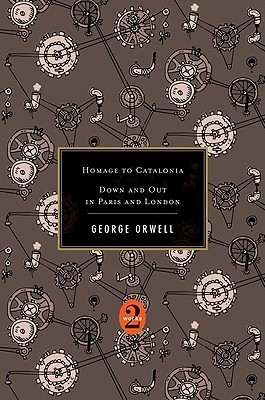
Homage to Catalonia is both a memoir of Orwell’s experience at the front in the Spanish Civil War and a tribute to those who died in what he called a fight for common decency. Down and Out in Paris and London chronicles the adventures of a penniless British writer who finds himself rapidly descending into the seedy heart of two great European cities. This edition brings together two powerful works from one of the finest writers of the twentieth century.
Eric Arthur Blair was an English novelist, poet, essayist, journalist and critic who wrote under the pen name of George Orwell. His work is characterised by lucid prose, social criticism, opposition to all totalitarianism (both fascism and stalinism), and support of democratic socialism.
Orwell is best known for his allegorical novella Animal Farm (1945) and the dystopian novel Nineteen Eighty-Four (1949), although his works also encompass literary criticism, poetry, fiction and polemical journalism. His non-fiction works, including The Road to Wigan Pier (1937), documenting his experience of working-class life in the industrial north of England, and Homage to Catalonia (1938), an account of his experiences soldiering for the Republican faction of the Spanish Civil War (1936–1939), are as critically respected as his essays on politics, literature, language and culture.
Orwell's work remains influential in popular culture and in political culture, and the adjective "Orwellian"—describing totalitarian and authoritarian social practices—is part of the English language, like many of his neologisms, such as "Big Brother", "Thought Police", "Room 101", "Newspeak", "memory hole", "doublethink", and "thoughtcrime". In 2008, The Times named Orwell the second-greatest British writer since 1945.
Orwell's memoir of fighting in the P.O.U.M militia (Party of Marxist Unification) during the Spanish Civil War of the 1930s. A lucid, incisive account of his time at the front and the turbulent suppression of 'Trotskyist' factions by the Communists. Orwell was one of the first to discuss the many fabrications, illusions and erosions of truth by the media and the suppression by foreign media. Near the end he presciently sees the next World War right before his eyes, against the evil of Natzism. It's hard to believe a journalist, who originally went to Spain to write letters eventually found himself fighting at the front: a wake up call for Socialist academics who stridently preach their ideologies whilst enjoying all the comforts of a bourgeois lifestyle...
My favorite Orwell ... an example of what anarchism could look like in a big city, state or even region. And I loved learning about the use of tu (instead of usted) in the military.
One of the best books I've ever read. I get the feeling Mr. Orwell is telling me his story directly.
The whole process is easy to understand if one remembers that it proceeds from the temporary alliance that Fascism, in certain forms, forces upon the bourgeois and the worker. This alliance, known as the Popular Front, is in essence an alliance of enemies, and it seems probable that it must always end by one partner swallowing the other. The only unexpected feature in the Spanish situation -- and outside Spain it has caused an immense amount of misunderstanding -- is that among the parties on the Government side the Communists stood not upon the extreme Left, but upon the extreme Right. Official Communism must be regarded (at any rate, for the time being) as an anti-revolutionary force.
To begin with, the things that most enlightened me had not yet happened, and in any case, my sympathies were in some ways different from what they are not.
It is nonsense to talk of opposing Fascism by bourgeois “democracy.” Bourgeois “democracy” is only another name for capitalism, and so is Fascism. The only real alternative to Fascism is workers’ control.
The Communist’s emphasis is always on centralism and efficiency; the Anarchist’s on liberty and equality.
On the surface, the quarrel between the Communists and the POUM was one of tactics. The POUM was for immediate revolution, the Communists not.
One of the most horrible features of war is that all the war-propaganda, all the screaming and lies and hatred, comes invariably from people who are not fighting.
One of the dreariest effects of this war has been to teach me that the Left-wing press is every bit as spurious and dishonest as that of the Right.
The people who write that kind of stuff never fight. It is the same in all wars: the soldiers do the fighting, the journalists do the shouting, and no true patriot ever gets near a front-line trench, except on the briefest of propaganda-tours.
As far as the journalistic part of it, this war was a racket like all other wars.
General and private, peasant and militiaman, still met as equals; everyone drew the same pay, wore the same clothes, ate the same food and called everyone else ‘thou’ and comrade.’ There was no boss-class, no menial-class, no beggars, no prostitutes, no lawyers, no priests, no boot-licking, no cap-touching. I was breathing the air of equality, and I was simple enough to imagine that it existed all over Spain. I did not realize that more or less by chance I was isolated among the most revolutionary section of the Spanish working class - in the strip of Aragon controlled by Anarchist and POUM troops.
The ting for which the Communists were working was not to postpone the Spanish revolution till a more suitable time, but to make sure that it never happened.
I used to think of the recruiting poster in Barcelona which demanded accusingly of passers-by: “What have you done for democracy?”
When you think what fighting means it is queer that soldiers want to fight and yet undoubtedly they do. In stationary warfare there are three things that all soldiers long for: a battle, more cigarettes, and a week’s leave.
For sheer beastliness, the louse beats everything I have encountered. I think the pacifists might fight it helpful to illustrate their pamphlets with enlarged photographs of lice. Glory of war, indeed! In war, all soldiers are lousy, at least when it is warm enough. The men who fought at Verdun, at Waterloo, at Flodden, at Senlac, at Thermopylae -- every one of them had lice crawling over his testicles.
At the front, everyone stole, it was the inevitable effect of shortage, but the hospital people were always the worst. The practicantes (hospital assistants) stole practically every valuable object I possessed, including my camera and all my photographs.
The Spanish Church will come back (as the saying goes, night and the Jesuits always return)
To the Spanish people, at any rate in Catalonia and Aragon, the Church was a racket pure and simple. And possibly Christian belief was replaced to some extent by Anarchism, whose influence is widely spread and which undoubtedly has a religious tinge.
It is queer how, just now and again, Spaniards can carry out a brilliant feat of organization.
I cannot convey to you the depth of my desire to get there. Just to get within bombing distance before they heard us! At such a time you have not even any fear, only a tremendous hopeless longing to get over the intervening ground. I have felt exactly the same thing when stalking a wild animal; the same agonized desire to get within range, the same dreamlike certainty that it is impossible. And how that distance stretched out!
I had joined the militia in order to fight against Fascism, and as yet I had scarcely fought at all, merely existed as a sort of passive object, doing nothing in return for my rations except to suffer from cold and lack of sleep. Perhaps that is the fate of most soldiers in most wars.
A kind of interregnum in my life...and they taught me things that I could not have learned in any other way.
interregnum (plural interregna or interregnums) is a period of discontinuity or "gap" in a government, organization, or social order
I had dropped more less by chance into the only community of any size in Western Europe where political consciousness and disbelief in capitalism were more normal than their opposites. Up here in Aragon entirely of working-class origin, all living at the same level and mingling on terms of equality. the prevailing mental atmosphere was that of Socialism. Many of the normal motives of civilized life -- snobbishness, money-grubbing, fear of the boss, etc. -- had simply ceased to exist.
To the vast majority of people, Socialism means a classless society. And it was here that those few months in the militia were valuable to me. For the Spanish militias, while they lasted, were a sort of microcosm of a classless society. In that community where no one was on the make, where there was a shortage of everything but no privilege and no boot-licking, one got perhaps a crude forecast of what the opening stages of Socialism might be like.
Like everyone about me, I was chiefly conscious of boredom, heat, cold, dirt, lice, privation and occasional danger. It was beastly while it was happening, but it is a god patch for my mind to browse upon. I wish I could convey to you the atmosphere of that time. It is all bound up in my mind with the winter cold, the ragged uniforms of militiamen, the oval Spanish faces, the Morse-like tapping of machine-guns, the smells of urine and rotting bread, the tinny taste of bean-stews wolfed hurriedly out of unclean pannikins.
The whole period stays by me with curious vividness… struggling to keep my balance and to tug a root of wild rosemary out of the ground. High overhead some meaningless bullets are singing.
I had been a hundred and fifteen days in the line and had come back to Barcelona ravenous for a bit of rest and comfort; and instead I had to spend my time sitting on a roof opposite Civil Guards as bored as myself, who periodically waved to me and assured me that they were ‘workers’ (meaning that they hoped I would not shoot them), but who would certainly open fire if they got the order to do so.
It may seem that I have discussed the accusations against the POUM at greater length than was necessary. Compared with the huge miseries of a civil war, this kind of internecine squabble between parties with its inevitable injustices and false accusations may appear trivial. It is not really so. I believe that libels and press-campaigns of this kind and the habits of mind they indicate, are capable of doing the most deadly damage to the anti-Fascist cause.
internecine = destructive to both sides in a conflict.
Anyone who has given the subject a glance knows that the Communist tactic of dealing with political opponents by means of trumped-up accusations is nothing new.
The only hope is to keep political controversy on a plane where exhaustive discussion is possible. But so long as no argument is produced except a scream of ‘Trotsky-Fascist!” the discussion cannot even begin. It is as though in the middle of a chess tournament one competitor should suddenly begin screaming that the other is guilty of arson or bigamy. The point that is really at issue remains untouched. Libel settles nothing.
libel = a published false statement that is damaging to a person's reputation; a written defamation.
newspaper correspondent: “This war is a racket the same as any other.”
No one in his senses supposed that there was any hope of democracy in a country so divided and exhausted as Spain would be when the war was over. It would have to be a dictatorship.
[The Spanish Civil War (Spanish: Guerra Civil Española) was fought from 17 July 1936 to 1 April 1939 between the Republicans, who were loyal to the established Spanish Republic, and the Nationalists, a rebel group led by General Francisco Franco. The Nationalists prevailed, and Franco ruled Spain for the next 36 years, from 1939 until his death in 1975
The conservative, strongly Catholic Basque country, along with Galicia and the more left-leaning Catalonia, sought autonomy, or even independence, from the central government of Madrid. The Republican government allowed for the possibility of self-government for the two regions,[76] whose forces were gathered under the People's Republican Army (Ejército Popular Republicano, or EPR), which was reorganized into mixed brigades after October 1936.
A few well-known people fought on the Republican side, such as English novelist George Orwell and Canadian physician and medical innovator Norman Bethune.
The Nationalists (nacionales)—also called "insurgents", "rebels", or, by opponents, "Franquists" or "fascists"—feared national fragmentation and opposed the separatist movements.
Many non-Spaniards, often affiliated with radical communist or socialist entities, joined the International Brigades, believing that the Spanish Republic was a front line in the war against fascism.
Though General Secretary Joseph Stalin had signed the Non-Intervention Agreement, the Union of Soviet Socialist Republics contravened the League of Nations embargo by providing material assistance to the Republican forces, becoming their only source of major weapons.
Franco's troops conquered Catalonia in a whirlwind campaign during the first two months of 1939. Tarragona fell on 15 January, followed by Barcelona on 26 January and Girona on 2 February. On 27 February, the United Kingdom and France recognized the Franco regime.
The Republicans showed a raised fistwhereas the Nationalists gave the Roman salute
In the anarchist-controlled areas, Aragón and Catalonia, in addition to the temporary military success, there was a vast social revolution in which the workers and peasants collectivised land and industry and set up councils parallel to the paralyzed Republican government. This revolution was opposed by the Soviet-supported communists who, perhaps surprisingly, campaigned against the loss of civil property rights.] https://en.wikipedia.org/wiki/Spanish...
Obviously they were Italians. No other people could have grouped themselves so picturesquely or return the salutes of the crowd with so much grace. The men who were well enough to stand had moved across the carriage to cheer the Italians as they went past. A crutch waved out of the window; bandaged forearms made the Red Salute. It was like an allegorical picture of war; the trainload of fresh men gliding proudly up the line, the maimed men sliding slowly down, and all the while the guns on the open trucks making one’s heart leap as guns always do, and reviving that pernicious feeling, so difficult to get rid of, that war is glorious after all.
It is a waste of time to be angry but the stupid malignity of this kind of thing does try one’s patience.
This was not a round-up of criminals, it was merely a reign of terror.
Fortunately this was Spain and not Germany. The Spanish secret police had some of the spirit of the Gestapo, but not much of its competence.
The little office hesitated a moment, then stepped across and shook hands with me.
Spaniards have a generosity, a species of nobility, that do not really belong to the twentieth century. Few Spaniards possess the damnable efficiency and consistency that a modern totalitarian state needs.
And then England -- southern England, probably the sleekest landscape in the world. Don’t worry, the milk will be on the doorstep tomorrow morning, the New Statesman will come out on Friday.
Down and Out in Paris and London George Orwell
O scathful harm, condition of poverte! - Chaucer
It is the peculiar lowness of poverty that you discover first; the shifts that it puts you to, the complicated meanness, the crust-wiping.
You discover, for instance, the secrecy attached to poverty. At a sudden stroke you have been reduced to an income of six francs a day. But of course you dare not admit it -- you have got to pretend that you are living quite as usual.
Homage to Catalonia: I don’t know much about the Spanish Civil War so this was an interesting intro. There are a lot of acronyms that sometimes make it hard to keep track of who is who. The author’s description of what it’s like to be shot was the most interesting part.
Down and Out in Paris and London: I really enjoyed the characters in this one. My main takeaway is that I would rather be poor in Paris than in London.
Overall, I enjoyed Down and Out more than Homage. Both worth a read.
Orwell fought in Spain as a soldier of POUM (Workers Party of Marxist Unification) - party opposed to Soviet Union. Describes uneventful days in the trenches, being injured and almost loosing his voice. POUM got abolished by the Republican government dominated by PCE - the Communist Party of Spain. On his return from sanatorium he goes to Barcelona and almost gets arrested. He avoids police and finally manages to leave Spain and return to England. He describes futility of war and how it is used to political aims.
This is an interesting and (naturally for Orwell) very well-written account of what urban poverty looked like in two midcentury Western countries. Perhaps the most striking fact in both cases is how the author, a highly educated and talented man, was essentially starving for weeks at a time in these two countries, where he spoke the language and in one of which he was a citizen. Hunger and homelessness were ubiquitous. The account of the chaos in the hotel restaurant is a memorable one, as are some of the characters and settings. It is short (191 pages in large print in this edition) and a quick read. His overall point that the poor and the rich are not "separate species" is an important one.
Still, to me this account didn't feel like it added all that much to my general appreciation of poverty. I'm not sure why-- the description of his work at the Hotel X reminded me of the description in Road to Wigan Pier of a coal mine, which I consider unforgettable. Part of it is just repetitive-- it's not that the accounts are overly verbose, but rather that the events are pretty similar to one another, so I feel that a careful selection of about 30 pages would probably have a similar effect as reading the whole thing.
Lastly, for a 21st century reader it's worth noting that there are some bits that would be (rightly) considered problematic today. Casual sexist, racist and antisemitic stereotypes are sprinkled throughout, and while I think this says less about his character than about norms of expression at the time, it is worth knowing.
Overall, this is definitely something worth reading if there are no better sources on the subject available, but I feel there are probably better sources.
Orwell tried to convey the events as well as his feelings towards it in a way that helps the reader to capture some of the essence of those feelings and succeeded in making you relate to lots of them, more and more if you have lived in Barcelona and travelled through the surrounding cities and if you have lived in Civil war situation. In any civil war no matter what if it involves religion, race or ideology; the same ugliness, malignity and horror will happen in different ways of course but what really defines it basically is the culture of the people and their daily living moralities plus the historical oppression experiences in the population's collective mindset.
Personal effect: as a man lived through a civil war and also happened to study in Barcelona for 2 years and know all those streets and plazas I can say I had very much related to Orwell events telling in a magnificent manner; although it's a political war book but it gave me hope with a sense of envy and jealousy I won't lie: hope that my home town ( or any place having a war) can someday have peace and as I know I won't witness that I envy those who will live it.
I enjoyed Orwell's account of his experience in the Spanish Civil War. I couldn't have imagined La Rambla, now a tree-lined open-air mall, as a battleground, but Orwell brought those chaotic days to life in my mind.
Once Orwell moves on from his first-hand account to a defense of the faction for which he fought, I lost interest and skimmed. From what I gathered, the English press demonized his faction and characterized them as Trotsky sympathizers, which lost them support from their British backers. The situation sounded like a huge mess, with various communist factions and anarchists all separately fighting the fascists and eventually losing.
This commentary is only on down and out in Paris and London. Starts off as a 3 as it details struggling to survive in Paris in a chronological way but then shifts to a 4 as he weaves in an observant and critical commentary on how work is rigged at all levels of the totem pole. The book ends with damming vignettes of homelessness in London and the charity system meant to help them along with a logical path to thinking of the homeless in a better way. Social commentary that foreshadowes his future works and that rang as true then as it does now. Will keep you thinking long after you put it down
What can i say about these two diaries that would do them justice !? Or what can i say of Orwell the man that would do him justice...
Ill only briefly say that his account of his participation in the spanish civil war along-side his anarchist and socialist brothers and of his account of his poverty-stricken sojourn in Paris and London and the conditions of the poor are testaments to human suffering and resolve
As fo Orwell... well a man of deep insight and an acute sharp mind with humane principles is a kindred spirit to those who feel the suffering of man
This is Orwell's account of his experience in Spain during the Spanish Civil War. It is insightful and depressing. He speaks first-hand about the frontline of the war. He writes about the politics of war and the misinformation that was spread to favor one faction over another. The misinformation leads to death and imprisonment of the innocent. He notes the evolution of power and consolidation within centralized, right-leaning leaders on both sides and how unions and workers are crushed.
Absolutely essential reading I regret not investigating much earlier in life. Should be assigned to every adolescent, much wisdom to be gleaned from Orwell's experiences related so shrewdly in entertaining fashion. Phenomenal and life changing insights into peace, politics, class, vocations, and so many different subjects.
George Orwell's (Eric Blair) amazingly well written personal accounts of his time as a tramp in Paris and London as well as his volunteer service in the Spanish Civil War ind defense of the Spanish Republic. A must read for fans of George Orwell.
A good account of what it was like to be part of the POUM militia, and of the internecine strife on the Republican side during the Spanish Civil War. However, Orwell's obtuse use of 'England' when he is manifestly speaking of a Britain does grate a bit.
A moving and relevatory account of his time as a militiaman fighting for the socialists against the fascists, and, it turns out, the other parties on the left. His descriptions, reminiscences and reflections are not to be missed. I would suggest it as a great intro to the Spanish Civil War.
The second half of this combination edition, IMHO, carried on the pro/cons of the first. Superior writing but incidents reported on that left me asking that most important question: Why would I care?
Provides grounding for his later writings regarding a totalitarian government and how his amazing experiences were a crucible for the insights found in "1984".
Orwell's prose is clear, concise, and crisp with considerable consistency of tone and style. However, his collection of essays, Burmese Days, demonstrates a definite development in his delivery of delightful prose.
Very interesting read and very interesting to get an understanding of a soldiers life in general and especially in an army that tried to do it the communist way, with no ranks and so on.
Having loved Orwell’s other books, I though hmm this one will be good, nope. I just found it boring it was uninspiring and un captivating, 2 stars as it’s Orwell so is written amazingly but ouch :(
This book includes two of George Orwell’s non-fiction works, Homage to Catalonia and Down and Out in Paris and London. George Orwell, of course, is famous for writing Nineteen Eighty Four and Animal Farm. Nineteen Eighty Four in particular is frequently referenced for its iconic descriptions of a fictional totalitarian regime and deceitful government propaganda. It is well known that Orwell intended Nineteen Eighty Four to be a critique of the Soviet Union, but it is less well known that it was also a critique of the British government’s conduct during and immediately after WWII. Orwell was passionately anti-communist, but he was also passionately anti-capitalist and was in fact a committed democratic socialist. Orwell’s political views that informed his works were heavily influenced by his experience fighting in the Spanish Civil War. Homage to Catalonia is his memoir of that experience.
In 1936, Orwell went to Spain and joined a socialist militia fighting on behalf of the Spanish government against a fascist coup d’etat led by General Francisco Franco and backed by Hitler and Mussolini. His time at the front lines was marked by boredom and sporadic fighting, which made much of the memoir a bit boring to read, despite it being stylistically well written. The main point of the book comes at the end with the description of the fighting behind the front lines in Barcelona between the various political factions that made up Spanish government forces. The communists, backed by the Soviet Union, briefly attacked the anarchists and then blamed the fighting on the socialists with whom Orwell was aligned. The government then cracked down on the socialists, rounding them up and executing them, and Orwell barely escaped with his life. Orwell describes in detail how the various papers – capitalist, communist, etc. – all printed lies and propaganda about what had occurred in Barcelona and often contradicted their own earlier reporting. The book was interesting in that it was easy to see the direct connection between Orwell’s experiences and Nineteen Eighty Four and it helped me learn a bit about the Spanish Civil War, a conflict I previously knew little about despite it serving as a prelude to WWII. But Orwell provides a fairly narrow perspective on the Spanish Civil War and the menagerie of political factions and their obscure and ultimately inconsequential (i.e. Franco won) political fights made for relatively boring reading.
Down and Out in Paris and London was a more entertaining read. This book chronicles Orwell’s experiences living in extreme poverty in Paris and London in the late 1920s. He describes the numerous strange, humorous and at times horrifying characters he meets while trying to survive without a steady income. In describing the day to day struggle to survive among of those in extreme poverty, he tries to dispel the many myths about people in poverty that continue to this day. Ultimately the book is Orwell’s effort to spur more compassion for those in poverty and to provoke reform of laws that created unnecessary burdens for the poor. Unfortunately, the book does express some latent antisemitism that Orwell struggled with and rejected later in life, especially after learning of the horrors of WWII.
Combined the two books offer a good window into who Orwell was and a few of the experiences that informed some of the most culturally significant writing of the 20th century.
I have long had an interest in the Spanish Civil War, perhaps because, fifty years ago, I saw a man pulling a wooden plow across a dusty field from a train to Barcelona. I also have a great respect for Orwell's work and share his sympathy for the working class.
In this volume, he recounts his experience as a member of POUM (Party of Marxist Unification), the revolutionary socialist-anarchist wing of the parties fighting against Franco and fascism and for the Spanish government. The pro-socialist side of Orwell is well masked in the US by the focus on his anti-Communism. That, however, partakes of his general distaste for fat cats and elites; certainly, this book reflects his distaste for capitalism/capitalists whom he saw, along with the well-entrenched RC church, as oppressors of the workers; Spanish poverty provides the backdrop for Orwell's service and sympathies and his fear and hatred of fascism comes across clearly, even to a closing warning to the dozing English (He wrote the book in 1937 right after returning from Spain.).
The descriptions of the streets of Barcelona at the height of Anarchist power, the leveling effect on society, the ability to operate effectively without the traditional hierarchy are matters of wonder and for praise. The experience on the front lines is gritty in its details and reflects the poorly equipped situation of the troops who were organized on a socialistic basis--same salaries (poor), same uniforms (raggedy), and so on. Orwell makes the point that the unit functioned well despite its lack of traditional ranks, etc.
Besides fascism, the "bete noire" of the book is international Communism which did not want a revolution and so helped to crush POUM through its press and its aid to the Spanish government which forced it to be compliant with the demonizing of the anarchists, something easily accomplished in the Western press. The Comintern had done the same thing to its own in China in 1927, and so this kind of betrayal was a practiced affair. Also, because of the anarchist/communist element in the war, the Western democracies stood aside, leaving the government to fall to Franco.
Altogether, it is easy to see and to share Orwell's unhappy frustration with his experience, his awareness of the international situation, and, with perfect hindsight, storm that was about to break.
Of course, the book is written clearly and sorts out the complexities of the political chaos that sapped the strength of the pro-government forces; there is some repetition, but the complexity and the front/behind-the-lines locales make much of that necessary.
Homage: This story peaks in the first chapter, where they have their utopia but soldiers are wasting food even though there's not enough of it, and military hierarchies are impossible because they now live in an equal society. I think the strongest aspect of Homage is when Orwell brings up how contemporary press couldn't be trusted, and neither should you blindly trust his perspective. Some chapters are a bit of a slog, but Orwell tells you beforehand they can be skipped if you've got no interest in the alphabet soup of Spanish politics.
Down and out: I find myself thinking of Brave New World when Orwell describes the social hierarchies present in the Parisian hotels, which might be another point in favor of Huxley. I think this should be recommended reading for anyone who suggests that the poor are merely lazy.
Orwell's psychological, political, and etymological observations are some of the clearest of the historical memoirs I've read. After reading "Homage", I learned more about the Spanish Civil War than most public-schooled Americans. I'm grateful to Orwell for his ability to be passionate and skeptical. In Spain, France, and England, he finds reasons to strive for humanity. He embraces the culture in which he is immersed, etching the trenches and hostels precisely. His conclusions on poverty are, in my experience, true. He also makes thought-provoking statements about the meaning of being a "slave" in the modern world. One thing I wondered about Orwell after reading "Down and Out" is how he felt about other races and religion. I intend to read more of his work.
This is a brilliant account of Orwell's time fighting the fascists in Spain. This is my first book on the complex Spanish civil war which ended just before WW2. Most of Spanish friends had recommended me reading this book in order to try and grasp the complex history of that period, and I think it was sound advice. Orwell has managed to produce an account which is both passionate and critical; he is a revolutionary and a dispassionate journalist at the same time which was pretty interesting. The account is only from the Anarchist/socialist point of view though so should be read considering that Orwell had anarchist leanings.