

What do you think?
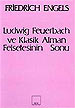
Ludwig Feuerbach ve Klasik Alman Felsefesinin Sonu
On the philosophy of Hegel and Feuerbach, and the essence and tasks of philosophy.
80 pages, Paperback
First published January 1, 1886
About the author
Friedrich Engels
2,066 books1,770 followersGerman social theorist Friedrich Engels collaborated with Karl Marx on
The Communist Manifesto
in 1848 and on numerous other works.
With the help of Friedrich Engels, Karl Marx wrote The Communist Manifesto (1848) and Das Kapital (1867-1894).
Friedrich Engels, a philosopher, political, historian, journalist, revolutionary, and also a businessman, was the closest and dearest friend of his lifelong colleague and collaborator.
https://en.wikipedia.org/wiki/Friedri...
With the help of Friedrich Engels, Karl Marx wrote The Communist Manifesto (1848) and Das Kapital (1867-1894).
Friedrich Engels, a philosopher, political, historian, journalist, revolutionary, and also a businessman, was the closest and dearest friend of his lifelong colleague and collaborator.
https://en.wikipedia.org/wiki/Friedri...
Ratings & Reviews
Friends & Following
Create a free account to discover what your friends think of this book!
Community Reviews
Displaying 1 - 30 of 93 reviews

June 22, 2020
One of the greatest and easy to read explainations of what dialectical and historical materialism really is. I'd definitely suggest this book to anyone new wanting to learn what dialectical materialism behind Marxism really is and what it stands for. Appart from that Engels makes some rather difficult concepts of Hegelian philosophy pretty easy and accessible and makes him (Hegel) less threatening to read. All in all a perfect book for what it intends to to.
(Επίσης οι σημειώσεις των εκδόσεων "Θεμέλιο" ήταν άψογες και ακόμα και στις Θέσεις του Μαρξ οι επεξηγήσεις ήταν λεπτομερείς και πολύ κατανοητές παρέχοντας το context του σε τι ακριβώς αναφέρεται ο Μαρξ για αυτούς που δεν έχουν μελετήσει τον Feuerbach)
5/5
(Επίσης οι σημειώσεις των εκδόσεων "Θεμέλιο" ήταν άψογες και ακόμα και στις Θέσεις του Μαρξ οι επεξηγήσεις ήταν λεπτομερείς και πολύ κατανοητές παρέχοντας το context του σε τι ακριβώς αναφέρεται ο Μαρξ για αυτούς που δεν έχουν μελετήσει τον Feuerbach)
5/5

May 6, 2018
Φοιτητικά αναγνώσματα. Ωραίες εποχές, μια άλλη "γλυκιά διάσταση".
October 6, 2018
This book serves as a synopsis of Marx's/Engels' philosophy of nature and history, specifically dialectical and historical materialism. When Engels published this small book, the more extended related work, "the German Ideology", wasn't out, so Engels believed that a more philosophical work about the matter was needed. In any case, German Ideology is much larger, thus this book comes in handy. I personally like Engels; he is a cheerful writer, with witty phrases inside the text, and he really cares for his reader to understand him.
This book basically tells the story how Marx and Engels were introduced to materialism via reading Feuerbach, while being back then Young/Left Hegelians. During the process they rejected and, at the same time, continued to respect both; Hegel envisioned a world of ideas in motion, and Feuerbach believed that ideas originated on human feelings, with the latter being static and eternal. Marx mixed these two concepts and envisioned a world of matter which undergoes constant changes. These changes in human society, in particular, then are reflected to ideologies and states.
Perhaps one of the best introductions to dialectical materialism, by one of its creators.
This book basically tells the story how Marx and Engels were introduced to materialism via reading Feuerbach, while being back then Young/Left Hegelians. During the process they rejected and, at the same time, continued to respect both; Hegel envisioned a world of ideas in motion, and Feuerbach believed that ideas originated on human feelings, with the latter being static and eternal. Marx mixed these two concepts and envisioned a world of matter which undergoes constant changes. These changes in human society, in particular, then are reflected to ideologies and states.
Perhaps one of the best introductions to dialectical materialism, by one of its creators.

February 18, 2025
thoughts:
I feel like a sieve pretending to be a bucket. I’ll have to read this again when I am more familiar with the topic, but I am honestly just happy I got through it the first time. You applaud, and I’ll do a deep bow, and then we’ll pretend for a while that I never read this.
I feel like a sieve pretending to be a bucket. I’ll have to read this again when I am more familiar with the topic, but I am honestly just happy I got through it the first time. You applaud, and I’ll do a deep bow, and then we’ll pretend for a while that I never read this.

December 16, 2024
Rather than an analysis of communist/socialist ideologies, this work looks at the concepts of dialectics, dialectical materialism, and certain philosophers misunderstanding or misrepresentation of these ideologies as potentially revolutionary ideas. It leads from Hegel's dialectics, to the understanding of materliams, to Feuerbach's (what I can gather) misuse of Hegel, to Marx's unification of dialectics and materialism and the disposing of philosophers such as Feuerbach, and thus classical German philosophy as a whole.
A good read for those interested in the more specific philosophical underpinnings of Marxism.
A good read for those interested in the more specific philosophical underpinnings of Marxism.

June 28, 2010
أسلوبك انجلس الرائع البسيط حد التعقيد في ذاته ، وعقليته النقدية الذفة تجعلني لا أنتهي تماماً من مطالعة كتاب كتبه إلا وعزمت العود إلى قراءته مجدداً ..
ملخص ، وموجز وفي الصميم في نقد الفلسفات المثالية بأسلوب لاينقصه براعة الاستدلال.
لا يفوت أبداً الفرصة لإطلاعك على ما قد تحتاج معرفته !
كتاب مهم ، ربما ألخصه بعد الفراغ من -شوية- مشغوليات ;D
ملخص ، وموجز وفي الصميم في نقد الفلسفات المثالية بأسلوب لاينقصه براعة الاستدلال.
لا يفوت أبداً الفرصة لإطلاعك على ما قد تحتاج معرفته !
كتاب مهم ، ربما ألخصه بعد الفراغ من -شوية- مشغوليات ;D

April 14, 2021
Important as a model for writing a materialist history of philosophy. In this review, I will focus on a less well known aspect of the book, namely its critique of Feuerbach.
Engels cheers Feuerbach on for his materialism, but argues that he remains an idealist when it comes to religion, seeking not to abolish it but to perfect it. Eros becomes the highest form of Feuerbach's new religion, culminating in an unmediated encounter between I and Thou. For Feuerbach, "Politics must become our religion," a religion grounded on the urge for bliss, rational self-restraint and love of the Other. Engels (no doubt uncharitably) compares Feuerbach's ethics to financial speculation:
"If my urge for bliss leads me to the Stock Exchange, and if there I correctly gauge the consequences of my actions so that only agreeable results and no disadvantages ensue, that is, if I always win, then I am fulfilling Feuerbach's precept. Moreover, I do not thereby interfere with the equal right of another person to pursue his bliss; for that other man went to the Exchange just as voluntarily as I did and in concluding the speculative transaction with me he has followed his urge for bliss as I have followed mine."
Engels' point is sound, if unfair. It is not enough to criticize the fantasmatic projections of idealism only to retreat to a cult of abstract man; materialists must investigate the historical development of all ideas, rejecting "every idealist quirk which could not be brought into harmony with the facts conceived in their own, and not in a fantastic, interconnection."
Engels cheers Feuerbach on for his materialism, but argues that he remains an idealist when it comes to religion, seeking not to abolish it but to perfect it. Eros becomes the highest form of Feuerbach's new religion, culminating in an unmediated encounter between I and Thou. For Feuerbach, "Politics must become our religion," a religion grounded on the urge for bliss, rational self-restraint and love of the Other. Engels (no doubt uncharitably) compares Feuerbach's ethics to financial speculation:
"If my urge for bliss leads me to the Stock Exchange, and if there I correctly gauge the consequences of my actions so that only agreeable results and no disadvantages ensue, that is, if I always win, then I am fulfilling Feuerbach's precept. Moreover, I do not thereby interfere with the equal right of another person to pursue his bliss; for that other man went to the Exchange just as voluntarily as I did and in concluding the speculative transaction with me he has followed his urge for bliss as I have followed mine."
Engels' point is sound, if unfair. It is not enough to criticize the fantasmatic projections of idealism only to retreat to a cult of abstract man; materialists must investigate the historical development of all ideas, rejecting "every idealist quirk which could not be brought into harmony with the facts conceived in their own, and not in a fantastic, interconnection."

February 17, 2022
I read this book as a recommendation to understand without reading Hegel - I only have one life and dedicating time to both work and reading Hegel sounds like too terrible of a life.
Here, Engels aptly gives the best explanation of Hegelian dialectics I've read (I am, however, not an expert on this), particularly as applied to materialism. However, this materialism - that of Marx - is greatly different from other materialisms that came before it; rather than taking an ideology or a basic scientific concept as the motor of human and material progress, Marx's dialectical materialism does away with these basic concepts and looks instead at history and to its development - this dialectical materialism sees the world, correctly, as a rolling process rather than as a steady state which evolved from some sequence of steady state in a deterministic manner. Engels notes, showing great knowledge on a number of fields, that this is the consequence of recent developments in natural sciences, particularly Darwinian evolution (I do wonder what they thought of Kropotkin's theory of evolution) and theories on the creation of the solar system, that showed how the world is not a state, but rather a process. This to me is the great lesson of dialectical materialism - human society is a rolling process of changes, at the heart of which is confrontation between classes divided by the dramatically unequal distribution of capital (and, in a more recent formulation, of the ability of exerting power, be it in the form of race, ethnicity, gender, ability or caste, to name a few).
Here, Engels aptly gives the best explanation of Hegelian dialectics I've read (I am, however, not an expert on this), particularly as applied to materialism. However, this materialism - that of Marx - is greatly different from other materialisms that came before it; rather than taking an ideology or a basic scientific concept as the motor of human and material progress, Marx's dialectical materialism does away with these basic concepts and looks instead at history and to its development - this dialectical materialism sees the world, correctly, as a rolling process rather than as a steady state which evolved from some sequence of steady state in a deterministic manner. Engels notes, showing great knowledge on a number of fields, that this is the consequence of recent developments in natural sciences, particularly Darwinian evolution (I do wonder what they thought of Kropotkin's theory of evolution) and theories on the creation of the solar system, that showed how the world is not a state, but rather a process. This to me is the great lesson of dialectical materialism - human society is a rolling process of changes, at the heart of which is confrontation between classes divided by the dramatically unequal distribution of capital (and, in a more recent formulation, of the ability of exerting power, be it in the form of race, ethnicity, gender, ability or caste, to name a few).
May 31, 2025
Absolute must read to understand the development of Marxism from German idealism. Hegel's thought represented a contradiction, a revolutionary aspect in the dialectic and a conservative aspect in the 'absolute idea'. Feuerbach made a start on developing the revolutionary aspect in Hegel by turning to materialism but never escaped the realm of abstraction. Marx, rather than setting Hegel on his head, turned him onto his feet, stood him upright with his eyes open.

September 17, 2019
Best short work of philosophy I've ever read. while German Ideology and 1844 have some superior aspects, they lack the lucid readibility of this text. Especially the brevity with which be both summarized and critiques Feuerbach & Hegel, situating them in their material context

September 6, 2007
Hard to understand... at least for me

July 5, 2025
" Only among the working class does the German aptitude for theory remain unimpaired. Here, it cannot be exterminated. Here, there is no concern for careers,for profit-making, or for gracious patronage from above. On the contrary, the more ruthlessly and disinterestedly science proceeds the more it finds itself in harmony with the interest and aspirations of the workers. The new tendency, which recognized that the key to the understanding of the whole history of society lies in the history of the development of labor, from the outset addressed itself by preference to the working class and here found the response which it neither sought nor expected from officially recognized science. The German working-class movement is the inheritor of German classical philosophy. " - Engals

August 10, 2024
Mijn 100ste boek is een product van de economische klasse! De leesclub wordt afgesloten 👻

August 22, 2022
This is an interesting and informative read, perhaps not as enlightening as some claim, but educational nonetheless, at least for the roots of dialectical materialism.
We see primarily in the first chapter Engels describing a portion of history of philosophy, intertwined, as it necessarily is, with philosophy of history: he moves from a description of Hegel’s own philosophical system, directly through to Feuerbach by virtue of Hegel’s own philosophy, or rather the dialectic specifically, as Engels is distinctly anti-idealist. It is interesting to note the way in which Engels’ own philosophical leanings shape the way he views history, and from that basis the way his philosophy of history is shaped (as they both must inform each other, even if plain knowledge of history comes first, it must still be affected by one’s preexisting ideas): materialism appears to ground us in the real, material history, and thus give us a solid foundation, yet it is for the just-mentioned reason that this foundation is already affected, and so Hegel’s idealism, which sees reality as having a conceptual structure, already accounts for this within the subject. Perhaps for the very reason that Engels sought to see the ‘sublation’ of Hegel’s own system, that being the sheer scope of ‘absolute truth’ (the “dogmatism” of which Engels claims to be self-contradicting), is precisely what delivers us back to it.
Nonetheless it is a clearly written explanation of the historical tides that took philosophy from Hegel, to the division between the young Hegelians and Right Hegelians, and then to Feuerbach cutting through with an "old materialism", which would be used and moved beyond by Marx Engels.
Moving forward, Engels, in the second chapter, begins with a description of the development of the notion of a god, and then shifts to a description of the materialist position, that being that this is merely an abstraction of ‘objectified subjectivity’ and the “personification of natural forces”. He then also, in opposition, outlines the idealist position, which he claims to be those “who asserted the primacy of spirit to nature and, therefore, in the last instance, assumed world creation in some form or other”.
He has an interesting remark which suggests that idealism is in fact a backwards materialism, the result only of the aforementioned history:
The rest of the text is dedicated to moving beyond Feuerbach's philosophy and establishing the case for dialectical and historical materialism, with an emphasis on a turn to recognition of class struggle as the form all political struggle takes. It is as you would expect, and pretty clear, though perhaps a bit repetitive in certain sections that appear to restate formerly established points.
The 'Outcome of Classical German Philosophy' is thus capped off with the conclusion, "the German working class is the inheritor of German classical philosophy.”
We see primarily in the first chapter Engels describing a portion of history of philosophy, intertwined, as it necessarily is, with philosophy of history: he moves from a description of Hegel’s own philosophical system, directly through to Feuerbach by virtue of Hegel’s own philosophy, or rather the dialectic specifically, as Engels is distinctly anti-idealist. It is interesting to note the way in which Engels’ own philosophical leanings shape the way he views history, and from that basis the way his philosophy of history is shaped (as they both must inform each other, even if plain knowledge of history comes first, it must still be affected by one’s preexisting ideas): materialism appears to ground us in the real, material history, and thus give us a solid foundation, yet it is for the just-mentioned reason that this foundation is already affected, and so Hegel’s idealism, which sees reality as having a conceptual structure, already accounts for this within the subject. Perhaps for the very reason that Engels sought to see the ‘sublation’ of Hegel’s own system, that being the sheer scope of ‘absolute truth’ (the “dogmatism” of which Engels claims to be self-contradicting), is precisely what delivers us back to it.
Nonetheless it is a clearly written explanation of the historical tides that took philosophy from Hegel, to the division between the young Hegelians and Right Hegelians, and then to Feuerbach cutting through with an "old materialism", which would be used and moved beyond by Marx Engels.
Moving forward, Engels, in the second chapter, begins with a description of the development of the notion of a god, and then shifts to a description of the materialist position, that being that this is merely an abstraction of ‘objectified subjectivity’ and the “personification of natural forces”. He then also, in opposition, outlines the idealist position, which he claims to be those “who asserted the primacy of spirit to nature and, therefore, in the last instance, assumed world creation in some form or other”.
He has an interesting remark which suggests that idealism is in fact a backwards materialism, the result only of the aforementioned history:
from Descartes to Hegel and from Hobbes to Feuerbach, the philosophers were by no means impelled…solely by the force of pure reason. On the contrary. What really pushed them forward was the powerful and ever more rapidly onrushing progress of natural science and industry. Among the materialists this was plain on the surface, but the idealist systems also filled themselves more and more with a materialist content and attempted pantheistically to reconcile the antithesis between mind and matter. Thus, ultimately, the Hegelian system represents merely a materialism idealistically turned upside down in method and content.Also, there is this further remark about Feuerbach's development:
With irresistible force Feuerbach is finally forced to the realisation that the Hegelian pre-mundane existence of the “absolute idea,” the “pre-existence of the logical categories” before the world existed is nothing more than the fantastic survival of the belief in the existence of an extra-mundane creator…Matter is not a product of the mind, but mind itself is merely the highest product of matter.I mention this primarily because I love the way this is written: as though Feuerbach’s ultimate realisation is a tragic yet necessary, a bittersweet, moment in the course of philosophy.
The rest of the text is dedicated to moving beyond Feuerbach's philosophy and establishing the case for dialectical and historical materialism, with an emphasis on a turn to recognition of class struggle as the form all political struggle takes. It is as you would expect, and pretty clear, though perhaps a bit repetitive in certain sections that appear to restate formerly established points.
The 'Outcome of Classical German Philosophy' is thus capped off with the conclusion, "the German working class is the inheritor of German classical philosophy.”

March 28, 2025
Amazingly lucid exposition of the development of German philosophy from Hegel’s idealism to Feuerbach’s materialism to Marx’s historical materialism and the very necessity of it. Engels masterfully connects the evolution of human thought with the material conditions that shaped it, especially with his breakdown of religion — not as a mere system of beliefs, but as a reflection of class interests and the conditions of the material world. I’d like to do more research on religion’s role in class society, so this was a great starting point. So far, it’s my favorite text from Engels, and it feels like the culmination of everything he’s written up to this point. I recommend his other article “Bruno Bauer and Early Christianity” and Marx’s “On the Jewish Question” as companions to this.

April 24, 2021
In this book, Engels (with the assistance of Marx, of course, although the latter died before thoroughly discussing the issue at hand) established the philosophical basis for the socialist philosophy. This act was in essence aided by the refutation of Feurbach, a preceding philosopher who managed to set some cornerstones while demolishing others, particularly with his 'idealistic' understanding of religion as 'a universal form of love' (hihihi). Engels excused the latter due to the indirectly enforced state of isolation he was living in, noticed his excellence, and moved on from that to demonstrate the philosophical framework of socialism, manifest in its most excellent of forms as the Marxist perception of history, eventually leading to communism.
Of course, this work came later on, after the death of Marx; thus, and due to the heavy experience of many years, one manages to sense its philosophical maturity and comprehensiveness, an aspect which might have been missing earlier on. The center of that ideology is still the same: studying history as a conflict between the two economical classes, a materialistic approach at its best. The rather 'abstract' ideas of Hegel, particularly his well-known dialectical process, has been borrowed and applied on history; Hegel employs his method on a rather notional realm of ideas, and not in a practical sense.
I am not in a position to accept nor refute such a philosophy, although I disagree with it on a fundamental level. From my perspective, it is rather simplistic to limit the study of history and narrow it down into a polar opposition, although the latter probably existed (and still does); to be fair, nonetheless, this struggle during the times of Marx and Engels was evinced the most, and that is mainly due to the industrial revolution; one would have to be blind to dismiss this observation. However, this does not mean that it is safe to project that on the entirety of history, observing this seemingly infinitely complex field of study into a mere opposition between the two classes. That is to say the least, I still have not ventured on dismissing communism as a solution for that (something which requires more study; I might agree with it after all, but this is highly unlikely; I am, eventually, an abstract idealist - my realm is elsewhere).
I admire both Marx and Engels, I think they were both exceptional philosophers who managed to give life to the Hegelian work, as they were true to their cause, and consistent with their currents of thought, a virtue which marks excellent minds: consistency. I also firmly believe that most of their followers have not read their books.
(Here, I would like to recall that the eventual aim of an educated mind is to entertain thoughts without necessarily accepting them.)
Of course, this work came later on, after the death of Marx; thus, and due to the heavy experience of many years, one manages to sense its philosophical maturity and comprehensiveness, an aspect which might have been missing earlier on. The center of that ideology is still the same: studying history as a conflict between the two economical classes, a materialistic approach at its best. The rather 'abstract' ideas of Hegel, particularly his well-known dialectical process, has been borrowed and applied on history; Hegel employs his method on a rather notional realm of ideas, and not in a practical sense.
I am not in a position to accept nor refute such a philosophy, although I disagree with it on a fundamental level. From my perspective, it is rather simplistic to limit the study of history and narrow it down into a polar opposition, although the latter probably existed (and still does); to be fair, nonetheless, this struggle during the times of Marx and Engels was evinced the most, and that is mainly due to the industrial revolution; one would have to be blind to dismiss this observation. However, this does not mean that it is safe to project that on the entirety of history, observing this seemingly infinitely complex field of study into a mere opposition between the two classes. That is to say the least, I still have not ventured on dismissing communism as a solution for that (something which requires more study; I might agree with it after all, but this is highly unlikely; I am, eventually, an abstract idealist - my realm is elsewhere).
I admire both Marx and Engels, I think they were both exceptional philosophers who managed to give life to the Hegelian work, as they were true to their cause, and consistent with their currents of thought, a virtue which marks excellent minds: consistency. I also firmly believe that most of their followers have not read their books.
(Here, I would like to recall that the eventual aim of an educated mind is to entertain thoughts without necessarily accepting them.)

Read
May 31, 2026Engels Marksın qaralamalarından yola çıxaraq hər ikisinin fəlsəfi həyatına təsir edən Hegel və Hegelçilərdən biri olan Feuerbachın fəlsəfi inşasına qarşı öz tənqidlərini yönəltmişdir. Hegeli kifayət qədər inqilabçı bir düşncə insanı kimi görsədə onu alman filisterliyi və tarixə yanaşma prinsipinə görə sərt tənqid emişdir. Feuerbachı isə idealist adlandırmış və onu real olmayan bir dunyada real olmayan bir insan yartmaq və ona əsasən bir sistem yaratmaqla tənqid edir, çunki ona görə istənilən sosial və fəlsəfi sistem inşası dövrün reallıqları əsasında yaradılmalıdı. Digər tənqidi isə tarixi materyalizmlə bağlı olub feuerbachın tarixə dırnaq arası baxmasının və onun əsas ünsür kimi görməməsinin onun başlıca yanlışı olduğunu söyləyir.

May 26, 2023
Engels has a strange view of natural science (perhaps he is to blame for Alan Woods). I cannot speak to his interpretation of Feuerbach, although I do suspect that his disparagement of romantic communism may be peremptory given its revival in people like John Holloway. But concerning natural science, he appears to believe that there were no premonitions of the 'three great scientific discoveries' of the 19th century: of evolution, the cell, and the convertibility of energy. Diderot was already hypothesising about evolution in the 1700s, and Engels' views on the possibility of chemically replicating life are certainly over-enthusiastic.

September 6, 2023
An essential weapon in my friend’s continuing mission to knock down my shabbily built walls of metaphysicality and put me on the path of materialism. Not sure how I feel about everything expressed here, but some of that is a revulsive reaction to being intellectually cornered into giving up the solace I’ve found in Mystery.

February 15, 2022
Essential reading for understanding historical and dialectical materialism.

March 11, 2024
I appreciated how many times Engels circled back to talk about how superior Lord Hegel’s thought was to the charlatans of his time such as Feuerbach, Jacobi, Schleiermacher, etc.

December 30, 2024
extrem gute historische herleitung der marxistischen philosophie

July 12, 2025
baba sen bu isi biliyon he

November 12, 2025
Been reading this as a break from reading about the Russian revolution for my leadoff but managed to find the most perfect quote for describing the role of revolutionary leadership

September 26, 2026
I decided to read this because apparently it was written in response to a request to rebuke neo-Kantianism. Recently, I encountered a person wondering whether it makes sense to be both a Kantian and a Marxist. Although there is a specific line of argumentation against Kant presented in this text, it is ultimately not really any abstract philosophical "position" that satisfies the task of rebuking Kant, but contextualizing Kant in an overarching *history* of philosophy, which the book traces in miniature.
One can, in a certain sense, be "Kantian" and a Marxist at the same time, insofar as it is not as if there is some absolute mutual exclusivity between "things Kantians think" and "things Marxists think."
In fact, there are some who might think that when Engels describes human knowledge as asymptotically approaching an understanding of reality, this is somewhat "Kantian." There are times that Engels sounds like a positivist. For if we can develop a model of the universe, even a "dialectical" one, is this not to insist that our concepts can correspond to or mirror reality? That would be undialectical. More likely, talking about and understanding dialectics is just difficult. Thought and reality are non-identical, but "knowledge" is not simply a question of our concepts and models, which don't have to be somehow interchangeable with reality in order for them to function. History has shown millions of times over, that models and theories that "work" are not necessarily "true" (because they've hit walls and been surpassed). Reality itself, even before our active input changes any part of it, is not static and immutable, much less is our thinking. Further, along with this non-identity (which doesn't imply that there is *no identity*), we are to understand that our knowledge is relative, and progressive, yet there is not something "beyond" our knowledge (the "thing-in-itself"), nor is thought or Subject "outside" of nature.
There are, meanwhile, all sorts of people today who understand the world, whether consciously or not, in terms of Kantian or pre-Kantian philosophical assumptions. A Marxist can explain why a pre-Kantian idea is "incorrect" through recourse to Kant, with an argument not at all disagreeable to Marxism, but the reason that this is feasible is not due to some philosophical, ungrounded (which matters to most "philosophers") meta-valuation that determines, ultimately arbitrarily, that Kant is "better." It's not a matter of taste or preference, even though one metaphysics is technically as good as another for the activity of all sorts of people in their daily lives. Two people with vastly different religious beliefs can work the same job. They might even be scientists. For that matter, what people claim to believe regularly, and even necessarily, contradicts what their daily practice evinces they must truly believe.
It is all rather reducible to a question of, why should we be debating epistemology or metaphysics in pre-Kantian terms at all? Recourse to Kant is a reminder that we've already dealt with these matters, so what do we make of an impulse to return to them? One need not be Kantian to see the relative reason in Kant. Our simultaneous desperation and inability to prove logically the "coherence" of science, for instance, leads us to turn over all the old stones, whether openly, or in the guise of talking about linguistics or cognitive science. It's not a logical matter of discovering the current best argument with the least prefabricated refutations, but a historical matter. Indeed, the point of bringing up Kant is precisely to remind ourselves that pure reason can "prove" any two opposite conclusions, and that we don't have any good reason to doubt that we "can" and indeed do have knowledge.
Engels uses a formulation in this text to rebuke Kant himself that I was already familiar with, although I'm not sure how I came across it. Does he use it in another work? In any case, it's a useful one.
"If we are able to prove the correctness of our conception of a natural process by making it ourselves, bringing it into being out of its conditions and making it serve our own purposes into the bargain, then there is an end to the Kantian ungraspable 'thing-in-itself.' The chemical substances produced in the bodies of plants and animals remained just such 'things-in-themselves' until organic chemistry began to produce them one after another, whereupon the 'thing-in-itself' became a thing for us — as, for instance, alizarin, the coloring matter of the madder, which we no longer trouble to grow in the madder roots in the field, but produce much more cheaply and simply from coal tar."
Of course, although this formulation works for its intended purpose, this is also a "one sided" argument, and too simplistic. Two people can evidently accomplish a single task practically while depending on different, even contradictory theories. The other thing that is missing in most non-Hegelian philosophy is that knowledge is not just a correspondence between thought and being in the mind of some individual, which is to say, knowledge is not a simple "state of being" itself. The nature of the facts that we discover is necessarily a function of the theories and methods used to arrive at them, they are necessarily based on the framing of problems, what questions we even think to ask, which are in turn based on our current concerns and knowledge.
Knowledge is intrinsically social and historical. Human practice has been functional in countless iterations over the course of history, even though the planet has materially remained more or less the same (although, of course, regional differences are certainly relevant in explaining cultural differences to an extent, but far from exhaustively). The nature of our problems changes with the nature of our practice. Historical theories cannot manage the newest problems. Rather than abandon what we know and revert to a prior theory, which is the first instinct of anyone these days who thinks that the source of our problems is technology, modernity, or even humanity itself, the weaknesses of a present theory have to be overcome, as humanity has successfully managed countless times throughout history.
Historical awareness suggests that "epistemology" is itself a dubious category, because consciousness, a speculative entity we by necessity experience "subjectively," obviously cannot be proven to be transcendental and immutable. On the contrary, we have no reason at all to believe it is, except for the mistaken impulse to treat consciousness the same way we treat, say, "matter," just so psychology and philosophy can emulate natural science. Yet in order to be actually scientific, human and social sciences have to recognize their subject matter for what it actually is, which means, precisely, treating it historically, and dialectically. This does not mean unempirically, obviously, but to recognize the diminished usefulness of empirical data when it is not incorporated into a dialectical view of social development, but only one that extrapolates static abstract entities from unexplained and decontextualized facts. The supposition that what we experience now, or the nature of our experience and thought, must always have been the same, is precisely the weakness of today's neo-Kantian, and, frankly, neo-scholastic philosophy. It's a weakness not just because it's a "bad argument," or because we have no definitive abstract grounding of our knowledge, which are dogmatic, pre-Kantian dilemmas, applying equally to natural science, that shouldn't be taken for granted as problems to begin with; it's a weakness because such suppositions are mystifying in practice.
Science does not prove something in a single experiment, but through countless experiments, amid and after which the knowledge remains provisional, though we must often act on it with certainty. Not only that, but science does not simply consist of the scientific method, but also "baseless" hypothesizing. Hypotheses cannot be proven in advance of actually being tested, so there's "no good reason" to test them at all, one might imagine. We do not apply the same standards to social theory, but rather, we look, for instance, at nominally "socialist countries," without verifying what socialism is, or if they are socialist, and say "there's no proof that socialism works." Are we really applying a scientific standard of "proof" here, or treating hypotheses as they are treated in science? Nothing can be proven without actually being given a fair shake, but when it comes to social upheaval, getting this fair shake in advance is impossible. Have we really experimented and tested the hypothesis? Is it possible to make general claims about the workability of a social system based on its success or failure in particular concrete conditions that can never be replicated? In other words, what are the actual "variables" that caused all this so-called socialism to allegedly fail? All of the social and human sciences by necessity suffer from the "crisis" of proof, or replication, when really it's a matter of a "crisis" in our conceptualization and methods.
The scientific method can be rejected on philosophical grounds (the problem of induction, for instance). The conclusions of science might strike us as absurd in our ignorance. The earth certainly doesn't *seem* round intuitively. However, the method and the conclusions can't be arbitrarily pit against each other. The method and the conclusion are proved by the same gesture: proving that the Earth is round via the scientific method. The veracity of the conclusion proves the method works, the reliability of the method supports the reliability of the conclusion. In other words, without a historical corpus of proof, there is no basis to believe we "know" anything. Epistemology can only run around in circles. Skepticism seems definitively insurmountable... if we disregard all of our experience. Yet this also means we do resort to thought extraneous to science for our faith in science, and for any motivation to do science at all; unscientific, unsupported, "irrational" reasons like "human values." Our reasons to exist and struggle for greater freedom, which is the ultimate point even of the natural sciences, are dependent on an empirically non-existent "meaning."
It's the Levi-Straussian view, which still greatly influences us today, that every culture is logical. It was hoped that this revelation could undermine the myth of the noble savage, but it has arguably only reproduced it in a new "relativist" form. This relativism is different from Engels' in that it is treated as relative to nothing, not reality and history. The so-called "ontological turn" criticized by David Graeber, who pointed out its "benevolent" conservatism and condescension, originates here. We keep our "reality," you have your "reality," as if nobody is capable of disagreeing with or taking a critical approach to their own culturally proscribed "reality." Cultures are immutable things that all adherents fully endorse and believe in.
Of course, every "culture" we observe is logical, depending on how we conceive of an artificially ossified, discrete thing called "a culture," because to the extent a culture is not logical, it would not survive to be observed at all. What lives must be operating logically enough, or else it would not be alive. What is overlooked here, though, is precisely all of the tendencies that cause cultures, which are really living and temporal things, and not frozen moments, to disintegrate. Even the most expansive civilizations have crumbled despite the fact that their culture was at some point apparently "logical," and usually they do not merely crumble, but pass some lessons along.
Yet all sorts of ill-conceived beliefs have certainly come into being and disappeared without our notice at all. Also, the "logical coherence" of a culture is tied to the context in which it operates, because it is adapted to its environment, although heavily mediated. As dialectics points out, cultures grow to be in *contradiction* with the environment they form in attunement with, because our means of subsistence run into, or even produce, new problems, forcing us to question how we live. Today, globalism overwrites local context by force. A culture might be suited to deal with local conditions, and to that extent it is logical, but global problems, like climate change, are objectively encroaching. What kind of theories and practices are adequate for dealing with climate change?
"The workers have by no means become reconciled to capitalist machine industry, even though they no longer simply break the machines to pieces, as they still did in 1848 on the Rhine," writes Engels. We can't confuse problems caused by the mediating technology we might call the exchange relation, to problems inherent to a "western culture," or to problems caused by the existence of specific machines or industries as such, for it is really exchange that begets the hoarding and waste that are aimed at maximizing accumulation while forestalling underconsumption. There is no need to "retreat" to more apparently minimal and wholesome modes of existence, but only to cast off the irrationality of production for the sake of exchange, for the survival of firms, trusts, markets and so forth, rather than for the survival of humanity.
The abandonment of technology, or a retreat into national isolationism does not actually address the problem. Aside from the fact that these are absurd dream scenarios, they are a way of saying "let's cut our losses." But these "losses" that some of us are so happy to sacrifice are to a large extent human beings and other creatures that have been helplessly dragged into a climate crisis that they did not, and could not cause. It is our duty to solve such problems and not "cut our losses," which means overcoming our theoretical and practical weaknesses, not retreating from them into romanticism. This is a bigger "moral" issue than any pretentious, fake-humble, "inclusive" or "deconstructive" stance that all ways of thinking are equally effective, or even better, equally delusional. Effective for what? (Religious) toleration on the one hand, and the opposition to dogmatism and repression on the other, two tendencies that are often in apparent tension with one another, do not put us into a "post-truth" situation. Putting people's desperate feelings and narcissism over their actual lives and freedom does. The recognition of the typical case, or that a relative, historical truth can be grasped, is not in itself repressive or dogmatic. The recognition of a "normal" is not a moral judgment per se against the "different." Ossification isn't a necessary endpoint of all language or knowledge in itself, it is a contingent failure in our own vigilance. We can't fall into the logic of tactical false advertising out of fear over how the truth might be opportunistically abused. Instead, we have to expose the truth along with the opportunistic abuse. Exaggerations and omissions don't make our problems any easier, but just complicate and proliferate more problems, more mystifications. The truth already incriminates society well enough, and fictions cannot provide a praxis to change it. (I would like to emphasize here, although this is no place to explain it in detail, that none of this implies any kind of reductive or essentialist biologism whatsoever).
We can't forget, on the other hand, that, as Sartre once put it, freedom is the irreducibility of culture to nature. Culture is not merely practical, not merely logical, but it includes all that is not simply subordinated to praxis and necessity. Cultural freedom is a reason to do politics at all, while politics is just a means to an end.
Another crucial point from Engels for those who question if Marxism is actually a Moral (which is just to say, after all, "practical") philosophy:
"The influences of the external world upon man express themselves in his brain, are reflected therein as feelings, impulses, volitions — in short, as 'ideal tendencies', and in this form become 'ideal powers.' If, then, a man is to be deemed an idealist because he follows 'ideal tendencies' and admits that 'ideal powers' have an influence over him, then every person who is at all normally developed is a born idealist and how, in that case, can there still be any materialists?"
Marxism is practical "philosophy," but not philosophy because it is not contemplative, but, contra moral philosophy, aimed at changing the world itself through practice; the drive to change the world might be derived in part from feelings and ambitions that are not purely "material," e.g. for freedom, happiness, or what have you. Marxism can only be construed as "moral" by those who consider all such feelings and desires "ideal," although they don't seem to disappear just because one acknowledges that matter precedes thought. In other words, it is a prejudice that derives from already believing that these things that exist in our world *need* an explanation that a merely material reality can't furnish.
Marxism is not Kantian, but it is not simply "not-Kantian," because Marxism is not ahistorical, it did not drop out of the sky. It developed from the German Idealist tradition. Marxism doesn't have to contain its "own" purely philosophical refutations of Kant, because it can show the necessary historical limits of a philosophy which lead to its overcoming. It is thanks to Kant that there's no need to waste the time to "logically" refute Kant. Now we look back desperately to older forms of thinking because we lack faith in our own, but also lack faith in *our* capacity to deal with the present problems in both our own thinking and in our reality. To try to re-inject more Kantianism into Marxism is a misguided idea of the same type.
One can, in a certain sense, be "Kantian" and a Marxist at the same time, insofar as it is not as if there is some absolute mutual exclusivity between "things Kantians think" and "things Marxists think."
In fact, there are some who might think that when Engels describes human knowledge as asymptotically approaching an understanding of reality, this is somewhat "Kantian." There are times that Engels sounds like a positivist. For if we can develop a model of the universe, even a "dialectical" one, is this not to insist that our concepts can correspond to or mirror reality? That would be undialectical. More likely, talking about and understanding dialectics is just difficult. Thought and reality are non-identical, but "knowledge" is not simply a question of our concepts and models, which don't have to be somehow interchangeable with reality in order for them to function. History has shown millions of times over, that models and theories that "work" are not necessarily "true" (because they've hit walls and been surpassed). Reality itself, even before our active input changes any part of it, is not static and immutable, much less is our thinking. Further, along with this non-identity (which doesn't imply that there is *no identity*), we are to understand that our knowledge is relative, and progressive, yet there is not something "beyond" our knowledge (the "thing-in-itself"), nor is thought or Subject "outside" of nature.
There are, meanwhile, all sorts of people today who understand the world, whether consciously or not, in terms of Kantian or pre-Kantian philosophical assumptions. A Marxist can explain why a pre-Kantian idea is "incorrect" through recourse to Kant, with an argument not at all disagreeable to Marxism, but the reason that this is feasible is not due to some philosophical, ungrounded (which matters to most "philosophers") meta-valuation that determines, ultimately arbitrarily, that Kant is "better." It's not a matter of taste or preference, even though one metaphysics is technically as good as another for the activity of all sorts of people in their daily lives. Two people with vastly different religious beliefs can work the same job. They might even be scientists. For that matter, what people claim to believe regularly, and even necessarily, contradicts what their daily practice evinces they must truly believe.
It is all rather reducible to a question of, why should we be debating epistemology or metaphysics in pre-Kantian terms at all? Recourse to Kant is a reminder that we've already dealt with these matters, so what do we make of an impulse to return to them? One need not be Kantian to see the relative reason in Kant. Our simultaneous desperation and inability to prove logically the "coherence" of science, for instance, leads us to turn over all the old stones, whether openly, or in the guise of talking about linguistics or cognitive science. It's not a logical matter of discovering the current best argument with the least prefabricated refutations, but a historical matter. Indeed, the point of bringing up Kant is precisely to remind ourselves that pure reason can "prove" any two opposite conclusions, and that we don't have any good reason to doubt that we "can" and indeed do have knowledge.
Engels uses a formulation in this text to rebuke Kant himself that I was already familiar with, although I'm not sure how I came across it. Does he use it in another work? In any case, it's a useful one.
"If we are able to prove the correctness of our conception of a natural process by making it ourselves, bringing it into being out of its conditions and making it serve our own purposes into the bargain, then there is an end to the Kantian ungraspable 'thing-in-itself.' The chemical substances produced in the bodies of plants and animals remained just such 'things-in-themselves' until organic chemistry began to produce them one after another, whereupon the 'thing-in-itself' became a thing for us — as, for instance, alizarin, the coloring matter of the madder, which we no longer trouble to grow in the madder roots in the field, but produce much more cheaply and simply from coal tar."
Of course, although this formulation works for its intended purpose, this is also a "one sided" argument, and too simplistic. Two people can evidently accomplish a single task practically while depending on different, even contradictory theories. The other thing that is missing in most non-Hegelian philosophy is that knowledge is not just a correspondence between thought and being in the mind of some individual, which is to say, knowledge is not a simple "state of being" itself. The nature of the facts that we discover is necessarily a function of the theories and methods used to arrive at them, they are necessarily based on the framing of problems, what questions we even think to ask, which are in turn based on our current concerns and knowledge.
Knowledge is intrinsically social and historical. Human practice has been functional in countless iterations over the course of history, even though the planet has materially remained more or less the same (although, of course, regional differences are certainly relevant in explaining cultural differences to an extent, but far from exhaustively). The nature of our problems changes with the nature of our practice. Historical theories cannot manage the newest problems. Rather than abandon what we know and revert to a prior theory, which is the first instinct of anyone these days who thinks that the source of our problems is technology, modernity, or even humanity itself, the weaknesses of a present theory have to be overcome, as humanity has successfully managed countless times throughout history.
Historical awareness suggests that "epistemology" is itself a dubious category, because consciousness, a speculative entity we by necessity experience "subjectively," obviously cannot be proven to be transcendental and immutable. On the contrary, we have no reason at all to believe it is, except for the mistaken impulse to treat consciousness the same way we treat, say, "matter," just so psychology and philosophy can emulate natural science. Yet in order to be actually scientific, human and social sciences have to recognize their subject matter for what it actually is, which means, precisely, treating it historically, and dialectically. This does not mean unempirically, obviously, but to recognize the diminished usefulness of empirical data when it is not incorporated into a dialectical view of social development, but only one that extrapolates static abstract entities from unexplained and decontextualized facts. The supposition that what we experience now, or the nature of our experience and thought, must always have been the same, is precisely the weakness of today's neo-Kantian, and, frankly, neo-scholastic philosophy. It's a weakness not just because it's a "bad argument," or because we have no definitive abstract grounding of our knowledge, which are dogmatic, pre-Kantian dilemmas, applying equally to natural science, that shouldn't be taken for granted as problems to begin with; it's a weakness because such suppositions are mystifying in practice.
Science does not prove something in a single experiment, but through countless experiments, amid and after which the knowledge remains provisional, though we must often act on it with certainty. Not only that, but science does not simply consist of the scientific method, but also "baseless" hypothesizing. Hypotheses cannot be proven in advance of actually being tested, so there's "no good reason" to test them at all, one might imagine. We do not apply the same standards to social theory, but rather, we look, for instance, at nominally "socialist countries," without verifying what socialism is, or if they are socialist, and say "there's no proof that socialism works." Are we really applying a scientific standard of "proof" here, or treating hypotheses as they are treated in science? Nothing can be proven without actually being given a fair shake, but when it comes to social upheaval, getting this fair shake in advance is impossible. Have we really experimented and tested the hypothesis? Is it possible to make general claims about the workability of a social system based on its success or failure in particular concrete conditions that can never be replicated? In other words, what are the actual "variables" that caused all this so-called socialism to allegedly fail? All of the social and human sciences by necessity suffer from the "crisis" of proof, or replication, when really it's a matter of a "crisis" in our conceptualization and methods.
The scientific method can be rejected on philosophical grounds (the problem of induction, for instance). The conclusions of science might strike us as absurd in our ignorance. The earth certainly doesn't *seem* round intuitively. However, the method and the conclusions can't be arbitrarily pit against each other. The method and the conclusion are proved by the same gesture: proving that the Earth is round via the scientific method. The veracity of the conclusion proves the method works, the reliability of the method supports the reliability of the conclusion. In other words, without a historical corpus of proof, there is no basis to believe we "know" anything. Epistemology can only run around in circles. Skepticism seems definitively insurmountable... if we disregard all of our experience. Yet this also means we do resort to thought extraneous to science for our faith in science, and for any motivation to do science at all; unscientific, unsupported, "irrational" reasons like "human values." Our reasons to exist and struggle for greater freedom, which is the ultimate point even of the natural sciences, are dependent on an empirically non-existent "meaning."
It's the Levi-Straussian view, which still greatly influences us today, that every culture is logical. It was hoped that this revelation could undermine the myth of the noble savage, but it has arguably only reproduced it in a new "relativist" form. This relativism is different from Engels' in that it is treated as relative to nothing, not reality and history. The so-called "ontological turn" criticized by David Graeber, who pointed out its "benevolent" conservatism and condescension, originates here. We keep our "reality," you have your "reality," as if nobody is capable of disagreeing with or taking a critical approach to their own culturally proscribed "reality." Cultures are immutable things that all adherents fully endorse and believe in.
Of course, every "culture" we observe is logical, depending on how we conceive of an artificially ossified, discrete thing called "a culture," because to the extent a culture is not logical, it would not survive to be observed at all. What lives must be operating logically enough, or else it would not be alive. What is overlooked here, though, is precisely all of the tendencies that cause cultures, which are really living and temporal things, and not frozen moments, to disintegrate. Even the most expansive civilizations have crumbled despite the fact that their culture was at some point apparently "logical," and usually they do not merely crumble, but pass some lessons along.
Yet all sorts of ill-conceived beliefs have certainly come into being and disappeared without our notice at all. Also, the "logical coherence" of a culture is tied to the context in which it operates, because it is adapted to its environment, although heavily mediated. As dialectics points out, cultures grow to be in *contradiction* with the environment they form in attunement with, because our means of subsistence run into, or even produce, new problems, forcing us to question how we live. Today, globalism overwrites local context by force. A culture might be suited to deal with local conditions, and to that extent it is logical, but global problems, like climate change, are objectively encroaching. What kind of theories and practices are adequate for dealing with climate change?
"The workers have by no means become reconciled to capitalist machine industry, even though they no longer simply break the machines to pieces, as they still did in 1848 on the Rhine," writes Engels. We can't confuse problems caused by the mediating technology we might call the exchange relation, to problems inherent to a "western culture," or to problems caused by the existence of specific machines or industries as such, for it is really exchange that begets the hoarding and waste that are aimed at maximizing accumulation while forestalling underconsumption. There is no need to "retreat" to more apparently minimal and wholesome modes of existence, but only to cast off the irrationality of production for the sake of exchange, for the survival of firms, trusts, markets and so forth, rather than for the survival of humanity.
The abandonment of technology, or a retreat into national isolationism does not actually address the problem. Aside from the fact that these are absurd dream scenarios, they are a way of saying "let's cut our losses." But these "losses" that some of us are so happy to sacrifice are to a large extent human beings and other creatures that have been helplessly dragged into a climate crisis that they did not, and could not cause. It is our duty to solve such problems and not "cut our losses," which means overcoming our theoretical and practical weaknesses, not retreating from them into romanticism. This is a bigger "moral" issue than any pretentious, fake-humble, "inclusive" or "deconstructive" stance that all ways of thinking are equally effective, or even better, equally delusional. Effective for what? (Religious) toleration on the one hand, and the opposition to dogmatism and repression on the other, two tendencies that are often in apparent tension with one another, do not put us into a "post-truth" situation. Putting people's desperate feelings and narcissism over their actual lives and freedom does. The recognition of the typical case, or that a relative, historical truth can be grasped, is not in itself repressive or dogmatic. The recognition of a "normal" is not a moral judgment per se against the "different." Ossification isn't a necessary endpoint of all language or knowledge in itself, it is a contingent failure in our own vigilance. We can't fall into the logic of tactical false advertising out of fear over how the truth might be opportunistically abused. Instead, we have to expose the truth along with the opportunistic abuse. Exaggerations and omissions don't make our problems any easier, but just complicate and proliferate more problems, more mystifications. The truth already incriminates society well enough, and fictions cannot provide a praxis to change it. (I would like to emphasize here, although this is no place to explain it in detail, that none of this implies any kind of reductive or essentialist biologism whatsoever).
We can't forget, on the other hand, that, as Sartre once put it, freedom is the irreducibility of culture to nature. Culture is not merely practical, not merely logical, but it includes all that is not simply subordinated to praxis and necessity. Cultural freedom is a reason to do politics at all, while politics is just a means to an end.
Another crucial point from Engels for those who question if Marxism is actually a Moral (which is just to say, after all, "practical") philosophy:
"The influences of the external world upon man express themselves in his brain, are reflected therein as feelings, impulses, volitions — in short, as 'ideal tendencies', and in this form become 'ideal powers.' If, then, a man is to be deemed an idealist because he follows 'ideal tendencies' and admits that 'ideal powers' have an influence over him, then every person who is at all normally developed is a born idealist and how, in that case, can there still be any materialists?"
Marxism is practical "philosophy," but not philosophy because it is not contemplative, but, contra moral philosophy, aimed at changing the world itself through practice; the drive to change the world might be derived in part from feelings and ambitions that are not purely "material," e.g. for freedom, happiness, or what have you. Marxism can only be construed as "moral" by those who consider all such feelings and desires "ideal," although they don't seem to disappear just because one acknowledges that matter precedes thought. In other words, it is a prejudice that derives from already believing that these things that exist in our world *need* an explanation that a merely material reality can't furnish.
Marxism is not Kantian, but it is not simply "not-Kantian," because Marxism is not ahistorical, it did not drop out of the sky. It developed from the German Idealist tradition. Marxism doesn't have to contain its "own" purely philosophical refutations of Kant, because it can show the necessary historical limits of a philosophy which lead to its overcoming. It is thanks to Kant that there's no need to waste the time to "logically" refute Kant. Now we look back desperately to older forms of thinking because we lack faith in our own, but also lack faith in *our* capacity to deal with the present problems in both our own thinking and in our reality. To try to re-inject more Kantianism into Marxism is a misguided idea of the same type.
February 5, 2021
Menandai titik tolaknya ke perjuangan sosialisme berlandas ilmu ekonomi-politik, Marx-Engels memulainya dengan sebuah dokumen pendek yang berisi rangkuman kritik filsafat berjudul On Feuerbach (1845) atau yang biasa dikenal dengan Tesis-Tesis Feuerbach.
Sebagai fondasi filsafatnya, Marx-Engels sangat dipengaruhi oleh filsafat Hegel (dalam dialektika) dan Feuerbach (dalam materialisme). Namun hal itu bukannya tanpa kritik.
Marx misalnya, sejak masa mudanya mengkritik berbagai posisi filsafat Hegel yang bersifat idea-sentris, dan sebagai konsekuensinya, tidak realistis. Begitu pula dengan filsafat Feuerbach.
Meski Feuerbach telah mengetengahkan filsafat materialisme lebih jauh hingga memengaruhi banyak filsuf muda Jerman saat itu, namun pikirannya tentang "hakikat manusia" berangkat dari sejumput ide-ide abstrak ke-maha manusia-an "universal", alih-alih dari realitas konkretnya.
Sayangnya hingga Marx wafat, sebagaimana dijelaskan Engels, keduanya tidak pernah sempat untuk menuntaskan posisi filsafat mereka dalam posisi yang lebih kukuh dari sekadar catatan "terburu-buru" mereka (maksudnya On Feuerbach) sehubungan dengan posisi Hegel dan Feuerbach.
Maka menjelang masa akhir kehidupannya itulah Engels menerbitkan buku polemik filsafat ini, yang menjelaskan titik-titik persinggungan dan perceraian filsafat Marx-Engels dengan Hegel dan Feuerbach.
"Tetapi langkah yang tidak diambil oleh Feuerbach bagaimanapun harus diambil. Pemujaan terhadap manusia abstrak, yang merupakan inti agama baru Feuerbach, harus diganti oleh ilmu tentang manusia-manusia nyata beserta perkembangan sejarahnya." (F. Engels, 1886)
Barangkali lebih dari sekadar upaya menghargai keduanya sebagai peletak fondasi pada filsafat Marx dan Engels. Tapi melampaui mereka adalah soal untuk kemajuan pengetahuan dan kemanusiaan di masa mendatang.
Sebagai fondasi filsafatnya, Marx-Engels sangat dipengaruhi oleh filsafat Hegel (dalam dialektika) dan Feuerbach (dalam materialisme). Namun hal itu bukannya tanpa kritik.
Marx misalnya, sejak masa mudanya mengkritik berbagai posisi filsafat Hegel yang bersifat idea-sentris, dan sebagai konsekuensinya, tidak realistis. Begitu pula dengan filsafat Feuerbach.
Meski Feuerbach telah mengetengahkan filsafat materialisme lebih jauh hingga memengaruhi banyak filsuf muda Jerman saat itu, namun pikirannya tentang "hakikat manusia" berangkat dari sejumput ide-ide abstrak ke-maha manusia-an "universal", alih-alih dari realitas konkretnya.
Sayangnya hingga Marx wafat, sebagaimana dijelaskan Engels, keduanya tidak pernah sempat untuk menuntaskan posisi filsafat mereka dalam posisi yang lebih kukuh dari sekadar catatan "terburu-buru" mereka (maksudnya On Feuerbach) sehubungan dengan posisi Hegel dan Feuerbach.
Maka menjelang masa akhir kehidupannya itulah Engels menerbitkan buku polemik filsafat ini, yang menjelaskan titik-titik persinggungan dan perceraian filsafat Marx-Engels dengan Hegel dan Feuerbach.
"Tetapi langkah yang tidak diambil oleh Feuerbach bagaimanapun harus diambil. Pemujaan terhadap manusia abstrak, yang merupakan inti agama baru Feuerbach, harus diganti oleh ilmu tentang manusia-manusia nyata beserta perkembangan sejarahnya." (F. Engels, 1886)
Barangkali lebih dari sekadar upaya menghargai keduanya sebagai peletak fondasi pada filsafat Marx dan Engels. Tapi melampaui mereka adalah soal untuk kemajuan pengetahuan dan kemanusiaan di masa mendatang.

June 13, 2023
Une des meilleures synthèses de la philosophie marxiste qui existe, Engels exprime mieux en peu de mots ce que d’autres n’arriveraient pas à exprimer dans des briques de 1000 pages

November 14, 2017
Engel's point of view on the historical process of the Western philosophy in alignment with social and economical progress was illuminating.
After watching Mr. Robot, my curiosity led me to Feuerbach's philosophy.
Self alienation from the morals and virtues to another plane seemed appropriate. Religion dissolves in society as we experience in today's world. To illustrate this, he supposes the humanity to be abstract and therefore, only comprehended as a species with natural identity of qualities in which many individuals are embraced. Abstract individual which he analyzes in 1848, belongs in today's reality. Lİfe of society is practical. All the mysteries which seduce speculative thought into mysticism find their solution in human practice and in concepts of this practice. The highest point to which materialism attains, that is the materialism which compreheneds sensation, not as a practical fact, is the point of view of the single individual
After watching Mr. Robot, my curiosity led me to Feuerbach's philosophy.
Self alienation from the morals and virtues to another plane seemed appropriate. Religion dissolves in society as we experience in today's world. To illustrate this, he supposes the humanity to be abstract and therefore, only comprehended as a species with natural identity of qualities in which many individuals are embraced. Abstract individual which he analyzes in 1848, belongs in today's reality. Lİfe of society is practical. All the mysteries which seduce speculative thought into mysticism find their solution in human practice and in concepts of this practice. The highest point to which materialism attains, that is the materialism which compreheneds sensation, not as a practical fact, is the point of view of the single individual
February 5, 2013
I read this book because Engels himself recommends it as one of the best explanations of historical materialism available. But the basic idea is get off with saying the modern science knows how the conscientiousness comes about, while I was eager to hear how it could be done. (Anyone saying this clearly shows he is not yet conscious of his own conscientiousness. And perhaps it is senseless to expect materialism will ever explain conscientiousness or at least grasp the fact it can never explain it.) Nevertheless, the book offers Marxism given from the first hand, it is short, popular and easy to understand. The interesting point - Marxism is just Hegel strongly vulgarized and turned upside down.
Displaying 1 - 30 of 93 reviews