“The stern sank below the waves, and the graceful arc of her bow aimed into the dark heavens, as she struggled, almost desperate to keep her proud head above water, and then as the hoarse screams of five hundred men rose, she began a slow watery spin, the water turning faster and faster and faster and faster, until the swirling vortex sucked the men into a suffocating darkness, deeper and deeper, cracking their ears, ripping the life vests from their bodies, tearing from their hands the planks and spars, sucking them deeper and deeper into the darkness, the pressure squeezing the air out of their lungs, salt water filling their noses and mouths and seeping into their eyes, their bodies twisting, the ship exploding all around them in the blackness, the pieces whirling, slamming into them, deeper and deeper and deeper, trapped in the vortex, entangled in the rigging, swallowing the salty water, their lungs filling, the last thoughts racing across their minds before the final darkness set in, descending with the once majestic steamer through the long column of black water, now possessed by her, and dead long before she crashed into the floor of the sea thousands of feet below.”
- Gary Kinder, Ship of Gold in the Deep Blue Sea
If I ever had any notions of being a treasure hunter, Gary Kinder’s Ship of Gold in the Deep Blue Sea disabused me of them.
There is something fun and romantic in the lure of lost gold. The promise of great financial rewards upon the solving of a riddle. But as Kinder shows in his epic book, it seems mostly awful. Instead of setting sail with an old, brown-stained map, X clearly marking the spot, the modern search for treasure involves Bayesian theory, and begging investors to buy stock in your limited partnership, and finding a good lawyer to file injunctions in admiralty court. It also helps to have a strong engineering background to create machines capable of working at the bottom of the sea.
All of this sounds like a bummer, and nothing at all like The Goonies. In point of fact, it seems like a lot more trouble than it’s worth. Even if you find something, you still have to protect it: from other salvagers; the insurance companies; the IRS.
It’s enough to turn you into Smaug.
***
Ship of Gold in the Deep Blue Sea is about one of the greatest treasure hunts in history: the quest for the SS Central America and her approximately $150 million in gold bars and coins.
On September 9, 1857, two days out of Havana and bound for New York City, the Central America ran into a hurricane. The side-wheel steamship was filled with passengers and gold from California. For several days, she battled wind and waves. Water filled the hull and knocked out the boilers, meaning she had no steam power. Captain William Herndon, a brave and skilled seaman, tried to raise sail, but they were ripped to shreds. The men formed bucket brigades to try to keep the ship afloat.
The sea’s relentless fury stymied their efforts. A passing ship took off the women and children in lifeboats. On September 12, the Central America foundered, taking over 400 men and a lot of wealth to the bottom.
Kinder begins Ship of Gold with a quick prologue about the California gold rush, before segueing to a powerful and vivid retelling of the Central America’s final struggle. He does a marvelous job weaving together survivor accounts to form a coherent, gripping picture. These opening chapters alone make the book worthwhile; a fine entry into the literary canon of men and women against the sea.
***
Once the Central America has come to rest some eight-thousand feet below the waves, Kinder moves the spotlight of his tale to Thomas G. Thompson.
As protagonists go, you could do a lot worse. A brilliant and idiosyncratic engineer, he was the type of person that grew up taking things apart and putting them back together; an expert tinkerer with an inquisitive mind. As a young man, he drove an amphibious car. He is the student in college who is smarter than the professor yet gets bad grades.
Kinder does a wonderful job evoking Thompson, with one glaring exception: he never explains why he settled on finding the Central America as his life’s challenge. This unexplored gap ultimately looms large, given Kinder’s miscalculation – discussed at the bottom – about what kind of man Tommy actually turned out to be.
***
Whatever his reasons, once Thompson decided to find the Central America, he went at the project with tirelessness, thoroughness, and ingenuity. Kinder follows Thompson as he painstakingly gathers investors, plots the possible locations of the Central America, and sets out to sea with untested deep-water ROVs (remotely operated vehicles) to find a speck on the ocean floor.
***
Kinder is a fantastic writer, combing a masterful narrative with comprehensiveness of coverage. There are scenes in the book – such as when Tommy’s research ship attempts to block an interloper from doing a sonar scan on their dive-site – that read like a thriller. But he also does a very good job of explaining all the different disciplines that go into a treasure hunt. He discourses on the plotting, the robotics, the mechanics of a sonar grid, and the arcane procedures of maritime law.
There is a palpable obsessiveness to men on the trail of gold. If you don’t believe me, crack open a beer, turn on the TV, and flip over to Turner Classic Movies for a showing of The Treasure of the Sierra Madre. Part of the magic of Ship of Gold is that Kinder translates that obsession into his telling, so that my fervor while reading matched Tommy’s while searching. This is a book, in other words, that kept me up past my bedtime on several nights.
***
My quibbles are relatively minor. First and foremost, there is a lack of endnotes or sources. This feels incredibly researched. The level of detail is astounding. But it would’ve been nice to have some idea of what that research entailed. In a brief acknowledgment, Kinder explains that he imbedded himself with Tommy and his group, but that is all the explanation that is given. There’s not even an index. The 507 pages of this book are all devoted to the text.
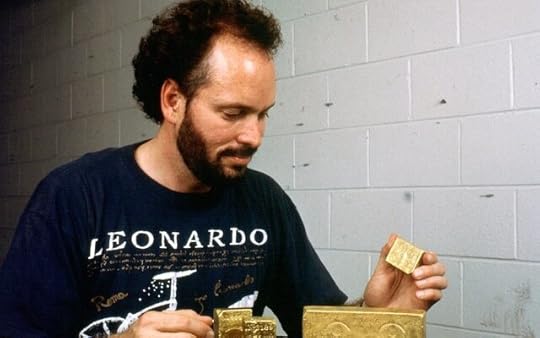
Second, there aren’t any pictures. Seriously, I like to know what people look like, especially when they aren’t famous. I spent a lot of time Googling when I should’ve been looking at a photo inset.
***
The greatest flaw is how Kinder wraps things up.
The Central America was discovered by Thompson's Columbus-America Group in 1989. Ship of Gold was published in 1998. Despite a lot of things happening in the interim, Kinder jarringly ends his story almost immediately after Tommy hits paydirt. Forsaking his earlier attention to detail, Kinder covers almost a decade’s worth of events in a brief epilogue. The epilogue greatly compresses the actual recovery of the gold, Thompson's fight with the insurance companies that tried to wet their beaks, and the ultimate disposal of the Central America’s treasure.
There is also an issue over which Kinder had no control: the continuation of the tale beyond the book.
A book is finite. At a certain point, arbitrary or not, it must end. Life, however, keeps on moving. Unfortunately, while Googling images that should’ve been included with the book, I came across Thompson’s sad postscript.
Kinder is very much attached to Thompson in Ship of Gold. His portrayal is uniformly positive. There were dozens of times when Thompson did something and I said to myself, What an asshole! But Kinder always gave an indulgent shoulder shrug, as if to say, Geniuses, am I right?
At the end of the epilogue, with the gold not yet distributed, Kinder is sanguine about the effects of enormous wealth on his hero. “Ultimately,” Kinder writes, “[Thompson] will receive a huge sum, but his friends, partners, and people at Columbus-America see him changing little.”
Well, he did change a little.
By which I mean he became Bogart from Sierra Madre. The latest news stories I can find have him in jail for contempt, refusing to divulge the location of the gold that is meant to pay off his original investors. This is after he was on the lam for several years, avoiding the civil lawsuits filed against him.
So maybe there is one thing that Ship of Gold in the Deep Blue Sea fails to do entirely. And that is to measure the power of greed on the human soul. “If more of us valued food and cheer and song above hoarded gold,” Thorin says at the end of The Hobbit, “It would be a merrier world.”
It’s a lesson Tommy Thompson might have done well to heed.
[Postscript: Just checked today, August 9, 2023, and Thomas G. Thompson is still in FCI Milan, where he’s been for eight years, refusing to divulge the contents of his own hidden treasure. He’s now seventy-one.]



 rosado mp3

 Gripping history, and who doesn't like stories of treasure. Fully recommended


