

What do you think?

In Search of Zarathustra: The First Prophet and the Ideas That Changed the World
A fascinating journey through time and across Europe and Central Asia, in search of the prophet Zarathustra (a.k.a. Zoroaster)—perhaps the greatest religious lawgiver of the ancient world—and his vast influence.
In Persia more than three thousand years ago, Zarathustra spoke of a single universal god, the battle between good and evil, the devil, heaven and hell, and an eventual end to the world—foreshadowing the core beliefs of Judaism, Christianity, and Islam. Moving from present to past, Paul Kriwaczek examines the effects of the prophet’s teachings on the spiri-tual and daily lives of diverse peoples. Beginning in the year 2000 with New Year’s festivities in Iran, he walks us back through Nietzsche’s nineteenth-century interpretation of Zarathustra to the Cathars of thirteenth-century France and the ninth-century Bulgars; from ancient Rome to the time of Alexander the Great’s destruction of the Persian Empire; and, finally, to the time of Zarathustra himself.
Not only an enthralling travel book, In Search of Zarathustra is also a revelation of the importance of the prophet, and a brilliantly conceived and lucid explication of the belief systems that helped shape the European Enlightenment, the Middle Ages, the Dark Ages, and the beginning of the Christian era. It is an enthralling study of a little-explored subject.
In Persia more than three thousand years ago, Zarathustra spoke of a single universal god, the battle between good and evil, the devil, heaven and hell, and an eventual end to the world—foreshadowing the core beliefs of Judaism, Christianity, and Islam. Moving from present to past, Paul Kriwaczek examines the effects of the prophet’s teachings on the spiri-tual and daily lives of diverse peoples. Beginning in the year 2000 with New Year’s festivities in Iran, he walks us back through Nietzsche’s nineteenth-century interpretation of Zarathustra to the Cathars of thirteenth-century France and the ninth-century Bulgars; from ancient Rome to the time of Alexander the Great’s destruction of the Persian Empire; and, finally, to the time of Zarathustra himself.
Not only an enthralling travel book, In Search of Zarathustra is also a revelation of the importance of the prophet, and a brilliantly conceived and lucid explication of the belief systems that helped shape the European Enlightenment, the Middle Ages, the Dark Ages, and the beginning of the Christian era. It is an enthralling study of a little-explored subject.
272 pages, Hardcover
First published January 1, 2002
About the author
Paul Kriwaczek
5 books66 followersPaul Kriwaczek was a British historian and television producer. In 1970 he joined the BBC full-time and wrote, produced and directed for twenty-five years. A former head of Central Asian Affairs at the BBC World Service, he was fluent in eight languages, including Farsi, Pashto, Urdu, Hindi and Nepalese.
Ratings & Reviews
Friends & Following
Create a free account to discover what your friends think of this book!
Community Reviews
Displaying 1 - 30 of 103 reviews

April 4, 2022
The Ideology of the Future
The talented amateur lives! Paul Kriwaczek has been an international car smuggler, a dental surgeon, a BBC radio producer, and a television film-maker before he wrote this book about the obscure but powerfully influential Persian religious figure, Zarathustra. Because Kriwaczek is not caught up in established disciplinary puzzles, he can make interesting connections that the professional historians of religion largely ignore or overlook. That he is often wrong in his judgment doesn’t diminish the importance of his creativity. Kriwaczek thinks that Zoroastrianism (the Greek version of Zarathustra’s religion) is the “ideology of the future.” He may well be right. But it is also the ideology of the past, one that has caused immense harm to humanity and the planet. It is therefore not an ideology to be seriously recommended.
There’s a good argument to be made that the Persian prophet Zarathustra, like the Sanskrit in which his thoughts are written down, is a primary source of Western culture. He invented monotheism (the one, invisible, entirely spiritual, God, Ahura Mazda), established the metaphysical and ethical dualism which is the foundation of Jewish, Christian and Muslim religious sentiment (Ahriman, the Power of Evil, as Mazda’s opponent who tempts and traps us), and created much of the spiritual symbolism and ritual which permeate Western culture (the halo representing the light of Mazda, angels as divine messengers, heaven, the virgin birth, the advent of a spiritual saviour, resurrection of the dead, final judgment, baptism, the mystical meal among worshippers, among others)
Zarathustra’s ideas were carried out of Central Asia by the Greeks of Alexander’s army, whence they were eventually incorporated into Greek philosophy (Pythagoras) and even the devotions of the subsequent Roman military (Mithraism). These same ideas leaked into the existing religions of Judaism (Satan) and emerging Christianity (the Magi), and eventually into the culture of Islam (the Divs or demons). Their message is that the battle between good and evil is “the essential wheel in the working of things.”
And despite its frequent suppression as contrary to official religious teaching, the Zoroastrian idea of a cosmic battle between good and evil has re-asserted itself continuously in the modern world in various forms. The Gnostics, the Manacheans, the Bogomils, the Cathars, strict Calvinists and Jansenists, the Mormons, and ultimately fundamentalisms of every type are direct descendants of Zoroastrian religious cults.
Yet the dominant official metaphysical ideology of the last two thousand or so years has been that the world is essentially good despite overwhelming evidence to the contrary. The Jewish, Christian, and Islamic Scriptures claim the goodness of the world explicitly (Genesis 1:31; Surah An-Nisa, 4:40).* Zoroastrianism acts as a hidden but pervasive bedrock for much of Western culture. As Kriwaczek says,
Western religions have always had a problem reconciling their doctrine of essential goodness with the obvious and ever-present existence of great evil. In order to maintain their metaphysical presumptions they have chosen to employ a sort of metaphysical hack and define evil theoretically as an ‘absence of God’ rather than a force in itself.
We know through experience that this is merely a theological rationalisation, a spiritual dream world. Our optimism about spiritual progress, the importance of reason and rationality, faith that faith will prevail has been shown to be obvious nonsense. The official explanation just doesn’t hold water. Perhaps this is a reason for the decline in participation among main stream sects.
In any case, in practice all Western religions support the cosmic Zoroastrian battle between good and evil. This is presented by them as the central drama of human life and is the clear residue of Zoroastrian ethical dualism. John Milton’s Paradise Lost is perhaps the most compelling example of the cultural penetration of the Zoroastrian metaphysic. Technically heretical, the ideological violence depicted in the poem is the source of not just Christian attitudes but also of general Western sentiment.
And the metaphysical background radiation of Zoroastrianism has very real consequences. For example, the American conception of its national existence as ‘a house on the hill’ confronting the Evil Empire of the day is a typical Zoroastrian political trope. As is Vladimir Putin’s crusade to re-instate the Russian empire, with the help of the Orthodox Church, as a bulwark against cultural degradation. For these folk, the good must not be compromised whether one is discussing abortion or armed invasion.
Like all metaphysics, the presumption of permanent conflict between good and evil itself, taken as a matter of implicit belief, is a self-fulfilling prophecy. It demands arbitrarily defining the good to be defended, taking sides, and purposely eliminating the possibility of negotiation and compromise. Zoroastrian ideology is therefore inherently divisive, the cause of secular war as well as religious strife. The growing cost of this metaphysic to democracy is becoming clear.
This is what Kriwaczek misses in his bouncing historical/travelogue narrative which shifts quickly from the splendour of the desert ruins of Central Asia to the musical genius of Mozart and the 18th century decipherment of Zoroastrian texts. His lack of systematic argument is evocative, enjoyable and informative but it carries no punch when it comes to reaching a credible conclusion.
So when Kriwaczek claims, for example, that Nietzsche, the philosopher who dedicated himself to overthrowing Zoroastrian dualism in his Beyond Good and Evil “was actually preaching a form of Zarathustra’s philosophy after all,” I begin to have my doubts about his perspicacity. And when he goes on to suggest that…
I agree with Kriwaczek that Zoroastrian Gnosticism is intellectually superior to any religious commitment to cosmic benignity. It is a coherent (and poetic) metaphysics which fits with the facts of existence as we know them. But this doesn’t make it truer or more beneficial for humanity or other living things. It is just another ideology which has shown itself to be as vulnerable to corruption as all others through the rationalising talents of human beings. Substituting one ideology for another is not an advance but a temporisation. See here for an alternative account: https://www.goodreads.com/review/show...
*The obvious contradiction between the sentiment of Genesis and that of the Book of Revelation is perhaps evidence of the substantial Gnostic impact on the emerging Jewish sect of Christianity.
The talented amateur lives! Paul Kriwaczek has been an international car smuggler, a dental surgeon, a BBC radio producer, and a television film-maker before he wrote this book about the obscure but powerfully influential Persian religious figure, Zarathustra. Because Kriwaczek is not caught up in established disciplinary puzzles, he can make interesting connections that the professional historians of religion largely ignore or overlook. That he is often wrong in his judgment doesn’t diminish the importance of his creativity. Kriwaczek thinks that Zoroastrianism (the Greek version of Zarathustra’s religion) is the “ideology of the future.” He may well be right. But it is also the ideology of the past, one that has caused immense harm to humanity and the planet. It is therefore not an ideology to be seriously recommended.
There’s a good argument to be made that the Persian prophet Zarathustra, like the Sanskrit in which his thoughts are written down, is a primary source of Western culture. He invented monotheism (the one, invisible, entirely spiritual, God, Ahura Mazda), established the metaphysical and ethical dualism which is the foundation of Jewish, Christian and Muslim religious sentiment (Ahriman, the Power of Evil, as Mazda’s opponent who tempts and traps us), and created much of the spiritual symbolism and ritual which permeate Western culture (the halo representing the light of Mazda, angels as divine messengers, heaven, the virgin birth, the advent of a spiritual saviour, resurrection of the dead, final judgment, baptism, the mystical meal among worshippers, among others)
Zarathustra’s ideas were carried out of Central Asia by the Greeks of Alexander’s army, whence they were eventually incorporated into Greek philosophy (Pythagoras) and even the devotions of the subsequent Roman military (Mithraism). These same ideas leaked into the existing religions of Judaism (Satan) and emerging Christianity (the Magi), and eventually into the culture of Islam (the Divs or demons). Their message is that the battle between good and evil is “the essential wheel in the working of things.”
And despite its frequent suppression as contrary to official religious teaching, the Zoroastrian idea of a cosmic battle between good and evil has re-asserted itself continuously in the modern world in various forms. The Gnostics, the Manacheans, the Bogomils, the Cathars, strict Calvinists and Jansenists, the Mormons, and ultimately fundamentalisms of every type are direct descendants of Zoroastrian religious cults.
Yet the dominant official metaphysical ideology of the last two thousand or so years has been that the world is essentially good despite overwhelming evidence to the contrary. The Jewish, Christian, and Islamic Scriptures claim the goodness of the world explicitly (Genesis 1:31; Surah An-Nisa, 4:40).* Zoroastrianism acts as a hidden but pervasive bedrock for much of Western culture. As Kriwaczek says,
“We have only to look around us at the prevailing myths of the twentieth century—in books and films—to see how strongly Zarathustra’s ethical dualism, the eternal battle between good and evil, continues as a constant theme in the human imagination.”
Western religions have always had a problem reconciling their doctrine of essential goodness with the obvious and ever-present existence of great evil. In order to maintain their metaphysical presumptions they have chosen to employ a sort of metaphysical hack and define evil theoretically as an ‘absence of God’ rather than a force in itself.
We know through experience that this is merely a theological rationalisation, a spiritual dream world. Our optimism about spiritual progress, the importance of reason and rationality, faith that faith will prevail has been shown to be obvious nonsense. The official explanation just doesn’t hold water. Perhaps this is a reason for the decline in participation among main stream sects.
In any case, in practice all Western religions support the cosmic Zoroastrian battle between good and evil. This is presented by them as the central drama of human life and is the clear residue of Zoroastrian ethical dualism. John Milton’s Paradise Lost is perhaps the most compelling example of the cultural penetration of the Zoroastrian metaphysic. Technically heretical, the ideological violence depicted in the poem is the source of not just Christian attitudes but also of general Western sentiment.
And the metaphysical background radiation of Zoroastrianism has very real consequences. For example, the American conception of its national existence as ‘a house on the hill’ confronting the Evil Empire of the day is a typical Zoroastrian political trope. As is Vladimir Putin’s crusade to re-instate the Russian empire, with the help of the Orthodox Church, as a bulwark against cultural degradation. For these folk, the good must not be compromised whether one is discussing abortion or armed invasion.
Like all metaphysics, the presumption of permanent conflict between good and evil itself, taken as a matter of implicit belief, is a self-fulfilling prophecy. It demands arbitrarily defining the good to be defended, taking sides, and purposely eliminating the possibility of negotiation and compromise. Zoroastrian ideology is therefore inherently divisive, the cause of secular war as well as religious strife. The growing cost of this metaphysic to democracy is becoming clear.
This is what Kriwaczek misses in his bouncing historical/travelogue narrative which shifts quickly from the splendour of the desert ruins of Central Asia to the musical genius of Mozart and the 18th century decipherment of Zoroastrian texts. His lack of systematic argument is evocative, enjoyable and informative but it carries no punch when it comes to reaching a credible conclusion.
So when Kriwaczek claims, for example, that Nietzsche, the philosopher who dedicated himself to overthrowing Zoroastrian dualism in his Beyond Good and Evil “was actually preaching a form of Zarathustra’s philosophy after all,” I begin to have my doubts about his perspicacity. And when he goes on to suggest that…
“… Zarathustra had such a clear vision of humanity’s moral choices that his counsel—good words, good thoughts, good deeds—is as applicable to our times as it was to his own...”… I hit an intellectual wall. It seems as if Kriwaczek has become so enamoured of his subject that he is incapable of good judgment about it. Like the diehard Communist who thinks that the Soviet State just wasn’t given enough time to complete its mission of liberating the proletariat, Kriwaczek wants us to try harder with Zoroastrian dualism.
I agree with Kriwaczek that Zoroastrian Gnosticism is intellectually superior to any religious commitment to cosmic benignity. It is a coherent (and poetic) metaphysics which fits with the facts of existence as we know them. But this doesn’t make it truer or more beneficial for humanity or other living things. It is just another ideology which has shown itself to be as vulnerable to corruption as all others through the rationalising talents of human beings. Substituting one ideology for another is not an advance but a temporisation. See here for an alternative account: https://www.goodreads.com/review/show...
*The obvious contradiction between the sentiment of Genesis and that of the Book of Revelation is perhaps evidence of the substantial Gnostic impact on the emerging Jewish sect of Christianity.

November 17, 2017
From Nietzsche To Zoroaster
The ancient Persian prophet Zoroaster taught that the world was caught in a struggle between good and evil. He believed in one God, called Ahura Mazda, in a struggle with the forces of darkness. He was a theological monist and an ethical dualist. Human beings had the responsibility of working to bring about the good and eliminate the evil. The good would triumph in the end. Zoroaster was one of the first religious teachers to preach the afterlife. He founded a religion called Zoroastrianism which remains one of the fundamental religions of man and, although it has relatively few adherents, it survives today.
Paul Kriwaczek's book, "In Search of Zarathustra", is a travelogue, political commentary, history, and study of Zoroastrianism all rolled into one. Mr. Kriwaczek was trained as a dentist but subsequently joined BBC as a specialist in Central and South Asian affairs. It is good to see a non-specialist who can write on Zoroaster with enthusiasm and knowledge and convey something of both to his readers.
The book is written in the form of a reverse chronology beginning with the present-day and progressing through successive chapters to the hazy early days (perhaps 1800 B.C.) of Zarathustra himself. We see many interesting figures along the way, and Kriwaczek is full of entertaining stories and digressions. This mostly makes the book a pleasure to read, but there are moments when the organization becomes confusing and the story gets a bit off track.
Kriwaczek spends a great deal of time on Friedrich Nietzsche and his famous work "Thus Spake Zarathustra." He explains well the sources of Nietzsche's fascination with the ancient Persian prophet and he discusses the advances in scholarship contemporary with Nietzsche that helped make Zoroaster accessible.
The book continues with a mixture of travel, history, and philosophy through a discussion of the Albegensians, the religion of Mani, Mithraism, Cyrus the Great, and the Jews during the period of the Babylonian Exile and the Second Temple.
There are outstanding color photographs illustrating the places and sites discussed in the book. Kriwazeck's treatments make no pretense of being scholarly or complete. But they are, on the whole, eloquent and thought-provoking. I enjoyed particularly the discussion of Mani, a reformer of Zorastrianism who gave his name to Manicheanism. Kriwazeck's account is based in part upon a recent novel, "The Gardens of Light" by the Lebanese author, Amin Maalouf.
Kriwazeck concludes that Zoroaster continues to have a great deal to teach. He sees Zoroaster as a predecessor of the "American religion" or "universal religion" (pp. 227-228) which emphasizes ecumenism and toleration in a large society composed of individuals from diverse backgrounds. Kriwazeck writes (p.228) that the Universal religion:
"comprises a belief in good and evil, angels, the devil, heaven and hell, the coming of a Messiah, and an eventual end of the world. These are beliefs with which Jews, Christians and Muslims can all agree-- as well as that majority who do not claim to believe in any particular religion. Every one of these ideas first appeared in Zarathustra's teaching long before the start of recorded history, a message as influential today as it ever was."
Kriwaczek has written a fine popular study of Zoroaster. It may awake interest in the fundamentals of Zoroaster's teaching and move the mind and heart of the reader.
Robin Friedman
The ancient Persian prophet Zoroaster taught that the world was caught in a struggle between good and evil. He believed in one God, called Ahura Mazda, in a struggle with the forces of darkness. He was a theological monist and an ethical dualist. Human beings had the responsibility of working to bring about the good and eliminate the evil. The good would triumph in the end. Zoroaster was one of the first religious teachers to preach the afterlife. He founded a religion called Zoroastrianism which remains one of the fundamental religions of man and, although it has relatively few adherents, it survives today.
Paul Kriwaczek's book, "In Search of Zarathustra", is a travelogue, political commentary, history, and study of Zoroastrianism all rolled into one. Mr. Kriwaczek was trained as a dentist but subsequently joined BBC as a specialist in Central and South Asian affairs. It is good to see a non-specialist who can write on Zoroaster with enthusiasm and knowledge and convey something of both to his readers.
The book is written in the form of a reverse chronology beginning with the present-day and progressing through successive chapters to the hazy early days (perhaps 1800 B.C.) of Zarathustra himself. We see many interesting figures along the way, and Kriwaczek is full of entertaining stories and digressions. This mostly makes the book a pleasure to read, but there are moments when the organization becomes confusing and the story gets a bit off track.
Kriwaczek spends a great deal of time on Friedrich Nietzsche and his famous work "Thus Spake Zarathustra." He explains well the sources of Nietzsche's fascination with the ancient Persian prophet and he discusses the advances in scholarship contemporary with Nietzsche that helped make Zoroaster accessible.
The book continues with a mixture of travel, history, and philosophy through a discussion of the Albegensians, the religion of Mani, Mithraism, Cyrus the Great, and the Jews during the period of the Babylonian Exile and the Second Temple.
There are outstanding color photographs illustrating the places and sites discussed in the book. Kriwazeck's treatments make no pretense of being scholarly or complete. But they are, on the whole, eloquent and thought-provoking. I enjoyed particularly the discussion of Mani, a reformer of Zorastrianism who gave his name to Manicheanism. Kriwazeck's account is based in part upon a recent novel, "The Gardens of Light" by the Lebanese author, Amin Maalouf.
Kriwazeck concludes that Zoroaster continues to have a great deal to teach. He sees Zoroaster as a predecessor of the "American religion" or "universal religion" (pp. 227-228) which emphasizes ecumenism and toleration in a large society composed of individuals from diverse backgrounds. Kriwazeck writes (p.228) that the Universal religion:
"comprises a belief in good and evil, angels, the devil, heaven and hell, the coming of a Messiah, and an eventual end of the world. These are beliefs with which Jews, Christians and Muslims can all agree-- as well as that majority who do not claim to believe in any particular religion. Every one of these ideas first appeared in Zarathustra's teaching long before the start of recorded history, a message as influential today as it ever was."
Kriwaczek has written a fine popular study of Zoroaster. It may awake interest in the fundamentals of Zoroaster's teaching and move the mind and heart of the reader.
Robin Friedman

March 26, 2021
Paul Kriwaczek's In Search of Zarathustra: The First Prophet and the Ideas That Changed the World represents a rather discursive attempt at fusing together his comprehensive research into the world's first monotheistic religion, a travel journal and ultimately a veiled quest for personal identity by a man who fled Nazi Germany for London, lived through the Luftwaffe bombings, became a dentist, then a journalist & ultimately an author of note, with books about Babylon and Yiddish Civilization in addition to this one.
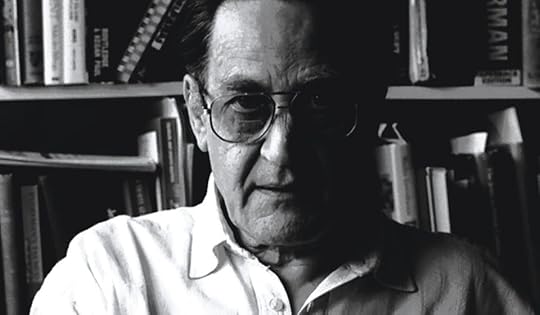
In Search of Zarathustra, or the quest for the mark of Zoro-aster, as I sometimes thought of it, may have seemed more interesting in concept & broad outline than in finished book form. We are taken at various points to Montsegur in the French Pyrenees where a 13th century group of several hundred Cathars, said to have been influenced by Zoroastrian beliefs and deemed Albigensian heretics by papal decree, are burned alive for their faith in the duality of life, assigning good & evil, the forces of the divine and the demonic equal weight, innocent peasants whose non-traditional belief did not cause anyone particular harm.
Intermixed with some early details about Zoroastrianism, which began in Persia around 1200 BCE with the prophet Zarathustra, we quickly come to Richard Strauss composing Also Sprache Zarathustra in 1896, a tone-poem based on the earlier work of the same name by Nietzsche,
which translates from the German as Also Spake Zarathustra. Nietzsche's anxiety-laden work, rendered by Strauss into dominant, memorable chords then becomes a theme on loan to Stanley Kubrick in his film, 2001, A Space Odyssey.
However, Nietzsche took Zarathustra's theme, the eternal clash between good & evil and upended the concept of ethical dualism to include his own ideas about the ubermensch (superman) & the dissolution of god-centered morality.
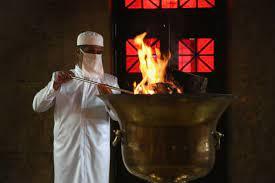
The author does intersperse details about basic concepts of Zoroastrianism, including the single deity or unifying spirit, Ahura Mazda, who created the universe, his prophet Zarathustra and the importance of fire as the divine symbol of the monotheistic religion that spread from Persia for a millennium or more, before being supplanted by the three Abrahamic religions, including Islam in today's Iran. Fire Temples still exist, chiefly in Iran, especially in Yadz and the religion continues to be freely practiced in that predominantly Shia-Muslim country.
The duality of good vs. evil, inspired by Zoroastrianism became a feature of the Manichean philosophy and there are existing examples of the original religious force still practiced by Parsees (Persians) in the west of India. However, the author also finds examples of the religion in a former Roman temple to Mithra in London, the ruins of which became evident in the aftermath of a WWII bombing. A point is made that while officially Islamic, Iran continues with embedded Zoroastrian traditions, including the 10 day celebration of Noruz, the Persian New Year.
Beyond that, the "Persian Book of Kings" by Ferdowsi, Shahnameh is an essential part of Iranian life, recited at cafes & elsewhere, a history-laden book that ends with the Arab invasion that caused Islam to supplant Zoroastrianism, while also having served to keep Farsi, the Persian language, alive rather than being replaced by Arabic as the invaders had decreed.
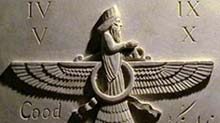
The figure of the high priest, Sarastro, in Mozart's The Magic Flute is said to be Zarathustra in disguise. Additionally, there is mention of the 3 Magi, Zoroastrian priests who come in search of the newly born child, Jesus. Much of Paul Kriwaczek's extensive travels around the world, including time in Afghanistan, focus on finding clues to Zoroastrianism at various stages in order to piece together a theological underpinning for a religious outlook that has long been in decline, a search for Zarathustra.
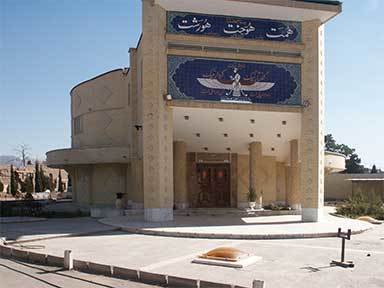
Having visited Iran and fire temples at Yadz, Kerman & elsewhere, including one high up in the mountains, a place of pilgrimage & still presided over by a Zoroastrian priest, I wanted to learn more about the religion. To be sure, Paul Kriwaczek filled gaps in my understanding of the religion, said to be the initial monotheistic faith but I was perhaps most intrigued by the author's own sense of connection with Zoroastrianism and by his frequent citing of sources, especially books that he researched in compiling In Search of Zarathustra, several of which appear very much worth reading.
*Within my review are the images of: author, Paul Kriwaczek; a Zoroastrian priest tending the sacred fire within a temple; the carved symbol of the Zoroastrian religion; a modern Zoroastrian Fire Temple at Kerman, Iran.
**16 pages of color images relevant to the book are included, as is an end-paper map of sites important to the religion's development & influence.
In Search of Zarathustra, or the quest for the mark of Zoro-aster, as I sometimes thought of it, may have seemed more interesting in concept & broad outline than in finished book form. We are taken at various points to Montsegur in the French Pyrenees where a 13th century group of several hundred Cathars, said to have been influenced by Zoroastrian beliefs and deemed Albigensian heretics by papal decree, are burned alive for their faith in the duality of life, assigning good & evil, the forces of the divine and the demonic equal weight, innocent peasants whose non-traditional belief did not cause anyone particular harm.
Intermixed with some early details about Zoroastrianism, which began in Persia around 1200 BCE with the prophet Zarathustra, we quickly come to Richard Strauss composing Also Sprache Zarathustra in 1896, a tone-poem based on the earlier work of the same name by Nietzsche,
which translates from the German as Also Spake Zarathustra. Nietzsche's anxiety-laden work, rendered by Strauss into dominant, memorable chords then becomes a theme on loan to Stanley Kubrick in his film, 2001, A Space Odyssey.
However, Nietzsche took Zarathustra's theme, the eternal clash between good & evil and upended the concept of ethical dualism to include his own ideas about the ubermensch (superman) & the dissolution of god-centered morality.
The author does intersperse details about basic concepts of Zoroastrianism, including the single deity or unifying spirit, Ahura Mazda, who created the universe, his prophet Zarathustra and the importance of fire as the divine symbol of the monotheistic religion that spread from Persia for a millennium or more, before being supplanted by the three Abrahamic religions, including Islam in today's Iran. Fire Temples still exist, chiefly in Iran, especially in Yadz and the religion continues to be freely practiced in that predominantly Shia-Muslim country.
The duality of good vs. evil, inspired by Zoroastrianism became a feature of the Manichean philosophy and there are existing examples of the original religious force still practiced by Parsees (Persians) in the west of India. However, the author also finds examples of the religion in a former Roman temple to Mithra in London, the ruins of which became evident in the aftermath of a WWII bombing. A point is made that while officially Islamic, Iran continues with embedded Zoroastrian traditions, including the 10 day celebration of Noruz, the Persian New Year.
Beyond that, the "Persian Book of Kings" by Ferdowsi, Shahnameh is an essential part of Iranian life, recited at cafes & elsewhere, a history-laden book that ends with the Arab invasion that caused Islam to supplant Zoroastrianism, while also having served to keep Farsi, the Persian language, alive rather than being replaced by Arabic as the invaders had decreed.
The figure of the high priest, Sarastro, in Mozart's The Magic Flute is said to be Zarathustra in disguise. Additionally, there is mention of the 3 Magi, Zoroastrian priests who come in search of the newly born child, Jesus. Much of Paul Kriwaczek's extensive travels around the world, including time in Afghanistan, focus on finding clues to Zoroastrianism at various stages in order to piece together a theological underpinning for a religious outlook that has long been in decline, a search for Zarathustra.
I felt a deep & moving kinship with the old Zoroastrian. Two & a half thousand years ago my ancestors & his had encountered each other in a meeting that would shape our world. Through my ancestors, the exiled Judeans of Cyrus the Great's empire, the teachings of Zarathustra had passed to the Jews, & through them to the Christians & the Muslims, eventually to become an integral part of the universal spiritual world-view.
Western culture is often said to have been erected on foundations of Hellenism & Judaism. From now on, I would have to add "and Zoroastrianism too."
Having visited Iran and fire temples at Yadz, Kerman & elsewhere, including one high up in the mountains, a place of pilgrimage & still presided over by a Zoroastrian priest, I wanted to learn more about the religion. To be sure, Paul Kriwaczek filled gaps in my understanding of the religion, said to be the initial monotheistic faith but I was perhaps most intrigued by the author's own sense of connection with Zoroastrianism and by his frequent citing of sources, especially books that he researched in compiling In Search of Zarathustra, several of which appear very much worth reading.
*Within my review are the images of: author, Paul Kriwaczek; a Zoroastrian priest tending the sacred fire within a temple; the carved symbol of the Zoroastrian religion; a modern Zoroastrian Fire Temple at Kerman, Iran.
**16 pages of color images relevant to the book are included, as is an end-paper map of sites important to the religion's development & influence.

September 13, 2016
کتاب در جستجوی زرتشت حاصل کار نویسنده ای غربی ست که جستجویی شخصی برای شناخت اندیشه های زرتشت و تأثیرات عالمگیر آن ها آغاز کرده است. عنوان کتاب جذاب نیچه، چنین گفت زرتشت، نویسنده را در سنین جوانی اش کنجکاو می کند. او می خواسته بداند چرا نیچه زرتشت را برای رساندن پیام خود برای انسان های مدرن برگزیده بود.
نکته ای که در مورد این کتاب جالب توجه است، این است که نویسنده تنها به غور در کتاب های نوشته شده در مورد زرتشت اکتفا نکرده و شخصاً به برخی نقاط جهان كه به نوعی تحت تأثیر اندیشه های زرتشت بوده اند، سفر کرده است.
کتاب ترکیبی ست از واقعیت های تاریخی، خاطرات شخصی نویسنده در سفرهايش و تأملات او در مورد اطلاعاتی که به دست می آورد. وی زرتشت را نخستین پبامبر و فیلسوفی می داند که عقاید و اندیشه هايش جهان را تغییر داد و هم اینک نیز در پوشش ادیان و اندیشه های مختلف پابرجاست.
نکته ای که در مورد این کتاب جالب توجه است، این است که نویسنده تنها به غور در کتاب های نوشته شده در مورد زرتشت اکتفا نکرده و شخصاً به برخی نقاط جهان كه به نوعی تحت تأثیر اندیشه های زرتشت بوده اند، سفر کرده است.
کتاب ترکیبی ست از واقعیت های تاریخی، خاطرات شخصی نویسنده در سفرهايش و تأملات او در مورد اطلاعاتی که به دست می آورد. وی زرتشت را نخستین پبامبر و فیلسوفی می داند که عقاید و اندیشه هايش جهان را تغییر داد و هم اینک نیز در پوشش ادیان و اندیشه های مختلف پابرجاست.

September 13, 2020
Kriwaczek is a grand old traveler, following the tracks of a tradition across the world, generally spiralling backward toward the original source of all our major monotheistic beliefs -- God and the devil, heaven and hell, the messiah and the day of judgement -- in the first Zoroastrians. From France to Bulgaria and Babylon to Bukhara, Kriwaczek is the perfect guy to travel with, always curious, down to earth, thoughtful, and almost poetically articulate.

July 30, 2011
Compelling reading, I finished this in 5 days despite a busy schedule. I bought 'In Search of Zarathustra' in the gift shop at the British Museum and was expecting a somewhat dry discussion of history and archaeology.
Instead, Paul Kriwaczek gives us a lively account of his personal journey of discovery to unearth the mysterious bronze-age figure of Zarathustra, who appears as one of the earliest, if not the earliest, prophetic figure to describe the world as a battleground between opposing poles of good and evil and to exhort mankind to follow the way of light and goodness - in short, to try to live up to some kind of moral standards rather than simply live in fear of angry spirits and fickle deities no better than their mortal worshippers.
The truth is that we know very little about Zarathustra himself, and so this book could more accurately be titled 'In Search of the Influence of Zoroastrianism on World Religions', for a good deal of Mr Kriwaczek's discourse is an examination of the history of various sects and the interplay of their ideas and philosophies, seeking to identify elements descended from Zarathustra's teachings. Don't expect scientific rigour here. Hard evidence is thin on the ground and some of the author's conclusions are by his own admission based on personal opinion and intuition, guided by long experience of middle eastern culture and visits to many ancient sites steeped in history.
The final picture the author seeks to paint is Zarathustra's teachings in the raw, unpolluted by the various additional influences that the (now much-dwindled) Zoroastrian faith has collected during the intervening centuries, much as other religions tend to start with a simple message and then accumulate all sorts of extra paraphernalia.
In short, a cracking read, lots of history and travel illustrated by amusing anecdotes, and illuminating insights into the mindset and culture of the middle eastern 'cradle of civilisation'.
Instead, Paul Kriwaczek gives us a lively account of his personal journey of discovery to unearth the mysterious bronze-age figure of Zarathustra, who appears as one of the earliest, if not the earliest, prophetic figure to describe the world as a battleground between opposing poles of good and evil and to exhort mankind to follow the way of light and goodness - in short, to try to live up to some kind of moral standards rather than simply live in fear of angry spirits and fickle deities no better than their mortal worshippers.
The truth is that we know very little about Zarathustra himself, and so this book could more accurately be titled 'In Search of the Influence of Zoroastrianism on World Religions', for a good deal of Mr Kriwaczek's discourse is an examination of the history of various sects and the interplay of their ideas and philosophies, seeking to identify elements descended from Zarathustra's teachings. Don't expect scientific rigour here. Hard evidence is thin on the ground and some of the author's conclusions are by his own admission based on personal opinion and intuition, guided by long experience of middle eastern culture and visits to many ancient sites steeped in history.
The final picture the author seeks to paint is Zarathustra's teachings in the raw, unpolluted by the various additional influences that the (now much-dwindled) Zoroastrian faith has collected during the intervening centuries, much as other religions tend to start with a simple message and then accumulate all sorts of extra paraphernalia.
In short, a cracking read, lots of history and travel illustrated by amusing anecdotes, and illuminating insights into the mindset and culture of the middle eastern 'cradle of civilisation'.

June 14, 2021
very interesting book. i was fascinated by the research and by the fascination the author feel for the ideas of Zarathustra. sometimes he jump from one idea to another based more on intuition than logic but once you are intrigued you go along. quite fascinating journey.

October 9, 2016
دوستی بهم گفت، چرا انقدر در مورد تاریخ میخونی؟ رها کن دنیای مردگان رو
در حقیقت من خودم برآمده از دنیای مردگانم، اما به گونهی عجیبی این کتاب زنده است و زرتشت زندهترین فرد تاریخه
سخته از آدمها بخوام تا برای شناخت زرتشت این ابرمردِ نیچه(superman) به گفتههای خود زرتشت در گاهان رجوع کنند، چون این کهنترین شعر بشری سخت فهم است، و از آن سختتر خواندن بُندَهش.
و خب پل کریوازک کار من رو راحت کرد، دیگه لازم نیست ثابت کنم که فیثاغورث و افلاطون وقتی میخواستن گنده گویی کنند یکیشون خودش رو شاگرد مستقیم زرتشت میدونست و دیگری نسبش رو به شاگرد شاگردان زرتشت میرساند.
الان با خیال راحت میتونم به بچه مسلمون ایرانی ( شیعه و سنی) بگم بزرگترین جشنتون نه یک آیین اسلامی که یک آیین زرتشتی است و با احتساب شب یلدا دومین جشنتون یک آیین میترایی،
میتونم بگم که آیین عزاداری محرمتون برگرفته از سوگ سیاوش و یادگار زریران است، مخصوصا آنجا که گرامی کردار سردار ایرانی پس از قطع شدن دستانش درفش پرافتخار ایران را با دندان نگه میدارد( چه داستان
آشنایی)
دیگر ماجرای یکسان بودن شب تولد میترا خدای ایرانی با تولد مسیح برای همه مشخص است( در فصل آیین میترای کتاب به خوبی توضیح داده است)
و تاثیری که زرتشتیگری بر روی یهودیت گذاشته است تایهوه از خدایی که کُشتی میگیرد، شکست میخورد و عصبانی میشود به خدای متعال تبدیل گردد
زمانی که ارداویراف موبد زرتشتی نوشیدنی مقدس هوم را نوشید تا از جهان پس از مرگ و دوزخ و چینودپل ( پل صراط اسلام) خبر بیاورد، محمدبنعبدالله به دنیا نیامده بود تا به معراج رود و دانته و کمدی الهیش هفتصد سال زمان داشتند تا از داستانهای زرتشتی بهرهببرند
چه بخواهیم و چه نخواهیم، جهان ما به دوران پیش و پس از زرتشت تقسیم میشود، در روزگارانی که خدایان ماهیت مادی داشتند و بیشتر شبیه انسان بودند زرتشت از اهورامزدا این سروَر دانایی سخن گفت، جهان ما را تبدیل به عرصه نبرد نیک و شر کرد و از تنها راه موجود در جهان گفت که آن راه راستی است.
تاثیر شگفت انگیز زرتشت بردنیای باستان و تمامی ادیان چنان قدرتمند است که گاهی وجود همچین فردی بسان افسانه میماند، چه افسانه باشد چه نباشد حتی امروزه هرزمان که در حال دیدن فیلمی از مارول و دی سی بودید بدانید به نبرد خیر و شر زرتشت نگاه میکنید، اگر راستگویی را دوست دارید و درست اندیشی را ارج مینهید و برای همگان نیکی را طلب میکنید شما پیروان راستین «هومت، هوخت، هورشت» هستید و از پندار بد گفتار بد و کردار بد دوری میکنید
ما در حدود سه هزارسال( شایدم شش هزارسال، زمان و زادگاه زرتشت نامشخص است) در جهان زرتشتی زندگی میکنیم و احتمالا تا ابد در این جهان نفس بکشیم به هر روی تاثیر زرتشت چنان عمیق است که اکثراً متوجه آن نمیشویم، تنها نیچه بزرگترین فیلسوف قرون اخیر حسش کرد و گفت
« در کنار دریاچه نشسته بود که ناگهان یک بر من دو گشت و زرتشت از کنار من گذشت»
امیدوارم یک برشما هم دو گردد.
در حقیقت من خودم برآمده از دنیای مردگانم، اما به گونهی عجیبی این کتاب زنده است و زرتشت زندهترین فرد تاریخه
سخته از آدمها بخوام تا برای شناخت زرتشت این ابرمردِ نیچه(superman) به گفتههای خود زرتشت در گاهان رجوع کنند، چون این کهنترین شعر بشری سخت فهم است، و از آن سختتر خواندن بُندَهش.
و خب پل کریوازک کار من رو راحت کرد، دیگه لازم نیست ثابت کنم که فیثاغورث و افلاطون وقتی میخواستن گنده گویی کنند یکیشون خودش رو شاگرد مستقیم زرتشت میدونست و دیگری نسبش رو به شاگرد شاگردان زرتشت میرساند.
الان با خیال راحت میتونم به بچه مسلمون ایرانی ( شیعه و سنی) بگم بزرگترین جشنتون نه یک آیین اسلامی که یک آیین زرتشتی است و با احتساب شب یلدا دومین جشنتون یک آیین میترایی،
میتونم بگم که آیین عزاداری محرمتون برگرفته از سوگ سیاوش و یادگار زریران است، مخصوصا آنجا که گرامی کردار سردار ایرانی پس از قطع شدن دستانش درفش پرافتخار ایران را با دندان نگه میدارد( چه داستان
آشنایی)
دیگر ماجرای یکسان بودن شب تولد میترا خدای ایرانی با تولد مسیح برای همه مشخص است( در فصل آیین میترای کتاب به خوبی توضیح داده است)
و تاثیری که زرتشتیگری بر روی یهودیت گذاشته است تایهوه از خدایی که کُشتی میگیرد، شکست میخورد و عصبانی میشود به خدای متعال تبدیل گردد
زمانی که ارداویراف موبد زرتشتی نوشیدنی مقدس هوم را نوشید تا از جهان پس از مرگ و دوزخ و چینودپل ( پل صراط اسلام) خبر بیاورد، محمدبنعبدالله به دنیا نیامده بود تا به معراج رود و دانته و کمدی الهیش هفتصد سال زمان داشتند تا از داستانهای زرتشتی بهرهببرند
چه بخواهیم و چه نخواهیم، جهان ما به دوران پیش و پس از زرتشت تقسیم میشود، در روزگارانی که خدایان ماهیت مادی داشتند و بیشتر شبیه انسان بودند زرتشت از اهورامزدا این سروَر دانایی سخن گفت، جهان ما را تبدیل به عرصه نبرد نیک و شر کرد و از تنها راه موجود در جهان گفت که آن راه راستی است.
تاثیر شگفت انگیز زرتشت بردنیای باستان و تمامی ادیان چنان قدرتمند است که گاهی وجود همچین فردی بسان افسانه میماند، چه افسانه باشد چه نباشد حتی امروزه هرزمان که در حال دیدن فیلمی از مارول و دی سی بودید بدانید به نبرد خیر و شر زرتشت نگاه میکنید، اگر راستگویی را دوست دارید و درست اندیشی را ارج مینهید و برای همگان نیکی را طلب میکنید شما پیروان راستین «هومت، هوخت، هورشت» هستید و از پندار بد گفتار بد و کردار بد دوری میکنید
ما در حدود سه هزارسال( شایدم شش هزارسال، زمان و زادگاه زرتشت نامشخص است) در جهان زرتشتی زندگی میکنیم و احتمالا تا ابد در این جهان نفس بکشیم به هر روی تاثیر زرتشت چنان عمیق است که اکثراً متوجه آن نمیشویم، تنها نیچه بزرگترین فیلسوف قرون اخیر حسش کرد و گفت
« در کنار دریاچه نشسته بود که ناگهان یک بر من دو گشت و زرتشت از کنار من گذشت»
امیدوارم یک برشما هم دو گردد.

November 3, 2010
Not a history book. This particular search for Zarathustra meanders in reverse chronological order from Nietzsche (surprise, surprise), the Cathars, the Bulgars & Mani to ancient Persia proper, frequently raising eyebrows and demanding not insignificant credulity from the reader.
The reverse chronology breaks the narrative with the author tending to jump back & forth in time to make a point, while using dualism as an "one size fits all" answer to explain the supposed connections between Nietzsche, the Cathars & the Bulgars.
The chapters on the Sassanid & Achaemenid empires are much more interesting but the final chapter on Zoroaster himself is a major disappointment - not surprising considering the lack of historical information on this first monotheistic prophet.
This book only leaves you confused and wanting for more - in the wrong sort of way.
The reverse chronology breaks the narrative with the author tending to jump back & forth in time to make a point, while using dualism as an "one size fits all" answer to explain the supposed connections between Nietzsche, the Cathars & the Bulgars.
The chapters on the Sassanid & Achaemenid empires are much more interesting but the final chapter on Zoroaster himself is a major disappointment - not surprising considering the lack of historical information on this first monotheistic prophet.
This book only leaves you confused and wanting for more - in the wrong sort of way.

September 22, 2017
a very informative comprehensive book on zarahustra.
unfortunately though, in some parts, it was more like a paper than a book and consequently a little bit boring.
overall, one could learn a lot on this subject which has not been discussed that often.
unfortunately though, in some parts, it was more like a paper than a book and consequently a little bit boring.
overall, one could learn a lot on this subject which has not been discussed that often.

March 12, 2022
I absolutely loved this book. I was so clearly the target demographic. Like. Was this written specifically for me? jkjk, BUT SERIOUSLY, that's how I felt.
There's an ENTIRE chapter about Nietzsche. We have some weird parallels in our personal life journeys, which was odd to recognize. I will have to move up my Nietzsche book in my TBR pile.
It traces back the Zoroastrian influences on the three big monotheistic religions, which I LOVE learning about aufwefibebdj SO MUCH.
I spent a great deal of time underlining, making notes, talking over points with Roommate.
I really appreciated how the author made it clear where his biases were or where his understanding ended or where he shifted from what information we have available and what is left to contemplation and guess-work.
It's a mix of travelogue, re-telling stories, and research. I thought it was balanced well between the three. Very readable. Very enjoyable. A lot to think about.
In the future I will write a more professional-sounding article about some of the contents of this book, but right now I'm still basking in the serotonin that reading this book produced.
There's an ENTIRE chapter about Nietzsche. We have some weird parallels in our personal life journeys, which was odd to recognize. I will have to move up my Nietzsche book in my TBR pile.
It traces back the Zoroastrian influences on the three big monotheistic religions, which I LOVE learning about aufwefibebdj SO MUCH.
I spent a great deal of time underlining, making notes, talking over points with Roommate.
I really appreciated how the author made it clear where his biases were or where his understanding ended or where he shifted from what information we have available and what is left to contemplation and guess-work.
It's a mix of travelogue, re-telling stories, and research. I thought it was balanced well between the three. Very readable. Very enjoyable. A lot to think about.
In the future I will write a more professional-sounding article about some of the contents of this book, but right now I'm still basking in the serotonin that reading this book produced.

November 23, 2010
Very enjoyable book about Zorastrianism's impact through time. The structure is interesting in that the chapters are arranged chronologically backwards. The first chapters deal with more modern fare, while the subsequent chapters get deeper and deeper into history. The middle chapters discuss the Cathar's, then Manicheism, and the final chapters are about what little we know about the origins of the faith. The book also serves as a travelogue, as the author visits each place associated with his story, describing the sites and scenes. Some of the descriptions of Afghanistan in particular were quite vivid, which makes sense as the author lived for a time as the only western dentist in Afghanistan.
I'd definitely like to read this book a second time to absorb more of the detail.
I'd definitely like to read this book a second time to absorb more of the detail.
February 17, 2008
Fascinating book about one man's journey to discover the underpinnings of one of the world's oldest (and least understood) religions

June 6, 2017
Interesting but also not very well organized. I felt like there was little coherence, although the history was incredibly interesting.

December 14, 2009
Lucky thrift store find. I took a passing interest in late antiquity “mystery cults” but have always found this area to be hard to keep straight. This book is wonderful at keeping these things fairly strait. Kriwaczek takes a trip throughout Europe and the middle east looking for traces of Manichaeism, Zoroastrianism (Parsees), the Cathars, Bogomils, Mithraism, as well as Judaism, Islam, early Christianity (St. Augustine was a Manichaean before he became a Christian)
Perhaps the best thing about the book is the author’s quite, steady respect for all religions. To my considerable surprise, I found Zarathustra (Zoroaster), the “great religious lawgiver of the ancient world” to be quite remarkable. I thought this fire-worship stuff was “merely” pagan, when in fact it is quite compelling. There is the light and dark thing going on, but there is this very interesting focus on “The Lie.”
King Darius of Persia put it this way on one of his inscriptions: “’You who shall be king hereafter, protect yourself vigorously from the Lie. Punish severely any man who follows the Lie, ifyour hope is: ‘May my country be secure.’” (p. 193).
“According to Zoroastrian tradition, as well as hints in the hymns themselves, the prophet taught that each individual had a free choice between good and evil, and that following the path of asha, righteousness, would led to salvation, even for lay worshippers. Until then, only priests and aristocrats had been imagined as having an immortal soul – heaven was the preserve of the upper classes, hell reserved for the laity. He condemned animal sacrifice as cruel and denounced the priestly cult of Haoma, probably a hallucinogenic plant and presumably related to the Soma of Hindu scripture….He did not preach the adoration of fire. His basic doctrine was rational, anti-ritual and anti-sacrifice, encouraging his followers to come to personal terms with their God.” (p. 213).
Kriwaczek visits one of the few remaining Zoroasterian fire temples in Iran and questions one of the elders to give a summation of his faith. Here is what he said, with Kriwaczek’s commentary afterwards:
“’Easily (explained),’ he said. ‘Our basic beliefs are very simple. Choose truth and oppose lies. And always strive for good words, good thoughts and good deeds.’”
Simple beliefs they may be, but profound too, teachings as practical and relevant for the post-religious modern world as they were for ancient times. Every writers, journalist or film-maker, every creative artist or scientist, every worker, business person or professional, indeed every individual can feel personally addressed by the perception that truth supports what is good, positive and creative, while falsehood leads to what is bad, negative and destructive. I thought, as I stood in the chamber of that little temple in the Iranian hills, that the message I had been given was a fitting final end to my long journey in search of Zarathurstra.” (p. 229)
Perhaps the best thing about the book is the author’s quite, steady respect for all religions. To my considerable surprise, I found Zarathustra (Zoroaster), the “great religious lawgiver of the ancient world” to be quite remarkable. I thought this fire-worship stuff was “merely” pagan, when in fact it is quite compelling. There is the light and dark thing going on, but there is this very interesting focus on “The Lie.”
King Darius of Persia put it this way on one of his inscriptions: “’You who shall be king hereafter, protect yourself vigorously from the Lie. Punish severely any man who follows the Lie, ifyour hope is: ‘May my country be secure.’” (p. 193).
“According to Zoroastrian tradition, as well as hints in the hymns themselves, the prophet taught that each individual had a free choice between good and evil, and that following the path of asha, righteousness, would led to salvation, even for lay worshippers. Until then, only priests and aristocrats had been imagined as having an immortal soul – heaven was the preserve of the upper classes, hell reserved for the laity. He condemned animal sacrifice as cruel and denounced the priestly cult of Haoma, probably a hallucinogenic plant and presumably related to the Soma of Hindu scripture….He did not preach the adoration of fire. His basic doctrine was rational, anti-ritual and anti-sacrifice, encouraging his followers to come to personal terms with their God.” (p. 213).
Kriwaczek visits one of the few remaining Zoroasterian fire temples in Iran and questions one of the elders to give a summation of his faith. Here is what he said, with Kriwaczek’s commentary afterwards:
“’Easily (explained),’ he said. ‘Our basic beliefs are very simple. Choose truth and oppose lies. And always strive for good words, good thoughts and good deeds.’”
Simple beliefs they may be, but profound too, teachings as practical and relevant for the post-religious modern world as they were for ancient times. Every writers, journalist or film-maker, every creative artist or scientist, every worker, business person or professional, indeed every individual can feel personally addressed by the perception that truth supports what is good, positive and creative, while falsehood leads to what is bad, negative and destructive. I thought, as I stood in the chamber of that little temple in the Iranian hills, that the message I had been given was a fitting final end to my long journey in search of Zarathurstra.” (p. 229)

January 17, 2021
This book is equal part history and equal part wild speculation.
The author is a persophile, and you can tell. He doubts the existence of Noah but Zarathustra, a figure that first appears in the historical record hundreds of years after having died is 100‰ real according to him?
There is also the fact that according to the author any dualistic religion or any concept of the afterlife that includes a paradise and hell or people just thinking that evil exists (i am not joking here) it's due to zoroastrians influence. I think this is a stretch to say the least.
There is also things that are just incorrect:
-the style of churches and castles he described started in northwestern France, not occitania.
- that winged figures were invented by persians: This is just not true, there is the famous winged Isis. There are winged figures that look like angels in babylonian art by 2000 bce and are called Lamma and they represent a protective diety. In fact the author completely ignores how much persian culture is indebted to the near east, specially babylon only mentioning it when he can't avoid it(when talking about Nouruz or the writing system). Also the concept of an angel might have come from zoroastrian beliefs but the way they are depicted in western art mostly copies athena nike and cupid figures.
-Ottomans did not force convert people to Islam and did not persecute people due to their religion: Depending on the ruler at the time they definitely did.
- the people that invented the animal style spoke iranian languages: i don't know where he got this but i couldn't find any information about it.
- handshaking was not a roman thing and was invented by the persians: yes it was, there are several statues of romans shaking hands. And even if that wasn't the case that does not mean that persians invented it.
There are plenty of other cuestionable things but you get the idea.
I really enjoyed the parts that were more about iranian culture and customs. And all the antiquities and architecture. They were really interesting.
The author is a persophile, and you can tell. He doubts the existence of Noah but Zarathustra, a figure that first appears in the historical record hundreds of years after having died is 100‰ real according to him?
There is also the fact that according to the author any dualistic religion or any concept of the afterlife that includes a paradise and hell or people just thinking that evil exists (i am not joking here) it's due to zoroastrians influence. I think this is a stretch to say the least.
There is also things that are just incorrect:
-the style of churches and castles he described started in northwestern France, not occitania.
- that winged figures were invented by persians: This is just not true, there is the famous winged Isis. There are winged figures that look like angels in babylonian art by 2000 bce and are called Lamma and they represent a protective diety. In fact the author completely ignores how much persian culture is indebted to the near east, specially babylon only mentioning it when he can't avoid it(when talking about Nouruz or the writing system). Also the concept of an angel might have come from zoroastrian beliefs but the way they are depicted in western art mostly copies athena nike and cupid figures.
-Ottomans did not force convert people to Islam and did not persecute people due to their religion: Depending on the ruler at the time they definitely did.
- the people that invented the animal style spoke iranian languages: i don't know where he got this but i couldn't find any information about it.
- handshaking was not a roman thing and was invented by the persians: yes it was, there are several statues of romans shaking hands. And even if that wasn't the case that does not mean that persians invented it.
There are plenty of other cuestionable things but you get the idea.
I really enjoyed the parts that were more about iranian culture and customs. And all the antiquities and architecture. They were really interesting.

March 5, 2008
Possibly the best book I've ever read...
It masquerades as a travel log by a seasoned travel writer, but it's actually an exploration of Central Asia's contribution to the world- philosophy, science, civilization - from the sites where it all went down.
Whether he draws upon details of his journey to induce connections across miles and millennia, or uses the works of historical authorities to deduce the same, Kriwaczek shows that the ancient world is behind every aspect of modern life.
Absolutely recommended!
It masquerades as a travel log by a seasoned travel writer, but it's actually an exploration of Central Asia's contribution to the world- philosophy, science, civilization - from the sites where it all went down.
Whether he draws upon details of his journey to induce connections across miles and millennia, or uses the works of historical authorities to deduce the same, Kriwaczek shows that the ancient world is behind every aspect of modern life.
Absolutely recommended!

July 21, 2009
One of the best books I have ever read. It gave me such a great overview of the world cultures and the flow of influence.As I read this book I cherish every paragraph. I am awed by it's perspective and admire this doctor for searching and making sense of so much. It is sad how our knowledge of history is limited to a couple of world wars and a few well known kings. This books tells you why and how our cultures came to be. It is just fanstastic.

December 7, 2009
This book is just fascinating! I looks at the historical ruins that are still in Iran that are associated with Zoroastrianism, as well as looking into the Cathars, and the way that modern communities, most of which are not Zoroastrians, are still embracing many aspects of this traditional religion and culture. An absolutely fascinating book that will open your eyes to the past, and it's influence on modern society. Wonderful. I can't recommend this book enough.

February 5, 2011
Passing a person in the street with an uncanny resemblance to yourself does not constitute proof of your father having sired an illicit love child. If you stop the person, and he or she tells you that they were born in the same small and remote town as yourself, while it may lead you to desire further investigation of your father's love life, it still does not constitute proof of your father's infidelity. Yet, on the basis of such family resemblance, Kriwaczek sees Zoroastrian love children everywhere. Since there is no genetic test available for the ancestry of ideas, proof of another kind is warranted. But Kriwaczek seems content with treating resemblance as proof of influence. Judaism, Christianity, Islam---all are descendants, at least in part, from Zoroaster according to the author.
The other problems I had with the book were the constantly interrupted narrative as the author chases down his notions back and forth in time, and the lack of a clear exposition of the Zoroastrian religion, its beliefs and practices. One can only pick up pieces here and there as the author sees the influence of the religion elsewhere. It is a shame because the author is a good writer and has clearly put a lot of time and energy into his investigations. But it does seem that the book ended up being more a work of passion than scholarship--conveying mostly the author's love of early Iranian history and his quest for signs of Zarathustra in the world around him.
The other problems I had with the book were the constantly interrupted narrative as the author chases down his notions back and forth in time, and the lack of a clear exposition of the Zoroastrian religion, its beliefs and practices. One can only pick up pieces here and there as the author sees the influence of the religion elsewhere. It is a shame because the author is a good writer and has clearly put a lot of time and energy into his investigations. But it does seem that the book ended up being more a work of passion than scholarship--conveying mostly the author's love of early Iranian history and his quest for signs of Zarathustra in the world around him.
October 5, 2012
It is times like this I wish I was a better writer. It is nearly impossible for me to explain what this book meant to me and how it shifted my perspective.
While I wouldn't consider it an in depth discussion of Zoroastrianism, the author does an excellent job laying out the impacts this important prophet had on his time and how his teachings have influenced religious thought through the ages.
Anyone who is interested in comparative religion should take the time to read this book.
Additionally, he touches on the rich and varied history of regions--Afghanistan, Iran, and others--that are known only to US readers because of the current political situation.
While I wouldn't consider it an in depth discussion of Zoroastrianism, the author does an excellent job laying out the impacts this important prophet had on his time and how his teachings have influenced religious thought through the ages.
Anyone who is interested in comparative religion should take the time to read this book.
Additionally, he touches on the rich and varied history of regions--Afghanistan, Iran, and others--that are known only to US readers because of the current political situation.

January 9, 2013
Interesting subject: an exploration of how Zoroastrianism has influenced philosophies and religions, peoples of diverse backgrounds for thousands of years.
Unfortunately, this book was very uneven and disorganized. Much time is devoted to Nietzsche - biographical info and how he came to be interested in and responsible for "bringing Zarathustra to life again for a modern age" through his writings. The tone and style is more that of a travelogue than I would have wished. The author in his enthusiasm jumps around also, making it difficult to follow along.
That being said, I am apparently in the minority. Most readers seem to enjoy this book. My loss...
Unfortunately, this book was very uneven and disorganized. Much time is devoted to Nietzsche - biographical info and how he came to be interested in and responsible for "bringing Zarathustra to life again for a modern age" through his writings. The tone and style is more that of a travelogue than I would have wished. The author in his enthusiasm jumps around also, making it difficult to follow along.
That being said, I am apparently in the minority. Most readers seem to enjoy this book. My loss...

July 12, 2010
It's been weeks now since I finished this one, and I'm trying to think what I still remember of it! Just an interesting wander through history around the mysterious figure of Zarathustra: a little Nietzsche, travels in Iran & Afghanistan, ruins under London, etc. He makes a pretty decent case for elements of Zoroastrianism being present in the big three monotheisms. Also, more tidbits that I can use for this idea I have for a D&D setting based loosely on central Asia.
November 13, 2020
What a great book! 4/5 because it's hard to follow as it careers around the Middle East but... That's not the point. It's written beautifully, it's witty, it's openly amateur, every page was a joy to read. What did I learn? Well that's on the last page and it's kind of obvious but it was worth the convoluted journey to get there! Highly recommended and it's sparked loads of follow on reading for me.

March 4, 2008
This book was originally listed as a travel book then moved to the comparative religion section which illustrates the broad scope of subjects discussed within as it follows the threads of dualistic monotheism through history. Anyone who has any interest in history, philosophy, religion, or life in general will find this book fascinating.

December 17, 2019
Not exactly the book I was hoping for. The author spends a lot of time chasing down references to Zarathustra (Zoroaster) in European literature and history and relatively little time elaborating on ancient Persian history itself. The title seems to sell a different book.

October 17, 2025
A very personal and idiosyncratic investigation into Zarathustra, the religion he founded, and its influence on history and the other religions that developed around it, into the modern. Part travel, part history, part pure speculation, the book is engagingly written, and a good introduction for one like myself almost ignorant of the topic.
The book defines its topic very broadly and includes an extensive history and discussion of the Bogomils and Albigenses, even though the connection is indirect through Mani and even the exact nature of Zarathustra's influence on Mani is unclear. Kriwaczek also discusses at length if and how Zarathustra-ism influenced Judaism and Christianity, and what Nietzsche knew or didn't know when he used Zarathustra as the mouthpiece for his philosophy.
I've still only touched on the many topics here. I wish the book was clearer about its sources. For a newbie like myself it can be hard to tell what is well-established and mainstream and what are the author's personal theories. Kriwaczek is definitely pushing on a thesis, but it is a personal passion rather than the usual academic's attempt to steer debate. I suspect he enjoys the topic too much to care if his views are broadly accepted. I'll probably try to find another book on the topic to triangulate on the truth.
Overall, an enjoyable read by a skilled writer.
The book defines its topic very broadly and includes an extensive history and discussion of the Bogomils and Albigenses, even though the connection is indirect through Mani and even the exact nature of Zarathustra's influence on Mani is unclear. Kriwaczek also discusses at length if and how Zarathustra-ism influenced Judaism and Christianity, and what Nietzsche knew or didn't know when he used Zarathustra as the mouthpiece for his philosophy.
I've still only touched on the many topics here. I wish the book was clearer about its sources. For a newbie like myself it can be hard to tell what is well-established and mainstream and what are the author's personal theories. Kriwaczek is definitely pushing on a thesis, but it is a personal passion rather than the usual academic's attempt to steer debate. I suspect he enjoys the topic too much to care if his views are broadly accepted. I'll probably try to find another book on the topic to triangulate on the truth.
Overall, an enjoyable read by a skilled writer.

July 23, 2024
This is more of a travel-history book than a comprehensively specific examination of Zarathustra the prophet and his teachings. I can appreciate that the author is attempting to tell history through narrative but for me personally it came across as unfocused and an overload of information. Chapter 2&3 I enjoyed: One dedicated to Friedrich Nietzsche and the other discussing the "heretical" early century religions like the Gnostics, Frankists, and Cathars.
April 27, 2026
Less a history of Zarathustra and Zoroastrianism and more a fireside chat with a well-travelled family friend

November 3, 2024
Packed with gorgeous tidbits, fascinating insights, and the occasional stretch of the imagination.
Written in the early 2000s, Kriwaczek's profound respect for Persian and central Asian history, as well as how these reverberate in the present, is satisfying. Kriwaczek speaks of an ancient world that bubbles beneath the surface, today, perhaps just waiting to again take its, perhaps, rightful place.
The author look's to Nietzsche’s Also sprach Zarathustra. Ein Buch für Alle und Keinen as a reimagining of the prophet’s teachings for the 20th century; shifting the battle of good and evil from the supernatural to, in a post-religious world, the individual.
Lovely tidbits:
Mehrabad, the name and location of Tehran’s main airport means ‘founded by Mithra’, an important figure in Zoroastrianism and the subject of his own religion.
The Persian word 'mehraban', ‘kind’, means ‘observant of mithra’.
The common Persian image of a sun rising above the back of a lion refers to Mithra, bestowing the light of his grace on the lawful ruler.
Christian halos find their origin in Mithra's solar rays being transposed on earthen just rulers.
Muharram, the Shiite commemoration of the death of the grandson of Muhammad, during which participants self-flagellate, is also marked by some carrying a large cross. Not certain, but Kriwaczek speculates this to be a memory of Christian commemorations of Christ’s Calvary.
The original rendering of Zarathustra is slightly different, Zaratushtra, which probably means something like “rich in camels”.
The Magi were the devotees of Zarathustra. From which the word magic derives. (And, so, there is a direct link between Zoroastrianism and Christianity, with the magi recognising Jesus as saviour.)
The Great Heresy, referring to a sect of Cathars in southern France, active until the 14th century, and annihilated through the Albigensian crusade, had adapted Christianity to contain two duelling powers, one good and one evil, very much like how Zarathustra characterised the world’s greater forces at play.
It was during this conflict that Arnald Amalric, the pope’s representative, when asked how to distinguish heretics from proper Christians replied “kill them all. God will recognize his own.”
Also, this region and time served as inspirations for what we now consider typical Arthurian stories and imagery.
Related, the word bugger, a derogatory term for homosexuals, derives from Bulgar, Bulgarian. Bulgarians, like Cathars, subscribed to a version of Christianity where good and evil were two equal and opposing powers. One feature of their practice was the existence of ‘perfects’, ascetics who were vegan, only performed good deeds, and travelled in same-sex pairs. Hence the slur.
Bulgars, perhaps meaning ‘mixed’, of Huns and Arians, settled in eastern Europe, following the Bogomil faith, based on Zoroastrianism, which was also adopted by Bosnians.
By 1867, the last Bogomil clan in Hercegovina had converted to Islam.
A-mazon means ‘without a breast’, the women supposedly cutting off one boob to be able to use the bow and arrow.
Scythians were replaced by the similar Sarmatians, who mixed with the later Goths, which took on the styles and lifestyles of the Sarmatians. Styles that, now, we call gothic, or medieval, and served as the inspiration for the Arthurian legends.
The gothic practice of herding livestock, when being pushed into Western Europe by waves of Huns, morphed into herding people by Visigoths, Ostrogoths, and Alans settling in south-Western Europe. Recognisable as early feudalism.
Serbs and Croats derive from Sarmatian, thus Iranian, tribes. (And I remember some Croats telling me of their Persian connection a few decades ago, when visiting the country.)
Kriwaczek comes to realize that Mani, the founder of Manichaeism, a derivative of Zoroastrianism, and who for a while was based in Bamyan, in Afghanistan, was a painter, and profoundly understood the interplay between light and dark, and raised that understanding to the level of a religion, supported by acolytes in the Afghan valley who extensively painted the area's cave walls.
After Mani’s death by the hands of a shah of Iran, the typical greeting between his followers was ‘Mani Khai’, which Christian Greeks used to label the movement, eventually bastardising it to Manichaeans.
Manichaeism had a long breath; this suppressed religion escaped to the central Asian steppes, and it seems probable nomadic tribes took it to Europe, settling down with it in, amongst other places, southern France. But, certainly, Turkic tribes took it to China, where it eventually only faded out in the 17th century.
Mithraism, also an offshoot of Zoroastrianism, flourished on the edges of the Roman Empire. In parts, like at Hadrian’s wall, this was likely because Iranian subjects from across the Danube were transplanted to northern England to there defend the empire, bringing the Iranian cult with them.
Mithraism, a mystery religion, left few traces, and little is known of it, but tentalizing leftover exists: Mithras, the mediator between God and people from Zoroastrianism, transferred divine power to his earthly representative through a handshake. If European Mithraism is indeed connected to Iranian Mithraism, which is not quite certain, and given that European Mithraism was replaced by Christianity, it’s possible that shaking hands as greeting and agreement, unique to Europe, is of Iranian origin.
By the time Jesus was to arrive on the scene, whether physically or metaphorically, there was not a single Jewish faith, but instead a range of sects, all with notable differences in how they practiced their religion. And, many had now been influenced by Zoroastrianism, not in the least in the acceptance of a heaven and hell, angels, and an end of times.
Kriwaczek makes the case that this shifted concept of Judaism made a general acceptance of the tenets of this new Judaic offshoot, Christianity, a low hanging fruit; it’s teachings fit how many Jews, and non-Jews, saw their religious, and humanity‘s future.
Therefore, much of today’s world, as a consequence, was shaped in the image of a Zoroastrian future, through not only Christianity, but also Islam and Judaism.
The author speculates that Cyrus’ capital, at Pasárgada, was a moveable tent city.
Also speculation is that, perhaps, with the shift from Cyrus to Darius, both related, but not father and son, Darius’ conquest of the supposed imposter of Cyrus’ son, was also a religious conquest, with Darius seeking a shift to Zoroastrianism as state religion.
Esther and Mordechai, of the biblical book of Esther, are supposedly buried in Iran. That book is now considered likely a novel, to explain the meaning and purpose of Purim. With Babylonian influences; Esther derived from Ishtar, mordechai from "Marduk khai!", Marduk lives.
Nowruz, pre-Islamic, is not Persian, but derived from Babylon. Here, in typical Catholic fashion, Semitics would, once a year, parade a statue of Marduk through town. And it was this symbolic coronation of God, reflected in the Jewish Rosh Hashanah, which apparently almost certainly, Cyrus imported into the Persian empire.
The famed stories of the Shahnameh hark back to the lands of Turan, not quite the Persian heartland, and, meanwhile, Zoroaster himself might have originated in Central Asia, somewhere on the borders of Afghanistan and Uzbekistan.
Little documentation exists that is connected to the foundation of Zoroastrianism.
Iranians, still today, put a lot of value in being able to recite classical texts, which might be an underlying reason, but perhaps also, Zoroaster’s teaching, and his followers, were perhaps never threatened enough to resort to having to write down their teachings. Until only the third century AD, perhaps 1000 years after Zoroaster himself walked the earth. Or more, as the linguistic similarities between Zoroastrian texts and Sanskrit date the prophet to perhaps 1200BC, with some scholars going back as far as 1700BC.
Fascinating, the fire cult so associated with Zoroastrianism might be a later addition by disgruntled competitors after Zoroaster ‘s death, harking back to even earlier times.
Kriwaczek tries to get to the meaning of the haft sin, the table with seven items beginning with the letter s, an integral part of Iranian new year celebrations. He accidentally learns from a teacher he comes across in the town of Yazd that, before Islam, it was haft shin, the shin also being a letter s, but one that is pronounced differently, and producing a very different table, with seven objects that all had strong symbolical meaning, including hemp seeds, which Herodotus himself also linked to the nomadic Central Asian Scythians.
Parsees, of which Freddy Mercury was a descendant, moved to India between the 8th and 10th century, not being about to stomach Muslim control in the Persian heartland, first changing their homes to Hormuz on the Persian gulf, before heading to India.
These Parsees were then picked by the British East India company as an alternative center of power to the Muslim Mughal rulers and Hindu majority, eventually facilitating the rapid economic rise of Bombay and acting as founders as several of India’s important heavy industries.
Kriwaczek casts the events of Ashura, when Hussain, according to Shia Islam the rightful heir to the prophet, who was slain by the Umayyads, and followed by the Shia, and the wait for the hidden imam, after which all will be well, as a Zoroastrian narrative. The connection is quite obvious, though that doesn't also mean the connection is real.
Zoroaster ‘s council: Good words, good thoughts, good deeds. A message for the ages.
Written in the early 2000s, Kriwaczek's profound respect for Persian and central Asian history, as well as how these reverberate in the present, is satisfying. Kriwaczek speaks of an ancient world that bubbles beneath the surface, today, perhaps just waiting to again take its, perhaps, rightful place.
The author look's to Nietzsche’s Also sprach Zarathustra. Ein Buch für Alle und Keinen as a reimagining of the prophet’s teachings for the 20th century; shifting the battle of good and evil from the supernatural to, in a post-religious world, the individual.
Lovely tidbits:
Mehrabad, the name and location of Tehran’s main airport means ‘founded by Mithra’, an important figure in Zoroastrianism and the subject of his own religion.
The Persian word 'mehraban', ‘kind’, means ‘observant of mithra’.
The common Persian image of a sun rising above the back of a lion refers to Mithra, bestowing the light of his grace on the lawful ruler.
Christian halos find their origin in Mithra's solar rays being transposed on earthen just rulers.
Muharram, the Shiite commemoration of the death of the grandson of Muhammad, during which participants self-flagellate, is also marked by some carrying a large cross. Not certain, but Kriwaczek speculates this to be a memory of Christian commemorations of Christ’s Calvary.
The original rendering of Zarathustra is slightly different, Zaratushtra, which probably means something like “rich in camels”.
The Magi were the devotees of Zarathustra. From which the word magic derives. (And, so, there is a direct link between Zoroastrianism and Christianity, with the magi recognising Jesus as saviour.)
The Great Heresy, referring to a sect of Cathars in southern France, active until the 14th century, and annihilated through the Albigensian crusade, had adapted Christianity to contain two duelling powers, one good and one evil, very much like how Zarathustra characterised the world’s greater forces at play.
It was during this conflict that Arnald Amalric, the pope’s representative, when asked how to distinguish heretics from proper Christians replied “kill them all. God will recognize his own.”
Also, this region and time served as inspirations for what we now consider typical Arthurian stories and imagery.
Related, the word bugger, a derogatory term for homosexuals, derives from Bulgar, Bulgarian. Bulgarians, like Cathars, subscribed to a version of Christianity where good and evil were two equal and opposing powers. One feature of their practice was the existence of ‘perfects’, ascetics who were vegan, only performed good deeds, and travelled in same-sex pairs. Hence the slur.
Bulgars, perhaps meaning ‘mixed’, of Huns and Arians, settled in eastern Europe, following the Bogomil faith, based on Zoroastrianism, which was also adopted by Bosnians.
By 1867, the last Bogomil clan in Hercegovina had converted to Islam.
A-mazon means ‘without a breast’, the women supposedly cutting off one boob to be able to use the bow and arrow.
Scythians were replaced by the similar Sarmatians, who mixed with the later Goths, which took on the styles and lifestyles of the Sarmatians. Styles that, now, we call gothic, or medieval, and served as the inspiration for the Arthurian legends.
The gothic practice of herding livestock, when being pushed into Western Europe by waves of Huns, morphed into herding people by Visigoths, Ostrogoths, and Alans settling in south-Western Europe. Recognisable as early feudalism.
Serbs and Croats derive from Sarmatian, thus Iranian, tribes. (And I remember some Croats telling me of their Persian connection a few decades ago, when visiting the country.)
Kriwaczek comes to realize that Mani, the founder of Manichaeism, a derivative of Zoroastrianism, and who for a while was based in Bamyan, in Afghanistan, was a painter, and profoundly understood the interplay between light and dark, and raised that understanding to the level of a religion, supported by acolytes in the Afghan valley who extensively painted the area's cave walls.
After Mani’s death by the hands of a shah of Iran, the typical greeting between his followers was ‘Mani Khai’, which Christian Greeks used to label the movement, eventually bastardising it to Manichaeans.
Manichaeism had a long breath; this suppressed religion escaped to the central Asian steppes, and it seems probable nomadic tribes took it to Europe, settling down with it in, amongst other places, southern France. But, certainly, Turkic tribes took it to China, where it eventually only faded out in the 17th century.
Mithraism, also an offshoot of Zoroastrianism, flourished on the edges of the Roman Empire. In parts, like at Hadrian’s wall, this was likely because Iranian subjects from across the Danube were transplanted to northern England to there defend the empire, bringing the Iranian cult with them.
Mithraism, a mystery religion, left few traces, and little is known of it, but tentalizing leftover exists: Mithras, the mediator between God and people from Zoroastrianism, transferred divine power to his earthly representative through a handshake. If European Mithraism is indeed connected to Iranian Mithraism, which is not quite certain, and given that European Mithraism was replaced by Christianity, it’s possible that shaking hands as greeting and agreement, unique to Europe, is of Iranian origin.
By the time Jesus was to arrive on the scene, whether physically or metaphorically, there was not a single Jewish faith, but instead a range of sects, all with notable differences in how they practiced their religion. And, many had now been influenced by Zoroastrianism, not in the least in the acceptance of a heaven and hell, angels, and an end of times.
Kriwaczek makes the case that this shifted concept of Judaism made a general acceptance of the tenets of this new Judaic offshoot, Christianity, a low hanging fruit; it’s teachings fit how many Jews, and non-Jews, saw their religious, and humanity‘s future.
Therefore, much of today’s world, as a consequence, was shaped in the image of a Zoroastrian future, through not only Christianity, but also Islam and Judaism.
The author speculates that Cyrus’ capital, at Pasárgada, was a moveable tent city.
Also speculation is that, perhaps, with the shift from Cyrus to Darius, both related, but not father and son, Darius’ conquest of the supposed imposter of Cyrus’ son, was also a religious conquest, with Darius seeking a shift to Zoroastrianism as state religion.
Esther and Mordechai, of the biblical book of Esther, are supposedly buried in Iran. That book is now considered likely a novel, to explain the meaning and purpose of Purim. With Babylonian influences; Esther derived from Ishtar, mordechai from "Marduk khai!", Marduk lives.
Nowruz, pre-Islamic, is not Persian, but derived from Babylon. Here, in typical Catholic fashion, Semitics would, once a year, parade a statue of Marduk through town. And it was this symbolic coronation of God, reflected in the Jewish Rosh Hashanah, which apparently almost certainly, Cyrus imported into the Persian empire.
The famed stories of the Shahnameh hark back to the lands of Turan, not quite the Persian heartland, and, meanwhile, Zoroaster himself might have originated in Central Asia, somewhere on the borders of Afghanistan and Uzbekistan.
Little documentation exists that is connected to the foundation of Zoroastrianism.
Iranians, still today, put a lot of value in being able to recite classical texts, which might be an underlying reason, but perhaps also, Zoroaster’s teaching, and his followers, were perhaps never threatened enough to resort to having to write down their teachings. Until only the third century AD, perhaps 1000 years after Zoroaster himself walked the earth. Or more, as the linguistic similarities between Zoroastrian texts and Sanskrit date the prophet to perhaps 1200BC, with some scholars going back as far as 1700BC.
Fascinating, the fire cult so associated with Zoroastrianism might be a later addition by disgruntled competitors after Zoroaster ‘s death, harking back to even earlier times.
Kriwaczek tries to get to the meaning of the haft sin, the table with seven items beginning with the letter s, an integral part of Iranian new year celebrations. He accidentally learns from a teacher he comes across in the town of Yazd that, before Islam, it was haft shin, the shin also being a letter s, but one that is pronounced differently, and producing a very different table, with seven objects that all had strong symbolical meaning, including hemp seeds, which Herodotus himself also linked to the nomadic Central Asian Scythians.
Parsees, of which Freddy Mercury was a descendant, moved to India between the 8th and 10th century, not being about to stomach Muslim control in the Persian heartland, first changing their homes to Hormuz on the Persian gulf, before heading to India.
These Parsees were then picked by the British East India company as an alternative center of power to the Muslim Mughal rulers and Hindu majority, eventually facilitating the rapid economic rise of Bombay and acting as founders as several of India’s important heavy industries.
Kriwaczek casts the events of Ashura, when Hussain, according to Shia Islam the rightful heir to the prophet, who was slain by the Umayyads, and followed by the Shia, and the wait for the hidden imam, after which all will be well, as a Zoroastrian narrative. The connection is quite obvious, though that doesn't also mean the connection is real.
Zoroaster ‘s council: Good words, good thoughts, good deeds. A message for the ages.
Displaying 1 - 30 of 103 reviews