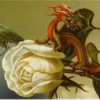
Dragons are real. At every turn, full-page powerful hypnotic eyes, fierce toothy maws, powerful sinewy bodies, convince us. Descended from dinosaurs, light bones separate compartments of hydrogen. Gas inflates for buoyancy. Chemical sulfur reactions flame breath. Soft gold metal cushions rock bedding. Human worship sacrifices submissive maidens.
Peter Dickinson was an English author and poet widely respected for his children's fiction, detective novels, and imaginative speculative writing. Raised partly in southern Africa before continuing his education in England, he developed an early fascination with adventure stories and classic literature, influences that later shaped his narrative style. He attended Eton College and later studied at King's College, Cambridge, before beginning a long association with the magazine Punch, where he worked for many years as assistant editor, reviewer, and resident poet. Dickinson eventually left journalism to pursue writing full time, publishing works for both adult and younger audiences. His crime novels featuring detective James Pibble earned critical praise, while his fiction for children established him as one of Britain's most distinguished authors in the field. Over the course of his career he produced nearly fifty books that combined historical imagination, fantasy, and thoughtful reflections on human behavior. He achieved rare distinction by winning the Carnegie Medal twice, for Tulku and City of Gold, recognition that placed him among the most celebrated children's writers in Britain. Dickinson also received numerous other literary honors and was elected a Fellow of the Royal Society of Literature. In addition to fiction, he wrote poetry and essays, and his work continued to influence generations of readers and writers in the field of children's literature.
I found a copy of “The Flight of Dragon” in a tiny used bookstore in Ottawa, and I was elated with how beautiful it is: I have always been crazy about dragons, and I especially love when they are depicted as intelligent and articulate beasts.
Peter Dickinson clearly loves them too, and spent some time wondering how such big creatures could fly, what biological mechanism would make it possible for them to breathe fire, why they would hoard treasure, and trying to explain why we have no trace of them in the fossil record.
I spent a rainy afternoon sipping tea and poring over this used bookstore treasure. This lovely book is an enchanting blend of fake science and whimsy, with gorgeous old-fashioned illustrations. Dickinson refers to many well-known dragon myths, including Le Guin’s Earthsea dragons (https://www.goodreads.com/review/show...), Tolkein's Smaug and plenty more!
If you are a fan of the 1982 movie and you are lucky enough to find a copy, jump on it immediately, and keep your eyes peeled for “The Dragon and the George”, which provided the inspiration for the more dramatic aspect of the movie’s storyline.
I'm culling books and gave this a reread, which reminded me of how I was so excited to get it as a kid, but then rather disappointed.
Dragons & Art were two of my favorite things, and the cover looked good! The blurb was promising. The art is well done, but the images are all very same-y -- sometimes literally, as they get reused in different places. Did these grown men assume kids wouldn't notice two illustrations were the same picture cropped differently? Wrong.
The idea of the text is that the author is imaginary-sciencing how dragon myth-behaviors like flying and breathing fire might plausibly work. Sort of interesting, although there is a lot of text for not a lot of reward, and honestly I'd rather have had more legends and less hot air.
The dragons in this are greedy brutes. No intelligent dragons, except where other stories about such are referenced. A bit odd to me personally that someone who imagined dragons in this way would feel motivated to put so much effort into a book about them, but okay.
Lastly, there was an odd tinge of misogyny that bothered me. Dickinson chooses to imagine that if baby dragons hatch in a mixed-sex clutch, at a point in their development the male babies will suddenly turn on their sisters and violently rip them apart, and eat them. Then later, when he is discussing human sacrifice to dragons, he says the reason girls are sacrificed is that women can't defend themselves but men can. And there's an uncomfortably voyeuristic dwelling on the sacrificial victim, "pale, huge-eyed with weeping, going to her death in her bridal dress," begging and being tied up. Also some gratutious bare breasts and (I mention for the squeamish) one naked person having their face bitten off.
Anyhow, my short review is that there are better non-fiction books materials on dragons. Wikipedia!
I loved this book as a kid, and not just because it had naughty boobie pictures that had nothing to do with the text. Dickinson takes the position that Dragons actually existed, then goes from there to ask questions like: why are they not in the fossil record? how could a creature that is generally depicted as huge and armoured supposedly fly? what's the deal with the fire-breathing? why are they often depicted as speaking and/or telepathic creatures? how come the accepted method of killing them is by a dude with a magic sword? The answers he comes up with were pretty convincing, at least to young me, and do a lot to fire the imagination.
Scattered throughout the text where Dickinson expounds on his theories are excerpts from stories about dragons (both ancient and modern) that serve to back-up, or at least explicate, some of his theories. After covering the basic elements of Dragon physiology Dickinson goes on to posit the life-cycle of a dragon living according to his design and it's a fascinating glimpse into the could-have-been life of a mythical creature. I especially liked the fact that even though Dickinson is ostensibly making dragons "realistic" they still don't lose their magic. No small feat. This isn't a dry-as-dust scientific treatise, but rather a "what-if" scenario that tries to bring our dreams to life.
Apparently they made an animated movie about this book, but I never saw it. I have no real desire to either...I like the text itself just fine, thanks. It's loads of fun, whether you're reading it cover to cover, or just leafing through and dipping in here and there.
I love love love stories of dragons. Cimorene is one of my favourite female characters of all time. Aerin is my hero. I filled up the entire library slip on my school's copy of Dragon's Blood singlehandedly. I spent a childhood reading heaps of wildly inappropriate books by Anne McCaffrey. My copy of Dragon's Milk and its sequels are so well thumbed they barely have covers left. And when Tamora Pierce featured a baby dragon in her Immortals quartet... oh the excitement! So to read a book which theorises about whether dragons could really have existed was a real treat. I can't comment on the accuracy of the science, but at least to my untrained eye it seems to stand up. Maybe, just maybe, dragons might have been real.
As an aside, the illustrations in this book are beautiful and it's worth picking up a copy for that alone.
This book fulfilled the measure of it's creation. On page one the author sets out that his intention is to offer a plausible theory on the scientific reality of dragons. By the time I finished this book I was 100% convinced!
Unfortunately, his version of historical dragons is much less romantic than what we've got going these days... more akin to a gruesome, drippy, poisonous flying giant crocodile of sorts - so I will disregard this and continue on my way believing in beautiful, majestic, intelligent and magical dragons instead.
Either way! It was well-executed and interesting. I'm so grateful I found a copy to read!
I saw the movie The Flight of Dragons as a child and loved it; Dickinson even came to my school where he laughed at the idea of making him this gallant hero that he was in the movie. I have wanted for many years to get the books the movie was based on; finally I was able to get them.
Peter Dickinson starts with a premise, that dragons really existed. He then goes on to explain how they would work in the real world and goes about this in a logical and believable way. He brings together many repeated ideas from stories and uses common themes to establish what elements dragons really had.
He discusses how such large creatures with relatively small wings would be able to fly, the reasons why they breath fire, how they could have four legs AND wings, why they have a treasure hoard and why was it thought they could speak to humans. He also brings many ideas together and explains how the work on a single creature.
The book is largely non-fiction, what is amazing is how Dickinson manages to make it both scientifically realistic and believable, while still being very interesting and easy to read. One chapter (Life Cycle) is written as fiction, it reminded me of a nature documentary where it followed the life of a dragon from egg, to adult and then the beginning of the next generation. What is really remarkable was that it didn't seem like a work of fiction it was believably real.
The book includes many quotations both from old texts such as Beowulf and from more moderns works such as The Dragon and the George by Gordon R. Dickson, The Hobbit by JRR Tokein, and Dragon Flight by Anne McCaffey. Dickson uses these to reinforce his ideas with demonstrations of where they are used in literature.
The artwork is amazing and superbly detailed. You can get totally lost just looking at all the pictures and spotting new things in them.
For those who have seen the movie The Flight of Dragons: Most of the times in the movie where characters are describing how the biology of dragons work these are taken from the book. For example the scene where Smrgol is teaching Peter/Gorbash to eat limestone and gemstones and how they fly, all of this is taken from the book. If you are interested in the story that the movie is based on be sure to check out The Dragon and The George by Gordon R. Dickson.
Spawned a thousand imitators. The art does not quite match the text, although I quite like it. It is fascinating how far paleontology has come (he quotes maximum pterosaur weights that are about one-tenth of some of the commonly cited masses for large azhdarchids known today, and appears to be influenced by old ideas of kangaroo-like therapods). But he is aware that birds are dinosaurs!
I am not sure if this book got out the door first with the idea of dragons as aerostats, but today it is a pretty universal notion when trying to justify their flight through recourse to pseudoscience, rather than just plain magic. I regret that the book argues that dragons evolved from dinosaurs: it is my contention that they arose from fish, which already use internal gas bladders. Leaping could have evolved into gliding (as with Exocoetidae) and from there to flight. Similarly, the “removable” nature of fish scales matches better with attested sources like The Hobbit.
If you love dragons, or ever wished that dragons really existed, then this book is for you. It has a lot going for it, from vivid illustrations, to a list of recorded dragon sightings in the UK. It also goes into the theoretical life cycle of a dragon in way that surely was a respectful nod to David Attenborough.
The author seriously approaches the problem if how such a huge animal as a dragon could fly or breathe fire. His explanations seem plausible, although I am not a chemist. For the record, there has been no proof that dragons existed anywhere except the human imagination.
This book, or, rather, my brother's copy of this book, impacted me more than the Bible. I so wanted dragons and unicorns to exist. I wanted that touch of magic to my drab and lonely life. When I was a senior in high school, I was faced with the choice of writing a killer long term paper
...or a novel.
Guess which one I chose?
That's right. I wrote a novel. It was an adventure of Doctor Who's sister, friend of winged, talking horses, who accidentally travel back in time to fight a fire-breathing, flying dragon in England. Part of the background was based on this book.
I got the A+ but my teacher threw the novel out. I had no idea that he hated me that much.
Later on in my life, I got it in my head that dragons really did exist and were invisible all around. That was a messed-up but fun part of my life. I've grown up now.
I haven't bought a replacement copy because I have so much of the book still in my head.
I've never been much of a fantasy reader, but my husband has wanted me to read this one for a couple of years. I was motivated to finally tackle it because of an autism spectrum student who enjoys dragons. I want to get him engaged in something and thought this book could be the ticket into his soul. And I am amazed by what I have read and by the magnificent illustrations within the book.
I honestly think now that dragons in some form actually existed. The author makes no bones that his research and ideas are entirely his own and may be wrong. He does not claim this to be a scientific work at all. But his logic and references ring true. Dragons may be the Sasquatch of antiquity, and while I do not believe in the latter, I now believe in the former.
The upshot of this is that I want to re-read Beowulf and The Hobbit. In fact, I want to read The Hobbit aloud to the student, as well as this book. Which should I read first? Will he even want me to read it? He claims to not be able to read, which is false because he does read things that fascinate him. My fantasy is that by reading these to him, it will lead us to other books and knowledge.
A fantastical, fictionalised study of dragonlore. Dickinson, a Cambridge university professor, examines the dragon's place in the human psyche and explains the feasibility of dragon biology and flight mechanisms with such ease that you feel almost as though you could allow yourself to believe what you have wanted to believe all along - that dragons are not mere myth but were flesh and blood animals that lived among us and are very much a part of our cultural past...perhaps even a part of what makes us human. His exploration of Beowulf is particularly exciting to discover and almost each page is adorned with beautiful, well-selected peices of art that complement and enhance Dickinson's arguments.
For Elizabeth and Ceridwen and all the dragon-lovers out there. I have no idea where this is still available - or if - but if you can find it, pick yourself up a copy. It's a truly beautiful flight of fancy wrapped around a "scientific" explanation of dragon flight. And the illustrations are just stunning.
__________________________
ETA: I just re-read this and it is as delightful as I remembered it -- although not 5-star delightful, and there is a truly upsetting effect/affect mis-use that I certainly hadn't noticed 25 years ago when I first read it.
And yes, I actually did RE-read the text, not just peruse the beautiful illustrations, so I'm taking this as another notch on my book-challenge bookcase.
A delightful book. With illustrations by Wayne Anderson, Peter Dickinson describes the history of dragons. Not as merely mythical beasts, but as real creatures. He gives a rationale for the features of dragons, flight, hoarding, fire-breathing etc. He builds a picture and makes the case for their reality. While it is clearly nonsense, it is done with such affection and thought that the whole package is hugely enjoyable.
Now this is the way that fictional non-fiction should be done! A truly delightful book that hangs tightly together and makes perfect sense. Every factoid about dragons is tied in to form a perfectly logical picture. An imagination tour de force!
This was an odd book. Usually, books will assume the reality of dragons or be an obviously fictional fantasy story. This book is more of a Q&A dialogue between the author and the readers and it is an argument for the existence of dragons, based on science and history. I didn't care for it.
This is like one of those no-fun-allowed “if this pop culture character were real, they would immediately die” science videos on YouTube, except Dickinson is trying to prove rather than disprove how dragons could hypothetically exist. Some of his points are a bit of a stretch (e.g. claiming Medusa could have been a dragon), but the overall pitch of “what if dragons worked like blimps and were full of hydrogen” is charmingly unconventional. The variety of fictional depictions and historical apocrypha used as sources are neat as well. Oh, and the art rules. The medieval oil painting style is an excellent fit and reminds me of Bosch’s paintings of hell. An all-around neat read.
In this fun, beautifully illustrated book, Peter Dickinson tackles the possibility that dragons existed. He goes into great detail on how flight would have been possible, why dragons belched fire, the life cycle of dragons, etc. He liberally sprinkles the text with quotations about dragons, from very old texts as well as more recent fantasy literature. If you love fantasy and/or mythology, this is well worth checking out. Other than Brian Froud's Faeries, I can't think of a similar book that I enjoy more.
We often take for granted how much we know about the mythical, fantastical dragons, yet I found myself quite surprised by Dickinson's brief, informative tome. He treats dragons as if they were real and devises an ingenious solution to the problems of their size, flight, and fire-breathing. He happily pulls from both folklore and (at the time) modern fiction to give us the best picture. It is dry at times, but the artwork by Wayne Anderson works hard to keep you engaged. A good resource and diversion for anyone interested in the fire-breathing lizards of legend.
You always hear conspiracy theories about Bigfoot, or Loch Ness, and for the people that believe them, the evidence is irrefutable. This book is that evidence for Dragons and it is wonderfully presented and thought out.
Not to mention, I learned so much about the 'history' and 'lore' of dragons. If you're trying to write a story with dragons in it, here's were you start looking for tropes. It was excellent.
A fun, albeit pseudoscientific, view of dragon mythology. Dickinson takes a naturalist’s perspective and tries to discern the reality of dragons across the world. The beautiful artwork kept me reading.
Recent Reads: The Flight Of Dragons. Peter Dickinson's illustrated novella (art by Wayne Anderson) is a study of the biology of dragons. Not the lithe creatures of legend though, his are natural airships, explaining their legends on terms of how they make hydrogen. It flies.
A fun thesis by Peter Dickinson which puts forwards theories about how dragons might have evolved and behaved, and contributed to legend in the way which they have. Dickinsons's clear love of science and fantasy come together in a delightful way.
I've been wanting to read this for soooooo long, lol. Shoutout to the state library for always stocking the weirdest fucking books (and for having the coolest reading room on Earth)
With this highly-illustrated nonfiction text, Dickinson intends to prove the existence of dragons: gigantic, firebreathing, flying reptiles. Through popular and historical descriptions of the beasts, he theorizes everything from dragon lifecycles, to dragon slaying, to the necessary connection between a dragon's form, firebreathing, and flight. He often draws on quotes from his sources, and Anderson's illustrations provide visual interest and help depict the mechanics of the dragon body and flight. Although Dickinson's arguments are often circular and his evidence is self-serving, the straightforward writing and novel theory make this an interesting and thoughtful read. Although neither fiction nor fantasy, it is also entertaining. This book is faulted, but I still recommend it.
Along with the book's good and bad traits, it was also, personally, a piece of nostalgia. I read this book as a child, and it withstands the test of time: Dickinson's theories are logical, fairly presented, and well-evidenced, and sound reasonable even to an adult reader. Pulling from everything from ancient Chinese myth and the story of Beowulf to modern authors such as J.R. Tolkien and Ursula K. Le Guin, Dickinson pulls his description of vampire behavior and ability direct from historical myth and popular culture. He then uses these excerpts to build and to prove the mechanics of the dragon, everything from lifecycles to flight. His theories on dragonflight (the chemical reactions of dragons blood produced gas, which were stored in huge internal chambers, allowing for flight; dragons belched fire to expel excess gas) is of course the highlight of the book (and the only similarity between the text and the movie of the same name). It is also the most reasonable, scientific, and convincing argument in the book. Here, Dickinson shines: he is well-researched, scientifically-minded, and very convincing.
Unfortunately, these qualities are not universally present. Often, the evidence is selected to fit the facts, or else the arguments are sustained by other arguments, not by evidence. Dickinson discards descriptions that don't fit his theories, instead justifying only what he can reasonably justify, and arguing that the rest is impossiblebut never justifying the fact that his sources seem to be both reliable and unreliable in a single breath. He relies heavily on limited, specific sources. In a book of this length, he does not have the space to go into detail assessing any one source, making his choices seem arbitrary. In all, there are various faults and in the research and the proof, and Dickinson's theories are by no means factual, or provable, or even solid.
But what matters in this book is not what Dickinson fails to do, but rather what he manages to achieve. He brings dragons alive: not my vivid descriptions, not by stunning visuals, but by thought, reason, and research. Even though he fails to prove the existence of dragons, he succeeds in proving the possibility. This makes for a fascinating and, in many ways, invigorating read. Dickinson appeals to both imagination and rational thought, and he does so through a text that is easily readable and convincingly argued. I greatly enjoyed and highly recommend this book, despite all of its faults.