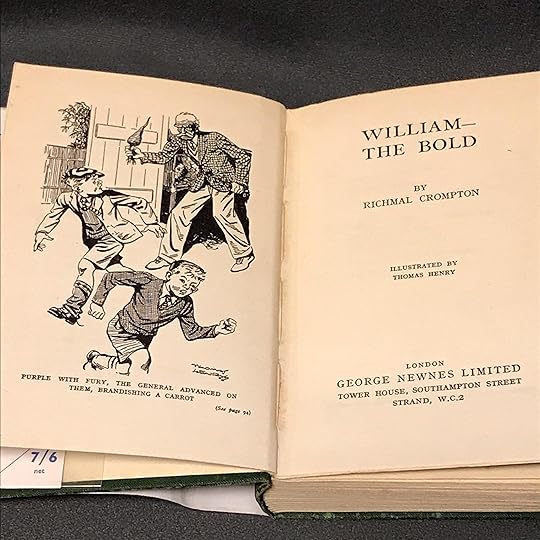
The 27th installment in the William series of books, this edition contains eight stories about the school boy and his gang. 1990 marks the centenary of Richmal Crompton's birth and this publication ties-in with the opening of "World of William" exhibition at the Bethnal Green Museum of Childhood.
Richmal Crompton Lamburn was initially trained as a schoolmistress but later became a popular English writer, best known for her Just William series of books, humorous short stories, and to a lesser extent adult fiction books.
Crompton's fiction centres around family and social life, dwelling on the constraints that they place on individuals while also nurturing them. This is best seen in her depiction of children as puzzled onlookers of society's ways. Nevertheless, the children, particularly William and his Outlaws, almost always emerge triumphant.
Richmal Crompton is one of the funniest authors ever, but this delicious collection of eight William stories sometimes casts a melancholy light on the way things have gone since 1950 when this book was published.
Every day for the past week William and Ginger had come in to Hadley to glue their noses against the window of the junk shop and gaze in rapture at the penknife.
“Four blades!” murmured William ecstatically.
I would bet that a modern story about kids would probably not feature a scene where two boys look longingly at a knife for sale.
William was fixated on the device on the penknife for getting stones out of horses’ hooves. “That’s not much good without a horse,” said Ginger. “You never know when you’ll get a horse,” said William.
The idea that William and Ginger might be pressured into joining a county lines drug distribution cartel and would be using the four bladed penknife on rival cartel members was not in anyone’s remotest imagination in 1950. In that year boys thought about getting stones out of horses’ hooves, not packets of cocaine.
There’s another story in which William and Ginger are playing along the railway tracks – this is something they do in the normal course of a long summer day. I can remember I did the same. You would put a penny on the track and wait for a train to come and flatten it. Nowadays you’ll find barriers and fences and giant warning notices to dissuade all wannabe penny-flatteners.
Then there’s what you might call The Problem Story called "A Witch in Time". William has an air rifle and unintentionally (I stress) shoots a cat called Hector.
Trembling with apprehension, he approached his old foe and examined him. There was no doubt about it, Hector’s troubles were over.
There follows much humour regarding the disposal of the dead cat, getting mixed up with other similar cats, hypnotised cats, and so forth. So shooting a cat dead is played for laughs. This will I think clash dissonantly on our seventy-years-later sensitivities. It ain’t very woke.
Then there’s the language. Who were these kids in the 50s who read William? They were faced with words like
impecuniosity
and stuff like
Any officious neighbour, meeting him, might demand to know the nature of the strange excrescence beneath his coat.
(It’s the dead cat again.)
Well, jarring 1950s attitudes aside, this collection was a joy to read and I am sorely tempted to read another William, then another, but I am a grownup now, so I really shouldn’t.
Fans of William books will be glad to know that in William the Bold Violet Elizabeth Bott still has a lithp, still is thickth, and still threatens to thcream and thcream until thee ith thick (and she can!) if she doesn’t get her way.
"Purple with fury, the General advanced on them, brandishing a carrot."
Glad to have read one of the series, so I know what it's like, but not at all my cup of tea--too much domestic disaster. I was too busy sympathizing with the grown-ups to find it at all amusing.
It is refreshing to be able to read an entire William book without knowing any of the stories already - firstly because I have never read it before and secondly because I have never heard Martin Jarvis reading any of them. They were all fairly typical but its not my favourite collection for some reason - maybe because the dialogue and plots become a bit repetitive, maybe because some of them seem darker than the usual fare -with William shooting a cat. But it has the usual cultural/historical references which are always interesting. I wonder if many people have done social history studies using the William books as a record of changing attitudes and customs and lifestyles spanning five decades.
Another collection of William stories which I enjoyed greatly. William and the Outlaws' antics never fail to make me smile.
My favourite stories were "William and The Brown Check Sports Coat" "The Battle of the Flowers" "Esmerelda Takes A Hand" "William and The Four Forty" "Cats and White Elephants"