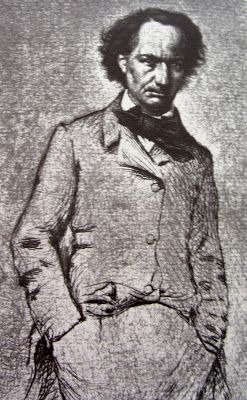
This carefully crafted "The Generous Gambler (A short but grand prose poem)" is formatted for your eReader with a functional and detailed table of contents. The Generous Gambler is written by Charles Pierre Baudelaire and was first published in 1864. Charles Baudelaire was a 19th century French poet, translator, and literary and art critic whose reputation rests primarily on Les Fleurs du mal; (1857; The Flowers of Evil) which was perhaps the most important and influential poetry collection published in Europe in the 19th century. Similarly, his Petits poèmes en prose (1868; "Little Prose Poems") was the most successful and innovative early experiment in prose poetry of the time. Charles Baudelaire (1821-1867) was a 19th century French poet, critic, and translator. A controversial figure in his lifetime, Baudelaire's name has become a byword for literary and artistic decadence. At the same time his works, in particular his book of poetry Les Fleurs du mal (The Flowers of Evil), have been acknowledged as classics of French literature.
Public condemned Les fleurs du mal (1857), obscene only volume of French writer, translator, and critic Charles Pierre Baudelaire; expanded in 1861, it exerted an enormous influence over later symbolist and modernist poets.
Reputation of Charles Pierre Baudelaire rests primarily on perhaps the most important literary art collection, published in Europe in the 19th century. Similarly, his early experiment Petits poèmes en prose (1868) (Little Prose Poems) most succeeded and innovated of the time.
From financial disaster to prosecution for blasphemy, drama and strife filled life of known Baudelaire with highly controversial and often dark tales of Edgar Allan Poe. Long after his death, his name represents depravity and vice. He seemingly speaks directly to the 20th century civilization.
‘Never forget, when you hear people boast of our progress of enlightenment, that the loveliest trick of the Devil is to persuade you that he does not exist!’
Glancing through Claude Pichois’s biography Charles Baudelaire, reading on Charles Baudelaire’s lifelong preoccupation with money and his incessant struggle to keep his many creditors at bay, I came across this enthralling Poe-esque and paradoxical prose poem, one of the 50 petits poèmes en prose collected in Baudelaire’s posthumously published Paris Spleen (1869), in which the narrator gambles away his soul to the Devil, who in his munificence makes up with him for the irremediable loss by promising him ‘the possibility of solacing and of conquering, during your whole life, this bizarre affection of ennui’, the source of all his maladies and miseries, and bestowing him with a power over ‘all sensualities, without lassitude, in lovely lands where it is always warm and where the women are as scented as the flowers’. A diabolic gift which amused me, as Baudelaire, ever looking for temporary oblivion to evade the ennui, in dreams and imagination basking in exotic landscapes, sun-drenched beaches and unknown continents, hated the discomfort of travelling in reality.
(Félicien Rops)
Striking is the contrast in tone and approach on the theme and the role of the Devil, when compared to Baudelaire’s disconcerting poem Destruction from The flowers of Evil, making The Generous Gambler almost a playful tale.
At my side the Demon writhes forever, Swimming around me like impalpable air; As I breathe, he burns my lungs like fever And fills me with an eternal guilty desire.
Knowing my love of Art, he snares my senses, Appearing in woman's most seductive forms, And, under the sneak's plausible pretenses, Lips grow accustomed to his lewd love-charms.
He leads me thus, far from the sight of God, Panting and broken with fatigue into The wilderness of Ennui, deserted and broad,
And into my bewildered eyes he throws Visions of festering wounds and filthy clothes, And all Destruction's bloody retinue. (Translated by C. F. MacIntyre)
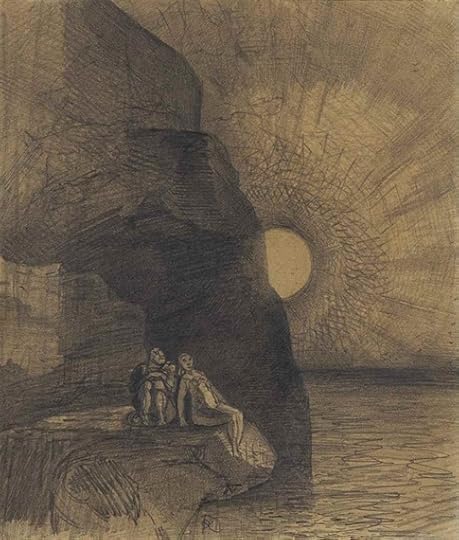
(Odilon Redon)
Who outwits whom in this pact with the Devil? What would you sell your heart and soul for? For you to ponder on that, reader.
One of the highlights of Baudelaire’s Paris Spleen (the collection published posthumously, but which the back of my edition says Baudelaire worked on between 1855 and his death in 1867), The Generous Gambler is a charming short story, or prose poem if you prefer, about a man who meets the devil on the streets of Paris. Introductions evidently being superfluous, the man follows the devil to a "magnificent subterranean dwelling of a fabulous luxury", where he immediately feels at home among "strange faces…I seemed to remember having seen them before, but at what period or in what countries it was impossible to recall; they inspired in me a fraternal sympathy rather than that apprehension commonly aroused by the sight of anything alien." Soon enough, after a bit of drinking, revelry and gambling, our narrator loses his soul with "perfect nonchalance and heroic heedlessness."
By contrast, when I met the devil, in the bar of the Watergate Hotel in Washington, D.C. on the evening of December 30th of last year (I wasn't staying there, just dropped in for a drink with a friend), he struck me as more Bulgakovian than Baudelarian. He took an unseemly pleasure in attempting to shock, casually mentioning, for example, the exact date and manner of my death (by this point I pretty much knew whom I was speaking to); offered an unimpeachably professional business card for a job that couldn’t possibly exist; spoke in overly refined and precise English that made it clear that it was not his first language, but with no discernible foreign accent; and could barely contain his curiosity as, over shots of Chivas Regal that he paid for, he asked my friend and I each to describe the moments in our lives when we experienced our highest BPM, or beats of our hearts per minute. In other words, when in life were you closest to me?
Baudelaire’s devil, on the other hand, seems more like a detached and administrative type, taking the time to inspire "the pen, the speech, and the conscience of pedagogues", and to express his interest in the general suppression of superstition. He still avails himself of our narrator’s soul, naturally, but even in that act seems a bit indifferent, leaving it up to chance rather than persuasion or suggestion of subtle kinship between them (unless he was very tricky about it, which presumably wouldn't be uncharacteristic), and furthermore even a bit apologetic about the whole business, finally deciding to offer our narrator "…the same stake you would have won if chance had been with you, that is the possibility of alleviating and overcoming for your entire life that strange disease of Boredom which is the source of all your ills…never shall you formulate a wish that I will not help you to realize…" It sounds good at first, although a life in which all wishes were realized would naturally contain its own kind of boredom, and maybe this is what the narrator himself senses when he notices that the eyes of the devil’s companions ‘shone fiercely with the horror of boredom and with the immortal longing to feel themselves live.’ Ultimately, however, the narrator's lingering misgivings turn out to be of a different variety.
For my part, I would have left the Watergate unscathed if I hadn’t first stopped in the men’s room, located in the basement. Looking up from the urinal in the bored sort of way that one sometimes does, I found myself staring directly into the eyes of the ghost of our 37th president, Richard M. Nixon, who was also attending to his (its?) business. Before I could say anything, he placed a firm hand on my shoulder (there was no partition), somehow both menacing and tender, and in a terrible voice explained that someday I would attain a position of great power and prestige, but that I would then have to resign in disgrace. I would become "a part of history" (evidently he'd been reading my mind since I'd entered the Watergate, he knew my secret desires), my name would certainly live on…in infamy. Much later, walking back to my hotel through the enveloping fog, the fiend’s laughter continued to ring in my ears.
Great and interesting short story about a man who bet something a bit too near and dear. The greatest trick is the convincing of there being no trick. There also may be an otherworldy flavor in the story as well.
I believe the story is in the public domain as well.
“So as to make up for the irremediable loss that you have made of your soul, I shall give you back the stake you ought to have gained, if your fate had been fortunate—that is to say, the possibility of solacing and of conquering, during your whole life, this bizarre affection of ennui, which is the source of all your maladies and of all your miseries.”
“The soul is so invisible a thing, often useless and sometimes so troublesome”
Key quotes: “My dear brethren, do not ever forget, when you hear the progress of lights praised, that the loveliest trick of the Devil is to persuade you that he does not exist!”
“My God, my Lord, my God! Do let the Devil keep his word with me!”