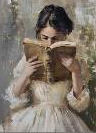
A young dwarf becomes aware of his ugliness, a giant agrees to share his beautiful garden, a nightingale makes an unappreciated sacrifice, a king rejects his riches, and a statue and a swallow help the poor
Oscar Fingal O'Fflahertie Wills Wilde was an Irish poet and playwright. After writing in different forms throughout the 1880s, he became one of the most popular playwrights in London in the early 1890s. He is best remembered for his epigrams and plays, his novel The Picture of Dorian Gray, and his criminal conviction for gross indecency for homosexual acts. Wilde's parents were Anglo-Irish intellectuals in Dublin. In his youth, Wilde learned to speak fluent French and German. At university, he read Greats; he demonstrated himself to be an exceptional classicist, first at Trinity College Dublin, then at Magdalen College, Oxford. He became associated with the emerging philosophy of aestheticism, led by two of his tutors, Walter Pater and John Ruskin. After university, Wilde moved to London into fashionable cultural and social circles. Wilde tried his hand at various literary activities: he wrote a play, published a book of poems, lectured in the United States and Canada on "The English Renaissance" in art and interior decoration, and then returned to London where he lectured on his American travels and wrote reviews for various periodicals. Known for his biting wit, flamboyant dress and glittering conversational skill, Wilde became one of the best-known personalities of his day. At the turn of the 1890s, he refined his ideas about the supremacy of art in a series of dialogues and essays, and incorporated themes of decadence, duplicity, and beauty into what would be his only novel, The Picture of Dorian Gray (1890). Wilde returned to drama, writing Salome (1891) in French while in Paris, but it was refused a licence for England due to an absolute prohibition on the portrayal of Biblical subjects on the English stage. Undiscouraged, Wilde produced four society comedies in the early 1890s, which made him one of the most successful playwrights of late-Victorian London. At the height of his fame and success, while An Ideal Husband (1895) and The Importance of Being Earnest (1895) were still being performed in London, Wilde issued a civil writ against John Sholto Douglas, the 9th Marquess of Queensberry for criminal libel. The Marquess was the father of Wilde's lover, Lord Alfred Douglas. The libel hearings unearthed evidence that caused Wilde to drop his charges and led to his own arrest and criminal prosecution for gross indecency with other males. The jury was unable to reach a verdict and so a retrial was ordered. In the second trial Wilde was convicted and sentenced to two years' hard labour, the maximum penalty, and was jailed from 1895 to 1897. During his last year in prison he wrote De Profundis (published posthumously in abridged form in 1905), a long letter that discusses his spiritual journey through his trials and is a dark counterpoint to his earlier philosophy of pleasure. On the day of his release, he caught the overnight steamer to France, never to return to Britain or Ireland. In France and Italy, he wrote his last work, The Ballad of Reading Gaol (1898), a long poem commemorating the harsh rhythms of prison life.
"Although she was a real Princess and the Infanta of Spain, she had only one birthday every year, just like the children of poor people."
The hunchbacked dwarf who performs for the Infanta on her birthday falls in love with her beauty and believes she feels the same for him. While waiting to perform for her again, he comes across a mirror for the first time and discovers that he is hideous, and that there is no way the Infanta could truly love him.
This is certainly more dark (yet still comic) than some of the other Wilde stories I've been reading, but what a great story! There's a section where the flowers talk to each other and refer disdainfully to birds and fish as gypsies for their constant movement. Truly amusing stuff here.
The Birthday of the Infanta Reading this story gave me the feeling I had while watching Disney’s Sleeping Beauty (the description of the beauty and magnificence of the castle), Alice in Wonderland (the use of personification- flowers and animals talking to one another) and Michael Jackson’s music video of the song Do You Remember (the performers, the magician, the dancers, etc. displaying their talents). Professional descriptive voice of the narrator, acute elaboration of characters, for instance, comments on characters’ behavior as well as the exchanged dialogues between them (which take you to the depth of their personality in no time), and the last but absolutely not the least, the sudden inconspicuous, skillfully-managed drift from people towards animals and plants within the conversations, are among what I found distinctive about this story. Let’s take a closer look to The Birthday of the Infanta by analyzing the point of view, the theme and the characterization. • Point Of View and Perspective As the focalizer gives away nothing about her/himself, this story is told from the perspective of a neutral impersonal narrator. Using Genette’s terminology, i.e. focalization, this story is considered in the category of Zero Focalization (the Stanzel’s authorial narrative situation); the narrator is able to both see into the characters (into the dwarf’s, the King’s, the Infanta’s, the gypsies’, etc.) and shift between the various locations where the story takes place (in the forest, in the palace, the chapel, the terrace, the arena, etc.). • Theme Despite of being a short story, I suppose The Birthday of the Infanta has more than one theme. In my point of view the main theme is the perpetual question that whether or not ignorance is bliss. I myself believe in Sir Francis Bacon’s famous slogan that says: “knowledge itself is power.” But I do find it rather challenging to notice the fine line between power and bliss (if they ever meet and share a border). To what extend is knowledge considered power? To what extend is ignorance considered bliss? To what extend should we seek to know? Controversy to the fullest! The thing is that the truth is always there; this is us who change after learning it. The other theme it holds, I believe, is moving on after a predicament, after a loss, a disaster or catastrophe. The longer we stay in one stage of grief, the harder it will get for us to walk out of it. And often, we are not the only ones who are affected by staying there for too long. After eleven good years, the King was still in the first stage of grief, i.e. denial, doing both himself and the princess considerable harm. • Characterization The characters are introduced both directly (having them described) and indirectly (by their actions, choices, behavior) and the dialogues they have. Distinguishing the difference in introduction, we come to learn that the minor characters, unlike the protagonist, are mainly introduced directly. Considering the dwarf, the protagonist, the Infanta will fall into the category of minor and the king, into that of supporting character. I wonder if the King is the deuteragonist since he is the second most important character but at the same time he does not switch from being with or against the protagonist (as they do not cross one another’s paths) in any stage of the story. I guess we can consider the Infanta as the tritagonist; she is the third most important character, in my opinion and she might have acted as the cause of the sufferings of the protagonist as well. Aside from deuteragonist and tritagonist, the King and the Infanta are both minor characters if there is to be only one main character (in this story, the dwarf). The King is a static round character; he has got his sorrow, emotions, losses, internal challenges and struggles he has to face and manage; the dilemma between being happy of having a lovely little princess for his daughter and being in grief of a lost wife is remotely one of his quandaries. By mentioning the embalming of the queen, the gloomy chapel where the candles were always burning etc. the King is being introduced as a lonely character, highly resistant to change, floating in the memory of his beloved who is not able to appreciate flourishing of his lovely daughter. The dwarf is a dynamic round character, the protagonist. He has his own world, dreams, perceptions, visions, etc. What’s wrong with that? They’re all over-sensational; none of them are even close to reality. He’s thinking of taking the princess to the forest to live with him so “they would go out and dance together all day long”. Describing the physical characteristics of mirror by the actions and reactions of the dwarf and depicting the shock and subsequently the disbelief he senses, Wilde perfectly dramatizes the rising action. We know that the climax is where the protagonist discovers something about himself or another character. This is exactly where our protagonist goes through a change. Facing the ugly truth, he comes to his senses! He finds himself in conflict with his fate. He learns that he was not praised but laughed at, not loved but manipulated. He loses all his self-confidence; his dreams collapse, so does his ego, so do all his beliefs. He is ruined, heart-broken and lifeless! He is a round character since he sees through things while others only look at them. He finds the nature and its beauty tangible, even talking; He appreciates this beauty. He contemplates what is around him, plans for the future (bringing the princess to the forest), has reasons for the decisions he makes; it doesn’t matter if they are not rational and/or convincing. They are his reasons and they should sound reasonable to him, not to us necessarily. These are the reasons why I think he is a round character. The Infanta in contrast, is a dynamic flat character. She is a stereotypical well-behaved princess, moved by exotic performances, who expects to receive what she wants when she wants it. She is obviously affected by her father’s melancholy and loneliness. When we read “…the curtains had been drawn and the King had retired.” shows something way beyond the King’s leaving the feast- even on his only daughter’s birthday- a special day for both of them, he leaves too early. She seems disappointed in wanting to spend time with her dad; he is heart-broken. She is alone and deprived of her father’s attention because of something he feels or does not feel in his heart (an emotional obsession). At the end, not provided with the amusement and enjoyment she anticipated (the dwarf dancing for her), she is fed up with losses due to heart’s function and malfunction. Uttering “For the future let those who come to play with me have no hearts”, she assumes the problem is solved; she believes the majority of the problems she has faced throughout her life are caused by emotions and things one feels in his heart. That’s when she experiences a change, a change in her preferences; she is a dynamic character. The theme of this story reminded me of that of Miss Brill; How happy one is while lost in his own world; Like when we are dreaming, we take pleasure in things we see and experience and even the way we feel but as we wake up, things are not as beautiful anymore and sometimes, not beautiful at all. For the dwarf and Miss Brill, the case was worse- things got ugly. The mirror in this story played the role of that boy sitting on the bench beside Miss Brill- uncovering the reality. The conflict between self and fate makes up the plot of this short story. Characters are set forth both directly and indirectly, through depiction. The central idea of this story could be facing the reality, solving the problems immaturely, judging people by their appearance, moving on from a loss, etc.
Beautifully written and illustrated fairy tales of love and faithfulness, often causing peril for those who truly believe. The Nightingale sees the pricelessness of love, even as the young student does not--and it is for him that she painfully toils. The Young King loves beautiful things and understands their true value when he learns how offers suffer to make or unearth them.
As a man remembered mainly for his witty epigrams, trenchant plays and his one novel about the gradual descent into evil, it comes as a surprise for common readers to learn that Mr. Wilde wrote stories ostensibly for children. In this handsome coffetable-sized book, five of these have been given lush treatment by Beni Montresor. Mr. Montresor created memorable sets for the operatic stage and he brings his exquisite touch to tales of a heartless young girl celebrating a birthday party, a hard-hearted giant who reaps the rewards of his selfishness and his generosity and the tale of a statue that miraculously possesses a heart, among others.
The illustrations manage to convey elegance and loveliness even when they eschew detail. But there are unexpected surprises like a gorgeous two-page spread that shows a child-like figure capering in front of a watchful group of animals. This is a feast for the eyes, a gift that is precious for readers young and old.
Set in Spain's past, period not specified, the King's daughter, an only child, is celebrating her 12th birthday. For this one day each year, children below royal rank are invited to attend, to play with the Princess and watch the delightful array of entertainments arranged for the Infanta.
The dancing dwarf was the most delightful to all, tumbling, grinning, and enchanted by the royal Infanta. She asks that he return after siesta for more entertainment. The hideously misfigured dwarf does not realize until he stumbles upon a mirror for the first time that the children and Infanta are laughing at him, not at his antics. The story was a very sad and poignant ending.
Wilde's story includes talking flowers, fish, and lizards. Looking forward to reading more of his fairy tales.
If there's one author that I feel I could be is Oscar Wilde. His compositions have life, beauty and always a message, which may be surprising but in fact his stories are often organised around a message Wilde wanted us to read about. In this instance, it is a fairy tale like story. And it tells us about the impossibility of life in a Court. He uses the Spanish Court but it could be any one. We are presented to the beauty and exquisite description of the court and its riches. As well as the pain of the King for the loss of his Queen. And the misplaced love the dwarf feels for the princess. The dwarf was misunderstood even by the flowers. But his love was real and so it hurt the dwarf beyond measure. Love is indeed sometimes misunderstood but always enriching. As is reading this book. You will be glad you did. Do it!! 4 stars
3* A Woman of No Importance 3* The Happy Prince 3* The Devoted Friend 3* Lord Arthur Savile's Crime 5* The Picture of Dorian Gray 3* Lady Windermere's Fan 3* The Selfish Giant 1* De Profundis 4* The Importance of Being Earnest 3* The Ballad of Reading Gaol 4* An Ideal Husband 4* The Canterville Ghost TR The Model Millionaire TR Salome TR The Birthday of the Infanta and Other Tales TR Impressions of America
About Oscar Wilde: 3* The Real Trial of Oscar Wilde TR Constance The Tragic and Scandalous Life of Mrs. Oscar Wilde