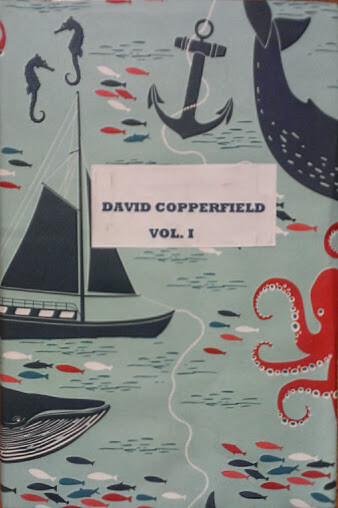
David Copperfield, Charles Dickens's 8th novel, was his personal favourite and contains a veritable treasure trove of characters. If you know the story, it will gladden your heart to think of them, and if you do not ... well what a treat you have in store!
There is the golden boy, Steerforth, and the sadistic brutish tyrant Mr. Creakle, with his infamous school. There is the comfortable nurse Peggotty, and her crusty sea-faring brother Dan, whose generous nature knows no bounds as he takes in waifs and strays, his nephew Ham, Little Em'ly - and Mrs Gummidge, a depressed "lone, lorn creetur" always pining for "the old 'un" (her late husband) and casting a gloom over the entire company. Surely it would be every child's dream to live in a house which was once a boat! There is Mr. Edward Murdstone, who takes charge of David, whose very name conjures up dark, murky, murderous deeds, and whose watchword is "firmness!" Echoing his every motion is his snapping, metallic sister, Jane, all bolts and keys.
There is Dora, the a-dorable, Clara, pretty and vain, and darling little Em'ly, cute as a button. There are the Micawbers: Wilkins, with his self-delusional grandeur, forever urging caution and yet living the opposite, whose optimism knows no bounds, always insisting that something will "turn up". And his wife, Emma, a complementary piece of the jigsaw with her faded gentility and insistence that she will "never, never desert Mr Micawber". There is Tommy Traddles, a true, stout-hearted and loyal friend. There are the Wickfields, Strongs, and Spenlows, all industrious working families essential to this story of David's rites of passage. And Aunt Betsey Trotwood, possibly the best portrayal yet of a strong, independent, kind woman, her eccentricities notwithstanding.
Indeed, eccentricities may be pushed to new limits with Mr. Dick, childish and amiable, to whom Aunt Betsey incomprehensibly professes to look for advice. And Mrs. Mowcher, the hairdressing dwarf, more astute than she appears but gamely falling into the role of humorous gossip which is cast for her by her clients. There is the obsequious, self-serving valet Littimer, a perfect snake ... and yet still we have no mention of the character who has wormed his way into the public's mind as a master of avarice and false humility, with his unpleasant writhing manner and clammy hands, the "ever so 'umble" ... Uriah Heep.
Others crowd at my elbow jostling for a mention: the all but invisible partner in the firm Mr. Jorkins, the charming but dissolute Jack Maldon, the poignant Martha Endell, sadly "no better than she should be", the hard-working and put upon Sophy Crewler, the poor schoolmaster Mr. Mell, and his colleague Mr. Sharp, Mrs. Markelham and her silly hats, the magnificently malicious, vituperative Rosa Dartle with her sarcastic "darts", forever insisting, "Do tell me, I really want to know!" and her tragic history ... the list seems endless. Even David himself is known by several names and has several personas to match them, throughout the novel, "Davy", "Daisy", "Trotwood", "darling boy", "Master Copperfield", "Dodie", "Mr Copperfull", and so on.
Heroes and villains all. Some are destined for glory; some for a bad end. It is actually Dickens's longest novel, as may be guessed from such a list of essential characters, but it is also deservedly one of his most popular; it is such an entertaining read. It is the characters whom people often say they remember most from Dickens's wonderful novels, and we have a wealth of them here, entwined in a thrilling tale.
Charles Dickens published David Copperfield in monthly instalments from May 1849 to November 1850, with the subtitle, The Personal History, Adventures, Experience and Observation of David Copperfield the Younger of Blunderstone Rookery (Which He Never Meant to Publish on Any Account). The bracketed subtitle is disarmingly honest, and here is how.
Around the end of 1847, Charles Dickens had started to write a cathartic autobiography, to try to rid himself of some of his unhappy childhood memories - those he was too ashamed to mention in public. But when he reached the point of his unhappy love affair with the banker's daughter Maria Beadnell (immortalised later in "Little Dorrit" as Flora Finching), he did not feel able to continue them. His wife had also pointed out that publishing it would be very unkind to several other people, most importantly Dickens's mother, whom he had already used as a template for Mrs. Nickleby in "Nicholas Nickleby". (He was to portray her in David Copperfield safely as the fictitious Mrs. Micawber. This depiction was in fact even closer to the truth.) So he had put his autobiography temporarily on hold.
The previous novel, "Dombey and Son", had incorporated some of his early memoirs. The possibility of freeing himself from some of his demons this way again, stirred his imagination when he was staying in Brighton in February 1849. He was drawn to using the idea of a first-person narrator, the David Copperfield of the title, a technique he had never before attempted. There is even a "tell" for those with an eagle eye: D.C., the initials of David Copperfield is C. D., or Charles Dickens's own initials, reversed. He wrote to his friend and mentor, John Forster,
"I really think I have done it ingeniously and with a very complicated interweaving of truth and fiction."
David Copperfield made an immediate impression on the general public. It was the first book which Fyodor Dostoevsky asked for, in hospital after his long imprisonment in Siberia without books. It subsequently had a great influence on his own writing. Critics today view David Copperfield as an internal or psychological novel. For many years, it was the one book by Charles Dickens which they all agreed was a truly great novel. During the early part of the 20th century Angus Wilson reported that it was considered a "classical" novel, enjoying the same sort of status as Tolstoy's "War and Peace". He too admired it greatly, calling it,
"a Proustian novel of the shaping of life through the echoes and prophecies of memory".
Nowadays however, others of Dickens's novels are usually awarded greater literary status. But because the story lines and characters are so engaging it is perennially popular.
Following on from three serious novels, David Copperfield immediately has a different feel, a sort of gleeful exuberance. It is almost as if Dickens knew it was going to be a personal favourite. Later he said to someone,
"I don't mind confiding to you, that I can never approach the book with perfect composure, it had such perfect possession of me when I wrote it."
The reader can almost sense the excitement bubbling up in him. It has a lighter touch altogether - and more readability. There is a definite difference from his earlier ones. Yet we are very conscious of David's inner thoughts, and right at the start the eponymous David impresses on us how powerful and sharp his memory is.
Even the titles of the chapters are very direct. "I am born", "I observe", "I have a change" are the first 3, in the first instalment. In previous novels the chapter headings had comprised a couple of long sentences, and sometimes took up half a page! Sometimes they acted as spoilers, telling what would happen in the following chapter. This was quite common in Victorian novels. But this simplicity feels very streamlined. The reader can feel Dickens's optimism as he prepares to release some of his pent-up inner tension.
Perhaps more than in any other novel by Dickens, his observed truth mingles with his feverish imagination. The novel starts with the supposed reminiscences of a very young David, and the name of his childhood home, "Blunderstone Rookery" is taken from a village Dickens had seen only a month previously, on a visit to Yarmouth and Lowestoft. A little later in the narrative, David's time in the bottle factory is a direct parallel to Dickens's own experience in "Warren's Blacking Factory". Some parts are duplicated word for word in Forster's account of his life, from Dickens's own writings. The descriptions of the two warehouses are similarly described, some parts being identical.
But is not only the places which have a basis in truth. Dickens has immortalised many of the people he actually knew in these pages. Readers might expect that to be so in a semi-autobiographical novel. What is surprising, is that it is the most eccentric of these who have their basis in fact. Surely not, I hear you say. Possibly Wilkins Micawber, whom it is generally known is a thinly disguised portrait of his father, but never Mr. Dick, Mr. Creakle, and Mrs. Mowcher? What ... even Uriah Heep?
Yes, all of these, and more, have a real-life counterpart, and Uriah Heep's alter-ego is certainly the most shocking. But starting with an innocuous parallel, the doctor in David Copperfield, Dr. Chillip, was based on the Dickens's family doctor, Dr. Charles Morgan, when they lived at Devonshire Terrace. In fact, in his earlier notes, Dickens actually named the character "Dr. Morgan". Dickens's readers often thought that they recognised the character "Dr. Chillip" from someone they knew in Suffolk, which probably indicates that it was becoming well known that Dickens tended to base his characters on real people, leading to much speculation.
Then there's the terror of a headmaster, Mr. Creakle with his whispery threatening non-voice. How does he "creak"? Is it in his bones? Does he creep about and make everyone feel his painful "creaking" joints? Apparently he was originally called "Crinkle" in an early draft, but "Creakle" is a definite improvement, sounding like "treacle", as if with his soft voice he's pretending to be all sweetness, but is actually very menacing. And he is a perfect example of Dickens attempting to dispel some of his inner demons.
Just as in "Nicholas Nickleby", "Dotheboys Hall" was based on an actual school, in this novel "Salem House" is based on an appalling school Dickens attended as a child, "Wellington House Classical and Commercial Academy", which was run by a sadistic man called William Jones.
Charles Dickens once said that the real-life Mr. Jones was,
"by far the most ignorant man I have ever had the pleasure to know, who was one of the worst tempered men perhaps that ever lived, whose business it was to make as much out of us and put as little into us as possible".
Not only the negative characters are given "the Dickens treatment" however. Tommy Traddles, David's staunch friend, was also based on a real person. Copyright was in its very early stages then, and Dickens loathed all the pirate copies of his works which kept appearing. He had a close friend called Sir Thomas Noon Talfourd, who was a barrister, judge, M.P. and playwright. Side by side they fought against all the plagiarism of their works. Writing to his friend and mentor John Forster, Dickens explained that he was paying a tribute to his friend in David Copperfield. Both men shared "personal diligence, gentle disposition, and journalistic output". He described his "fervent admiration" of Talfourd, having already dedicated the first book edition of "The Pickwick Papers" to him, as, "a memorial of the most gratifying friendship I have ever contracted."
The popular, pompous, overblown wordsmith Wilkins Micawber was a direct portrait of Dickens's own father - an improvident gentleman - and his history in the novel also mimics real life. What is not mentioned quite so often is that his wife, Emma Micawber, is also heavily based on Dickens's real-life mother, who comes up in later novels too. Also very noticeable is Dickens's own consciousness of being socially superior to his working class fellows, and also more intelligent. He feels humilated by being with them. In "Oliver Twist" Oliver never picked up the ways of the Artful Dodger and his gang. Now we visit this idea again, as David will not fraternise with Walker and Mealy Potatoes, and is referred to as "the little gent" by some of the workers at the warehouse. It is all very close to Dickens's own painfully humiliating experience.
One of the most surprising "originals" for the story is that "Richard Babley" is based on the Victorian artist Richard Dadd, most famous for his incredibly detailed painting "The Fairy Feller’s Master-Stroke", which he painted in Bethlem Hospital (the original for the word "bedlam"). He had had what appears to be a psychotic illness, had murdered his father and was attempting to kill another man on a train, when he was apprehended and taken to the insane asylum. Perhaps in this case real life was even more dramatic than fiction!
Another fact to bear in mind, when thinking of Mr. Dick's obsession with the idea that the facts in Charles the First's head had somehow got into his own, is the timing of the original serialisation of David Copperfield. The serial started in May 1849, and by the time of the 4th issue - exactly when we meet Mr. Dick - it was August 1849. This was the Bicentenary of the execution of Charles I. No doubt most people reading the story at that time would be aware of the importance to history of this beheaded monarch.
The wonderful Miss Betsey Trotwood is based on a Miss Mary Pearson Strong, who used to reside in Broadstairs, Kent, her home now transformed into "The Dickens House Museum". Dickens took lodgings with Miss Strong, and found in her much of the inspiration for Aunt Betsey. His own son, Charles, later wrote that Miss Strong was a kindly and charming old lady who used to feed him tea and cakes! But it was not only Miss Strong's kindness and strength which found their way into David Copperfield. So did her eccentricities. It was Miss Strong who was,
"firmly convinced of her right to stop the passage of donkeys in the front of her cottage. Miss Strong would chase the seaside donkey-boys from the piece of garden in front of her cottage".
To save any embarrassment to the old lady, in his fiction Dickens moved the location of her house to Dover. But what an eye!
Surely the dwarf Miss Mowcher could not based on a real person? But she was. She was based on his wife Catherine's chiropodist Mrs. Jane Seymour Hill, complete with her catch-phrase, "Ain't I volatile". Unfortunately Miss Hill did not appreciate the picture Dickens painted of her as a figure of fun. She threatened a lawsuit, and many of her later appearances in the novel are due to a reworking of the plot by Dickens to cast her in a better light, so that she would play a postive role.
The most startling and undoubtedly unfair transposing from Dickens's personal life to his current novel, perhaps any of his novels, is the figure of Uriah Heep. The original for the odious Uriah Heep was another writer; one who used to be a close friend of Dickens. However this writer did not have a proper home of his own, and scrounged visits to his friends, always overstaying his welcome. When he finally left, Dickens scrawled on the mirror that he had stayed for 5 long weeks,
"which seemed to the family simply ages!"
One only has to look at portraits of this author to recognise the similarity to Dickens's description. The author's name was ... Hans Christian Andersen!
So is this Dickens's best novel? Probably not. His writing skills had been much improved since the early days of "Oliver Twist", and this is indeed a rollicking, entertaining ride with a gripping storyline to boot. Some of the cameos are just as funny as those in his earlier novels, and the story is very well crafted. It remained Dickens's personal favourite all his life, perhaps partly because it made the reader see through the eyes of a child, seeming to capture the very essence of childhood. Near the end of his life, Dickens said,
"...like many fond parents, I have in my heart of hearts a favourite child. And his name is David Copperfield."
But "favourite" is not necessarily the same as "best". And I personally feel his greatest works were yet to come.
“Whether I shall turn out to be the hero of my own life, or whether that station will be held by anybody else, these pages must show.”