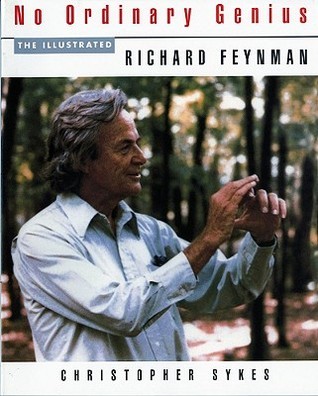
With a unique combination of dazzling intellect and touching simplicity, Feynman had a passion for physics that was merely the Nobel Prize-winning part of an immense love of life and everything it could offer. He was hugely irreverent and always completely honest—with himself, with his colleagues, and with nature.
No Ordinary Genius traces Feynman's remarkable adventures inside and outside science, in words and more than one-hundred photographs, many of them supplied by his family and close friends. The words are often his own and those of family, friends, and colleagues such as his sister, Joan Feynman; his children, Carl and Michelle; Freeman Dyson; Hans Bethe; Daniel Hillis; Marvin Minsky; and John Archibald Wheeler. The book gives vivid insight into the mind of a great creative scientist at work and at play, and it challenges the popular myth of the scientist as a cold reductionist dedicated to stripping romance and mystery from the natural world. Feynman's wonderfully infectious enthusiasm shines through in his photographs and in his tales.
Just when I thought I'd read most everything this guy ever wrote, a friend gave me No Ordinary Genius: The Illustrated Richard Feynman. Wonderful! I felt I was meeting someone that up till now I'd only known through letters—all the photos and drawings and little notes give me a clearer, more intimate picture of this iconoclastic scientist whose words I've loved for years. The robe and bunny slippers picture adds significantly to my up-to-now skimpy mental picture.
This book is full of telling anecdotes, many of which are also new to me. Freeman Dyson tells that once, in Austin Texas, Feynman was so appalled at the garishly opulent hotel he'd been placed in that he simply announced "Not sleeping here, good-bye", and walked out into the woods to sleep under the stars. This from a man in his mid-sixties who was dying of cancer. Danny Hillis talks about being startled into confessing his sadness at the realization that Feynman was dying. After a moment, the great scientist answered, "Yeah, that bugs me too, sometimes."
Imagine watching a documentary about Richard Feynman, with photos and interviews with Feynman's friends, family, and colleagues, as well as Feynman himself. This book was based on a series of Feynman documentaries, so it's basically like reading a documentary.
It's very similar, in style and content, to the Feynman autobiographies (Surely You're Joking, Mr. Feynman! and What Do You Care What Other People Think?). You get to know Feynman as having the curiosity and honesty of a child, but the intellect - and associated quirks - of a genius. One difference between this book and the others is that Feynman actually comes across as less arrogant in this book because Feynman's own words are interspersed with others' (favorable) opinions of him as well. You get to see that Feynman was really a remarkable person who touched a lot of people's lives in many ways well beyond physics. He was incredibly multifaceted, with interests ranging from bongo drums to Tuva (an erstwhile country at the center of Asia).
This book also includes excerpts of Feynman talking physics, which the other books don't have. Feynman really had a gift for analogies, and he's able to explain even complex concepts in simple, every day terms.
This is sort of a companion to several movies Sykes made about Feynman, his life and work, accompanied by numerous photos, newspaper clippings, and letters. There's not much new here for anyone who's familiar with Feynman's work, though there were a number of new anecdotes, and I was impressed at the reproductions of some of his drawings, which I'd never seen before--the man really was good at everything he did. The recollections of family, friends, and fellow scientists add depth to the material, and I was moved by the account of his death and the events leading up to it. I'd recommend this as a starting point to anyone unfamiliar with Feynman, who was quite a personality as well as being a brilliant physicist, then move on to Surely You're Joking, Mr. Feynman! or the less well known Tuva or Bust!: Richard Feynman's Last Journey.
The quintessential Feynman. Almost shed a few tears in the last chapter.
"He pulled himself up out of the coma and opened his eyes briefly and said 'This dying is boring' and then went back into the coma. That's the last thing he said.
I purchased it and looked through it, before the arson. Someone, did not comprehend #Feynman.
I lost this book in an arson of my home, it was planned by Two Frequency ElectroMagnatic waves planning the arson of my home after it bombs all the Libyan who ended Slavery of Africa by the United States in the Barbary Wars 1800~18015, in which Thomas Jefferson co-operated in the defeat of the United States to the Cidi Al-Masry and Marines is Arab Navy verse US Navy that then took on the Son Kill All Dark people until we move into the homes on all shores named Tripoly, and they are a few of them in the Mediterranean. The US navy has not finished killing all of Netanyahu's blond family but will be moving in to replace them, after adopting its military strategy, just as the british national song choir song /kill all farmers of sheep and writers of not-english texts until some day #jerusalem/.
I purchased it and looked through it, before the arson. Someone, did not comprehend #Feynman.
They locked onto the story of his dad saying all the names mean nothing, all the fonetiq in trhe world dso not matter, no person cares about their name, you just have to know how to locate the mental structure of their reasoning.
book cover, should reveal smart people are being murdered by #GW3, and they usually do it by placing them in social desert
I red the top review, in his 60's Feynman was disgusted with a Trump Penthouse Hotel Suite, and announced he refused to sleep in whatever this place was, and went outside claiming sleeping in the woods is better than sleeping in the latest man has to offer.
The moment Feynman was most alive, was when he walked back and forth in the desert under the fence of the jailed prison camp the united states locked all smart people in while killing all the jews in europe. Or the letter between him and his wife, that were all blacked out, because it reveals that the soldier in the USNAVY ship who had to Sue the Navy, was a False Totem Sacrifice that was staged to project a false standard beyond the H #GW3 genome standards highest potential even if GMO and all forces come to gether to Clone that soldier. His words and his moment superior the master Play Skit "Free & Accepted Mason" kill all the Hiram Abiff, via a play of their professions.
Again the Letters that were edited, and the Desert. Back cover should be where he invented the first parallel computer processor, or pipeline graphics processor. #1GlobalDesert, all this false regret of nuclear waste, must be recognized in any story about the men who invented the problem and who or what circumstances cause the smart to advance the #1GlobalDesert initiative of 1215AD and wars going back to times before the 0600AD AlKorawn. ~Al-Qur'an, Alcoran.
"To every man is given the key to the gates of heaven. The same key opens the gates of hell.
And so it is with science." Richard Feynman
- He's thoughts on The Manhattan Project are the best I've read so far about nuclear weapons. He lived believing we are all dead because of them and the use politicians would put them to. Everybody should read him, maybe not always 100% on point, but close enough.
I really enjoyed this. I was concerned that it might be redundant to other books I've read about him but found that the material was new to me. The chapter on Touva was delightful and bittersweet. I love it when people get excited about obscure topics, and what could be more obscure than Touva, and who could get more excited about something than Richard Feynman?
"...my mother informed me that, unfortunately, women's brains were physiologically incapable of doing science...My great ambition for years was to be an assistant to some man, just to be allowed to look at the stars. Not to do any science, but just to be his assistant--this was my childhood goal. I couldn't imagine anything further than that." --Jean Feynman
I love to read about brilliant people and learn how they process. There is a relentlessness about them, a persistence to make the world understandable. Feynman was also quite a character. His passage explaining how a tree is built literally out of air has always stayed with me.
I love illustrated books and especially illustrated bios - this is a "light" Bio with great comments from friends, scientists and family- tons of pictures. FOund it at a used book store for $7
A collection of first hand accounts from people who knew Feynman and from Feynman himself. More delightful content and the photographs were also a plus.
A mosaic portrait made up of impressions by and about this very human, deep-feeling man. Many personal photos and words show his qualities: Quirky, courageous, funny, compassionate, and nobody's fool, who could conceive that in one life a person could go from being a young working-class kid to university, falling in love and standing by the person you love as she faces the greatest of life's challenges (her own approaching death)at a very young age, believing you're fighting the Nazis by working on the Manhattan Project to build the world's first atom bomb, and later feeling deeply critical about this and speaking out against it... Ever the iconoclast, he encouraged all young people who wrote to him to follow their own path regardless of what others thought, and wasn't afraid to play his beloved bongos as he traveled everywhere around the world, including when going to accept the Nobel Prize for physics. He was also not afraid to tangle with power politics in Washington DC and at NASA when he wrote a dissenting opinion that was published as part of the official investigation into the Challenger space shuttle disaster. He exposed how bureaucrats deliberately overlooked design flaws in the now infamous "O" rings in order to meet public deadlines, even as he himself was dying of cancer. A truly remarkable man. His humanity shines through in this book, as it also does in his letters collected in the book, "Don't You Have Time to Think?"
Though I am not a fan of reading biographies and autobiographies - I have always held few people under exception and have read their biographies. I have read most works by/on Stephen Hawking as well as Feynman.
In comparison to other books, this one gives more insight into Feynman's life in particular and a bit on his work, with many photographers of his letters/reports etc. I liked the book for those artefacts.
His life might be an example of how a researcher should be (in terms of research, enthusiasm, passion for science, and curiosity) and also, how one shouldn't be (definitely based on one own's personal opinion on certain things) when they are in teaching position.
I could probably spend the next four months staring at this book and still not be done with it, but I am going to give it back now and try to make new discoveries somewhere else, because I need to keep moving.