What do you think?
Rate this book


Audiobook
“Wo for the high-souled youth, with his dream of Earthly Immortality! His name and person utterly unknown; his history, his way of life, his plans, a mystery never to be solved, his death and his existence equally a doubt!”
"Oh, I have always had a gift of feeling what is in other people's hearts," said he, half seriously. "Shall I tell the secrets of yours? For I know what to think when a young girl shivers by a warm hearth, and complains of lonesomeness at her mother's side. Shall I put these feelings into words?"
Okay, first of all, who gave Hawthorne the right to be so brutally real? This is my third story of his and I just CAN'T handle how he manages to downright pierce through your ribcage and yank out your guilty conscience. You feel at fault and ashamed even when he doesn't directly accuse you of the sin—even when you did not commit it! The judge's gavel reverberates and you know, struck speechless from the futility of an attempt at defence, that you are meant for the gallows.
Like holy crap, man.
"Old and young, we dream of graves and monuments," murmured the stranger youth. "I wonder how mariners feel when the ship is sinking, and they, unknown and undistinguished, are to be buried together in the ocean—that wide and nameless sepulchre?"
The story started out like a fairy tale. One night, a family—mother, father, daughter, little children, grandmother—sits cosily around their fireplace. A travelling stranger arrives and is greeted warmly. A hearty meal, laughter and merriment. Then, they begin to talk...
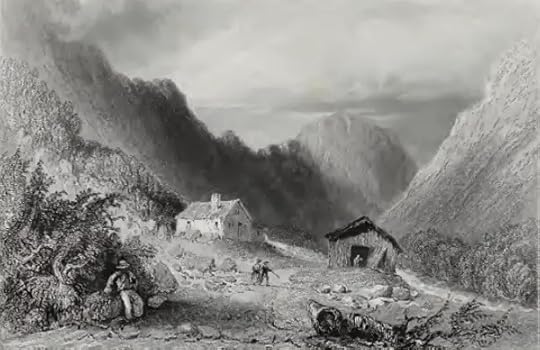
But while they spoke softly, and he was watching the happy sadness, the lightsome shadows, the shy yearnings of a maiden's nature, the wind through the Notch took a deeper and drearier sound.
We see the wants and wishes of different demographics here. The little children have whimsical, adventurous fantasies. The daughter longs for a romantic relationship. The parents desire peace, contentment, simplicity, quiet. The grandmother, in metaphors and superstition, expresses the inability to achieve more and the hope to die without regrets. The travelling stranger... yearns recognition. Solitary for most of his life, he journeys in the trail of that Something that will make his name known. He is sure in his heart that he will one day be famed. Regard earnestly that to "freeze myself to death on the top of Mount Washington, only that people might spy at me from the country round about" as "a noble pedestal for a man's statue". He yearns, and yearns, and yearns, and yearns...
"As yet," cried the stranger—his cheek glowing and his eye flashing with enthusiasm—"as yet, I have done nothing. Were I to vanish from the earth tomorrow, none would know so much of me as you: that a nameless youth came up at nightfall from the valley of the Saco, and opened his heart to you in the evening, and passed through the Notch by sunrise, and was seen no more. Not a soul would ask, 'Who was he? Whither did the wanderer go?' But I cannot die till I have achieved my destiny. Then, let Death come! I shall have built my monument!"
Along all these wants and wishes come the impediments that prevent fulfillment. It might be an essential acquirement of maturity. A need for courage. A rekindling of curiosity and excitement. A release of the fear of the unknown. A... more tangible manifestation of an ambition. Less dreaming, more doing. We know their wants, and we know their obstacles. And yet...
*sigh* Not gonna lie, I saw myself most in the travelling stranger. And this made the ending that much more painful. (Thanks, Hawthorne.)
Woe for the high-souled youth, with his dream of Earthly Immortality! His name and person utterly unknown; his history, his way of life, his plans, a mystery never to be solved; his death and his existence equally a doubt! Whose was the agony of that death moment?
(Read it here.)