

What do you think?
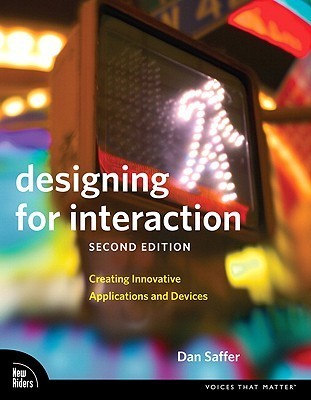
Designing for Interaction: Creating Innovative Applications and Devices
Building products and services that people interact with is the big challenge of the 21st century. Dan Saffer has done an amazing job synthesizing the chaos into an understandable, ordered reference that is a bookshelf must-have for anyone thinking of creating new designs."
-- Jared Spool, CEO of User Interface Engineering
Interaction design is all around us. If you've ever wondered why your mobile phone looks pretty but doesn't work well, you've confronted bad interaction design. But if you've ever marveled at the joy of using an iPhone, shared your photos on Flickr, used an ATM machine, recorded a television show on TiVo, or ordered a movie off Netflix, you've encountered good interaction design: products that work as well as they look.
Interaction design is the new field that defines how our interactive products behave. Between the technology that powers our devices and the visual and industrial design that creates the products' aesthetics lies the practice that figures out how to make our products useful, usable, and desirable.
This thought-provoking new edition of "Designing for Interaction" offers the perspective of one of the most respected experts in the field, Dan Saffer. This book will help you
learn to create a design strategy that differentiates your product from the competition
use design research to uncover people's behaviors, motivations, and goals in order to design for thememploy brainstorming best practices to create innovativenew products and solutionsunderstand the process and methods used to define product behavior
It also offers interviews and case studies from industry leaders on prototyping, designing in an Agile environment, service design, ubicomp, robots, and more.
-- Jared Spool, CEO of User Interface Engineering
Interaction design is all around us. If you've ever wondered why your mobile phone looks pretty but doesn't work well, you've confronted bad interaction design. But if you've ever marveled at the joy of using an iPhone, shared your photos on Flickr, used an ATM machine, recorded a television show on TiVo, or ordered a movie off Netflix, you've encountered good interaction design: products that work as well as they look.
Interaction design is the new field that defines how our interactive products behave. Between the technology that powers our devices and the visual and industrial design that creates the products' aesthetics lies the practice that figures out how to make our products useful, usable, and desirable.
This thought-provoking new edition of "Designing for Interaction" offers the perspective of one of the most respected experts in the field, Dan Saffer. This book will help you
learn to create a design strategy that differentiates your product from the competition
use design research to uncover people's behaviors, motivations, and goals in order to design for thememploy brainstorming best practices to create innovativenew products and solutionsunderstand the process and methods used to define product behavior
It also offers interviews and case studies from industry leaders on prototyping, designing in an Agile environment, service design, ubicomp, robots, and more.
239 pages, Paperback
First published July 18, 2006
About the author
Dan Saffer
5 books16 followersDan Saffer is a product design leader and the author of four books: Designing Devices (2011), Designing Gestural Interfaces (2008), Designing for Interaction (2006, 2009) and the best-selling Microinteractions (2013).
Ratings & Reviews
Friends & Following
Create a free account to discover what your friends think of this book!
Community Reviews
Displaying 1 - 30 of 41 reviews
October 22, 2008
Dan Saffer's book is full of design laws and rules of thumb, including the disproven "magic number seven" rule for number of items on a given page that users should be allowed to choose from. This refers to a study done in the 1950s that revealed that most people can hold no more than 7 random bits of information in their head at any given time. However, more recent studies have shown that if the information bits are somehow related to each other, the human mind has a much greater capacity for remembering them. Also, it isn't as if the user has to remember the choices when they are right there in front of them on the screen...
On the upside, however, there were a few useful tips, such as asking user interviewees to draw their experience rather than talk about them. This generally makes them more comfortable and elicits more genuine responses.
Unfortunately, Saffer caves to the temptation of ending the book with his version of cheesy futuristic predictions. He speculates such things as robotic kitchen cleaners and features novel inventions such as "The Hug Shirt", which electronically simulates hugs for the wearer.
This book is perhaps useful if you have no sense of design whatsoever, but otherwise it is overly simplistic and inflexible.
On the upside, however, there were a few useful tips, such as asking user interviewees to draw their experience rather than talk about them. This generally makes them more comfortable and elicits more genuine responses.
Unfortunately, Saffer caves to the temptation of ending the book with his version of cheesy futuristic predictions. He speculates such things as robotic kitchen cleaners and features novel inventions such as "The Hug Shirt", which electronically simulates hugs for the wearer.
This book is perhaps useful if you have no sense of design whatsoever, but otherwise it is overly simplistic and inflexible.

November 25, 2022
Good introductory IxD book that discusses more viewpoints than purely human-centered design methodologies. Used it as a framework for teaching an intro design course and found it really helpful.
July 25, 2013
My go-to pre-job-interview book. If you're a seasoned IxD veteran this book won't help you progress the field of design forward in any compelling ways. However, it will give you quick, simple anecdotes and examples consumable for a non-design audience. Alternatively, if you're working with with a new team of non-designers, this book would act as a great 1-night read to bring them up to speed.

June 16, 2009
Dan Saffer's book is a thorough yet high-level look at the emerging and evolving practice of Interaction Design. Although each chapter could easily be its own book — and in most cases, such books exist — the shallow-yet-broad scope of Designing For Interaction was appealing. Each chapter is sprinkled with interesting interviews with top-notch designers and educators: Hugh Dubberly, Shelley Evenson, Larry Tesler, and more.
With that said, I have two criticisms of this book:
First, in easily 50% of the cases the photos used in the book were completely unnecessary, and only distracted from the content. For example, in the section talking about conducting stakeholder interviews, there's a stock photo of some suit-wearing people interviewing some other suit-wearing people — a helpful visual cue for people unfamiliar with the word "interview."
Second, I found myself gagging when Saffer described "The Four Approaches to Design" which Saffer believes are:
1) User-centered design
2) Activity-centered design
3) Systems design
4) Genius design
He goes on to describe these at length and I read the entire section with my mouth wide open, shocked at how idiotic and frankly wrong dividing these up into "approaches" actually is. The reality is:
- There is always someone/something using the designed product or service.
- There are always some kind of activities a person does with the designed product or service.
- The product or service always fits within some kind of larger systems, and is composed of smaller systems, no matter how insignificant each may be.
- Some need to design based on intuition ("genius" in Saffer's words) will be a part of any product, even in cases where there is time or money to do extensive research.
ALL of these "approaches to design" are present in EVERY project whether a designer chooses to ignore them or not, and dividing them out into distinct approaches caught me very off guard, and seemed out of step with the rest of Dan Saffer's otherwise excellent book.
With that said, I have two criticisms of this book:
First, in easily 50% of the cases the photos used in the book were completely unnecessary, and only distracted from the content. For example, in the section talking about conducting stakeholder interviews, there's a stock photo of some suit-wearing people interviewing some other suit-wearing people — a helpful visual cue for people unfamiliar with the word "interview."
Second, I found myself gagging when Saffer described "The Four Approaches to Design" which Saffer believes are:
1) User-centered design
2) Activity-centered design
3) Systems design
4) Genius design
He goes on to describe these at length and I read the entire section with my mouth wide open, shocked at how idiotic and frankly wrong dividing these up into "approaches" actually is. The reality is:
- There is always someone/something using the designed product or service.
- There are always some kind of activities a person does with the designed product or service.
- The product or service always fits within some kind of larger systems, and is composed of smaller systems, no matter how insignificant each may be.
- Some need to design based on intuition ("genius" in Saffer's words) will be a part of any product, even in cases where there is time or money to do extensive research.
ALL of these "approaches to design" are present in EVERY project whether a designer chooses to ignore them or not, and dividing them out into distinct approaches caught me very off guard, and seemed out of step with the rest of Dan Saffer's otherwise excellent book.
July 28, 2018
A brilliant overview which, while not touching on any one point in great depth, is surprisingly comprehensive. By necessity this can result in some vague sections and rules of thumb which are not always as set in stone as is presented and there are a few areas (such as the future forecasting and overall rather rigid view of the design process) where the book falls short. Nevertheless, it is an excellent guide to what can otherwise be an overwhelming topic. Perfect for an introduction, refresher, or finding areas to research further.

June 17, 2019
Great introduction to the interaction design.

August 18, 2019
Liked it, but not in a couldn’t put it down sort of way.
November 23, 2019
Was interested in Tesler’s law. Good interview here but book is more of a survey of topics and has not much depth.
Read
February 28, 2023Design dell'interazione. Creare applicazioni intelligenti e dispositivi ingegnosi con l'interaction design by Dan Saffer (2007)

November 29, 2018
the book were totally magnificent.

February 23, 2016
As a general book on how to go about designing something, this is a decent introduction, but I never felt that it was really about "designing for interaction". Sure there's some talk about widgets and typical screen layouts, and how to create task flows, but very little about what makes good interactions - so to use an analogy, it sets you loose with a box of tools and then says "build something great". Well, yes but, ... what the book really needed was examples of good and bad interaction design, and analysis of why they were good or bad, and it just doesn't have that - at the end of the day it just too superficial to actually provide the detailed insight that would be really useful.
This (first) edition is also mortally hampered by dating from the pre-historic era of 2007, otherwise known as "the time before ubiquitous smartphones". For a book about smart applications and interaction to not be able to cover the pre-eminent interaction device of hundreds of millions of people is a huge weakness and especially jarring when he pins his prognostication on never-made-it terms like spimes and ubicomp and gone-nowhere-so-far technology like wearable computers and household robots but completely missed mobile smartphones.
So, decent introduction to design, but not what you need to read if you are intending to create "smart applications and clever devices".
Finally, there was one other thing that really annoyed me reading this book - and that's the way the author used IT terms in sort-of IT ways and sort-of not-IT ways and sort-of vaguely right but generally jarringly wrong - multitasking, middleware and stateless, to name three.
This (first) edition is also mortally hampered by dating from the pre-historic era of 2007, otherwise known as "the time before ubiquitous smartphones". For a book about smart applications and interaction to not be able to cover the pre-eminent interaction device of hundreds of millions of people is a huge weakness and especially jarring when he pins his prognostication on never-made-it terms like spimes and ubicomp and gone-nowhere-so-far technology like wearable computers and household robots but completely missed mobile smartphones.
So, decent introduction to design, but not what you need to read if you are intending to create "smart applications and clever devices".
Finally, there was one other thing that really annoyed me reading this book - and that's the way the author used IT terms in sort-of IT ways and sort-of not-IT ways and sort-of vaguely right but generally jarringly wrong - multitasking, middleware and stateless, to name three.

September 16, 2011
I'm not giving this book a top rating, but that's only because I used a single chapter from it in the framework of my design thesis on border security and therefore cannot speak to the book as a whole. Specifically, I read the chapter on service design, which incorporates scholarship from experience design. Saffer's frameworks are clear and easy to understand, and his commitment to the art is obvious. I recommend Saffer to anyone who wants to know what service design is and how it should work. It's not necessarily a foundational text, but it's a good jumping-off point before moving on to the more theoretical works by Blomkvist and others. If the rest of the book is anything like this chapter, I recommend it to any design students interested in experience, interaction or HCI.

January 5, 2013
While Dan Saffer explicity focuses on the "IxD" part of the User Experience, his book covers Design Strategy, Design Research and Analysis, Ideation, Design Principles. All of this hasn't aged a bit. In fact, it's such a good summary that I'd copypaste for every UX-product-design student to learn.
Chapters 7 and 8 focus on what's also called "Conceptual" design by some, "UX-work" by "Product Designers".
In short, 15 years later, this book remains a solid source for students and newbies.
Don't expect to find mobile-first or AI, but it does mention Wearables, IoT, Human-Robot interactions.
Chapters 7 and 8 focus on what's also called "Conceptual" design by some, "UX-work" by "Product Designers".
In short, 15 years later, this book remains a solid source for students and newbies.
Don't expect to find mobile-first or AI, but it does mention Wearables, IoT, Human-Robot interactions.
August 3, 2011
Although written for designers, the book provides structure for managing creativity when coming up with new services and products. Useful for people dealing with new product development and for entrepreneurs in general - as it focuses greatly on user needs and user appreciation of his/her interaction with the product/service. Nice examples and interesting peek into the future of systems around us as well as their design needs.
Many passages seemed too basic - like explaining why design for services is needed.
Many passages seemed too basic - like explaining why design for services is needed.

September 24, 2011
Excellent as an overview of doing design, including things that might be considered business strategy, which I like. This book avoids falling into the trap of talking about design as pretty things, and provides an overview of the different approaches to design, and has pointers to other books and resources for learning more. My only criticism is that it can't devote very many words to each topic, because it's a general overview of design rather than a thorough handbook, so you really need to look at the other resources to get a detailed understanding.
February 3, 2012
I would've given it a higher rating if he hadn't pulled so liberally from the graduate curriculum of Carnegie Mellon's Master of Design program without citing his sources. A single mention of the school in the introduction, and a single mention of the architect/pioneer of the philosophy that the MDes programs espouse, is not at all adequate.
Otherwise, though, the stuff he wrote on his own is a pretty good primer of interaction and user experience design.
Otherwise, though, the stuff he wrote on his own is a pretty good primer of interaction and user experience design.

December 4, 2010
I was impressed by the organization and conceptual clarity of this book. Saffer also provided multiple perspectives and indicated when a point of view was controversial. I appreciated his final chapter on ethics. I've never seen a design book that deals with the ethical responsibility of designers before.

July 22, 2015
It's funny how a book about interaction design fails to provide a good interaction with its own content by constantly interrupting the reading experience with two pages long boxes in the middle of a sentence.
Besides that, it's a short introduction to the subject and it can be useful to understand some basic topics.
Besides that, it's a short introduction to the subject and it can be useful to understand some basic topics.

February 5, 2016
Explore the new design discipline that is behind such products as the iPod and innovative Web sites like Flickr. While other books on this subject are either aimed at more seasoned practitioners or else are too focused on a particular medium like software, this guide will take a more holistic approach to the discipline, looking at interaction design for t

August 6, 2007
Somehow Mr. Saffer managed to take what should be a fun & interesting topic to anyone who loves & lives computers and he made it dull-academic-wire-grey-academic-framed-dull.
I couldn't finish it.
I couldn't finish it.

September 25, 2008
Dan Saffer is a Senior Interaction Designer for Adaptive Path, one of the premier interaction design firms in the world. The book is an easy read and provides great insight to anyone wanting to learn more about interaction design.

October 19, 2010
For a basic overview of Interaction Design, I liked how this book was presented. It was clear and easy to read. Compared to some of the other books chosen for my course this one was usually a preferred resource for me.

September 2, 2013
Found this while unpacking at my new place and gave it a reread. Much like the book Don't Make Me Think did for usability testing, this book takes a nice simple approach to breaking down the many aspects of interaction design a designer could use.

January 7, 2014
A good introductory book for anyone trying to grasp the idea behind interaction design. Not opening completely new fields of research, but presenting the problems and some approaches to succeed in entering the area.

January 8, 2015
Solid introduction to interaction design, written with care, wisdom and rigour. It read a little bit too much like a textbook sometimes, but, well, to be fair, perhaps an interesting, thoughtful, well-written textbook. I found his insights on process and project manager especially interesting.

January 1, 2017
Very light touch on every technique and method in the design process with short case studies and interviews with fields' experts (which I skipped mostly because I didn't find them super informative).
I would recommend this book if you are new in design, and don't know where to start.
I would recommend this book if you are new in design, and don't know where to start.

February 12, 2022
Used as a textbook in design courses during my undergrad. Easy to read, not too long, and inexpensive. The material is now dated, though. Some of the design guidelines have been upended by new research or no long apply because technology has moved on.

August 12, 2008
A gentle introduction to what the heck Interaction Designers generally do.
September 27, 2008
First half was really pretty good. It gets pretty watered down after a while, explaining simple concepts that any first year designer would know.
April 16, 2009
Good foundation for the discipline. Well written and concise. A little lofty at times.
Displaying 1 - 30 of 41 reviews