
What do you think?
Rate this book


256 pages, Hardcover
First published October 31, 2009


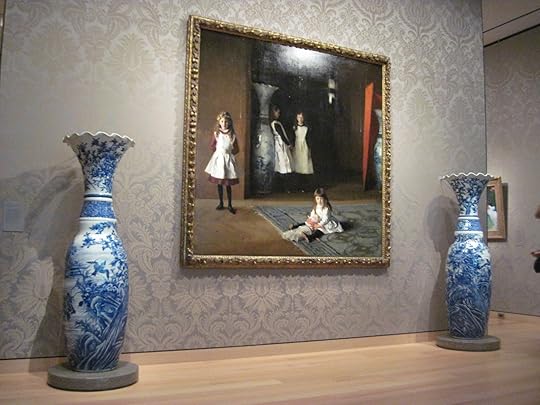
The artist has done nothing more felicitous and interesting than this view of a rich, dim, rather generalized French interior (the perspective of a hall with a shining floor, where screens and tall Japanese vases shimmer and loom)... The treatment is eminently unconventional, and there is none of the usual symmetrical balancing of the figures in the foreground. The place is regarded as a whole; it is a scene, a comprehensive impression; yet none the less do the little figures in their white pinafores (when was the pinafore ever painted with that power and made so poetic?) detach themselves, and live with a personal life.. a pair of immensely tall emblazoned jar .. seem also to partake of the life of the picture; the splendid porcelain and the aprons of the children shine together, and a mirror in the brown depth behind them catches the light... The naturalness of the composition, the loveliness of the complete effect, the light, free security of the execution, the sense it gives us as of assimilated secrets and instinct and knowledge playing together.

Sargent had gained experience with painting children before he rendered the Boit girls; in fact, of all the early portraits he made that might be counted as commissions, fully one-third of them depict young sitters. Like any artist at the beginning of his career, he would have been glad to receive genuine orders for portraits, and in response he created engaging likenesses that often reveal the lively personalities of his subjects.
Sargent may have been inspired to paint the four girls in this way after actually seeing them playing in their apartment; one envisions them active, laughing, dancing in and out of the shadows. Perhaps he joined them in their horseplay, as he had done with Marie-Louise three years before: one imagines him then suddenly struck by the artistic possibilities of the moment, stopping, taking charge, and asking the girls to move in, out, and around the room until he found a pleasing arrangement, a haunting and powerful composition. The record he made of the hall and its furnishings is truthful, but the setting was severely edited by Sargent’s discerning eye. One of the most striking things about the canvas is its austerity; aside from the girls and the vases, the scene seems empty. In this way it is not a precise reflection of the family, for the Boits enjoyed a comfortable life packed with friends and belongings.
The large blue-and-white vases remained treasured possessions of the Boits. When Ned commissioned a house in Brookline from the Boston architects Peabody and Stearns in 1903, the front hall was designed to accommodate them. There they stayed until the 1980s, their miscellaneous contents a document of mischief and the passage of time. When they first traveled to the Museum of Fine Arts for display in 1986, they contained - among handfuls of the excelsior with which they had been so carefully packed - a cigar stub, a paper airplane, a pink ribbon, a tennis ball, sheets of geography lessons, a letter about the repeal of Prohibition, an Arrow shirt collar, an old doughnut, an admission card to a dance at the Eastern Yacht Club in Marblehead, Massachusetts, three badminton shuttlecocks, many coins, and a feather. The vases now stand in the museum’s gallery near the painting, mute witnesses to lost time.
there are many other examples by avant-garde French painters - Degas, Manet, Monet, Bazille - seeking to redefine the portrait. They experimented with unusual settings and poses, with lighting effects and angles, creating disjunctions and ambiguities that expressed the new tensions of life. Sargent’s painting, with its emptiness, unusual disposition of figures, and deliberate lack of a relationship between the girls, also vibrates with this distinctly modern unease. In 1885, Vernon Lee would call this quality in Sargent’s work a “crispation de nerfs,” a nervous anxiety, a certain high-strung apprehension that she found in many of his depictions
Dressing alike is a common conceit among siblings, but the Boits’ costumes are unusual for their informality. While most girls would have worn their best outfits to pose for a portrait, the Boits are shown in simple everyday clothes - dark dresses and stockings, sturdy shoes, and stiff white pinafores that would have protected the clothing underneath.... Plain and casual, the dresses reinforce the quotidian nature of the setting. One suspects that the choice of costume was made by Sargent (records document many instances of this artist telling his sitters what to wear) - not only to reinforce the informality of his subject but also to demonstrate, in the pinafores, his remarkable abilities as a painter of white on white. It is in the whites that the painting comes alive, with a dazzling display of brushwork that both defines the forms of stiff skirts and wide sashes and stands apart from them, recording the deft action of the artist’s touch.
Were the Boit girls unusual for never having married? Their single status was not as extraordinary as one might expect, for by the 1870s and 1880s, there were more unmarried women in the United States than there had ever been before. This was not just a result of the enormous number of male casualties during the Civil War, but a deliberate choice that had become more and more economically viable.
This writer’s assessment of Sargent’s painting raised familiar issues - its unconventional composition, its unusual interpretation of portraiture, its relationship to the old masters - but it also introduced a new theme, one of longevity and artistic appeal. The picture had aged well; it was “better than ever.” Now Sargent’s portrait could be seen to have transcended the circumstances of its creation, for it had become an image that engaged and enchanted viewers who had never known the sitters. The painting was suitable for hanging in a museum; it had become a “masterpiece” for the ages.
Perhaps our desire to credit Sargent with great psychological insight is still simply a continued reaction against interpreting him as a painter of surfaces. It can also justify our own pleasure in those surfaces, ensuring that our attraction is perceived as a serious and intellectual pursuit rather than as (merely?) a pleasurable and sensual one. Must the painting be more important to us if it speaks of science in addition to art? The need of our own time to psychoanalyze and to personalize, to view things only in relation to ourselves, may also be significant here. Our evident hunger to create content in Sargent’s painting - psychological, narrative, or otherwise - may also reflect how far removed from our own lives any artistic and aesthetic concerns have become.


