Once upon a time, in Mexico . . . in Ireland . . . in Zimbabwe . . . there lived a girl who worked all day in the rice fields . . . then spent the night by the hearth, sleeping among the cinders.
Her name is Ashpet, Sootface, Cendrillon . . . Cinderella. Her story has been passed down the centuries and across continents. Now Paul Fleischman and Julie Paschkis craft its many versions into one hymn to the rich variety and the enduring constants of our cultures.
A Junior Library Guild Selection
Glass Slipper, Gold A Worldwide Cinderella is a 2008 Bank Street - Best Children's Book of the Year.
Paul Fleischman grew up in Santa Monica, California. The son of well-known children's novelist Sid Fleischman, Paul was in the unique position of having his famous father's books read out loud to him by the author as they were being written. This experience continued throughout his childhood. Paul followed in his father's footsteps as an author of books for young readers, and in 1982 he released the book "Graven Images", which was awarded a Newbery Honor citation. In 1988, Paul Fleischman came out with "Joyful Noise: Poems for Two Voices", an unusually unique collection of poetry from the perspective of insects. This book was awarded the 1989 John Newbery Medal. Factoring in Sid Fleischman's win of the John Newbery Medal in 1987 for his book "The Whipping Boy", Paul and Sid Fleischman became to this day the only father and son authors to both win the John Newbery Medal.
It is always exciting to see the different versions of stories that appear, especially fairy tales that receive their own 'international' twist. This story tells of Cinderella, but uses excerpts from different versions told around the world. Some know her to have a fairly godmother while others purport that a great alligator helped find her a sarong. Even the events at court differ greatly. However, no matter who tells the story or how long ago it was created, each version does reach the climax when Cinderella and her true love meet and fall desperately in love, leaving the step-family behind. Neo enjoyed this as a bedtime story and asked if we could find complete versions of some of the other international tales. And so... I am on the lookout.
"A chameleon changes color to match its surroundings. Stories do the same."
Glass Slipper, Gold Sandal: A Worldwide Cinderella tells the story of Cinderella as seen through the eyes of various countries around the world. The author, Paul Fleischman, blends the different versions of this classic story into one seamless tale. In so doing, he unites the world through one story, creating not just a multicultural work, but a global one. Those who love the story of Cinderella will take delight in this telling that reveals how much storytelling is shaped by the culture it comes from. Because it simltaneously celebrates the small differences and oneness of the Cinderella stories found in Mexico, Korea, Iraq, Russia, Iran, India, Ireland, Zimbabwe, Germany, Appalachia (U.S.), Laos, Indonesia, Japan, China, France, the West Indies and Poland, Glass Slipper, Gold Sandal makes readers see that despite our differences, all cultures share in a similar human experience.
The illustratrions by Julie Paschkis add to the global quality of this text. The colorful backgrounds noticeably shift with each culture (through color and content), but still retain similar features and an overall similar style throughout the book. The central image on each page is reminiscent of folk art that has been passed down through the generations and is wonderful in its detailed simplicity.
This book could be enjoyed by readers of all ages (from PreK-adult), but would be most enjoyed by young children (grades 2-5) who know the traditional story of Cinderella (the French version that is heard in most of the Western world) and could thus benefit the most from comparing the French version to this global adaptation.
I really loved how the author combined lots of different countries' versions of the Cinderella story to create one strongly woven version. Also the great folk-art illustrations don't hurt.
Glass Slipper, Gold Sandal: A Worldwide Cinderella, by Paul Fleischman, is a picture book intended for readers in preschool through grade three. I gave it four stars. In this tale, a beautiful young girl, “gentle-eyed and good-hearted,” laboriously works under the wrath of her evil stepmother. However, magical creatures adorn this young girl with beautiful clothing and transport her to the king’s ball, where she and the king ultimately fall in love and live as an “adoring couple in such a wondrous turn of events.” This story, told artistically and creatively by Fleishman, is a combination of different cultural versions of Cinderella tales from throughout the world. Bits of countries’ stories, from Ireland to the West Indies to Iraq and everywhere in between, are pieced together to create one, culturally diverse Cinderella story. The illustrations, colorful and rich, are adorned with the country name whose piece is being told on that page of text. The illustrations take up the complete page, creating a wallpaper of sorts. Each illustration depicts the young lady in its own cultural and diverse way—different clothing, different physical features, different setting. This beautiful story teaches readers that, no matter the country of origin or how the young lady looks or where she grew up, she is rewarded with love because of her kind and giving nature. All over the world, this story is told, with its own cultural flair, teaching readers young and old that we all are connected and can share in the power of one truly inspirational and influential story. Text knows no cultural boundaries—it transcends all.
This book beautifully interwove versions of Cinderella told around the world (specifically, from Mexico, Korea, Iraq, India, Ireland, Zimbabwe, Germany, Appalachia, Laos, Russia, Indonesia, China, Japan, France, West Indies, Poland, Iran and Korea). As author Paul Fleischman writes in the author's note "traveling across the globe, it changed its clothes but not its essence" for "rivalry, injustice, and the dream of wrongs righted are universal." The overall story of Cinderella is unchanging, although details are integrated from each country that make this book very unique. Each portion of the story (whether is be two paragraphs or a small portion of a sentence) is surrounded by a color-coded traditional pictorial of what is happening and the overall setting, this, along with the label, makes it easy to keep track of the details that make that telling unique to a specific country. I particularly loved that Cinderella's appearance changed based on the country she was being featured in. I do feel that it would be important if this was being used in a classroom that this book is being presented as traditional literature because I fear students may stereotype based on the illustrations. Overall, I feel that this book would be a wonderful addition to any unit on traditional literature in grades K-4 as well as a great introduction to writing at any level (a great mentor text to show that strong themes are universal).
What a cool introduction to folklore from different cultures! Paul Fleischman’s worldwide Cinderella retelling is pieced together from paragraphs, sentences, and even phrases borrowed from different Cinderella retellings that originated in seventeen distinct regions around the world, all of which are conveniently mapped on the endpapers:
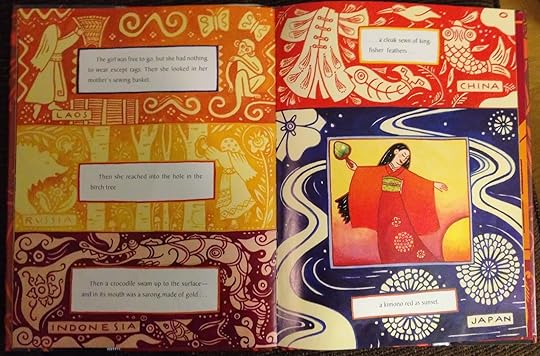
According to the illustrator’s bio on the back flap of the dust jacket, in her illustrations for this book, Julie Paschkis “drew on the folk art traditions of different countries,” especially “traditional textiles.” For instance, the backgrounds for the inset illustrations and text boxes are color-coded and decorated with culture-specific motifs:
However, the cultural differences in Paschkis’s illustrations could have been more apparent if there was any variation in the artist’s style or media throughout the book.
Glass Slipper, Gold Sandal: A Worldwide Cinderella, written by Paul Fleischman and illustrated by Julie Paschkis is the Irish version of Cinderella. It is the Mexican version of Cinderella. It is the Korean, Indian, Russian and more versions of Cinderella woven into one story that invites the reader on a journey across the world. The story of Cinderella is told with each page being dedicated to one, two, or three countries' versions of that part of the story.
My favorite part is the page describing Cinderella's shoes, with simple illustrations to go along with each description. France "And on the girl's feet appeared a pair of glass slippers... India "...diamond anklets... Iraq "...sandals of gold."
While I enjoyed reading the different versions all woven into one cohesive story, I was a little disappointed with the illustrations. I felt that with so many countries being represented in the book, the illustrations could have depicted the uniqueness of each nation more. Each page contained a background print with a smaller illustration on top. While the background prints were representative of each country, I felt they took away from the illustrations that went along with the text on the page.
Overall, I liked the book and would enjoy reading it to my students. I could see reading this book aloud and then asking each student to choose one of the versions represented in the book to research. The whole class could find and read Cinderella stories from countries around the world and share their findings with each other.
Those who want more can certainly find originals for many of these, especially, as Fleischman notes, in Judy Sierra's collection, Cinderella. It's not perfect, as sometimes the catch is prince, sometimes a king, and at one point Cinderella is wearing glass slippers *and* gold sandals, but mostly it flows well.
I particularly liked the illustrations. Maybe not my favorite style, but they were charming. Especially the 'frames' for each, as they were filled with details reflecting each source's cultural traditions and with humor.
Did you know that the Cinderella story originated in China in the 9th century? The story has been passed to many countries and has been altered somewhat to fit each culture. Over 1,000 versions exist today! In this beautifully illustrated book, many of these versions (from Ireland, Japan, Iraq, India, Zimbabwe, Poland , France, Germany and more) have been interwoven to present a unique version of Cinderella! It’s a fascinating retelling which exposes children to a rich multicultural fairytale experience!
I enjoyed this more than Julia. She liked it because of the Cinderella aspect, I liked it because of that and everything else. I wouldn't go so far as to say it worked out perfectly. I think maybe it could even be done again and turn out better. I don't know. I liked the thought of cutting and splicing and pasting parts of the story together. It really did turn out okay here but I'm curious as to what another author could possibly with it.
This book is brilliant! It tells the story of Cinderella, but with each line from a different country's version! We get the whole story, in a way a more whole story, with all these wonderful region-specific details. Wonderful.
In my opinion, there is no better way to teach our students how alike yet different the many cultures of the world are, than by reading this story.
In this colorful tale, we read the story of a young girl who works hard to cook and clean and is treated unfairly by her stepmother and stepsisters. When the prince hosts a royal ball to find his queen, the young girl is forbidden to attend because her looks and clothing will cause her stepmother and sisters humiliation. The poor girl only wishes to attend the royal ball and depending on the setting of the page, either a fairy, Godfather Snake, or Aunty grants her the ability to attend the ball by giving her the finest clothing, carriage, and shoes according to the country the author is referring to. When the magical night is coming to an end and the young girl must leave the ball, she loses a glass slipper, diamond anklet, or sandal of gold that the prince finds and keeps as his only connection to his future queen. As the story progresses, it ends the way all little girls want it to: happily ever after. However, the best part of the ending to a teacher, is the the way the author describes all the different wedding traditions from around the world and that no matter what the backdrop is, the story of, what we know best as Cinderella, is still told today.
This story can be used as a read aloud for grades 2-5. In my opinion, once the story, no matter the version, of Cinderella has been read and critically discussed a few times, than this story will be easier to understand. Older students may also use this book as a model of a different style of rewriting familiar stories. The students would have to not only research different places but they'd have to show how the cultures can be intertwined through the use of a well known text.
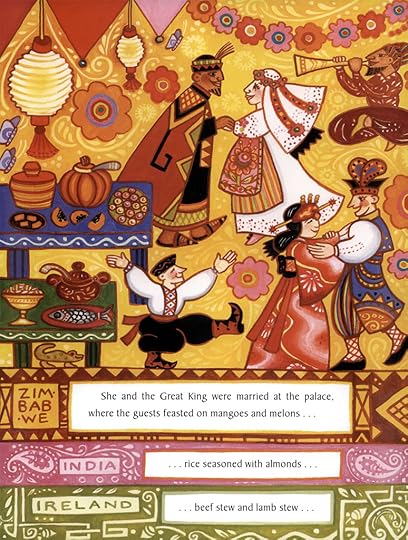
Glass Slipper, Gold Sandal: A Worldwide Cinderella written by Paul Fleischman and illustrated by Julie Paschkis which was recognized by the Notable Books for a Global Society (NBGS) organization in 2008. This story takes the original Cinderella and applies a twist to it where the story is told as it would be in many different countries like Korea, Iraq, Mexico, Russia, Iran, India and Ireland to name a few. The uniqueness of this book is the fact that is portrays the story through many different cultures. When the author is discussing the glass slipper in France, he includes that in India it would be, “diamond anklets” and in Iraq the shoe would be “sandals of gold” (Fleischman, 12). The format that the book is written in is appealing to the reader because no matter where you are from you are able to experience the story in the way it would take place in your culture, while also learning what it would be like in other cultures. This gives the reader an opportunity to reflect and respond to the story in many different ways. A child could try to interpret one of their favorite stories by learning about other countries in order to retell the story as it would be in another country. The story is rich in details about other cultures, for example when the daughter marries the King, at their feast the guests ate, “mangoes and melons” in Zimbabwe, “rice seasoned with almonds” in India and “beef stew and lamb stew” in Ireland (Fleischman, 32). The accuracy in this book is unknown due to the fact that the author did not refer to any sources. However, if you were to research the different clothing attire and food consumed in other countries you would find that the author was accurate in his writing. This book is recommended for those in grades 2-4.
Fleischman, P., & Paschkis, J. (2007). Glass slipper, gold sandal: A worldwide Cinderella. New York, NY: Henry Holt and.
Glass Slipper Gold Sandal follows the traditional format of Cinderella, but is told as an amalgamation of tales from around the world. Writer Paul Fleishman seamlessly tells the troubles and triumph of the “gentle-eyed and good-hearted” protagonist while maintaining elements unique to her native lands in Mexico, Appalachia, Ireland, France, Germany, Poland, Russia, Iran, Iraq, India, China, Korea, Laos, Japan, Indonesia, and Zimbabwe. Readers can take part in on the spot comparisons of foods Cinderella ate and footwear she wore for the ball.
Illustrator Julie Paschkis creates visual interest for the reader by framing the words and key pictures of the story on a batik-like two-toned background. The background lets the reader know the geographic location represented in this part of the story and provides additional cultural details for the reader to further explore. The key pictures are colorful and bright. Together, these two elements result in a stunning photo album of the “love story.”
Because it only provides a glimpse into different cultures, Glass Slipper Gold Sandal could be read in conjunction with the Cinderella stories from the different countries represented in the text leading to discussions of authenticity. Readers can confirm or add to the cultural details used in Glass Slipper Gold Sandal. Older readers, familiar with the traditional version of Cinderella, may examine this version with a critical eye, analyzing both text and illustrations for intent. In this way, this text lends itself for an in depth lesson on critical literacy.
Writer Paul Fleischman, and illustrator Julie Paschkis tell the traditional Cinderella tale by incorporating elements from the same story as told in all different countries and regions. It starts out in Mexico where a little girl is given pan dulce by a woman who wants to marry her father. After she talks her father into marrying the woman the story moves to Korea where the new spouse orders the girl around, and to Iraq where she vows not to complain to her father because as she says, “I picked up the scorpion with my own hand.” Each part or page of the story is written from a different place. They incorporate foods from each area like when the fairy gives a hungry Cinderella figs and apricots in Iran, and the Godfather Snake gives her rice from India. In the Appalachia section she was told to scour all the pots so that she could not go to the ball. Next a witch woman comes in and casts a spell to make the pots scour themselves. In the end the Korean magistrate slips a straw sandal onto her foot, and she marries and has a feast with foods from all different countries.
I really enjoyed this version because of the diversity. This would be a great way to explore the similarities and differences between all places. Each page is labeled with the country or place it represents. I think that the way the story flows makes it easy to show kids that we are all very similar, and that we can incorporate all different cultures into our world.
The author's note discusses stories change to match their surroundings. In this Cinderella story, we follow (more or less) the plot of the classic version of the tale. The only change is that each page, or page section is labeled with a country and illustrated to match the culture. In addition, cultural language is used that is unique to the countries referenced. The most impactful part of the story is not the cultural diversity, but rather, how a traditional story binds together many cultures to focus on a similarity. Some of the strongest moments were when the author put the same part of the story, but written through the lenses of several different cultures. The title of the book is an example. "...glass slippers (France)...diamond anklets (India)...sandals of gold (Iraq). The beauty in this is that meaning is not lost in the telling of the story. It still has all of the components of traditional literature and follows the classic Cinderella story.
In a classroom, I would use this with upper elementary as an introduction to traditional literature to show that the stories are known throughout the world and have been around for a long time. Another possible use could be reading Glass Slipper, Gold Sandal after sharing several different versions of Cinderella from other countries. In this case, it would blend everything together.
This book covers a wide variety of different countries versions of how the classic tale of Cinderella. The storyline follows the basic story of the evil stepmother forcing the powerless Cinderella to do chores to prohibit her attendance to the prince’s ball. Then, in all versions of the story, some sort of animal or fairy godmother help to dress Cinderella and get her to the ball. Cinderella then always loses a shoe, forcing the prince to come searching for his princess he longed for at the ball. As always, the princess finds Cinderella with no help from the evil stepmother and Cinderella lives happily ever after. The story does not explicitly follow a pattern, however, every countries tale is covered more than once in the story. While I thought it was interesting that a wide variety of cultures were represented, I found it hard to follow and thought it would be confusing for young readers. I would only recommend that students in the 4th or 5th grade utilize this book, which limits the reader scope. If I were to use this story in my classroom I would love to have students compare and contrast all of the differences within the book.
This book told the classic story of Cinderella through the view of multiple cultures and countries. Each page was decorated with different colors, different races, telling new aspects of the stories with unique elements of the different countries.
In the classroom, I think that this book would be a great way to show how stories can go across cultures, and not be limited to a single story of a single group of people. It would make for a great read aloud, and then turning into a discussion of different countries, and the cultures that are from those respective countries. I would love to turn this lesson into both a literacy and social studies lesson. After the read aloud, I would have students choose their own country, research the culture of that country, then choose a folk lore story that they would then adapt to the culture of their chosen country.
I chose this book as one of my WOW books because I had never read before a folklore story that had been adapted into a different culture. Not only were the illustrations and language of the story beautiful, but I also thought it was beautiful the way the cultures flowed in and out of each other, creating one unified story.
I really enjoyed this mishmash of Cinderella type tales from around the world although it's definitely for older readers. Younger kids who aren't familiar with any of the more traditional versions of the story won't be able to follow it well, or understand that the author is incorporating different elements from different places. I really like the sort of faux-folk style illustrations, although I think that the amount of pattern can be overwhelming, even if the contrast on the colours is minimal. The consistent use of one colour for each country is good, except that several of the greens look very similar to each other. While the format seems a little chaotic with all that's going on on each page, it does have enough consistency for everything to be clearly readable. The book does do a good job of keeping the text amount to a minimum while including a wide variety of elements. This may present some awkwardness when reading aloud if th text does not flow well. Overall, a fun book that takes fairytales to the next level.
Another one of the versions of the classic Cinderella, this version was something very enjoyable. I must admit, I am not expert on all that is Cinderella, so I don't have much to compare it to, but from my unbiased perspective, this story was one that I believe could truly catch and more importantly keep the attention of young students. All of the different animals and what not helping her to get to the ball make for an underlying theme of the beautiful nature of animals in the world. Another one of those themes in this quick read is the idea to be nice! Look how being nice can get someone such a long way... All the way to the kingdom possibly! Last but not least, the beautiful, elegant pictures that are illustrated throughout this book is great. While the reading is quick, stopping and observing the pictures is something that readers will most likely do without instruction. The only thing that I could have asked for is some more story. I was into it, so a bit more of the product is my only critique. A great read for 2nd grade and down.
My school librarians helped me locate this book amongst the folktale and fairytale section in our school library. This book has won the BELA award and the NSSTB award. The author comprised different versions of the Cinderella story from all over the world. I would use this story with 3rd - 5th grade students as part of a compare and contrast lesson. Students can compare the international versions of Cinderella in this book to the traditional Cinderella story. Students can also participate in a "notice and wonder" activity by studying the illustrations in the story. One thing that I noticed was that with the exception of countries like Zimbabwe and Iran where the women were illustrated wearing head wraps, the majority of the illustrations of Cinderella were of young looking women with long flowing hair. Students can also look for other images in the illustrations to notice and wonder about.
Newbery Award-Winning author Paul Fleischman tells the "worldwide" version of Cinderella in Glass Slipper, Gold Sandal. Drawing on various versions of Cinderella from countries around the world, Fleischman weaves them all together to create a story in which various cultures, lifestyles and "Cinderellas" are portrayed. The illustrations and labeling help the reader to understand where that part of the story originated. "And on the girl's feet appeared a pair of glass slippers... (France) diamond anklets (India) sandals of gold." (Iraq) After reading a variety of Cinderella's this would be a wonderful way to bring them all together. With older students you could have deeper conversations and even do research about the countries of origin to learn more about the different elements in that specific version.
What a great story. I love fairy-tales, and this telling of Cinderella is fascinating. It can be a bit confusing at times, especially the part when she is getting ready for the ball. This story looks at different culture's variations on the Cinderella story. The story is told with the same arc, however each sentence can come from a different country's version of Cinderella. The illustrations show the girl in different outfits, and different settings on each page as the story progresses to go along with country's version of events. The illustrations are very vibrant and beautiful. This book is a must read, especially when looking at different versions of the classic fairy tale.
I really enjoyed the text of this story: it incorporated aspects of versions of the Cinderella story from all over the world. Parts from Korea, Indonesia, the West Indies, Germany, Ireland, France, Russia....
The illustrations were also well-researched as to costume, color, etc. But I just didn't like them at all.... Personal preference.
Lovely Cinderella-esqe book covering many continents across the globe. I think perhaps they tried to include these cultures at the expense of really applying something unique and different from each of the cultures into the text.
Another good one from Paul Fleischman. Braids together many of the hundreds of versions of the Cinderella story from all over the world. Illustrations are wonderful.
In this global Cinderella story, the reader is taken on a journey through seventeen different countries’ versions of their Cinderella story. It has the same universal plot of a girl whose father is widowed. She encourages him to marry the single lady on their street and he does. The woman and her two daughters move in with Cinderella and her father, and soon Cinderella is no longer treated like a member of the family by her stepmother. In the excerpt from Korea, she has to sleep in the ashes by the fireplace to stay warm at night and must tend the rice fields many hours a day. In order to prevent Cinderella from going to the ball in the German story, her stepmother throws a pile of lentils into the ashes of the hearth and makes her pick them all up. She gets a sarong to wear from a crocodile in the Indonesian story and a red kimono in the Japanese rendition. Then, in the West Indies version, her auntie magically transforms a breadfruit into a coach. She goes to the ball and dances with the prince all night under the rooster crows (Indonesia). When she is leaving on her horse (Ireland), the prince grasps for her, but only grabs ahold of her shoe. She has gotten away. Eventually, despite her stepmother’s efforts to hide her in a mat (Laos), the prince finds her and fits the shoe to her foot. They are married in an extravagant ball at his castle.
My one critique of this story is that is may be confusing for some children to follow because there are sections where the story doesn’t flow perfectly, but is repeated in different descriptions from different countries. This happens when Cinderella gets glass slippers in the French story, diamond anklets in the Indian version, and sandals of gold in the Iraqi rendition. A child could be confused and think that she is wearing all three items at once rather than understanding that she wore different shoes in the different countries' versions of the story. Otherwise, it is a beautiful multicultural version of the classic story with beautiful illustrations and new details.
“Glass Slipper, Gold Sandal” is a folklore book that creatively combines the versions of “Cinderella” told around the world. This book is great for any third or fourth grade classroom! One idea for implementation is to have students choose one of the countries featured in the book and read the full version. Then students will write a paper comparing and contrasting the version they read to the traditional Western version most children in the United States are accustomed to. This will give students practice writing compare and contrast essays and also exposes them to different cultures. This is a great way to integrate social studies into reading and writing curriculum! Another idea for implementation is reader’s theater. Students will be split into groups. Each group is assigned a country featured in the book. The students will read the full version of their assigned country, and create a performance for their peers. This is a fun way to expose children to literature from other cultures. “Glass Slipper, Gold Sandal” was a WOW for me! I thought the author did an amazing job combining the many versions of “Cinderella” in one seamless story. I think this was a creative idea that will help not only children, but adults alike, to learn about different cultures. It is important for children to be exposed to literature from around the world and to learn new perspectives. This story is also a great way to remind students that folklores are oral stories passed down for many generations. Reading this book reminded me of the quote by Chimamanda Ngozi Adichie, "The single story creates stereotypes, and the problem with stereotypes is not that they are untrue, but that they are incomplete.They make one story become the only story."