

What do you think?

The Starship & the Canoe
"In the tradition of Carl Sagan and John McPhee, a bracing cerebral voyage past intergalactic hoopla and backwoods retreats." "--Kirkus Reviews"
"An unusual and often moving double biography...In their individual ways, the Dysons embody the extremes of twentieth century life--science and technology and the revolt against them." "--The New Yorker"
"A compelling and evocative biography of father and son...a highly moving allegory on the compelling ideologies of our times...Aside from any deeper meanings one could extract from this book, it is a lot of fun." "--San Francisco Chronicle"
"An unusual and often moving double biography...In their individual ways, the Dysons embody the extremes of twentieth century life--science and technology and the revolt against them." "--The New Yorker"
"A compelling and evocative biography of father and son...a highly moving allegory on the compelling ideologies of our times...Aside from any deeper meanings one could extract from this book, it is a lot of fun." "--San Francisco Chronicle"
272 pages, Paperback
First published May 3, 1978
About the author
Kenneth Brower
45 books8 followersKenneth Brower is an American nonfiction writer. He is the oldest son of the late environmentalist David R. Brower.
He is best known for his many books about the environment, national parks, and natural places, many of them in hundreds of libraries and by major publishers, including several titles in the series The Earth's Wild Places published by the Friends of the Earth in the 1970s. His most widely read book, on Yosemite, is in over 1200 worldCat libraries. Many of his books have been published by The National Geographic Society. Several of his books have been translated into Japanese, German, Spanish, and Hebrew.
He is also known for being the author of The Starship and the Canoe, a comparison of the lives of scientist Freeman Dyson and his 'rebellious' son George Dyson.
(from Wikipedia)
He is best known for his many books about the environment, national parks, and natural places, many of them in hundreds of libraries and by major publishers, including several titles in the series The Earth's Wild Places published by the Friends of the Earth in the 1970s. His most widely read book, on Yosemite, is in over 1200 worldCat libraries. Many of his books have been published by The National Geographic Society. Several of his books have been translated into Japanese, German, Spanish, and Hebrew.
He is also known for being the author of The Starship and the Canoe, a comparison of the lives of scientist Freeman Dyson and his 'rebellious' son George Dyson.
(from Wikipedia)
Ratings & Reviews
Friends & Following
Create a free account to discover what your friends think of this book!
Community Reviews
Displaying 1 - 30 of 78 reviews

May 20, 2024
Charming biography of Freeman Dyson and his son George during a time they both built ships. Both highly intelligent men, but with vastly different intelligences and interests.
Freeman Dyson worked on the alternative starship Project Orion. Alternative because it used nuclear explosions to provide thrust. A wildly-imaginative, never-realized project still used extensively in SF (Footfall, The Three-Body Problem series). Freeman possessed the ability to swim nimbly within the waters of the theoretical where he remained almost exclusively.
George Dyson worked on building large ocean-going canoes. He built and lived in a large treehouse and designed the largest known baidarka - A kayak of Aleut origin. George dwelled almost entirely in the land of the practical, constantly building, tinkering, experimenting.
The Starship and the Canoe concentrates on George, and understandably so. George moved frenetically and always with purpose and curiosity - an experiential life. George would go on to write several books, including Project Orion: The True Story of the Atomic Spaceship.
Freeman Dyson worked on the alternative starship Project Orion. Alternative because it used nuclear explosions to provide thrust. A wildly-imaginative, never-realized project still used extensively in SF (Footfall, The Three-Body Problem series). Freeman possessed the ability to swim nimbly within the waters of the theoretical where he remained almost exclusively.
George Dyson worked on building large ocean-going canoes. He built and lived in a large treehouse and designed the largest known baidarka - A kayak of Aleut origin. George dwelled almost entirely in the land of the practical, constantly building, tinkering, experimenting.
The Starship and the Canoe concentrates on George, and understandably so. George moved frenetically and always with purpose and curiosity - an experiential life. George would go on to write several books, including Project Orion: The True Story of the Atomic Spaceship.

February 28, 2020
“Henry Thoreau was proud of building a grounded house at Walden for $28.12. George built higher, and for $20 less.”
--The Starship and the Canoe, Kenneth Brower
Behind in my reviews.
An old favorite, I read this back in February (2023), for at least the third time. It would make a splendid father’s day gift! It’s the fascinating, beautifully written (1978) biography of two remarkable men: the astrophysicist Freeman Dyson (1923-2020), and his son, George Dyson (born 1953, just in his twenties at the time). Each has a completely different vision for mankind. For Freeman, man’s best hope for survival is to populate comets. The atmospheres on these far-flung new habitats would be created by bioengineered trees:
(Excerpt)
“How high can a tree on a comet grow? The answer is surprising. On any celestial body whose diameter is of the order of ten miles or less, the force of gravity is so weak that a tree can grow out for hundreds of miles, collecting the energy of sunlight from an area thousands of times as large as the area of the comet itself. Seen from far away, the comet will look like a small potato sprouting an immense growth of stems and foliage. When man comes to live on the comets, he will find himself returning to the arboreal existence of his ancestors.”
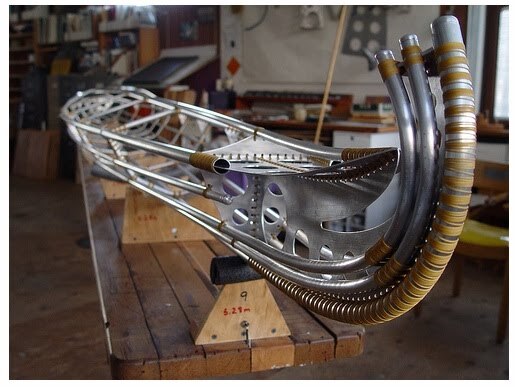
For his part, George has different ideas. A young man, he lives in a tree house nearly one-hundred feet above the ground in a Douglas fir tree in British Columbia. An expert sailor and boat builder, he explores the waterways from British Columbia to Alaska in large kayaks he’s built himself. For most of this book, his kayak (or baidarka as it is locally termed) is a 31 footer. By page 195, he’s built the largest kayak in history: 48 feet long, almost five feet wide. He plans to build a 62 footer, and dreams of a coastline traveled by a host of such eco-friendly crafts.
My oldest copy is a battered, now-coverless paperback from the 70’s. My other copy is unfortunately marred by artless cover art. Not only is it unappealing, it’s inaccurate. The cover depicts a man in a tiny kayak, perhaps 8’ feet long. Those dimensions may or may not characterize some of the kayaks in that area historically, but they are completely wrong for the book. As I said, in the course of this book, George builds the largest kayak in history. Is it too much to ask that the artist read, or at least take a glance, at the book they’re trying to represent?
More about George and Freeman.
https://en.wikipedia.org/wiki/Freeman...
https://en.wikipedia.org/wiki/George_...
……..
For my future reference, particularly memorable excepts:
18-20, the firebombings of Tokyo and Dresden
45-46 Brower’s evocative descriptions of the Inside Passage; the Ice Age is “not over”…. “The glacial milk is ground-up continent in suspension, for inland the ice continues its whittling. The Ice Age is not over in George’s country, and continues to enlarge it for him.”
47-50, on the extraordinariness of PNW art. “Agriculture is the invention that is supposed to let a people lay in the food reserves that permit the idle periods that allow experimentation with art, and the coast Indians practiced no agriculture at all, expect for planting a little tobacco. It was the sea that allowed them to break the old rule.”
147-150 Starships propelled by hydrogen bombs that explode against pusher plates. Even at the “staggering rate of one parsec per century”, such a ship would travel ¾ of the way to the nearest star, Alpha Centuri, in one hundred years. “To absorb a megaton of energy, five million tons of exposed surface would be necessary, so the ship would be enormous. Acceleration would be gentle, so the ship would not need to be especially sturdy. It would be a spidery structure twenty kilometers in diameter.
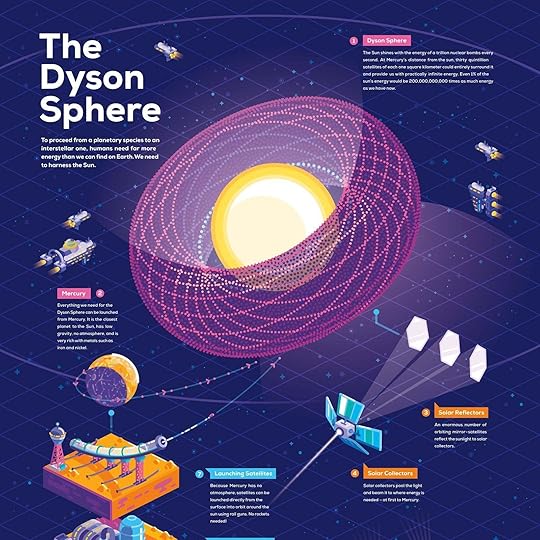
p 150 Dyson sphere "It would be logical development for a high civilization to have disassembled one of its larger planets in order to build an energy-capturing shell around its sun. We are wasting our time searching near visible stars. We should look instead for dark, room-temperature objects about the size of Earth's orbit which radiate as intensely as the star hidden inside, but radiate in the far-infrared."
--The Starship and the Canoe, Kenneth Brower
Behind in my reviews.
An old favorite, I read this back in February (2023), for at least the third time. It would make a splendid father’s day gift! It’s the fascinating, beautifully written (1978) biography of two remarkable men: the astrophysicist Freeman Dyson (1923-2020), and his son, George Dyson (born 1953, just in his twenties at the time). Each has a completely different vision for mankind. For Freeman, man’s best hope for survival is to populate comets. The atmospheres on these far-flung new habitats would be created by bioengineered trees:
(Excerpt)
“How high can a tree on a comet grow? The answer is surprising. On any celestial body whose diameter is of the order of ten miles or less, the force of gravity is so weak that a tree can grow out for hundreds of miles, collecting the energy of sunlight from an area thousands of times as large as the area of the comet itself. Seen from far away, the comet will look like a small potato sprouting an immense growth of stems and foliage. When man comes to live on the comets, he will find himself returning to the arboreal existence of his ancestors.”
For his part, George has different ideas. A young man, he lives in a tree house nearly one-hundred feet above the ground in a Douglas fir tree in British Columbia. An expert sailor and boat builder, he explores the waterways from British Columbia to Alaska in large kayaks he’s built himself. For most of this book, his kayak (or baidarka as it is locally termed) is a 31 footer. By page 195, he’s built the largest kayak in history: 48 feet long, almost five feet wide. He plans to build a 62 footer, and dreams of a coastline traveled by a host of such eco-friendly crafts.
My oldest copy is a battered, now-coverless paperback from the 70’s. My other copy is unfortunately marred by artless cover art. Not only is it unappealing, it’s inaccurate. The cover depicts a man in a tiny kayak, perhaps 8’ feet long. Those dimensions may or may not characterize some of the kayaks in that area historically, but they are completely wrong for the book. As I said, in the course of this book, George builds the largest kayak in history. Is it too much to ask that the artist read, or at least take a glance, at the book they’re trying to represent?
More about George and Freeman.
https://en.wikipedia.org/wiki/Freeman...
https://en.wikipedia.org/wiki/George_...
……..
For my future reference, particularly memorable excepts:
18-20, the firebombings of Tokyo and Dresden
45-46 Brower’s evocative descriptions of the Inside Passage; the Ice Age is “not over”…. “The glacial milk is ground-up continent in suspension, for inland the ice continues its whittling. The Ice Age is not over in George’s country, and continues to enlarge it for him.”
47-50, on the extraordinariness of PNW art. “Agriculture is the invention that is supposed to let a people lay in the food reserves that permit the idle periods that allow experimentation with art, and the coast Indians practiced no agriculture at all, expect for planting a little tobacco. It was the sea that allowed them to break the old rule.”
147-150 Starships propelled by hydrogen bombs that explode against pusher plates. Even at the “staggering rate of one parsec per century”, such a ship would travel ¾ of the way to the nearest star, Alpha Centuri, in one hundred years. “To absorb a megaton of energy, five million tons of exposed surface would be necessary, so the ship would be enormous. Acceleration would be gentle, so the ship would not need to be especially sturdy. It would be a spidery structure twenty kilometers in diameter.
p 150 Dyson sphere "It would be logical development for a high civilization to have disassembled one of its larger planets in order to build an energy-capturing shell around its sun. We are wasting our time searching near visible stars. We should look instead for dark, room-temperature objects about the size of Earth's orbit which radiate as intensely as the star hidden inside, but radiate in the far-infrared."

March 27, 2013
Freeman Dyson wants to build a starship to take him into the cosmos atop a column of atomic fire. His son George wants to build an ocean-going canoe. While his father dwells in an Ivory Tower, George lives in a tree house. One an accomplished mathematician who lectures at universities worldwide, the other a high school drop-out who's done jail time for drugs. On the surface, father and son could not seem more different, but in this part-biography part-travelogue Kenneth Brower shows how very similar they are, and how even in their differences they are quite similar. Through their own words, Brower shows how even though one looks to the far future of humanity while the other looks to humanity's beginnings, they are, in actuality both looking at man's destiny. This book is a remarkable fusion of biography, travel, history, science and social commentary. It is a must-read.
NOTE: This book is the third book read as part of the 2013 "Dust Off Your Classics" Reading Challenge
NOTE: This book is the third book read as part of the 2013 "Dust Off Your Classics" Reading Challenge

March 25, 2014
I read this way back when it was first published (1978). What do you do when you're overshadowed by a famous father? George Dyson retreats to the wilderness while intellectual Freeman Dyson grapples with the cosmos. They're estranged, yet share an affinity for remote travel, whether in a canoe or a starship.

January 10, 2008
I found this book at a used book store some time ago in Arcata.
Well let me rephrase that; my girlfriend found it. My girlfriend being Ken Brower's niece while the title, cover and description of the book caught my interest - it was an immediate buy. (Though I later learned I could just pull one of a handful of copies from Ken's shelf at a later time).
I did't read this for almost two years after that purchase. I had seen various references to Freeman and George Dyson, had heard my girlfriend's mother talk about her friendship with George, had seen George give a speech at a TED conference...all things that made me want to dive right in, but I didn't.
Perhaps part of me was scared. Scared to finally know a real writer. I have developed a fairly close relationship with Ken Brower over the years - what if I somehow disliked this book?
Then I read it. I didn't dislike it. You can see the stars above this review, I loved it.
It's not a perfect book - for me, I'd be hard pressed to note non-fiction and biographical works as such. But when the book is good - it's really good.
You see, knowing Ken - it allows me to put a voice to the text. He's a very personable individual. Therefore in describing the emotional tension between father and son - he succeeds. In describing his outrageous adventures tagging along with George - he succeeds. In conversing with Freeman Dyson over multiple hamburger-and-coke meals, you feel like you're in the restaurant with them.
But there are slow sections that rear their head around the middle - when the writing becomes a bit technical, the history recalling that of indigenous peoples rather than the ever-engaging Dyson's. It should be noted that I read the first 1/3 of the book in a couple of days. The last 1/3 in a couple of days and the middle 1/3 over the course of 2-3 weeks.
And it's not that it's bad - looking back now, it is just that I had that fear again. "Oh no, I'm not loving this section...this could turn out poorly" and thus I plodded through slowly. But the fact is, those sections are important in the grand scheme of things. Perhaps as a second read, knowing where the story of these two individuals starts and ends, I would see these sections as key background information in investigating the Dyson's on my own. I'm sure I'll do it again, someday.
Rarely can works of non-fiction or biographies breathe with the life of their similarly themed fictional accounts. The Starship and the Canoe does more than breathe life though - it breathes two.
Good work Ken.
Well let me rephrase that; my girlfriend found it. My girlfriend being Ken Brower's niece while the title, cover and description of the book caught my interest - it was an immediate buy. (Though I later learned I could just pull one of a handful of copies from Ken's shelf at a later time).
I did't read this for almost two years after that purchase. I had seen various references to Freeman and George Dyson, had heard my girlfriend's mother talk about her friendship with George, had seen George give a speech at a TED conference...all things that made me want to dive right in, but I didn't.
Perhaps part of me was scared. Scared to finally know a real writer. I have developed a fairly close relationship with Ken Brower over the years - what if I somehow disliked this book?
Then I read it. I didn't dislike it. You can see the stars above this review, I loved it.
It's not a perfect book - for me, I'd be hard pressed to note non-fiction and biographical works as such. But when the book is good - it's really good.
You see, knowing Ken - it allows me to put a voice to the text. He's a very personable individual. Therefore in describing the emotional tension between father and son - he succeeds. In describing his outrageous adventures tagging along with George - he succeeds. In conversing with Freeman Dyson over multiple hamburger-and-coke meals, you feel like you're in the restaurant with them.
But there are slow sections that rear their head around the middle - when the writing becomes a bit technical, the history recalling that of indigenous peoples rather than the ever-engaging Dyson's. It should be noted that I read the first 1/3 of the book in a couple of days. The last 1/3 in a couple of days and the middle 1/3 over the course of 2-3 weeks.
And it's not that it's bad - looking back now, it is just that I had that fear again. "Oh no, I'm not loving this section...this could turn out poorly" and thus I plodded through slowly. But the fact is, those sections are important in the grand scheme of things. Perhaps as a second read, knowing where the story of these two individuals starts and ends, I would see these sections as key background information in investigating the Dyson's on my own. I'm sure I'll do it again, someday.
Rarely can works of non-fiction or biographies breathe with the life of their similarly themed fictional accounts. The Starship and the Canoe does more than breathe life though - it breathes two.
Good work Ken.

November 16, 2020
I had never heard of this book, or its two subjects, until a friend told me about it a year ago. Now, after reading it, and seeing the low number of ratings here on GoodReads, it seems to me that this book is vastly underrated and unknown. I was fascinated by this book. Of course both Freeman and George's stories are fascinating in themselves, but the book packed so much into only 270 pages. I learned things about space and earth sciences, I took journeys to glaciers and places I've never been, I was awed by wildlife, I laughed at jokes, I learned about the history of native tribes of the the Northwest and about canoe-making, and most of all I was presented with life lessons and philosophical ponderings that sent me into states of wonder and deep thought. This book had everything, and Ken Brower did an impeccable job in writing it. His metaphors and analogies were spot on and never too overbearing, his thoughts were clear and well-presented, he painted the characters in ways that made me want to know them (and sometimes made me feel like I did). His writing was soothing, easy to digest, and kept me rapt until the very end (except maybe when Freeman would get so deep into mathematical/physics concepts that I just had to accept that I wouldn't understand and move on).
I think so many more people should read this book than it seems have. The secret's out, pass it on.
I think so many more people should read this book than it seems have. The secret's out, pass it on.

September 1, 2020
This is a weird book. It doesn't quite know what it's about: Freeman Dyson's science or his son's hippy wilderness lifestyle. It talks too little about both topics while hardly connecting them together. There are some charming anecdotes from each world. But the author seems ill equipped to do justice to either story line. Instead we get mostly Kenneth's journey through worlds he doesn't understand.
I don't want to read a lay person's half-understood explanation of science.
I don't want to read a total square's judgemental, outsider's view of wilderness survival.
Sadly, that's all this book has to offer.
I don't want to read a lay person's half-understood explanation of science.
I don't want to read a total square's judgemental, outsider's view of wilderness survival.
Sadly, that's all this book has to offer.
May 11, 2022
I’ve read this book several times and while it may not be the best book I’ve ever read, it just might be my favorite. I don’t feel I can add anything of substance that hasn’t already been said by others; I just want to say for the record how much I like this book and how glad I am that I just happened to pick up a copy from my high school Chemistry teacher’s little library shelf in the back of the class one day nearly two decades ago and decided to read it instead of doing my homework.

January 24, 2023
I wasn't sure what to think at first, but this book really grew on me as I read on. Very interesting subject matter, and the description of nature and the amazing kayak George built made me feel like I was there! Love learning about real life, and the author did a good job portraying his subjects.

January 24, 2023
I wound up enjoying this book way more than I thought I would after starting it. The true stories of father and son on their quests to explore what they are most fascinated by. Freeman Dyson (father) is obsessed with space exploration and travel while George Dyson (son) is obsessed with exploration and travel in a kayak throughout the waters and wilderness of British Columbia. In turn, I became obsessed with George Dyson's story. It may be a better bet to read the hard copy as I listened on audible and I didn't care for the narrator's voice.

Read
August 22, 2022got this book on a first date. leaving it on the island of Capri in a Little Free Library. Wondering what sort of future adventures it will have

July 18, 2024
I'm sure the author didn't intend to write an indictment of his generation. On the one hand, Bower gives us excerpts from the writing of Freeman Dyson, who spent his post-war life trying to put people in the Kuiper Belt. On the other, we get interviews with Dyson's son George, who lives in a tree and builds canoes. George Dyson had his reasons to repudiate his father, but I can't help but see his life as a waste of potential. Every time the book switched from father to son I got sad, so I put it down at around the halfway point. Perhaps Bower found some great synthesis to wrap up his book, but looking at the world around me, I don't find myself in want to a synthesis. I just want the Starship.
December 28, 2007
Don't be dissuaded by the sci-fi cover, it's not sci-fi. I'm not sure how it's classified, which is part of why it's compelling. Much of it is written from a biography perspective, with the author following a man preoccupied with building kayaks, and following his father, a prominent nuclear physicist. They are both dreamers- of engineering capabilities and of civilizations. The son is rooted in the past while the father looks only ahead.
Aside from being about the father-son relationship, The Starship and Canoe is about the world we came from, the world we are creating and the many ways to live in our present construction.
Aside from being about the father-son relationship, The Starship and Canoe is about the world we came from, the world we are creating and the many ways to live in our present construction.

January 30, 2017
I got a bit bored with George roaming around seemingly aimlessly in the Pacific Northwest, and Dyson, from my perspective, not coming up with any concrete impact upon the space program, but eventually I realized I didn't like the qualities in this father and son that I readily recognize in myself. The wandering of body, mind, and spirit, the restlessness that ends up producing only so much that others can even grok, yes. If only I were as truly productive as either Freeman. The ending spoke to me as an odd father. We release our children to the world, they follow their own paths, and sometimes, just sometimes, we might even understand them.
August 15, 2012
I really enjoyed this short read. The author's use of descriptive language to paint a picture of both the main character as well as the places he visits on his adventure left me with a longing to spend some time in the Alaskan wilderness, well away from the 'grizzly' of course.

March 11, 2013
Wonderful book about the intersection of science and non-science. Father and son, one a world-renowned nuclear scientist who helped created the A-bomb, the other striving to understand the world the the creation of a birch-bark canoe.
June 24, 2007
I've read this book twice, and it captivated me both times. It's informative and beautifully written.
September 23, 2007
Inspired me to learn how to sea kayak.

October 9, 2010
I read this when I was big into sea kayaking (mid-'80s), and between Brower's powerful prose and the extra-ordinary life of Dyson, it was a hit.

January 7, 2012
A father and son with vastly different goals and views reveal how they are united by their love for possibilities and exploration. The possibility of this unusual relationship is worth exploring.

February 9, 2012
Excellent book,especially if you are about to visit Alaska and do some kayaking, and if you are a certain age. Hard to find in a library though....I bought it and passed it around.
March 5, 2012
This is a true story of Freeman Dyson and George Dyson! He just released a new book -- George that is. He wrote: Turing's Cathedral.

Read
June 7, 2013This is the story of Freeman Dyson, brilliant and iconoclastic theoretical physicist and his son George, iconoclastic canoe builder, and how the two of them did or did not get along.

July 28, 2020
Enchanting and enticing double biography of Freeman and George Dyson (father and son) by their friend and companion Kenneth Brower. Flawless and elegant writing style. Utterly loved it.
January 24, 2021
Probably the best book I have ever read.
Also Lottie I am sorry. It was all for the banter.
Also Lottie I am sorry. It was all for the banter.
March 15, 2009
I love this book because it talks about my geeky side and my naturalist side.
February 12, 2023
Brower contrasts the worlds of Freeman Dyson and his son George.
Brower is both a descriptive and a thoughtful writer. His portrayals of the British Columbia landscape and peoples are terrific. His analysis of the two men is very well done.
Freeman Dyson was an accomplished physicist who has lobbied for the colonization of space. He observed that "... space is huge enough, so that somewhere in its vastness there will always be a place for rebels and outlaws. Near to the sun, space will belong to big governments and computerized industries."
Dyson civilizations: After three thousand years of growth in a solar system like our own, it would be a logical development for a high
civilization to have disassembled one of its larger planets in order to build an energy-capturing shell around its sun. If this has happened, he wrote, we are wasting our time searching near visible stars. We should look instead for dark, room-temperature objects
about the size of Earth’s orbit which radiate as intensely as the star hidden within, but radiate in the far-infrared.
Freeman Dyson was a major player in the design of the TRIGA reactor, which was designed to produce medical isotopes. Many TRIGA reactors were built around the world. The design originated when Edward Teller stated that what the world needed was a reactor so safe it was “not just foolproof, but Ph.D.-proof.” Dyson liked the idea, and they joined the safe-reactor team.
He was also chief theoretician of the Orion project. The plan was to propel spacecraft with a series of nuclear detonations. In a chemical rocket, temperature limitations hold the velocity of the ejected gas to about four kilometres per second. In a nuclear rocket with plasma drive the limit is about eight kilometres per second. A nuclear-powered rocket remains an inviting idea, however, in that nuclear fuel is the most compact energy source known, with a million times the energy of any chemical fuel.
George, on the the hand, was taken by the environment of the west coast and the accomplishments of the natives. He was particularly interested in the canoes built with waterproof skins called baidarkas which allowed them to withstand the stresses of the stormy, shallow, and ice-filled northern seas.
George had decided to build the Queen Mary of kayaks - a superbaidarka. He applied for a grant from the Canadian government in his grant application, George settled upon a purpose that was large and socially significant. He was going to revive canoe travel in British Columbia. His vision was, of course, crazy.
It was the biggest kayak in history, a realization of the six-man model George had blueprinted on the wall. It was forty-eight feet long, yet not quite five feet wide. Brower relates the construction and launching, within particular note of the characters of the community.
Author feels that Freeman Dyson was on the wrong track, seeing increasing technology as being synonymous with the evolution of humanity (man’s destiny is in the stars - Dyson sphere). Brower's opinion: "Technology forges on, not from any need of the species, but from the need of certain of its more brilliant members for interesting games to play."
Brower finishes with an account of the reunion of Freeman and George, in which an increased appreciation of the other is apparent.
Brower is both a descriptive and a thoughtful writer. His portrayals of the British Columbia landscape and peoples are terrific. His analysis of the two men is very well done.
Freeman Dyson was an accomplished physicist who has lobbied for the colonization of space. He observed that "... space is huge enough, so that somewhere in its vastness there will always be a place for rebels and outlaws. Near to the sun, space will belong to big governments and computerized industries."
Dyson civilizations: After three thousand years of growth in a solar system like our own, it would be a logical development for a high
civilization to have disassembled one of its larger planets in order to build an energy-capturing shell around its sun. If this has happened, he wrote, we are wasting our time searching near visible stars. We should look instead for dark, room-temperature objects
about the size of Earth’s orbit which radiate as intensely as the star hidden within, but radiate in the far-infrared.
Freeman Dyson was a major player in the design of the TRIGA reactor, which was designed to produce medical isotopes. Many TRIGA reactors were built around the world. The design originated when Edward Teller stated that what the world needed was a reactor so safe it was “not just foolproof, but Ph.D.-proof.” Dyson liked the idea, and they joined the safe-reactor team.
He was also chief theoretician of the Orion project. The plan was to propel spacecraft with a series of nuclear detonations. In a chemical rocket, temperature limitations hold the velocity of the ejected gas to about four kilometres per second. In a nuclear rocket with plasma drive the limit is about eight kilometres per second. A nuclear-powered rocket remains an inviting idea, however, in that nuclear fuel is the most compact energy source known, with a million times the energy of any chemical fuel.
George, on the the hand, was taken by the environment of the west coast and the accomplishments of the natives. He was particularly interested in the canoes built with waterproof skins called baidarkas which allowed them to withstand the stresses of the stormy, shallow, and ice-filled northern seas.
George had decided to build the Queen Mary of kayaks - a superbaidarka. He applied for a grant from the Canadian government in his grant application, George settled upon a purpose that was large and socially significant. He was going to revive canoe travel in British Columbia. His vision was, of course, crazy.
It was the biggest kayak in history, a realization of the six-man model George had blueprinted on the wall. It was forty-eight feet long, yet not quite five feet wide. Brower relates the construction and launching, within particular note of the characters of the community.
Author feels that Freeman Dyson was on the wrong track, seeing increasing technology as being synonymous with the evolution of humanity (man’s destiny is in the stars - Dyson sphere). Brower's opinion: "Technology forges on, not from any need of the species, but from the need of certain of its more brilliant members for interesting games to play."
Brower finishes with an account of the reunion of Freeman and George, in which an increased appreciation of the other is apparent.

January 23, 2022
I'm surprised at how much I liked this book. I didn't expect to NOT like it, not at all! But it ended up being a really fascinating read. Brower dives into the complex life stories of physicist Freeman Dyson (he of Dyson Spheres) and his son George. Apparently the two men had a strained relationship for many years, bordering on (but not quite reaching) estrangement, and Brower traces their lives as they unfold in parallel, noting all the while that both men are focused in much the same way on very different projects: Freeman Dyson on developing the Orion spacecraft (a conceptual ship that would literally use nuclear bomb detonations behind the ship as propulsion), and George Dyson on developing the "big canoe", an almost 50-foot-long canoe for six passengers to use to navigate the waters of coastal British Columbia and Alaska.
The chapters on George were more engaging to me, because of all the nature writing involved; the possibilities there are greater than with an office-and-classroom-bound physicist. But the way the two men are both apparently distrustful of other people, the way they see themselves as the voices of reason--the qualities shared by two men who nevertheless tend to keep each other at arm's length are deftly depicted by Brower.
The book is from 1978 and is billed (at least in my edition) as being akin to Robert M. Pirsig's ZEN AND THE ART OF MOTORCYCLE MAINTENANCE, and I suppose it is in a way, but there's little of that book's philosophical depth here. That is not a criticism! It's just not the kind of book this is. But it does have that 1970s "feel" to it.
Recommended.
The chapters on George were more engaging to me, because of all the nature writing involved; the possibilities there are greater than with an office-and-classroom-bound physicist. But the way the two men are both apparently distrustful of other people, the way they see themselves as the voices of reason--the qualities shared by two men who nevertheless tend to keep each other at arm's length are deftly depicted by Brower.
The book is from 1978 and is billed (at least in my edition) as being akin to Robert M. Pirsig's ZEN AND THE ART OF MOTORCYCLE MAINTENANCE, and I suppose it is in a way, but there's little of that book's philosophical depth here. That is not a criticism! It's just not the kind of book this is. But it does have that 1970s "feel" to it.
Recommended.

February 27, 2023
The starship and the canoe is a lesson in perspective via a tale of father and son branching off from one another to take opposing paths in life. These paths likely lead to vastly different evolutionary futures for humans. Father with an incredible mind for physics, mathematics, and mechanics is leading the charge toward the stars via short the asteroid belt. Son getting back to ancient native roots in the Aleutian Islands.
Space faring and sea faring humans will inevitably be different species a la books like the Expanse. Another set of books that clearly took inspiration from the technology from here are the Bobiverse. I imagine Adrian Tchaikovsky peppered many of his. Overs with homages here too. I love how trailblazing and inspiring science/scifi writers were to writers and inventors alike.
I enjoyed the juxtaposition of these two stories told alongside one another. Their similarities (looks, ship building, and earth’s future) and differences (each looking 3000 years away from now in opposite directions for motivation) quickly become complimentary story telling.
The interviewer/documentarian/biographer as narrator trope aged quite well itself.
I originally compared the tech driven father as a SpaceX project manager. Later comparing the mayflower privately funded voyage following the previously government funded Columbus voyage to NASA followed by this private space company is apropos.
Space faring and sea faring humans will inevitably be different species a la books like the Expanse. Another set of books that clearly took inspiration from the technology from here are the Bobiverse. I imagine Adrian Tchaikovsky peppered many of his. Overs with homages here too. I love how trailblazing and inspiring science/scifi writers were to writers and inventors alike.
I enjoyed the juxtaposition of these two stories told alongside one another. Their similarities (looks, ship building, and earth’s future) and differences (each looking 3000 years away from now in opposite directions for motivation) quickly become complimentary story telling.
The interviewer/documentarian/biographer as narrator trope aged quite well itself.
I originally compared the tech driven father as a SpaceX project manager. Later comparing the mayflower privately funded voyage following the previously government funded Columbus voyage to NASA followed by this private space company is apropos.
May 7, 2024
This is not great literature but it is more than tolerably passable and Kenneth Brower creates a book that defies simple classification. In a time capsule of the mid to late 70's he paints parallel thumbnail biographies which juxtapose a physicist father with a dream of building a ship to go to the stars and a back to nature son who has the more earthbound dream of building the perfect canoe. They are at the same time very different personalities from radically different lifestyles but with shared genes which enable the author to peer through their strained relationship to identify the commonalities that keep the binding between them from snapping entirely.
Each of the characters is of great interest but the author's own background directs the book and its sympathies primarily towards the son and his disparate band of loose human associations.
It is a deeply satisfying read and succeeds on a number of levels as part-life biography, nature reflection, insight into 70's west coast Americas alternative lifestyle and the relationship between a father and son.
Each of the characters is of great interest but the author's own background directs the book and its sympathies primarily towards the son and his disparate band of loose human associations.
It is a deeply satisfying read and succeeds on a number of levels as part-life biography, nature reflection, insight into 70's west coast Americas alternative lifestyle and the relationship between a father and son.
Displaying 1 - 30 of 78 reviews