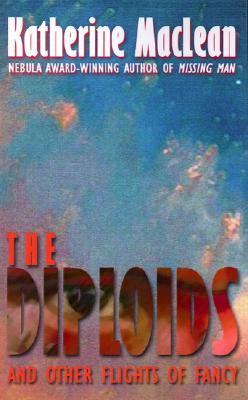
Bored with the ordinary, mundane, work-a-day world? Tired of the same old routine? Then toss your cap over the windmill and meet Katherine Maclean. It's an experience you'll never forget.Through her artistry and imagination you'll soar through space, you'll touch the stars, you'll bask in the glow of other suns... and you will be oneThe long-legged lawyer who suspected that he was a Martian; the boy who became all the characters in his make-believe games; the sewing-circle ladies who took over the world; the alien spacemen adrift in a raindrop; the woman who discovered the terrible secret of immortality.There are other stories in this remarkable collection, but to merely describe them might give away their plots, and that, as every S-F fan knows, is a dastardly crime punishable by indefinite exile on mysterious, fog-shrouded Planet X!The Diploids (1953) novella.Defense Mechanism (1949) short story.The Pyramid in the Desert (1950) short story.The Snowball Effect (1952) short story.Incommunicado (1950) novelette.Feedback (1951) short story.Games (1953) short story.Pictures Don't Lie (1951) short story.
Katherine Anne MacLean (born January 22, 1925) is an American science fiction author best known for her short stories of the 1950s which examined the impact of technological advances on individuals and society.
Brian Aldiss noted that she could "do the hard stuff magnificently," while Theodore Sturgeon observed that she "generally starts from a base of hard science, or rationalizes psi phenomena with beautifully finished logic." Although her stories have been included in numerous anthologies and a few have had radio and television adaptations, The Diploids and Other Flights of Fancy (1962) is her only collection of short fiction.
Born in Glen Ridge, New Jersey, MacLean concentrated on mathematics and science in high school. At the time her earliest stories were being published in 1949-50, she received a B.A. in economics from Barnard College (1950), followed by postgraduate studies in psychology at various universities. Her 1951 marriage to Charles Dye ended in divorce a year later. She married David Mason in 1956. Their son, Christopher Dennis Mason, was born in 1957, and they divorced in 1962.
MacLean taught literature at the University of Maine and creative writing at the Free University of Portland. Over decades, she has continued to write while employed in a wide variety of jobs -- as book reviewer, economic graphanalyst, editor, EKG technician, food analyst, laboratory technician in penicillin research, nurse's aide, office manager and payroll bookkeeper. photographer, pollster, public relations, publicist and store detective.
It was while she worked as a laboratory technician in 1947 that she began writing science fiction. Strongly influenced by Ludwig von Bertalanffy's General Systems Theory, her fiction has often demonstrated a remarkable foresight in scientific advancements.
A collection of short stories that I will inadequately describe as "old-style" science fiction -- very focused on a concept, with just enough character to flesh out the idea, often ending with a clever twist.
I wasn't blown away by any of them, but they did reward full reading. MacLean was able to make well-worn concepts like alien first contact and eternal youth, and even off-beat ones like sewing circles (trust me) memorable.
At this moment I only read The Diploids alone. Reads like an “ehh” episode of The Twilight Zone, but still irrevocably Twilight Zone.
A disfigured man begins to believe he’s not of this planet, and his path towards the truth leads in towards violence and distrust.
I can’t help feeling sympathetic towards him, he’s been bullied throughout his life, and when he meets a lady that likes him, he’s insecure, and sure something about himself will ruin their relationship. Characters are Maclean’s strongest quality, Marty and Nadine’s chemistry was witty and adorable, and Kieth was as unlikable as co-workers who hear only themselves in conversations... it’s the least outdated part of this story, we still don’t have Police in Helicopters instead of cruisers, or legally drugging random innocence without consent. That being said, it has nice visual flair.
I still recommend other short story collections like The Illustrated Man or The Martian Chronicles if you want good classic sci-fi/fantasy. This story felt like a Post-Modern 1950s.
Two Men, a Sociology Professor Wilton Caswell Ph.D and Mr. Holloway, Dean and President of a University, decide to conduct a small Sociology Experiment to prove that Sociology, as a Science, is a legitimate and systematic investigative tool for ascertaining authentic results for analytical inferences.
"This department's analysis of institutional accretion, by the use of open system mathematics, has been recognized as an outstanding and valuable contribution to --"
So being smart and well educated men, they manufacture a set of formulas, Social Mathematics, that are essentially the framework of a Ponzi Scheme. Built into the Social Mathematics there are supposed to be factors that would cause the Ponzi Scheme to fall apart in six months.
And being clever and conniving Men, they find a Women's club, the Watashaw Sewing Circle Club and sit in on a meeting. At the end of the meeting they give a written Framework of their scheme to a Mrs. George Searles. They claim it is a Growth Plan for increasing membership in the women's Sewing Circle Club.
Mrs. George Searles is a large built, aggressive, suit-wearing manly-looking Lesbian type of Woman so dearly loved by Male Pulp Sci-Fi writers.
After The Men leave the meeting, they hide in their car, giggling like School Boys at the joke they feel they have put over on The Women of The Watashaw Sewing Circle Club.
But things do not go as hypothesized by The Men. In fact matters soon spire out of their control.
The Watashaw Sewing Circle Club grows and grows and grows so big.......that by the end of the story, it appears that The Women of The Watashaw Sewing Circle Club are potentially on the edge of taking over and controlling the entire World!!!
The Men.....are not very happy with the results of their experiment.
A cheeky fun read.
7. Games - 4 stars
Interesting. A thoughtful reading experience.
It felt a bit dense and convoluted but I believe KM was going for that feel. The reader would be a bit confused at times as to which mind they were thinking with at the moment. The minds of the Old Scientist Purcell and the Youngling Ronny mingle through their telepathic link and their simular actions blurs the boundary between their two realities.
The point being that the weaponizing of Purcell's research, although seemingly created in the theoretical isolation of a research facility, will ultimately affect the real world lives of everyday people. Innocent people like the young Ronny, who has still to have any significant real world experiences.
Too many Research Scientists, to this day, have a tendency to take the money, shrug their shoulders and say: "I'm innocent. What a Government chooses to do with my "Pure Research" is not my problem or responsibility".
"Now I am become death, the Destroyer of Worlds."
8. Pictures Don't Lie - 4 stars
A fun story about first contact with an alien culture.
I quickly knew something was up though. I knew this wasn't going to be a run of the mill contact story. But I just computers my finger on it as I was listening.
About halfway through I started to get worried. I was afraid it was going to be aothet take on A.C. Clarke's "History Lesson". Ha! Fooled me it did.
I found the Aliens interesting in a vague sort of way. They weren't overly described but, that only served to deepen the mystery and keep the reader in a state of suspense.
I like this story enough that I've put the X Minus One Radio broadcast of the story on my To Be Listened To list.
------SPOILER BIT---------
The idea of size perspective is an interesting Sci-Fi concept that has be explored in a number of different ways in some other stories. I just recently re-read "Youth" by Issav Asimov's. Size perspective helps set up the context for the plot in that story.
Definitely a lot of intriguing ideas but I don't fully share the author's ways of exploring them. Also the genetics stuff is very outdated. My favourite was probably the one about the woman who unlocked immortality but the one about the language of machines is the one I've thought about the most
MacLean’s sci-fi shines a light on how people cope with other people’s distorted conceptions of reality. Collected here are 8 stories from 1949-53.
Her showcase novella, The Diploids - Die, Freak (1953), starts off unassumingly about a lonely man with six fingers struggling to fit in with normal life. But when he joins a meet-up for for other diploids like himself, things take a sinister turn. They’re all part of an undercover cloning operation involving a Martian spy ring, bumbling cops, and a very grumpy front desk attendant who’s hiding a secret door. This story oozes with the kind of oddball paranoia that permeates so much of P.K. Dick’s later work.
In The Snowball Effect (1952), a university's sociology department is facing budget cuts, but before the axe is delivered, they’re given six months to demonstrate to the committee just why sociology might actually matter. So an informal test is devised. A practical list of 5 core sociological tenets is handed out casually at sewing circle luncheon to inspire the group to recruit more members. Six months later an army of thousands are on the march to Washington DC demanding to be heard by their government. Not all of MacLean’s stories are overtly political, but most are. In the story Feedback (1951), a little boy comes home from school wearing his baseball cap backwards. He tells his mom that his teacher, Mr. Dunner, said “everybody could be as different as they liked.” His mom disapproves, so she instigates a violent mob who hunt down Mr. Dunner, put him on trail for sedition, and torture a full confession out of him. Its heavy-handed political satire in the vein of Burgess’ novella 1985 (1978).
Eight stories trending towards scifi suspense and uncertainty:
The Diploids: A man uncovers his engineered, remarkable ancestry. Defense Mechanism: Telepathy works strange wonders in an infant's mind. The Pyramid in the Desert: An endocrinologist reworks her body, grasping at immortality, but in curing aging is struck dumb with germophobia. The Snowball Effect: Two researchers unleash the optimal, ultimate pyramid scheme. Incommunicado: When the 'details' half of a 'big ideas-and-details' team is killed (in a freak outer space explosion) the ideas man must learn to rewrite his brain. Feedback: Primal tribalism destroys independent thought. Games: A child's imagination allows him to connect to the real people whose lives he's imagining. Pictures Don't Lie: A radio survey detects the first contact with an extraterrestrial species, decodes and translates their broadcasts, but fails to communicate some important context.
I really enjoyed 'Pyramid', 'Incommunicado', and 'Pictures'. 'Feedback' wasn't any deeper than my one-line synopsis, but might have made a bigger point (say, against McCarthyists, or militant patriotism) when it was first published in 1951. Most of the stories hold up very well over time though, the author had a knack for extrapolating interesting effects of likely future technologies. I'd be interested in reading more of her work.