Anyone who actually listens to my opinions and bases their library picks on my star ratings (hi, mom!) deserves to know what the unusual fifth star represents. My stars make zero effort at even an obviously subjective judgment of how "good" I think a book is. Instead, the fourth star is a measure of how much I personally enjoy a book and find it engaging, while my elusive fifth star is granted when I feel a book has made enough of an impression on me that it's demonstrably changed my life.
I honestly don't know that I've ever related as much to a character in a book as I did to Miss Roach in The Slaves of Solitude. In a way, that seems like a crazily personal thing to admit to strangers and loved ones on the internet, but I suppose that horse escaped from the barn a long time ago.... While I'm making inappropriately intimate online pronouncements, I'll reveal that I read this on Christmas, which perhaps not incidentally was the day of an annual break-down-and-cry-noisily-for-forty-minutes-or-so-in-the-empty-bathtub- whilst-suddenly-overcome-by-the-immutable-inevitability-of-human-loneliness - sort-of-existential-crisis little thing that can happen sometimes around the holidays when I don't wind up going over to the Cratchits' for figgy pudding and make the mistake of staying home alone.... Anyways, this Christmas, after I finally stopped sobbing and decided to pull myself out of the tub and put some clothes on and try to behave like an ordinary atheistic Jew with plenty of lovely friends and a wonderful family and no right at all to freak out on such a ridiculous occasion, I was overcome with gratitude towards Patrick Hamilton for so perfectly conveying that very sense of inescapable and excruciating loneliness from which we all spend 364 days of the year trying to shield ourselves.... Thank heavens I had the rest of this book to turn to on that awful day! Of course, later on, it occurred to me that Mr. Hamilton's novel might have been at least partially responsible not just for pulling me out of my Yuletide meltdown, but also for pushing me into it, so maybe I needn't have felt so grateful.... Still. Even if the book was the cause and not just the cure, is that really so bad? It's probably healthful to confront, on occasion, one's unavoidable, soul-crushing solitude, and there are doubtless worse ways to get there -- and back -- than this wonderful book.
Okay, so I need to admit the possibility that another reader might emerge a bit perplexed from a foray into Slaves of Solitude, scratching his or her head and saying, "Well, Jessica, it's not bad or anything, it's fine, but it is sort of the book version of one of those weird, stiff, old colorless BBC comedies that are kind of oddly funny in that strange British way that neither of us really get because we're American. Isn't it true that you've got your knickers (so to speak) in a twist over some shriveled up Limeys crankily insulting one another over boiled meat?" And yeah, I mean, I guess Slaves of Solitude is kind of like that. It's set in a boarding house during World War II, in a tiny suburban village where our heroine Miss Roach has gone to escape from London during the Blitz. That is pretty old BBC comedy already, yeah?
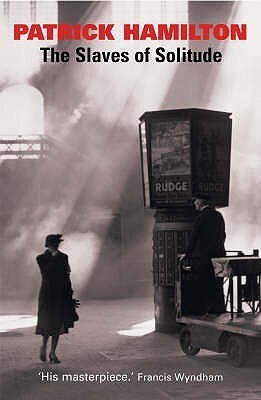
Please do not be fooled by the New York Review Books' sexy, stylish cover! No one in this book is good-looking or has any allure whatsoever, at all. This is a novel about drab, miserable people who are trapped in their cramped and uncomfortable sad little lives. Most of the novel is Ms. Roach being bullied by the villainous dull, pompous, elderly Mr. Thwaits, over shitty WWII-era English dinners in the boarding house dining room. The unattractively aging Ms. Roach chokes down unremitting rounds of "gin and french" with her American Lieutenant and German frenemy; she takes the train to and from work, and stolidly, despairingly, quietly, bravely, gets up day after bleak, hungover, blacked-out day of an indeterminable war, an indeterminable life.... ughhhh..... I mean, I suppose it's sort of bleak, in a way. But it's also pretty funny! Ha ha! Oh, I loved it. Someone else should read this and tell me if it's at all as great as I thought it was, or if it just really struck a chord for some reason. I honestly can't remember the last time I related to strongly to any character in fiction! It also provided some perspective. I mean, at least we're not in the middle of a world war at the moment, right? Jesus.... Also, this has some of the best descriptions I've read of what it's like to be drinking a lot, around other people who're also drinking a lot, and everyone's just so miserable and exhausted and awful.... Great!
Okay, so here's a wonderful excerpt, in which Hamilton puts the experience of waking up in the morning in a singularly harsh new light:
Even then the guests did not wake into full life. Instead, there was a dazed period in which each guest, turning in bed, renewed his acquaintanceship with his own problems and the fact that a war was being waged all over the world, and, finally rising and flinging back the curtains, contemplated the awful scene of wreckage caused by his sleep. The feeling of the morning after the night before is not a sensation endured by the dissolute only: every morning, for every human being, is in some sort a morning after the night before: the dissolute merely experience it in a more intense degree. There is an air of debauch about tossed bed-clothes, stale air, cold hot-water bottles, and last night's cast-off clothing, from which even the primmest of maiden ladies cannot hope to escape. Sleep is gross, a form of abandonment, and it is impossible for anyone to awake and observe its sordid consequences save with a faint sense of recent dissipation, of minute personal disquiet and remorse. (pp 62-63)
AAARGHH!!! If you don't think that's great, you're a nutball!
I'm gonna read Hangover Square next. I can't wait!




![Profile Image for [P].](/_next/image?url=https%3A%2F%2Fi.gr-assets.com%2Fimages%2FS%2Fcompressed.photo.goodreads.com%2Fusers%2F1486240560i%2F40516522._UY200_CR13%2C0%2C200%2C200_.jpg&w=128&q=75)


