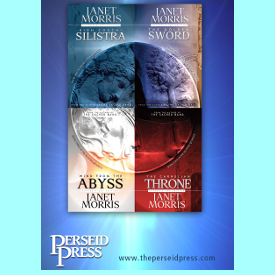
To truly appreciate the epic scale that encompasses The High Couch of Silistra, you need to understand the complexity and profundity of thought Janet Morris incorporated into the historical foundation that forms Silistran society.
I’ll summarize what you need to know here:
Thousands of years before our story takes place, Silistra faced catastrophe, a catastrophe so severe that all life would have been wiped out were it not for the prudence and tenacity of a special group of people, the Day Keepers and the forereaders.
(The Day Keepers are guardians of Silistra’s history – past, present and future – whilst the forereaders are those who have received training in the understanding and management of future probabilities as they affect the unfolding development of Silistra’s eternal destiny)
They, it was who, having predicted the coming calamity, ushered a select number of Silistran’s into one of seven specially prepared hides (deep underground life-support complexes) sixty years before disaster fell, where refugees would be able to wait for the wounds inflicted upon their world to heal. After millennia had passed, thousands of survivors and their progeny emerged to reestablish their civilization under a set of precepts known as the “chaldra.”
Simply put, the chaldra is a form of self-rule, deeply influenced by the circumstances of Silistran society’s enforced isolation and the consequences of their reduced birthrate thereafter, and the eternal outworking of their eternal destiny. The chaldra edicts and guides the standards, morality and governance of Silistra in all situations and is divided into two broad spectrums.
High-chaldra – those tasks and responsibilities undertaken to strengthen the spiritual/inner consciousness of the individual and/or society as a whole, in relation to the metaphysical outworking of their eternal future, and;
Low-chaldra – that pertaining to the survival and betterment of the mundane individual and the acquiring of life skills relating to material import only.
It is essential you understand these tenets affect all of the main laws, duties and labors of Silistran life – even their approach to sexual practices and preferences, relationships and family matters. Yes, all are determined by chaldric. Indeed, an individual’s dedication to their society’s wellbeing is represented by the chald, a belt of chains soldered about a person’s waist, each colored link of which denotes their various accomplishments.
With the foundation thus revealed, we can better appreciate the setting. More than twenty-five and a half thousand years have passed since Silistran refugees emerged from their hides. The emergent population naturally settled in those areas close to the hides. Such locations became known as “Wells” – places where some of the highest ranking and most respected members of their civilization made their home.
Our story takes place, as told from the perspective of Estri Hadrath diet Estrazi. Estri is “High Couch” a position known formally as “Well-Keepress” of the capital city of Astria. She is celebrated for her beauty, her lineage and the fact that as High Couch of the most celebrated house of pleasure in all the civilized stars, she commands a great price.
Although highly sexualized, Well-Keepresses are by no means looked upon as prostitutes. Far from it, for their role and entire modus of operating is intimately bound to the social and moral development of Silistran culture as a whole. Don’t forget, because of the horrors inflicted upon them in the past, Silistran’s still struggle with infertility and shockingly low birthrates. To compensate, not only have Silistran scientists developed a serum that restores youthful vigor and extends life far beyond its normal span, but the couch system was devised whereby the very best genetic traits could be harnessed to ensure future generations would benefit.
And the Well-Keepresses would know exactly how to accomplish this through whom they choose to couch, for they are among the strongest forereaders in existence, and are able to manipulate the very texture of time to select the ultimate outcome.
In comparison to others, Estri is young. On her three hundredth birthday, she receives a silver cube containing a holographic message from her mother who died when Estri was born. In it is a video of Estri’s actual conception revealing her father to be none other than a mysterious godlike barbarian from an unknown mystical race. Such a legacy bodes well for all Silistra, and her long-dead mother counsels Estri to reach out to the stars in an effort to find her father and his people in order to claim the full might of her heritage.
Moved by her mother’s impassioned plea, Estri accepts the “chaldra of the mother” and sets out on a remarkable pilgrimage. While I won’t reveal the details of that quest here, be advised, Estri endures trial and tribulation, pitfall and peril aplenty...and it is here that we come to the crux of this remarkable tale, for Janet Morris has skillfully highlighted a profound truth within the pages you will read: That, like it or not, the differences between the masculinity of men and the feminine wiles of women are very real. Poles apart, many feel such differences will always prove a barrier to true understanding.
But in an evocatively subtle way, the abuse, turmoil and heartrending loss Estri and her travelling companions face underscore philosophical karma at work...that sometimes, tenacity and strength of character are of higher value than strength of arm, and that it’s only by facing such hardships with determination and courage that a person – no matter what their gender or sexual orientation – can truly grow into the individual they were meant to be.
Let me say in conclusion that I thoroughly enjoyed this story.
A science fiction and fantasy aficionado, I cut my teeth on the likes of Asimov, Clarke, Bradbury and Heinlein. I went on to develop a taste for Tolkien, Le Guin, May, Donaldson and Feist.
Just a glance at this list should hint at the refinement of my reading tastes. But, such is the way of things that, as I grew up and adult life invariably got in the way; I ended up missing a true literary gem the first time it was presented to the world.
Well, better late than never.
In High Couch of Silistra, you’ll find the pomp and space opera scope associated with the likes of Dune. You’ll find a vocabulary reminiscent of Stephen Donaldson at his best. And you’ll discover a flair for worldbuilding few can match.
My bookshelf reeks of quality, and soon, there’ll be another series proudly filling the little space I have left.
Bravo Janet Morris, a true fantasy classic that sets the bar at a height few will ever reach.