Jump to ratings and reviews
Rate this book

The Witch and the Tsar

Rate this book
In this stunning debut novel, the maligned and immortal witch of legend known as Baba Yaga will risk all to save her country and her people from Tsar Ivan the Terrible—and the dangerous gods who seek to drive the twisted hearts of men.

As a half-goddess possessing magic, Yaga is used to living on her own, her prior entanglements with mortals having led to heartbreak. She mostly keeps to her hut in the woods, where those in need of healing seek her out, even as they spread rumors about her supposed cruelty and wicked spells. But when her old friend Anastasia—now the wife of the tsar, and suffering from a mysterious illness—arrives in her forest desperate for her protection, Yaga realizes the fate of all of Russia is tied to Anastasia’s. Yaga must step out of the shadows to protect the land she loves.
 
As she travels to Moscow, Yaga witnesses a sixteenth century Russia on the brink of chaos. Tsar Ivan—soon to become Ivan the Terrible—grows more volatile and tyrannical by the day, and Yaga believes the tsaritsa is being poisoned by an unknown enemy. But what Yaga cannot know is that Ivan is being manipulated by powers far older and more fearsome than anyone can imagine.
 
Olesya Salnikova Gilmore weaves a rich tapestry of mythology and Russian history, reclaiming and reinventing the infamous Baba Yaga, and bringing to life a vibrant and tumultuous Russia, where old gods and new tyrants vie for power. This fierce and compelling novel draws from the timeless lore to create a heroine for the modern day, fighting to save her country and those she loves from oppression while also finding her true purpose as a goddess, a witch, and a woman.

420 pages, Hardcover

First published September 20, 2022

725 people are currently reading
39446 people want to read

About the author

Olesya Salnikova Gilmore

5 books416 followers
Olesya Salnikova Gilmore is the author of The Witch and the Tsar and The Haunting of Moscow House. Originally from Moscow, she was raised in the US and graduated from Pepperdine University with a BA in English/political science, and from Northwestern School of Law with a JD. She practiced litigation at a large law firm for several years before pursuing her dream of becoming an author. Now she is happiest writing novels in a variety of genres, including fantasy, paranormal, gothic horror, and historical fiction. She also loves exploring Eastern European history and folklore. Her work has appeared in LitHub, Tor.com, CrimeReads, Writer’s Digest, Historical Novels Review, Bookish, Washington Independent Review of Books, among others. She lives in a wooded, lakeside suburb of Chicago with her husband and two daughters.

Ratings & Reviews

What do you think?
Rate this book

Friends & Following

Create a free account to discover what your friends think of this book!

Community Reviews

5 stars
1,023 (18%)
4 stars
1,980 (35%)
3 stars
1,780 (31%)
2 stars
601 (10%)
1 star
185 (3%)
Displaying 1 - 30 of 1,081 reviews
Profile Image for Marquise.
1,958 reviews1,409 followers
February 3, 2023
How do you know for sure America won the Cold War? When you have a Russian author living in Chicago depict their quintessential witch running through a blizzard with snowflakes the size of fists forgetting that, unless you're Legolas, you'll sink in real fast instead of daintily sprinting across fresh snow.

It's a universal truth that if anyone knows all about snow besides Alaskans, Scandinavians, Inuit, Canadians, my friend from Minnesota, and polar bears, it's the Russians.

Tongue-in-cheek musings aside, this book has got praise for its "authenticity," and yet, to me it's been the least authentic depiction I've ever read of Baba Yaga for more reasons than just the characterisation. The author might be from Russia, but about all the difference that made from Baba Yaga retellings by Western writers is that Olesya Gilmore knows the proper gender of Russian names. Big achievement, that. The rest? She goes for the same stereotypes and clichés about Russia and Russians that Western authors get regularly roasted for.

I remember that, when Catherynne M. Valente and Katherine Arden wrote their retellings of Koschei the Deathless and Vasilisa the Beautiful respectively, there were angry complaints by some readers for cultural appropriation, offensive mischaracterisation of villains as sexy mofos, politicisation of Russian folktales, stereotyped cultural customs, how characters are always drinking kvas, being supertitious, the "Russian soul" cliché, and, above all, about making great tragedies from Russian history not the work of evil men but of supernatural forces and deities, like when the Siege of Leningrad in "Deathless" was a result of a dispute between two supernatural characters instead of, you know, the very human Nazis. I remember the arguments that Koschei and Maria Morevna were unrecognisable because they were the opposite of how they're in the folktales. I remember the accusations of the "Winternight" trilogy being anti-Christian because in the dispute between pagan magic/deities and Christianity the latter were being depicted as the baddies. I remember that readers complained that Russians were always drinking kvas, which is too strong and not drunk all the time as they argued. I remember all that and more.

And yet, The Witch and the Tsar, written by a Russian and thus presumably above accusations of cultural appropriation and racist stereotypes and Russophobia, is really no different in this sense.

You could argue that, in fact, it's less forgivable in some ways because of the knowledge imbalance. A Western author not familiar with the language and culture would totally think the nickname of Vladimir is Vlad, because they wouldn't know. But a Russian born and bred would know. So why does Salnikova call Vladimir the Holy "Vlad"? She would have to know the diminutive is Volodya or Vova, not Vlad like Westerners would think, and yet, she directly calls a character "Vlad." Any teen edgelord doomscrolling the Ukrainian war news sites will be quick to tell you Vlad is not short for Vladimir.

I don't think this is just a casual mistake, because there's instances in the rest of the book where the author seems to assume Westerners might be too dumb or lazy to do the legwork and understand things on our own without being force-fed everything. Examples that come to mind are when she has a character explaining what "Oprichnina" and "Oprichniki" are (Ivan the Terrible's personal kingdom and army) in a way that is basically a Russian explaining to another Russian what their own language means, about as sensical as me explaining to another English speaker that "applesauce" comes from a compound of apple and sauce and that apple is a fruit and sauce something you put on food. And whenever one of the characters says something in Russian, the author immediately "translates" it right in the next line, the result being that Russian characters that supposedly speak only their native tongue do, in fact, talk in two: theirs and "translated" English. As a polyglot myself, I hate this trope, it's so unnatural, so fake, and dumbs it down to give the impression you don't trust your readers to know or look it up. Translation should be kept to the glossary, not clutter the writing a la "dorogaya, my dear." I always feel talked down to whenever I see this.

Oh, and you remember how many times we Westerners are made fun of because Russian characters in our books and films often know two words in Russian at most? Da, nyet, spasibo, do svidanya, babushka... is all the Russians can say. Well, here you have Mrs Gilmore write this oh so not-stereotypical and cringey line: "Tell this woman spasibo for your life." Why? Because her Western audience will recognise spasibo is thanks in Russian, same as she'll have them drink kvas all the time because her audience knows from stereotypes that Russians drink kvas like Coca-Cola (vodka is medicine in this book, go figure). And you remember the stereotypes by Westerners about Russians being a passionate, super religious, superstitious, mysterious, reckless, boastful, wild and semi-savage at parties, and long-suffering? It's all here, too.

Have I mentioned, too, that the way Baba Yaga speaks here is rather modern? Not "howdja doin', fam?" or "Okay, then" levels of modern, thank goodness, but plenty of modern turns of phrase and ways of addressing people that would be out of place in 1560s Russia. "Well, well, well, we meet again then," and things like that. What was I saying about winning the Cold War again? It goes beyond language and cultural depictions that are clearly American-influenced into a mentality that is clearly neither Russian nor of the 16th century. Which brings me to my biggest issue with this novel...

In her authorial notes, Gilmore writes:

"After I read Andreas Johns’s Baba Yaga: The Ambiguous Mother and Witch of the Russian Folktale, I learned that the Baba Yaga we know is an invention of the fairy tales written and disseminated in the nineteenth century—mostly by men. Some believe that before Christianity arrived in Russia, Baba Yaga had been a fertility and earth goddess worshipped by Slavic pagans. She may even have been a version of or a descendant of the deity Mokosh herself.
That’s when I knew I had to write a feminist tale about a powerful yet vulnerable woman reduced to a witch by the men of her time. And I would call her simply Yaga."


So, the crux of her argument is that it was men (of course, it's always the evil males, even though Gilmore herself says in the previous line that Baba Yaga is complex, "both benefactor and villain, a mother and an old maid, a witch and a woman.") who made Baba Yaga be a witch instead of, I don't know, a powerful goddess as she supposedly was before, so the aim of this novel is to "restore" Baba Yaga to her old self. The implication here is that Baba Yaga was defamed and needs restoration to be properly understood and feminist. Instead of powerful and vulnerable, though, this novel made Baba Yaga, the multilayered witch of the Slavs that is one of the extremely few women in folktales that is neither an evil hag nor a simpering damsel, into a naïve, easily impressionable, judgmental, profoundly self-unaware, politically inept, defanged and declawed, wimpy, and, horror of horrors, too-stupid-to-live young woman.

That's what you get for thinking feminism is erasing all complexity and flaws from women's character and giving back to us goody-goodies that do no wrong, God forbid we women be as bad mofos as men can be, no, we have to be patronised into being good, we can be badass and wield swords, but still have to be spotless little doves because everything wrong and evil in the world is the fault of men and selfish gods. This "woobification" of characters is the same lazy and unimaginative technique as the vilification of the heroes/heroines from the original tales that is simply switching places with the villain with no thought as to the literary context or point of the story; in this trope, you simply cut the villain/anti-hero/gray character's claws, pull out their teeth, comb their wild hair, and make them civilised little tea drinkers that wouldn't embarrass Queen Victoria. At worst, it's a variation of the racist Noble Savage trope that purports everything was good in the beforetimes because pagans never did anything bad until corruption was brought to their pristine belief system by external actors.

And how is Yaga here a defanged and declawed wimp, you ask? For a start, because she's lived several centuries and is the daughter of a goddess, Moist (sorry, Mwana, is only business) Mother Earth, but she's profoundly and incredibly ignorant for her age. She doesn't know how society works, she doesn't understand people's psychology, she doesn't even entertain the idea that, maybe, just maybe, she's giving people reason to distrust and be hostile to her instead of all happening just because. She keeps insisting all she wants to do is to heal and help people, nothing else, no payment required, and is all "Why does everyone hate and fear me?" Well, perhaps because, you know, you're in 16th century Russia, living amongst superstitious peasants, on a magical house with chicken legs, you never age and people never see you age or get ill but stay forever young, you have a giant wolf for a companion that you can talk with, you have a creepy owl that you can talk with, you have magic, you can travel to the underworld, you see the gods, you refuse to mingle with people, and oh, did I mention that all and every client of yours can see that you never age past 30? But no, it can't be all this why people would distrust you and fear you in a time when science wasn't at the forefront of peasants' lives and few could read, not at all! They call you a vedma, a witch, because they're mean and they're all men, which is the same thing.

Sweet mother of mercy, the sheer lack of self-awareness of this Yaga is astounding and left me speechless many times. She never ever, not for one second, considers that she is giving people cause, and never thinks of hiding her magic better and being more discreet. She's about as subtle as an elephant with diarrhoea, and then has the gall to blame it all on The Men.

She also ignores all the proper protocol at court, ignores the social customs of the Russian people, never thinks anything of being a lone woman travelling around at the speed of plot necessity (oh, the mockery towards people that don't know how large Russia is), and even creates dangerous situations that would have her killed if plot convenience and Animals ex Machina didn't save her naïve butt just in time. Like when she confronts the tsar's Oprichniki gorillas and taunts them deliberately, irking them into casually discussing raping her and then killing her right there and then, only to be saved by her magical owl & wolf coming to the rescue with other animals. She always thinks her independence and lack of a husband is the reason she's attacked, never anything else. When she gets good advice, she goes all you're just jealous because I'm a woman and you want Ivan all to yourself. The self-righteousness snootiness and self-delusion is strong with this one.

Did I mention she's lived for centuries, since before Russia existed? Well, be prepared for an ignorant witch to give you history lessons, then, because this book is heavy on the infodump as the author often doesn't know how to weave the historical facts into the plot and uses Yaga as your history teacher. A history teacher that thinks Russia is the continuation of Rus' without even mentioning that it was Kyivan Rus', and lets Ivan call Prince Volodymyr the Great, who was Grand Prince of Kyiv, one of the "great princes of Russia"... conveniently ignoring that, just right before this, it was said Russia didn't exist yet and again erasing Kyivan Rus' from the picture. Oh, and also, the Livonian war that's going on for a good chunk of the book isn't a result of, you know, Russia's imperialist ambitions, no, it's the Lady of Death making Ivan hunger for expansionism because she wants to destroy poor old Russia. The villain here is her rather than Ivan, who's just a poor crazy old sod manipulated by the evil goddess and Koschei the Deathless and their minions, thus erasing any semblance of responsibility from Ivan the Terrible as a mere puppet instead of the mastermind and instigator he really was. Good Tsar/Bad Boyars is played throughout with the Oprichnina, too, because the bloodshed is shown in detail and in all its gory glory when it's the Oprichniki acting on their own, but never when it's Ivan spilling the blood. What was I saying about the outrage over the Siege of Leningrad being the fault of folktale characters' infighting in Valente's book? Well, here's one of the bloodiest and "cataclysmic" (Gilmore's word) periods of Russia's history being presented as the fault of Selica, the goddess of Death, and not a very human tsar Ivan Vasilyevich.

Now, on to the godly shenanigans. Gilmore didn't dare write the confrontation between paganism and Christianity that Arden did dare to (and offended some thin-skinned Christians in the process), because for all that she implied it was the fault of Christianity that the old gods of Russia aren't worshipped anymore, she didn't have the courage to write a headlong collision between both. In fact, she chickened out so much she wrote Yaga Mokoshevna praying to the Christian God in one scene, piously and self-deludedly justifying it because her dear friend the late tsaritsa believed in him. The author never clarifies if the Christian God exists in this world, too, because Yaga always shies away from mentioning this for all that she occasionally thumbs her nose at "their god." Mmm, we're talking about a devoutly Christian period of history, and Christianity has a track record of confronting paganism headlong; it's just a fact of history, like it or not, where this religion has been the majority, paganism has had no chance. You can depict Christianity as the heroes or the villains in this struggle, but you simply can't run away from writing this clash of faiths and worldviews in a historical novel setting. It's simply not possible. And yet, this novel did. Yaga is inconsistently both scornful and respectful of the rival religion and avoids having at least a solid opinion on "their god," and the pagan gods don't either.

Ah, that reminds me. Yaga's matronymic (because she has no patronymic, her mother never bothered to tell her who her mortal father was, amongst a million things she should've told her) is Mokoshevna, "daughter of Mokosh," the Moist (sorry, Mwana, is only business) Mother Earth. But, curiously, nobody in all of Russia ever thinks for a moment how suspicious it is that this supposedly slandered witch has such a name that blatantly tells her ancestry. It's a mystery indeed, why everyone would distrust this bint with a pagan goddess' name as part of hers. There's so many plotholes regarding her and the Russian gods, so many things left unexplained. Like, how did Little Hen, the house with chicken legs, came to exist? Nobody knows, the house just... exists, don't ask questions. How come Yaga is so uneducated about Russia, the city, people, customs, etc., but then suddenly she goes off on history lessons she supposedly doesn't know about because nobody educated her? She goes to Moscow without knowing a fig about it, but then starts telling us about the Kremlin like she's Ivan's majordomo in possession of a map of the place. She doesn't know what a vedma is, but right after she is hurt because she's been called a vedma by those sexist and prejudiced men. She existed before Dusha the wise woman, but knows less about basic witchery or housechores than this crone, and goes to learn earth magic with her, though we hardly see her do anything beyond get kicked in the face by a cow for her abysmal milking skills (farmgirl me was taught you have to immobilise a cow's back feet when you milk her the first time precisely to avoid this possibility, but a centuries-old immortal doesn't know this? Child me was a better milking girl than Baba Yaga). I could go on an on listing the inconsistencies...

And finally, we have the Lurve Story. After protesting so much that she's a Strong and Independent Woman and that it's why she's hated and attacked, our blushing daisy falls in love with a mortal. Insta-love, too, she meets him, it's love at first lust for him, and she's soon getting hot and bothered about him too; slow-burn is for losers. Of course, even though Adashev is a good little Christian, he has no issue accepting magic and the gods' existence, and hardly bats an eye when Yaga tells him her mother is Mokosh. No confrontation, little surprise, no resistance. It's the same for everyone here, they all accept Yaga and magic and the pagan gods without question, all are so progressive and accepting of witches and nobody in a historically homophobic setting judges bisexuality in Maria Morevna. Only the baddies are anti-magic and anti-paganism, that is Ivan and his pet gorillas, and not even because they're of the opposite religion but because the wrong kind of pagan gods are behind them.

Bottom line is, whether you're Russian or Westerner writing retellings of Baba Yaga or other Slavic tales, your retelling will be as good as your research and writing are. And this would've been better as a purely fantastical story, or even set in an alternate-world version of Russia rather than risk the real Russia with lots of plotholes, accuracy flops, and writing & characterisation issues.
Profile Image for Nilufer Ozmekik.
3,115 reviews60.6k followers
October 12, 2022
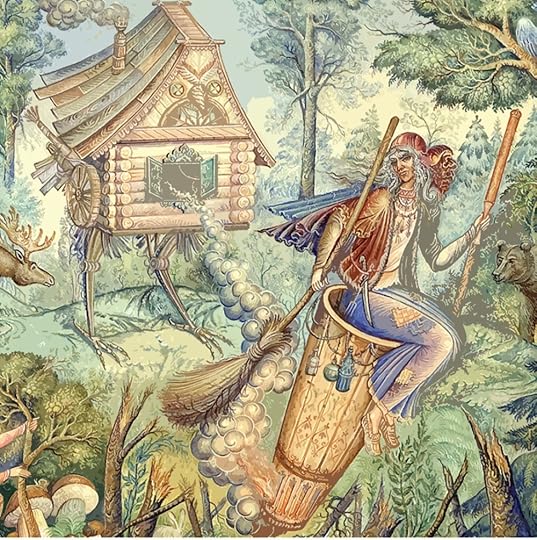
In Slavic folklore, Baba Yaga, also spelled Baba Jaga is described as a supernatural being who appears as a deformed and/or ferocious-looking woman. In fairy tales Baba Yaga flies around in a mortar, wields a pestle, and dwells deep in the forest in a hut usually described as standing on chicken legs. And she’s definitely evil entity.

This book retells the entire folkloric story with another perspective, humanizing Yaga, giving her true defiant, powerful voice she needs. She doesn’t feed herself with children, flying around in a mortar, terrorizing her community as it’s told. It’s a remarkable redefinition and recreation of the character! I truly loved this version more!

Regular people are used to be afraid of anything unusual and different. But different doesn’t mean something horrifying, vicious, scary when you learn to be open minded.

This book takes place in Russia at 16th century and Yaga chooses to live a solitude life because she’s described as something disgusted, threatening, horrifying by her own people. So she lives and communicates with her animals, practicing her healing powers all alone. Her best friends are her owl Noch, her wolf Dyen and her izbushka: a hut that stands on chicken legs.

Her peaceful life ends when Anastasia , wife of Tsar Ivan The Terrible, an old friend of hers visits her to request urgent help.

At this part, we witness the political atmosphere and true historical aspects of Russian history where it has been ruled by blood thirsty, paranoid, threatening leader Ivan IV. And we also enjoy the wild, epic journey of Yaga who really cares more about Russian people than the ruler of the empire, bold enough to fight against the enemy to shed blood and finding a man who sees her and accepts her as she is.

This book is powerful, thought provoking, captivating, mind bending journey, discussing our beliefs, our prejudices. What we scared of might be our best solution to bring us the redemption we desire.

I loved the author’s creative perspective and her talent to mash up folklore, mythology with true Russian historical facts. It’s a marvelous, heartfelt, exhilarating journey you should not miss!

Special thanks to NetGalley and Berkley Publishing Group / Ace for sharing this amazing digital reviewer in exchange my honest opinions.
Profile Image for Will Byrnes.
1,372 reviews121k followers
December 15, 2024
Once war is on men’s minds, Selica had said, it festers within, claiming them.
--------------------------------------
For a soldier to let his enemy live despite the entrenched inclination to kill touched my heart with a flame. And as he looked out on our land, on the people dying and bleeding on it, no matter if they were Russian or Mongol, I saw pain, deep and endless and raw, open inside him like a ravine about to swallow us. There was light there, light that left me hopeful. Perhaps life, possibly even goodness, did exist, even in a soldier, and it prevailed in the world after all.
Baba Yaga, aka Bony Legs, has gotten a bad rap. Ivan the Terrible, however, deserves all the lousy press that can be heaped upon him. Terrible seems far too tame a word, The monstrous, the psycho-killer, the unspeakable, the mindless slayer of mankind, and on, and on, [insert your pejorative here]. (Of course, this is the portrait presented in the book. The real-life Ivan may have had cause for his paranoia, given the considerable opposition of the gentry to many of his policies. Find out more in this small piece in Britannica.)

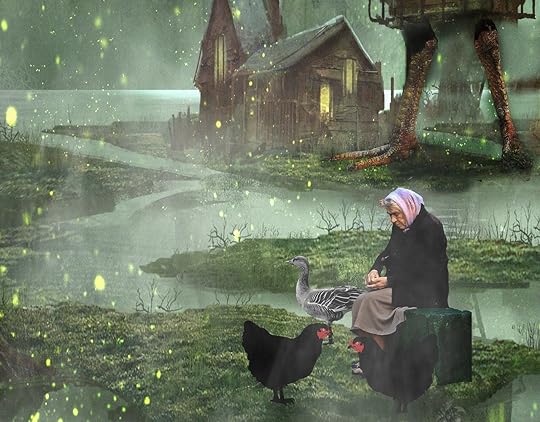
description
Olesya Salnikova Gilmore - image from her site

The most common images of Yaga are of a frightening witch, tooling about in a strange vehicle, trapping and devouring children, and generally doing dirt to people, a personification of evil. But even in traditional lore, she is sometimes shown with a softer side, a healer instead of a tormenter, a consoler, a comforter instead of a horror. She has been seen as a personification of nature, a Slavic version of Persephone. She appears as a change agent in many stories, a trickster, helping the hero or heroine fulfill their quest.

description
Image from The House of Twigs
I had written two books that had gone nowhere. Totally uninspired, almost desperate, I turned to the Russian folktales I had grown up with as a child. Baba Yaga loomed large in these stories—her elusive and mercurial character, her enchanting chicken-legged hut, her terrific mortar and pestle mode of transport, her sharp tongue and fearsome appearance, unsurprising for a woman of knowledge living alone in the wood.
As it turns out, some scholars believe the Baba Yaga we know—the old, ugly hag from the fairy tales—is based on, or is a descendent of, a fertility and earth goddess worshiped by ancient pagan Slavs. I was instantly fascinated by how a goddess could become a witch and just knew I had to write a book not about the infamous hag, but about the little-known woman named Yaga.
- from the Writer’s Digest interview
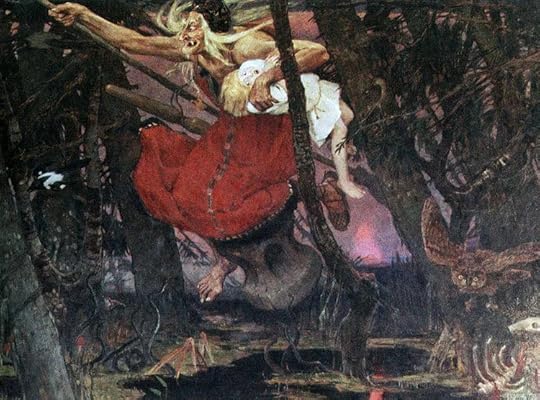
description
A painting portraying Baba Yaga. According to Slavic folklore, Baba Yaga was a witch who often preys on children to eat them. However, some accounts present her as a wise and helpful creature. The painting was created in 1917 and is now located at the House Museum of Viktor Vasnetsov in Moscow.

Gilmore is looking to give Yaga some better press, make her more human in some ways, more of a bad-ass superhero in others. She has a team, of course. (Y-men?) The house on chicken legs that is the very definition of creepy, has been transformed into Little Hen, a supportive, nurturing friendly character who might have been the original mobile home. When Yaga speaks to Little Hen she regards her as somewhere between a beloved pet and a partner. Dyen (meaning day) is a considerable wolf. He (thankfully) is Yaga’s primary means of high speed transportation, while also offering his considerable fierceness. Noch (meaning night) is an owl. Noch specializes in reconnaissance and intel-gathering. They share Yaga’s immortality.

description
Xénia Hoffmeisterová [cs], Ježibaba [cs] (2000)

As a provider of potions for this and that, Yaga has a following. Among those is the tsar’s wife, the tsaritsa, whom she has known for a long time. She is suffering from an illness that the court physicians cannot seem to touch. Yaga helps her out, but suspects foul play. Although she would prefer to remain safely in her house in the woods, she must go to Moscow to find out who is doing this to Anastasia Romanovna, a kind, sweet young woman. It would appear that Yaga and crew are not the only immortals wandering about. The tsar has fallen under the influence of a dark-hearted ageless sort, someone Yaga knows. And the game is afoot.

description
Image from King Edward’s Music

Tsar Ivan is not exactly the best administrator, and it is not long before he is laying waste to large swaths of the country, under the guidance of a dark force. Whether getting there because of his genetic inheritance, or because his mind had been poisoned by a demonic sort, (The actual Ivan was quite superstitious, taking an interest in witchcraft and the occult.) Ivan, who seems at least somewhat rational when we meet him, is soon barking mad, seeing enemies everywhere, even among friends, and showing no hesitation about slaughtering anyone who displeases him. Yaga loves her Mother Russia and considers it her patriotic duty to defend her against enemies foreign and domestic. Ivan definitely counts among the latter. So, superhero vs supervillain.

description
Ivan Bilibin, Baba Yaga, illustration in 1911 from "The tale of the three tsar's wonders and of Ivashka, the priest's son" (A. S. Roslavlev)

There are levels of existence here with diverse characteristics, lands of the dead and living, a glass mountain, with spells aplenty. Yaga’s adventures might remind you of western mythology and Campbellian quest forms having to do with descending to hell in order to emerge better armed to take on whatever. Yaga needs help from other immortal sorts to accomplish her mission, which becomes pointedly clear later in the book. In the shorter term, she is faced with carnage in Russia, and trying to find ways to stop or even just slow it down.

description
Baba Yaga depicted in Tales of the Russian People (published by V. A. Gatsuk in Moscow in 1894)

There is even a bit of romance to counterbalance some of the considerable blood-letting.
After I had witnessed my first birthing not ten years into my life, Mokosh had explained to me the intricacies of lovemaking and child making. “Though immortals can birth other gods and half gods,” she had said, gently, “it is not simple for us, with mortals above all. Most of the time, it happens not. It is even harder for half gods. If it happens, it does so for a reason. It is willed by the Universe.” I had known many men over the centuries, both mortal and immortal. Not once had my trysts ended in anything other than fleeting pleasure or pointless regret. I knew it would never happen for me.
But then she meets Vasily Alekseyevich Adashev, studly warrior, but mortal, which is a problem. It gets complicated. He is probably in his 20s or 30s, she is several hundred. (Baba Cougar?) It is a delightful element.

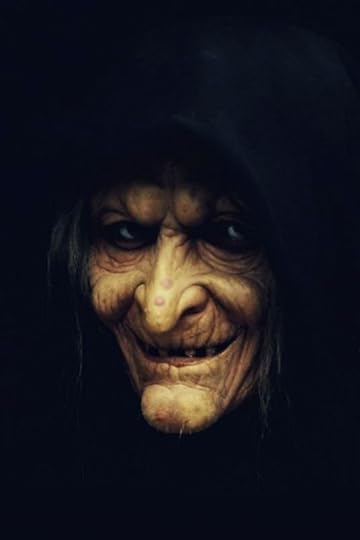
This is a time of transition in Russia, when the old gods were being replaced by the Christian invader. But local loyalties were sometimes with the old and sometimes with the new. Yet, the old gods were still actively interfering in human activities. Getting a look at such a tumultuous period in Russian history is one of the bonuses of this book.

description
Image from Meet the Slavs

The view of reality Gilmore presents is informed by her childhood exposure to Russian mythology. She was born in Moscow and spent her early years there. Fairy tales from childhood figure large, particularly stories set in Old Russia. (Gilmore would have included even more, but maybe in some future work.) Setting her tale in medieval times felt right, which led to focusing on Ivan as THE medieval tsar. It helped that he made an ideal villain, given his location in history, his interest in the occult, and his apparently mass murderous sociopathy. What makes a guy go there?

This being a book by a Russian-born author, about Russia, you can expect that many characters will be referred to be multiple names. And it can be tricky discerning the good Ivans, Vasilies and Alexes from the bad ones. I read an ARE, so cannot say if the final print (and epub) versions contain character lists. If your copy lacks one, you might want to start your own. My minimal gripes about the book have to do with the attention required to keep everyone straight, and a need for a primer on the structure of everything in Old Russian lore. How many layers of afterlife are there? How does one move from to another? It can be eye-crossing keeping this in order.

description
Image from Amino Apps

That said, I found The Witch and the Tsar a delightful, satisfying read. Yaga was a very appealing character. Gilmore has succeeded in making her relatable, and her companions appealing. The devastation wrought by Ivan and those driving him provide all the motive force anyone might require to do everything possible to stop it, which gives us a lot to root for. The romantic element is a nice touch. Added payload on Russian history, folklore, and old religion is most appreciated. I have provided a few links in EXTRA STUFF to more about Yaga in folklore. I urge you to check those out. Baba Yaga may have had plenty of unpleasant things written about her, and many a hideous image created, but in The Witch and the Tsar, Yaga is looking pretty good.
Mother had taught me the immortal side of earth magic, of doing without awareness, without feeling. With Dusha, I learned to listen to the natural world around me, not only to the sky, the trees, the waters, the very air, but also to myself.

Review posted – 11/25/22

Publication date – 9/20/22


I received an ARE of The Witch and the Tsar from Ace of Berkley of Penguin Random House in return for a fair review. Thanks, folks, and thanks to NetGalley for facilitating.


This review has been cross-posted on my site, Coot’s Reviews. Stop by and say Hi!

=============================EXTRA STUFF


Links to Gilmore’s personal, FB, Instagram, and Twitter pages

Gilmore is hard at work on her next novel, with a draft due to her editor in September. This one will be a gothic, set in the 1920s, after the revolution. Two sisters confront their past in their old ancestral house in Moscow. Pub date TBD.

Interviews
-----Malaprop's Bookstore & Cafe - The Book of Gothel: Mary McMyne in convo with Olesya Salnikova Gilmore - video - Gilmore reads from the beginning of her book - 0:00 to 21:48. Mary McMyne then reads from her book - to 39:43. Then Stephanie Jones-Byrne interviews them from about 40 minutes
-----Writer’s Digest - Olesya Salnikova Gilmore: On Introducing Russian History to Fantasy Readers by Robert Lee Brewer
-----Paulette Kennedy - DEBUT SPOTLIGHT: Olesya Salnikova Gilmore

Items of Interest from the author
-----Paste Magazine - excerpt
-----discussion guide from her site

Items of Interest
-----World History Encyclopedia - Baba Yaga
-----Literary Hub - Baba Yaga Will Answer Your Questions About Life, Love, and Belonging by Taisia Kitaiskaia
-----Britannica on Ivan the Terrible
Profile Image for Siavahda.
Author 2 books308 followers
August 12, 2024
So first off, this is not actually a book featuring Baba Yaga. This is a book about a half-mortal child of a Slavic goddess, a woman who is physically frozen in her thirties and works as a magical healer, especially of women. Her name is Yaga, but she is not Baba Yaga. The myths and folklore we know are false, lies spread by hateful Christians, particularly hateful Christian men.

That was immediately disappointing to me. I was looking forward to a novel about the real, complex, often frightening figure of Russian and Slavic folklore, the one who rewards intelligence and cunning and eats idiot heroes for breakfast. Because that is an interesting character. Not necessarily a nice one, and certainly not an easy figure to write about if you’re looking to make her likable to your readers, but definitely interesting. I wanted to see that Baba Yaga going up against Ivan the Terrible and kicking his ass.

The Witch and the Tsar is not that book. And I’ve gotta be honest, I think what Gilmore’s done is unbelievably boring and lazy. You wanted the cachet of a big, powerful mythological name, but didn’t want to or didn’t know how to take on the complexity that comes with that name. Gilmore stripped away Baba Yaga’s age, her trickster-esqueess, the terror she inspires and wields, her power and her wildness – and left us with a younger, sweet, naive twit whose life has been hard Because Men.

How is that not insulting? That’s not a feminist power-move, it’s the exact opposite, making her younger and prettier and more palatable to the pearl-clutchers. Making her tamer in the name of making her likable.

It’s extra frustrating because it would have taken so little effort to separate this story from any connection with Baba Yaga. Gilmore’s Yaga just needs a different name and a different house, and this could have been the exact same novel without turning an epically monstrous and powerful witch into a milquetoast.

You didn’t need to co-opt Baba Yaga for this book. And I wish Gilmore hadn’t.

However, even if she’d left Baba Yaga alone and named her witch something else, this would likely still be a DNF. Gilmore packs the first few chapters with telling-telling-telling that doesn’t flow especially well, while hand-waving the interesting bits (for example, the famous chicken-legged house ‘just came’ to Yaga after her mother’s death – no explanation as to where it came from, how it was made, etc). Her main character is incredibly bland and over-familiar – we’ve seen this exact character template so many, many times – and there’s so many moments of just jaw-dropping stupidity that I felt insulted as a reader.

Case in point: one of Yaga’s companions, Dyen, is an immortal wolf who can speak to her telepathically. When Yaga goes to Moscow, Dyen accompanies her. Yaga then wonders why people are staring at her when she’s done her best to fit in – despite the massive wolf walking next to her. A wolf which is allowed into the royal palace without protest. A wolf which, once Yaga’s audience with the king is over, runs off into the palace alone and everyone is fine with that.

I’m pretty sure 16th-century Russians were not that cavalier about wolves. Because, you know. Wolves.

So, I quit. This isn’t the book I wanted it to be, and the book that it is is also pretty terrible. No thanks.
Profile Image for PamG.
1,293 reviews1,031 followers
September 19, 2022
The Witch and the Tsar by Olesya Salnikova Gilmore is a reimagining of the witch Baba Yaga from Russian folk tales. Rather than a wicked witch who stole children, readers meet a powerful healer and witch with vulnerabilities called Yaga. This retelling has a feminist slant to it. Other spirits and creatures from mythology and folk tales also play roles in this story set in Russia between 1560 and 1582. Yaga is a half-goddess possessing magic and living in a hut with chicken legs (Little Hen). With the hut and animals for company, she is lonely. Dyen, a wolf, and Noch, an owl, help her and communicate with her. Mortals seek her out only when they need healing.

Her old friend Anastasia, now married to Tsar Ivan Vasilyevich, visits Yaga, suffering from an unknown illness. Yaga realizes the fate of Russia is tied to Anastasia’s health and travels to Moscow to be with her. A volatile situation, an unknown antagonist, and the tsar being manipulated by one or more individuals are only the beginning of the problems.

The characterization was a mixed bag. Yaga didn’t seem to have the power, knowledge, and decision-making capability she should have had after living for centuries. Tsar Ivan the Terrible was well-done and brought chills to this reader.

The author weaves a story of light versus darkness that highlights Russian history, mythology, and folktales. The country seemed to come to life in this descriptive tale that has excellent world-building. However, the pacing was slow at times. Interspersed throughout the story are themes of power and ambition, expectations and rules for women, charity, hope, manipulation, mental health, blame, hatred, violence, murder, love, friendship, and family by choice as well as family by blood.

The narrative is rather straightforward and the plot didn’t have the twists and turns that I expected. However, the historical references to actual people and events added a significant layer of interest to the plot. The author’s note is especially helpful in getting insight into what the author wanted to accomplish as well as whether some events were real or fictional. There is also a glossary of key figures (historical, fairy tale, and mythological) as well as places that are key to the story. The historical content seemed well researched.

Overall, this was a violent and emotional story that kept me engaged. Those that enjoy reimagined folk tales and mythology may want to consider this book as their next read.

Berkley Publishing Group – Ace and Olesya Salnikova Gilmore provided a complimentary digital ARC of this novel via NetGalley. This is my honest review. Opinions are mine alone and are not biased in any way. Publication date is currently set for September 20, 2022. This review was originally posted at Mystery and Suspense Magazine.

----------------------------------------------------------------
My 3.21 rounded to 3 stars review is coming soon.
Profile Image for Paromjit.
3,080 reviews26.3k followers
November 1, 2022
Olesya Salnikova Gilmore's debut plunges the reader into a tragic and brutally violent period of Russian history, blended with the traditions, culture, myth, legend, magic and folklore of the country and painting a markedly different picture of the notoriously dangerous Baba Yaga from her terrifying reputation. Here, she is a healer, using her magic and potions to help others, a more vulnerable and beautiful woman, a half goddess living in isolation in the woods in a hut that stands on chicken legs, with Dyen, a wolf, and Noch, her owl. When old friend, Anastasia, the wife of Tsar Ivan, arrives seeking her help, Yaga overcomes her fears, reluctance and the dangers and threats she faces in order to do all that she can to protect her dear friend.

She makes her way to the royal court of Ivan to ensure Anastasia's safety, through time the country falls prey to the increasing insanity, tyranny, violence and paranoia of Ivan the Terrible. However, the courageous Yaga sees that there is far more at play than the acts of men as she battles obstacle after obstacle to try and save Russia. She is a woman coming to terms with all that it is possible for her to be, she even finds a unexpected love crossing her path. This is an atmospheric, engaging and character driven read, of the horrors of Russian history and its myth and folklore, but there are pacing issues and I struggled at times to accept the author's characterisation of Yaga, it didn't feel entirely authentic to me. Many thanks to the publisher for an ARC.
Profile Image for Melissa ~ Bantering Books.
367 reviews2,268 followers
January 16, 2024
2.5 stars

The Witch and the Tsar is no The Bear and the Nightingale, no matter how I wanted it to be.

I had so much hope for this book. I was ready for Olesya Salnikova Gilmore to sweep me away to the brutal winters of 16th century Russia, back to the mythology of Baba Yaga and the reign of Tsar Ivan the Terrible. I wanted to be magicked by the tale, just as I was when I read Katherine Arden’s The Winternight Trilogy. But alas, it never happened.

It’s such a missed opportunity, too, because the story itself is appealing. I love how Gilmore ties together Russian folklore with history by having Yaga fight to save her country from the wrath of the Tsar. By all rights, the story should’ve worked.

I have many gripes about the book, most of which boil down to the quality of the writing. One is that the characters are underdeveloped, and another, the story lacks urgency and emotion. I neither felt tension while I read, nor was my heart ever invested in Yaga’s plight. And most bothersome is the book’s vernacular. Yaga speaks and thinks as if she lives in 21st century America, not nearly five hundred years ago in Russia. The modern dialect is so out of place.

Do not regret skipping The Witch and the Tsar. You won’t be missing out on much.


My sincerest appreciation to Olesya Salnikova Gilmore, Ace, and NetGalley for the digital review copy. All opinions included herein are my own.
Profile Image for Bradley.
Author 9 books4,866 followers
January 14, 2023
Let me first say that I think this was a pretty good novel, a sprawling, adventuresome novel full of death and the death realms, gods, magic, and interesting Russian folktale retellings. As pure fiction on this specific topic of Baba Yaga and the Deathless and Ivan the Terrible, I like this one better than some -- not as much as others -- while still thinking it was a pretty fun ride.

But here's where I start to have a bit of an issue: Baba Yaga is being reimagined as an old but youthful seeming, misunderstood feminist icon trying to learn how to get along in a life that is complicated and strange, butting heads with gods and the Deathless and the earthly powers that be, let alone the encroaching Christianity versus the old gods.

I can easily appreciate the attempt while feeling a little queasy about the implication. This is on the same level as humanizing Disney Villains and trying to make them misunderstood icons twisted through a man's ugly eye. And maybe that does happen. I'm not saying it doesn't. But it also ignores the fact that all people can be crazily good or evil and no amount of wringing of hands or revisionary writing can whitewash it.

What we got was a happy ending with a flawed, but ultimately good feminist icon. If I didn't know anything about Baba Yaga at all, I'd be pointing at this and going, "See? See? Men bad!" while ignoring the necessity for the big bad, the big wishgranter, the complicated, bigger-than-life IDEA of Baba Yaga and what she meant to countless myth-lovers.

There's a reason she endured the way she was. It wasn't because Wise Women who were burned as Witches were all really good people underneath. And so, I miss the full range and scope of what is usually a fascinating character.

As a novel that only vaguely resembles the original legends, I'm quite certain I enjoyed it, but it was still weak Vodka.
Profile Image for Trish.
2,386 reviews3,744 followers
January 15, 2023
I always liked mythology from all over the world and Baba Yaga has been one of my favorites for a long time.

This Yaga (don't call her BABA Yaga, as she finds it offensive to be called "grandmother" despite being hundreds of years old) is different though. Still youthful, she does have powers and a connection to deities and sprites, but she also still has ties to the human world. Such as tsarina Anastasia who shows up one day because she's in danger. Turns out, someone is trying to poison her.
Begrudgingly, Yaga goes with her to the palace, meets the tsar, the courtiers - and the tsar's adviser who is none other than Koshei the Deathless.
However, Yaga soons find out that the tsarina's enemy is a formidable one, has deep knowledge of the supernatural and it's about more than Yaga's childhood friend.

The backdrop for this book is Ivan the Terrible's reign over what was a unified Rus(sia). There were many political factions that didn't like having been brought under the control of one ruler. Not to mention that good old Ivan had ... a temper. Yeah, let's call it that. So there were revolts, bloody abatements and lots and lots of executions.

But there is more. You see, it was around this time that a "new" religion had come to dominate Rus(sia): Christianity. Leaving out food for old house spirits was suddenly devil worship and if you didn't subject ...

Technically, the perfect background / worldbuilding for a story about a witch. After all, she's an unmarried woman living alone, having extensive knowledge and is independent. In this case, she's also powerful. However, whether we talk about men or male deities, most never suffered a witch/woman to live (freely).
I say "technically" because there wasn't as much of the formidable background as I had hoped. Sometimes, I wished for more historical connection, some other times I wished for more extensive looks at the magical world(s).
And always, the males of whatever species ended up being the baddies. The problem? Not all women are good, not all men are evil and making it so is not only feminist revenge porn, it also makes the characters flat. Not to mention that Baba Yaga was unapologetic. She punished and she teased. She wasn't evil, not exactly, but she also didn't give out freebies. Why should she have?! Wishes or magical remedies ... they cost. As they should. And just because there IS a witch living in "your" woods doesn't mean she HAS to help you.

So yeah, I like my witches with more spunk or even teeth. Therefore, while this wasn't bad, it suffered from a modern trend many books are following and it was to the detriment of the myth itself.

If you ignore the source idea, the story was quite entertaining though.
Profile Image for Gabriella Saab.
Author 4 books413 followers
April 23, 2022
A celebration of the beauty, complexity, and majesty that embodies Russia—her people, her history, her folklore, her culture, her triumphs, her tragedies, her heart. THE WITCH AND THE TSAR is gripping, heartbreaking, romantic, and mesmerizing, and Olesya Salnikova Gilmore’s storytelling is its own enthralling magic.

First allow me to go straight to this story’s core: authenticity, a rare and special gift given to readers only by authors who write of their own culture and experiences. Not even the most learned historian or cultural anthropologist can capture that indescribable spark that comes only from an authentic voice. In this novel, the author’s love for and intrinsic understanding of Russia and Russian culture leaps off every page—in lush atmosphere and setting, in mouth-watering food and drink, in unique and interesting clothing, in ancient traditions and folklore, in the humanity of character, in colors, sights, smells, feelings. When a culturally authentic author pours her entire heart, mind, and soul into every aspect of a story, it creates an intense vulnerability and deep honesty capturing the most genuine love and respect for a place and people. And when imparted onto readers, the experience is different, noticeable, breathtaking.

Set in Russia in the 16th century, this sweeping tale begins deep in the Russian woods, where the reader meets Yaga, a half-goddess, half-mortal who desires to heal and help others with her spells and potions—not Baba Yaga, a vicious, decrepit hag who flies on a mortar and pestle and eats children. Tales from the perspective of a woman defined through one particular lens, that which makes her out to be a villain, inevitably fascinate me, so when I learned of this debut novel delving into the legend of Baba Yaga, I was certain I would be captivated. And I was right. Until now we have heard about Yaga only from those who vilified her, who deemed her a dangerous, vicious witch. Yet this is the reader’s opportunity to hear her story from the woman herself. And as is often the case with such stories, the truth is not as it may have seemed.

As an immortal who has lived for hundreds of years but not aged beyond that of a woman in the prime of life, Yaga is intelligent, beautiful, has the ability to communicate with animals, and uses the earth around her to create magical potions to help the Russian people she loves so dearly. Those people once revered her, then spurned her and dubbed her Baba Yaga, spreading horrible tales about her, distrusting her, threatening her. Hurt and betrayed, she retreats to a life of solitude, aiding the mortals who come to her but no longer seeking them out or mingling in their cities and villages. She lives in her forest with three faithful companions—Noch, her fiercely independent owl; Dyen, her strong and protective wolf; and Little Hen, her feisty izbushka, a hut that stands on chicken legs. All three adore Yaga and are faithful to her, and she them, and all three embody elements of Yaga herself—her strength and independence, her quick and clever wit, and her desire to protect and assist others. Yet Yaga carries the mortality in her blood like a burden, fearing it makes her weak. She is exactly the kind of protagonist that draws me in and leaves me cheering for her success, one who despite her flaws and fears is brave, self-assured, and has a heart for others.

And when Anastasia, wife of Tsar Ivan IV and an old friend of Yaga’s, comes to her for help, Yaga is faced with her reluctance to mingle with mortals again and her desire to protect her friend from an unknown threat that, Yaga fears, is a larger threat than even she knows yet. So Yaga does what she always does: She does not let the small minds of men stop her, those who would prey on the mortality that leaves her susceptible to harm and even death, and instead does what she must to help another in need by going to the royal court in Moscow to care for Anastasia.

Over the next several decades, the reader accompanies Yaga as, all around her, Russia falls victim to Tsar Ivan, soon known as the Terrible—an arrogant man obsessed with his position and power, with his own self-proclaimed religious fervor, yet paranoid about his enemies, all of which leads to a descent into madness and bloodshed against his own land and its people. The same land and people Yaga loves so passionately. And Yaga soon discovers that tangled with Ivan’s cruelty and insanity is another battle, that of the immortal sort. As a reader relatively unfamiliar with this time in Russian history and knowing only general basics of Russian folklore, it was so fun and fascinating for me to be swept up in a world where both intermingle so fluidly. The author wraps so much history and mythology into a story that remains fast-paced, thoroughly explained, and compulsively readable, never leaving me lost or confused, as would have been easy to do with such complex and ambitious subject matter.

Yaga is determined to protect Russia from Ivan and all those who would see to its destruction. She embarks on a journey to do so along with a varied and colorful cast of characters of both the mortal and immortal sort, many of whom the reader will recognize from history or tales of Russian folklore—or perhaps will be introduced to for the first time, and to a world previously unknown to them. Among these people Yaga finds acceptance, betrayal, devious enemies, faithful friends who become more like family—and even the opportunity for authentic, romantic love. Yaga has never known men to truly love or care for her, as all others were driven by selfish motives and never gave her the love or respect she deserves. Yet among those she meets along this journey to save Russia and its people, she finds a man who does not see her magical gifts as something to fear or suppress but rather to celebrate, that which makes her authentically real and deeply herself; he desires to love her, to care for her, and to support her in all she is, all she does, and all she will be. And she, in turn, sees a man who loves his country and his people and desires their protection, a man willing to give anything, even his life if necessary, for those he loves. These two were absolutely one of my favorite elements of this story. Theirs is a beautiful relationship in which both find the opportunity to be truly themselves, vulnerable and honest as they accept one another’s strengths and flaws; they are perfect examples of authentic masculinity and femininity, and of how this authenticity creates a deep bond and mutual respect.

With fully realized and achingly real characters, suffering and horrors that left me breathless, rich and fascinating history and folklore, and deep humanity that pierced right into my soul, this beautiful story took me into its world and refused to let me go. It is a story of striving to become one’s authentic self, of uncovering strength in perceived weakness, of combatting darkness with light, and of finding acceptance and, through it, family; but above all it is the story of a woman taking charge of herself, her life, and her destiny and redefining it not by another’s terms, but by her own.

My thanks to the author for providing me with an early edition of this novel, and I cannot wait to read many more of the author’s works to come. What a unique, promising, captivating debut.
Profile Image for Stitching Ghost.
1,481 reviews391 followers
June 13, 2025
It took me almost 5 months of reading bits of this book while on my way to work to finish it, I had such a hard time sticking with it, the writing style was just drab and the story so drawn out in all the wrong places that I kept finding myself drifting out of my reading app after a few minutes.

I liked the characters and their progression so I really wanted to finish this book but I ended up not being that thrilled with the ending. I did appreciate the research and work the author put into writing this book though.
Profile Image for Athena (OneReadingNurse).
969 reviews140 followers
January 25, 2023
This book reminded me a lot of Circe, in that the author went out to humanize and reclaim a mythological witch’s narrative and somewhat succeeded.  It also falls right into that genre of cold, dark, and bloody Russian mythological stories like the Winternight Trilogy in which we desperately need more books.

The story itself is so rich and complex. Yaga must come out of her exile to save Russia from Ivan the Terrible, while finally learning what it means to be both a mortal and part deity.  I loved the story itself even though it was often a slow burn with some dubious pacing.

Bringing mythology into history is always challenging. Gilmore wrote a stunning appendix featuring both the deities and real life historical figures that she brought into the story.  As someone who gets hung up on accuracy vs. interpretation a lot, it was cool to have the author point out where she took the biggest liberties and learn what she found important in the real life historical sense.

The world build & setting is quite well done too.  I have come to expect lots of architecture, idolatry, clothing, food, customs and lore, and lots of cold weather from these stories and Gilmore does not disappoint. I loved it all from the rich imagery of the palaces to the bloody descriptions of the military police riding out and the towns they devastated.  There’s a constantly solid blend of tragedy and hope that I liked quite a bit.

Like any story of Russian evolution, one big conflict was the old spirits & mythology vs the new Christian god. I think this was nailed as Yaga tried briefly to assimilate to court before everything went to hell, where she got a first hand view of everyone’s shiny new Christianity.  Weaved throughout are the descriptions of sprites and spirits, lesser and more powerful gods, charms and other magic.  With characters like Little Hen and Volos, the magic really had a life of it’s own too.  Yaga’s spells and abilities were interesting enough, made more so when she filled the gaps in her learning with a mortal witch and then was able to travel through dimensions of the spiritual realms.  The gods and goddesses obviously had influence and magic too so there was always something mischievous going on.

Lastly let’s meet the characters! Yaga wasn’t the fearsome witch I expected at all. I found her lack of knowledge a bit disorienting at first considering the length of her existence and legendary witchery.  She really had pretty limited skills at first and constantly didn’t know what to do in various situations, but then we see that Yaga had some of the lessons but none of the context from her mother’s teaching. It took a while to build up her experience and characterization.  She gained a much greater awareness throughout the book before fully embracing herself. There were lots of good character arcs too like the Tsar’s descent into tyranny, Vasily as the Russian soldier archetype, Marina, and of course the mediating of all the feelings associated with changing times.

Overall this was a pretty solid debut.  The book got a tad repetitive at times and slowed it’s pace way down to focus a lot on Yaga’s journey. None of it was bad but I ended up docking some points for how it really did feel like a much longer book. That said, I loved the history and magic, the setting and imagery, and in general I am a big fan of Gilmore’s writing! I’ll be looking for whatever she writes next for sure!

Thank you to the publisher for my early reading copy via NetGalley! All opinions are my own 
Profile Image for Allison.
Author 12 books330 followers
April 20, 2022
Fierce and fearless, The Witch and the Tsar whisks the reader back to a 16th-century Russia that's enthralling, frightening, and completely unforgettable. With stunning prose and sharp insight, Olesya Salnikova Gilmore conjures up a captivating battle between gods, emperors, and folkloric spirits, led by a prickly, powerful heroine who leaps off the page and refuses to be ignored. This is Baba Yaga like you've never seen her before, and you're going to love her.
Profile Image for Rachel (TheShadesofOrange).
2,887 reviews4,798 followers
August 17, 2023
3.0 Stars
Video Review: https://youtu.be/U9KIoxdYmfo

This is an atmospheric piece of historical fantasy. I really liked the setting which offered insights into a time and place I am not overly familiar with.

The protagonist is intended to be a baba yaga character, but she does not share the characteristics one would expect from this iconic personality of folklore. I wanting a strong personality when instead she was quite soft.

I enjoyed the setting but as for the story, I will admit that I found it lackluster. I was overly invested in our protagonist or the larger surrounding story. The novel had a lot of potential but I found myself wishing for a punchier version.

Disclaimer I received a copy of this book from the publisher.
Profile Image for Britt.
1,116 reviews15 followers
September 2, 2022
I got about 35% of the way through this one, and feel comfortable sharing why I didn't love it - Baba Yaga is an AWESOME mythological witch who like, eats children and goes around in a house on chicken legs and generally does kind of awesomely wicked things. Oh yeah, and she's like an old crone. Outside of the chicken legs, we don't get any of that here - Baba Yaga is young woman just trying to make it in a man's world. But jeez y'all, she was kind of boring and ordinary and insanely naïve. She made terrible decisions at every turn which was frustrating for me to read. I understand humanizing the character, but let's humanize the old evil lady and like maybe make her slightly less evil instead of changing virtually everything. This was a completely different take on the character that will likely work for some (maybe those who aren't familiar with Baba Yaga?), but definitely didn't do it for me. DNF at 35%. What I read was ok.

Thanks to Penguin Group and Netgalley for the eARC which I received in exchange for an unbiased review. The Witch and the Tsar is out 9/20/22.
Profile Image for Cozy Reading Times.
574 reviews15 followers
February 17, 2023
I don't really understand why so many people seem to despise this book.
Well, I see why this might not have been what readers hoped it might be. It's a story about Baba Yaga, shouldn't it be badass and dark and delightfully evil - about a witch both feared and revered, the mother of all ass-kicking women who doesn't need a man to rule in life?

Well, "The Witch and the Tsar" doesn't tell that kind of story.
It is the story about a rather ordinary (well as much as magic is ever ordinary) young witch, who is only painted a monster by the men of the world, who need her to be more or less than she is to justify her power. She isn't that brave, isn't that badass, and does fall in love over the course of the story.

But she still has courage. She still stands up against a tyrannical ruler. Still protects her people and fights for them. And to me at least, this "ordinary" woman, who isn't any "more" than any other woman but is no less of a hero, seemed more likable, more relatable than a true Baba Yaga, larger than life, ruthless and undefeatable.

It was at times a tad slow and maybe a little longer than it needed to be, but that was the only complaint about this book I had, and I enjoyed most of it (it also has a beautiful writing style that was very atmospheric).
Profile Image for Veronica (Honey Roselea Reads).
784 reviews206 followers
October 31, 2022
description

My Blog | My BookTube | My Book Club | Instagram | Twitter

Thank you to NetGalley and Ace Books for inviting me to read The Witch and the Tsar and for providing me with an ARC in exchange for an honest review!

A review will be up on my blog on November 1, 2021 at 10 am CST on Honey Roselea Reads for you guys to check out!

My review on The Witch and the Tsar will be accessible using this link from November 1, 2021 at 10 am CST and onward.

For now, here is a preview to what the review will look like:

❀❀❀❀

When Russia is being threatened by an unknown force, half-goddess Yaga must discover a way to stop evil from taking over from the lands she loves. As she travels through Russia, teaming up with various people, warriors and creatures, she discovers secrets that change her life and her views of this incoming war on Russia.

I gave The Witch and the Tsar four stars, really enjoying the [ continue reading ]
Profile Image for Janna G. Noelle.
338 reviews36 followers
September 10, 2022
I was both lucky and grateful to receive an advance reader copy of The Witch and the Tsar from the author via NetGalley. I didn’t know very much about Baba Yaga going into this book beyond the fact of her being an old, ugly witch who lived in the woods in a hut built on chicken legs, and that she had a reputation for stealing children. But according to Gilmore's author's note, this portrayal of her was one that was popularized followed the arrival of Christianity into Russia—that prior to this she may have been a fertility/earth goddess worshipped within the Slavic polytheistic tradition.

It is this pre-Christianity version of Yaga (just Yaga; she is no babushka) who features in this book—an immortal half-goddess struggling to relate to her human half and humans in general due to past hardships brought about by their fear and hatred of her powers and independence. Still, she does have one human friend: the tsaritsa Anastasia Romanovna, wife of Tsar Ivan IV, whose mysterious illness draws Yaga out of her safe, isolated forest into what soon becomes a desperate mission to save her country and people from Ivan and his tyranny, the Tsar recreating himself as the infamous Ivan the Terrible.

I found the story quite educational, for I also knew nothing about 16th century Russian history. I enjoyed learning about Tsar Ivan's Oprichnina (the kingdom he carved out from Russian territory for his own totalitarian use), his oprichniki (the brutal soldiers who razed countless Russian villages and oppressed/murdered their inhabitants at Ivan's command), and the response of Ivan’s son, Tsarevich Ivanushka, to his actions. Upon reading the author's note, I was amazed at just how many historical figures and events Gilmore seamlessly incorporated into the story, among which she interspersed various fascinating Russian pre-Christian gods and other supernatural creatures. The Witch and the Tsar is a story filled with culture, heart, and a beloved cultural character's journey of discovery toward all that’s good about embracing her humanity.
Profile Image for Molly Greeley.
Author 4 books357 followers
May 10, 2022
In THE WITCH AND THE TSAR, Baba Yaga is transformed by the magic of Olesya Salnikova Gilmore's prose from a shadowy figure into a breathing woman with a beating heart. Yaga here is fierce and vulnerable, human and immortal, as complex and beautiful as Russia itself, which Gilmore paints with the sort of authenticity that only comes from truly knowing and loving a place and its culture. A powerful and moving debut.
Profile Image for Mira Mio.
333 reviews78 followers
October 24, 2022
DNF 10%

Древняя Яга превратилась в невинную сьюху, которая просто хочет лечить людей (but not in a fun way).

Сюжет тупой до безобразия.

Обьяснения русского фольклора задолбали еще на первой главе.
Profile Image for Sud666.
2,330 reviews198 followers
October 20, 2023
"The Witch and the Tsar" was a very interesting retelling of the popular Baba Yaga story. Gilmore chose a more feminist perspective due to Baba Yaga stories mostly stemming from orthodox priests. So her Baba Yaga is no Baba (grandmother) but an immortal young woman who, far from being an evil witch, is a priestess of an Earth goddess (Mokosh) and a healer. She does have magical powers and also a house on a chicken leg (Little Hen).

In this story, Yaga (she doesn't like being called "Baba") intercedes on behalf of her friend the Tsarina, who is dying. During this time she meets Tsar Ivan IV (Ivan Grzony or "Terrible") and then all their destinies become interwoven.

As Ivan descends into madness and paranoia, Yaga must help the resistance forces band together to fight his oppression. During this conflict, she realizes that there are gods and goddesses involved in what is going on and she must pierce the veil to other worlds to find out what is going on. What she finds will change her life as she meets her sister. No more spoilers.

While it was a good story and certainly different, I have to admit I liked the old Baba Yaga character far more. She was scary. This Yaga? She falls in love, has children, and is kind-hearted and courageous...it makes for an interesting re-telling but removes any of the fear and awe the name Baba Yaga induces. Much like a Dracula novel where the Count isn't a vampire lord but a compassionate noble who works for the World Health Organization to stop the spread of malaria. Cool for a retelling but doesn't it really take away from a great and established character? I liked the story but not this version of Baba Yaga, whom I consider to be an outstanding female character and supernatural being.
Profile Image for Sara Jesus.
1,673 reviews123 followers
October 7, 2022
Such a great debut, perfect to autumn season with similar vibes of "The bear and the nightingale" and "The witch´s heart". Baba Yaga is a fantastic main character, I really love her journey trying to save Russia and the same time find her place in the mortal world.

Koshey, Volos, Morozko and Silca were other characters from the slavic culture with intresting journeys. Little Hen, Dyne and Noch were very adorable, and show the reader how much connected is Yaga with the nature. Vasily was one of my favorite characters, his bravery and his love for Yaga conquered my heart.

I only wanted more scenes with the Tsar, we saw some glimses of his madness and the terror that he cause from his people but we didnt not see very much of his life. I wanted to know more of why he did became paranoid and an violent ruler.
Profile Image for Josie.
284 reviews25 followers
December 1, 2022
Setting/Worldbuilding: 5/10
Main characters: 1/10
Side characters: 1/10
Dialogue: 3/10
Plot: 3/10
Technique: 1/10
Prose: 7/10
Romance: 4/10
Ending: 3/10
Overall enjoyment: 1/10
29/100 (1.45)

I'm sorry, but I am getting very grumpy at the lack of well-written Russia-inspired fantasies out there. How did the complex folkloric wonder of Slavic cultures that is known as Baba Yaga descend into a simpering, too stupid to live immortal beauty, indistinguishable from every other YA main character out there?

I'm too tired and annoyed to talk more about this book - I direct you instead to this review , which has encapsulated pretty much everything I feel about this book.

Bye.
Profile Image for Alessa.
294 reviews75 followers
November 21, 2022
Thank you to NetGalley and the publisher for providing me with an ARC of this book.
Actual rating: 1,5 stars, but rounded up.

For me, there are two ways to look at this book.
One is taking it at face value, and the other is looking at it as a historical fantasy that is based on Russian folklore and history.

When I just look at the book itself and rate my enjoyment, I'd give it 3 stars.
It's decent, I enjoyed it, but I was also frustrated. The writing is okay, it did bother me a bit that all these Russian words were randomly thrown in, followed by the English translation. I'm all for including foreign words from whatever language/country a book is based on, but there are more elegant ways to do so.
I also wasn't a fan of the pacing, and sometimes I was missing explanations, and it felt a bit jumpy at times.
The FMC was frustrating at times, because she seemed so ignorant and quite frankly stupid. She walks into Moscow with a pet wolf but is confused when people look at her, even though she's trying to blend in? Huh?
But overall, the plot itself was okay, not my favorite, but definitely enjoyable for the most part.

BUT as mentioned earlier, this is a historical fantasy based on Russian folklore, and when I take that into account, I have no choice but to lower my rating.
I get that creative liberties (usually) have to be taken in historical fantasy, but there's a line between creative liberties and lazy research/writing.
My main issue was the FMC. I was excited to read a book featuring the Baba Yaga, this scary but clever witch, instead, I got... a naive forest witch who's supposedly hundreds of years old but acts like a teenager at times. It's clear that the author changed the character to make her more likable and easier to root for, but in my opinion, it is not okay to re-write a central figure of Russian folklore just to make her fit your novel. To me, that seems like wanting to profit off the name, without putting in the work and research to write her into the complex character she is. And I know the author's intention was wanting to write a more feminist version of Baba Yaga because most of the tales about her were written by men, but personally, I think a badass swamp witch who eats children is kinda cooler than a naive girl who is oblivious to politics and society despite supposedly being immortal.

The historical inaccuracies were also questionable to me. The novel is set in the 1560s Russia, where Ivan the Terrible is ruling. Now here's what I don't understand: The real historical figure Ivan the Terrible makes for a great villain, with his greed and cruelty and ruthlessness. So why is book-Ivan... not all that? He felt like just another bad ruler, when he had so much potential.

There were more things I noticed but I think other reviewers have done a better job at pointing out the issues this book has. This was just what I picked up on despite my limited knowledge of Russian history and folklore. I just wanted something different from the book. Maybe if it had been high fantasy or set in a secondary-fantasy Russia, I would have been able to enjoy it more, but if I read a historical fantasy novel that feels poorly researched to me, I just have a hard time getting into the story.

I do think the author has potential and I would like to read whatever she writes next, but this just was not for me.
Profile Image for Yvonne (the putrid Shelf).
994 reviews383 followers
December 17, 2022
The Witch and the Tsar is a story magnificently told. The frozen landscape of Russia is home to treachery, romance, and strength. My imagination was on fire so much I think I combusted a little!

It is books like The Witch and the Tsar reminds me why I enjoy reading literature from other cultures. The imagery in this story was stunning, the frozen landscape, the chill emanating into your bones from thousands of miles away, it is told so succinctly that if you look up you can almost feel the delicate snowflakes land on your skin. It is a book that makes you forget your sense of place, time, and everything in between. The Witch and the Tsar will stay with me for a long time to come.

It is really difficult to find the words to do this story justice – it’s fantastical and taut with glorious imagery and characters that breathe life into the mythology of the Baba Yaga – a firm favourite of mine. The author transports you with ease and it never really felt like reading a book, it was an experience.

The immortal witch, known as Baba Yaga (from the well-known Slavic folklore) she has always been known for evil deeds, residing deep in the forest in a home that sits on chicken legs. This story has forged a different path, one where Baba Yaga is humanised, she has emotion and an affinity towards animals. A visit from her long-time friend, Anastacia, the wife of the Tsar changes the course of her life. Anastacia implores her old friend to help her for she is being poisoned. She knows that the fate of her beloved mother Russia lies in the hands of Anastacia’s survival so she must step out of the shadows of her woods and travel to Moscow to ensure her friend’s safety.

I took an instant liking to Yaga. She’s spunky, resourceful, and doesn’t hesitate to put those whom she loves first, even if that means something catastrophic happens to her. She’s the strength of Russia, the scaffolding, the moral compass, and yet she is still left to deal with egotistical men that seek nothing but status and power. She is bold and powerful, but she has never had to harness the full extreme of her powers, never had to consider it until now when it appears The Lord of Winter is back long before his time – summer should still be in full swing. Where has the imbalance materialised from?

Set in 16th-century Russia, Anastacia is the wife of the future Ivan the Terrible. I really enjoyed the historical fiction aspect of the story; it gave a sense of knowing and I had to do some further reading on the terrible Tsar’s actions upon finishing this amazing tale. Isn’t it wonderful when you read something that makes you want to read more on the subject?

Every character in The Witch and the Tsar made me feel a part of their group, very quickly you get involved, you start caring about their outcome and pain and it becomes impossible to tear yourself away! The author has created a beautiful picture of Russia and its surroundings. I welcomed the path she took me down.

Profile Image for Sydney Young.
1,239 reviews98 followers
September 24, 2022
One can read The Witch and the Tsar for its delightfully imaginative powers in retelling Old Russia’s fabled mythology surrounding Baba Yaga, along with a slew of other well known larger-than-life’s deity types, and their beloved, interesting companions. One can read it for a simple tale of a woman finding her power and her own place in a man’s world, carving out her own world. And that would be enjoyable enough, for it’s a fine tale and will keep you enraptured to the end.

But there’s far more to it. When reading the author’s note, you learn of what inspired the author and what she hoped to achieve. I think she did. This is one of those books that will only grow richer with rereading.

Besides the beautiful story and evocative world, there’s a rich additional layer of the only recently unleashed brewing power of the female goddess / half-goddess archetype (think Madeline Miller). What I love about The Witch and the Tsar is its evolution for these types of retellings.

Here, Baba Yaga is a woman, half-goddess, who’s been burned by gods and mortals alike, so she’s retreated and is simply doing what she does well in the dark of the forest. Soon though, she must answer the call for help from a dear friend, and she spends the rest of the novel trying to fulfill the ultimate goal of this particular quest, as Russia comes more and more under the grip of the increasingly mad Ivan the Terrible. No, she’s not the supposed hag, which familiar tale we’ve accepted from the mouths of men for far, too long. And she’s not embraced her power, hasn’t even had the chance to learn to do so, due to events beyond her control. But this story is where her powerlessness ends, and the crux of the novel finds its way into our hearts.

Gilmore managed to surprise and thrill me with her twist to Baba Yaga’s journey in fully finding her power. After all, we are quite used to the Disney type of heroine being without a mother and making her way. It’s not very often that we get to see a mythical heroine make a trip back to her own giver of life. And then, to also see that it’s her (our) humanity and femininity that saves her (and can save us) in the end. This twist caused me to sit up and look at this journey with different eyes.

I’m not very versed in Russian folklore and mythology, even while I count Russian authors among the greats who’ve influenced me and my reading/writing /thinking. At a time when the world seems very scary, I’m glad for my world to be enlarged with this greater understanding of old Russia and it’s colorful people, while my belief in the power of women (oh, if only we’d reach out and grab it!) is affirmed and delighted.

I read and listened. Loved the narration!

Well done.
Profile Image for •Mrs Pizza•.
501 reviews139 followers
February 27, 2023
I have less than 60 pages left and I just can’t. The amount of just “telling” instead of showing in this book. 😑 Everything is convenient, whether it benefits the good or bad guy doesn’t matter. I don’t care. She’s not even an old forest witch, she’s like 30 and it’s not an origin story 🙄
Not enough chicken leg house.
The magic is all over the place.

Did not like
Profile Image for Reading With  Ghosty.
173 reviews77 followers
June 19, 2024
I felt like it was missing something to give it that spark. On its own it was mediocre, if not a bit drab at parts. Hinting anything to do with baba yaga when it wasn't relevant isn't the move.

Would not recommend.
Displaying 1 - 30 of 1,081 reviews

Can't find what you're looking for?

Get help and learn more about the design.