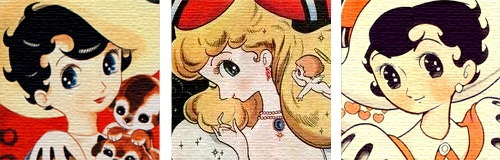
Safiri cai vítima de um plano arquitetado pelo terrível Duque Duralumínio, que quer usurpar o trono da Terra da Prata e colocar o príncipe Plástico como novo regente. Além disso, a princesa terá de lidar com Satã e a Madame Satã. O diabólico casal quer tomar o coração de donzela de Safiri para dá-lo à sua filha Heckett. Como se não fosse suficiente, a heroína ainda enfrentará o Capitão Blood e seu bando de piratas, mas ela sempre contará com a ajuda do anjinho Ching e com o príncipe Franz, da Terra do Ouro.
Dr. Osamu Tezuka (手塚治虫) was a Japanese manga artist, animator, producer and medical doctor, although he never practiced medicine. Born in Osaka Prefecture, he is best known as the creator of Astro Boy and Kimba the White Lion. He is often credited as the "Father of Anime", and is often considered the Japanese equivalent to Walt Disney, who served as a major inspiration during his formative years. His prolific output, pioneering techniques, and innovative redefinitions of genres earned him such titles as "the father of manga" and "the God of Manga."
So this is the second and final part of the series. Basically this is Tezuka's take on classic fairy tale tropes, told only in the way that he can. The basic plot is that of a child born with both a boys and a girls heart, and is then raised as a Prince so that "he" can inherit the throne. His dual identity is a kept secrete, and all kinds of woe from witches, rivals, demons and goddesses. The story moves at a steady pace, and Tezuka keeps everything light. The art is impeccable as always. It's my understanding that this book, first published in serial form in 1953, pretty much single-handedly created the "Sojo" genre of "girls manga". I think anyway. It's an early example and that's probably why many people will now have a problem with it.
For it's time, it's an incredibly progressive take on gender types and roles. "Gender identity" is the type of topic that I'm far to ignorant to explore properly in some dumb review no one reads, but I certainly saw it being questioned in this book. Prince/Princess Sapphire is at both a strong lead, and a weak one, and that's the problem. Whenever the "Girl Heart" takes over, Sapphire becomes a weak mess,only to return strong when the "Boys Heart" re-establishes itself. This stereotype is sure to infuriate most of today's' readers in our politically correct climate who tend to have the blinders on when reading things from the past.
So there it is, a damn fine book from the master comic creator, that might not be suitable for you if you can't get past dated gender stereotypes.
Osamu's work is of course defining, especially for Japanese comics, and should be read by anyone interested in the art; Princess Knight is no exception, especially considering its importance in the development of shojo. This doesn't mean that the God of Manga's works are all above criticism or scrutiny. On the contrary, a number of his works can be quite perplexing in revealing the author's limited worldviews. Princess Knight is a good example of this, when we see Osamu's characters in the same breath matter-of-factly exclaim the equality of the sexes as well as the weakness of women. Ideologically, Princess Knight is perplexing and annoying when it decides to sabotage its transcendental morals for typical sexist narrative. Narratively, the story and art are enjoyable if you can separate the author's moral failures. As far as the ending is concerned I'm not convinced if it is interesting for not ending at the expected event, or if it simply goes longer than it should have. Historically, it is interesting but is utterly forgettable when matched with Buddha, Adolf, MW, or Ode to Kirihito.
Can't believe Tezuka killed captain blood just so he wouldn't end up with sapphire
Can't believe Tezuka created a female swordsman (swordswoman?) that has more chemistry with sapphire than franz ever did but didn't make her marry sapphire bc "oh no, not LESBIANS!! That is too far"
Can't believe sapphire really ended u with boring plain ass prince franzzzzzzzzzz 💤💤💤💤💤 charming
I mean, it's a nice story and all. But DAMN. Wish franz had died instead 😔
This entire review has been hidden because of spoilers.
Well, I can see why this story was influential in its own time and how it still is an interesting historical document, but for me it was just too much 50-ies misogyny and gender stereotypes to be enjoyable.
I finally managed to get around to getting my hands on this book after looking around for a while. It's very much worth the wait and effort to find. (I ended up getting it in a local comic book store.)
The artwork in this is classic Tezuka, so fans of his style will love every single panel of this series. I have to say that my two favorite characters as far as artwork goes was Heckett (the witch's daughter) and the pirate (can't remember his name off the top of my head). It's a good thing that both of them get a lot of face time in this volume, as they're also my most favorite characters overall.
The story is excellent and like the first volume, I'm very struck by how progressive Tezuka was for the time period, which was 60s era Japan. (They weren't cavemen, but women's rights weren't exactly as far in Japan during that time as you'd think.) I was a little heartbroken to see that some of the characters die (slightly spoilerish, but I won't tell you who bites it), but they die well.
This will absolutely be something I'll re-read in the future and if we ever get any of the other versions of the series, I'd absolutely buy them. (Now I just have to catch up on my BlackJack!) Vertical is swiftly becoming one of my favorite publishers for their fine treatment of the manga they release. I'd almost recommend this as a purchase for that reason alone!
So... ultimately I don't think I enjoyed this Tezuka series as much as some of the others I have read. Granted, a princess story is probably not geared toward a 30-year-old male, but there were several things that I think even a younger reader, regardless of gender, would have complaints about. Specifically, in part 2 there were probably at least 6 different spots were the story could have concluded, and yet it continued to drag on and on and on. Together, the story is over 700 pages, which even as a graphic novel, is quite a slough for young readers. And while fantasy and fairy tales are borrowed from copiously in Princess Knight, at a certain point the twists and interference from characters becomes tedious and annoying. What starts out as a "Arthurian" regal tale meanders through both Greek mythology AND Biblical yarns, and while the chapters, in which a story in miniature plays out, sometimes to excess, the PK's conclusion wraps up in a rather hasty four pages! For your time, better to just stick with Tezuka's BlackJack or Dororo.
Definitely not as good as the first half of the story. I feel like everything really started to just drag on, especially when an entirely new villain gets added for the sole purpose of making the story longer.
I do appreciate Osamu Tezuka making up for last time, Sapphire lost her boy heart for a second and could no longer fight, but he fixed that in this volume, showing that's she's a great swordswoman regardless.
The ending felt rushed too. We spent so long having Franz and Sapphire trying to save and find each other, and we don't even get to see their wedding. Kind of lame honestly.
The story overall was still pretty good, but like I said, the first half is definitely superior.
Well, I was enjoying myself with this fluffy manga. I thought it was cute and fun, which it still is. However, the ending..... was disappointing. And it felt like it came out of left field (such as the goddess Venus is the final obstacle while the rest of the story was Christian-inspired world. Why is a Greek goddess randomly here?). I also didn’t like how Captain Blood’s storyline ended. It was still enjoyable. It would had 3 stars if it weren’t for that ending.
This entire review has been hidden because of spoilers.
Like the last volume, somewhere between 2-3 stars. The art is absolutely gorgeous and expressive, but the storyline jumps around to ridiculous points. Glad to have checked out some vintage manga I've been wanting to read for ages, but not something I'll be picking up often!
Prince Sapphire is born with both a boy’s and a girl’s heart in a woman’s body. Her subjects know her to be a prince whereas she longs to live as a girl. In order to keep her uncle from taking the throne, she must continue to play the prince’s part and keep her female heart a secret. This only becomes more difficult once she encounters the prince from a neighbouring kingdom with whom she falls in love.
Princess Knight was released in 1953 and is thus the oldest manga I have read. In fact, it was one of my main motives for reading this series; I was curious and interested in seeing what older manga would be like. Not to mention that the author, Osamu Tezuka, was such an influential one for manga.
The Western, and most notably Disney, influences are more than apparent, though. Sapphire and a few of the other main characters had designs similar to modern manga, but all other characters were very Western. Disney showed itself in various ways: Sapphire’s design resembled that of Disney’s Snow White, the prince’s name Prince Franz Charming, the animal designs were close to one on one with Disney designs and of course they gathered around the prince(ss) Sapphire.
The evil witch’s dragon form reminded of Maleficent and then you also had various other references from other Western influences such as Swan Lake, Greek mythology, and just the general art style. Because of this, the art seemed to be split into the manga and the Western half – a combination I could not handle well. I love Disney but I have never been overly fond of Western style comics. I thought Sapphire herself looked beautiful; she was fair and petite. Perhaps not my ideal female heroine but she certainly had some beautiful panels.
The story itself was very typical for a fairy tale – something I usually do not mind. If I go into a story knowing that it is of the fairy tale type I do not mind if there is not much depth to the characters. It was not the instant romance between the main characters that bothered me but the unnatural reactions to most any situation. The prince gets more than obviously shot by an arrow and his subject asks him “Have you been shot, milord?” as though he were inquiring about the weather. This made the story seem awfully fast-paced and characters who achieved something and actually sacrificed themselves for others were taken for granted. Oh, you just died to save my life – whoops well thanks – gotta hurry and keep up with my own business.
Nonetheless, the two things that really kept me from enjoying this series more might not even be the manga’s fault – at least one of them. The translation was horrible. I have never read a manga with such a terrible, terrible translation. At least I hope and assume that the Japanese version was not so crude. They were using such a horrible modern slang I could hardly stand it. If you are writing a story with a medieval setting – please, if you are not able to use old English, at least use standard English!
There was also quite a bit of unnecessary cursing which did not suit the otherwise innocent story. The other thing that bothered me was the modern joking. Though, I believe that to be a mere case of personal taste. Unless we are talking about Shrek, I never like when there are modern jokes or references in a medieval setting. Things such as “cameras have not yet been invented, milord” – ah, please no!
Although I spent a good deal of time ranting on this one – it is by no means bad. It is worth looking into even if it is just to see the evolution of manga. It has its moments and an unusual mixture of art styles. I thought one could also see where Riyoko Ikeda might have gotten some of her influences from.
I can't think of a higher compliment I can make that I'm going to be absorbing and processing this marvellous little piece for some time and so any initial thoughts I have right now feel somewhat trite and ill-considered. This is a deceptively simple manga (and a highly influential one), ostensibly written for children, about a girl accidentally born with a girl and a boy's heart who ultimately has to hide her feminine self so that she may be heir to a kingdom which will only allow men as rulers.
There's simultaneously a whole lot of stuff going on here but it's all presented in such a frivolous manner that one can't ever confidently tell what Tezuka is trying to say, and I think perhaps that's the point. It almost feels as if Tezuka is throwing down the gauntlet here insomuch as challenging "you want to talk about women, you want to talk about gender roles? Well ... here you go!" and the work will deftly flit from pronouncing that Princess Sapphire when she's fully a girl (minus boy-heart) is weak and can't lift a sword, to presenting another female character who as an entirely capable expert swordswoman. In fact, everytime gender roleing is mentioned it's almost always with a wink and a nod and for comic effect - did he really just say that? It seems so but somehow the characters all charge onwards defying expectations regardless. For example, One plotline - perhaps my favourite, sees Madame Hell (literally the devil's wife) trying to steal Sapphire's girl-heart to give to her daughter Hecate, who is simply not feminine enough for her. Once she's done this she'll be able to marry her off to the Prince Franz, or so she thinks. Hecate simply doesn't want the heart because she doesn't want to be feminine and tricks her mother into thinking she has it by acting feminine. Tezuka's assumptions seem pretty clear here: One can - and maybe should - be a woman but not wish to be beholden to the gender assumptions behind womanhood.
For me, therefore, this is a really slippery text and deliberately so. The whole thing seems to be - at least metaphorically - a story of Princess Sapphire being in something of a gender identity crises, her constant switching between how she chooses to present herself as a boy or girl is muddied by society's constant expectations of how she should be i.e she must have a girl heart or a boy heart and only one. It's interesting to note that her female sex-type is only brought up once, at the very end, as proof that she is actually a woman when she shows her breasts to another woman. Elsewhere in the story friends and enemies alike are happy to make assumptions based on her gender-type without seeking biological proof.
It's not much of a spoiler to say that she does eventually wind up with a girl heart only but by this point in the story her external constraints (as represented by (the duke, Madame Hell and Venus respectively) have mostly ebbed away all and I'm not entirely sure what this means for her future. Will she be able to live as a ruler of Silverland and a girl now? I'm not arguing that princess Knight is a fully-progressive piece by the standards of 2023, but I do think it is aware of its own assumptions and the feminist conversation.
(NB: If this is the end of the story, however there is a short follow up series entitled The Twin Knights which I guess I'll have to read)
Tezuka certainly keeps these kinds of tensions at the forefront of the narrative but on another level, what's remarkable here is that this is still a children's story. It initially seems quite Disney-esque but the influences are also clearly from MGM style swashbucklers too. It's never less than straightforward fun and the wacky narratives can be enjoyed perfectly well without thinking about them too deeply. Tezuka certainly keeps the pace going and there are more than enough ideas here to warrant the 27 chapters worth of length. (it's just a shame that the original anime series hasn't been subbed - the dub is un-watchably bad and I gave up on it pretty quickly)
This is... better than the first 16 chapters, at least. It's hard to dispel the incredibly bad taste in my mouth from them, but I can admit it starts settling into a pretty okay silly adventure, even if it moves at breakneck pace without ever a chance to catch its breath, and plays the melodrama card so hard that it's hard to keep caring about any of it.
...But that just could not hold, and it dives off the rails as quickly as it found them. Killing off the old villains he sets up an entirely new absurd plot, this time mixing in Greek gods, a clone of Sapphire who is instantly sapphic for her, and an appearance from The Big Guy himself. Through it all, Sapphire, Charming, and Blood all seem to be afflicted by some irresistible attractiveness that drives everyone around them mad, which is just about the only thing driving the plot. Absolutely no one seems to be motivated by anything but infatuation, including the mains, and any sense of direction they might ever possess gets tossed out the moment they see their "love."
The sexism really ramps up in this volume, too. For being the titular hero of this story, Sapphire sure does spend a lot of time in prison or dead, waiting for someone to save her. Despite a few speeches to the contrary, every woman in the story is shown to only care about housework and marriage, even the ones with masculine skills are ready to drop them on a whim.
A classic Osama Tezuka. I started reading his books after visiting the exhibition about him and his works (Tokyo). He's the "godfather" of manga. He takes all the time he wants to tell his story, so Princess Knight is in 2 volumes. It is more or less a classic story. There's a princess, a prince and a pirate who would like to marry her, the evil uncle trying to kill her so he can get his son to become king, an evil witch with a rebellious daughter, an angel trying to help out etc. (the works). The twist lies in the fact that Princess Sapphire has 2 hearts, a boy's heart and a girls heart. What is her true identity? If you can set aside the christian religious parts of the book (it has been mixed with Greek mythology), it looks as if Tezuka was ahead of his time regarding the gender issues as discussed these days (2020). I would recommend any of his books. (Ode to Kirohito is great as well). Clean sharp drawings. Good story.
The Second volume of Princess Knight was way better than the first. In this one we see women standing up for themselves. The "women's movement" in conjunction with the strong female figures presented in this volume is outstanding. Additionally, I liked the play on gender ambiguity and the fact that Sapphire attracted the attention of both sexes and it wasn't until Sapphire confessed to being male or female (depending on which she felt like that day) that her enamored would finally believe her. I was really happy with this volume.
Osamu Tezuka is the creator of two animes I used to watch religiously as a child, Princess Knight and Kimba the White Lion. Both of which really had an impact on me as a child, I even had a stuffed white lion which I would go everywhere with. It is creative and innovative people like Tezuka who I really appreciate and respect and it is his artistry that still lives on in my heart today. He made my childhood so much more memorable and his work is just a nostalgic trip for me. A must read for anyone interested in Anime and Gender ambiguity.
I liked this volume a lot more than the first volume. I felt that the first half of the story relied to heavily on the trope of them taking one of her hearts (making her girly, which makes her weak, or manly, which makes her unkind). This volume dispenses with that trope and instead chooses to show that both men and women can be strong and thoughtful in different ways, which made for a much stronger and compelling story.
I love this book. It's like the best parts of old Disney comics (especially Barks, Gottfriedson, and some of the Italian masters) mixed with Tezuka's signature comic style and gorgeous artwork. I must read for any child or adult with a girls heart, even if the body doesn't match. Love you so much.
This is the second installment to the Princess Knight manga that I read A YEAR AGO! Where does the time go? For the previous book I talked about how I could see modern parrallels with the main character Prince Sapphire with people who identify as transgender. This most likely not the intention of the author, Osamu Tezuka. There is actually more written about how the character Prince Sapphire is the first "gender neutral" character in Japanese mangas. So what is the basic plot line? The Queen gives birth to a girl and the King, scared for his lineage, decides to raise his baby Sapphire as a boy and hide the sex of the baby from the kingdom. As a result, in heaven Sapphire gets both a boy and girl heart, and an angel is sent to Earth to remove her boy heart to become a proper girl. The story is complicated by the fact that Sapphire's true sex is discovered and get's overthrown, and Sapphire falls in love with Prince Charming.
My criticism about the series was that there were some gender stereotyping. Sure there was the roles of which genders play, but there was the constant reminder that females are physically weaker than males. So how the did the second installment hold up? Well, in the second book Sapphire's boy heart is completely removed but is still able to be strong. This I enjoyed. But since she has more or less made that transition as a girl, the story becomes more focused on getting Sapphire and the Prince together.
Well, there is an interesting storyline where an evil queen keeps trying to steal Sapphire's girl heart for her daughter, who isn't "feminine enough." What I liked about the daughter character was that she mischievous and spunky, but never wanted Sapphire's girl heart. In the end she helps the leading couple, and is shown in a positive light, giving approval that girls don't need to be quite and reserved. Sadly, she dies because of a weird "connection" to her mother, which does conflict with my previous statement.
Overall I liked the series, though it is a little dated because of the changed roles of women over the years. And I think I mentioned before that it is a little weird reading as a westerner. Tezuka clearly is emulating western fairytales, but seems to jumble Grim's fairytales, with Disney movies, with Greek/Roman mythology. If you can get past these items, this will be an enjoyable read.
I really didn't like Part Two as much as I liked Part One and I'd like to explain why by talking a bit about the work as a whole and how it plays out differently depending on what chapter you're looking at. Just a quick note, I know that the series was originally serialized but if you're getting it in any format, it's probably going to be omnibus, not individual parts. So keep that in mind.
1) Part Two moves almost too fast and it's hard to keep up. The first half has moments where there's a lot going on and it's one thing after the other but it's not as bad as Part Two. I think it's because we think we're at a natural fairy tale ending and then it's like NOPE GOTTA DO THIS and then it goes NOPE THAT DIDN'T WORK HOW YOU PLANNED and then it's like WHOOPS NOT QUITE YET. By the time you get to the real ending, it's pretty weak, not gonna lie. Still enjoyable, but weak.
2) This is going to sound weird but I'm going to try to explain it. It's really hard to respect Sapphire's choice in terms of which heart Sapphire keeps. Basically, the premise is that Sapphire is born with male and female hearts. Christian!God (yup, he's in here) tells his angel Tink that he has to right his mistake of giving Sapphire two by taking her male heart. Constantly through out the story somebody's trying to take one heart or the other. In fact, we get to see what happens when one is taken (twice in fact, different one each time) and it's...not pretty feminism-wise. As a person in 2012, there are some things with gender roles and identity in this book that won't sit well with some people. So it's hard as a reader, to accept when Sapphire decides which heart to keep, no matter what your personal views on gender, sex, and sexuality. That doesn't make Part Two weaker, it just makes it uncomfortable for a modern audience. For 1970s Japan, this was progressive but now, it's an interesting study but it falls flat for our expectations.
3) Sapphire does a lot less in Part Two. Or at least, not as many cool things, as Part One.
Other than these three things, Part Two is good and this manga is a solid good read. I recommend it for anime fans, particularly those who like mahou shoujo (magical girl) or shoujo (girl) anime.
Sometimes, I get really impatient with manga. Some titles I like have just went on for too many volumes - in my opinion - and it can feel like a bit of a slog to get through it all. I still really enjoy the titles I enjoy, but it can be a bit of a slog to get through everything. Princess Knight was not one of those manga... though I think it suffers a little from ending fatigue.
To explain: in the second volume we follow Princess Sapphire as her cousin changes the laws in their home country so that she may rule even though she is female. In essence? This takes only a few pages to happen - women of the country basically fight back and make the men realize that life would be a lot easier if they were all on the same page, and so the government pass the laws. The rest of the book? While very entertaining, it does feel a little like they were trying to stretch out the story, particularly in the last few chapters with Venus...
Yeah, Venus is a character in this. She's actually in fitting with some older interpretations of Aphrodite - being quite mean and selfish when she wants something - but she is definitely Venus.
Overall, it's still a manga I would recommend to near anyone, though with the caveat that the gender politics displayed are very much a product of their times and should be read with that in mind. Otherwise it can come off quite distasteful.
Still, it's cute and the art is lovely. Worth a read.
This volume is more gritty than the first 1 but still wonderful. I warmed up 2 the Prince Franz after his first conversation with Sapphire which proves he see's her as an equal despite her being a woman. I still like Captain Blood more though, his death came as a suprise and was quite tragic dying for the love a woman who was in love with another man yet depsite knowing that still wanted her 2 b alive & happy, yet she still ending up dead anyway! Hecate's death was swift & brutal, I felt sorry for Franz having to do that, He became friends with her. I was worried when Fiebee turned up she'd b axed as well but thankfully not. The Marquis was amusing. The Duke's suicide came as a suprise, because he beleived he'd inadvernatly killed his son, not your typical villian death. Venus was a seductive cruel villaness. A lot goes in this book you feel upbeat one minute, depressed the next then content at the end. It had a typical fairytale ending. I liked Saphire's transition, She decides to be a girl but 2 b strong too ( I think Plasic & Friebee helped her with that) and she get's her Prince and Tink goes back to heaven. A fantastic manga.
This entire review has been hidden because of spoilers.