Jump to ratings and reviews
Rate this book

The Minotaur #1

The Minotaur Takes a Cigarette Break

Rate this book
Five thousand years out of the Labyrinth, the Minotaur finds himself in the American South, living in a trailer park and working as a line cook at a steakhouse. No longer a devourer of human flesh, the Minotaur is a socially inept, lonely creature with very human needs. But over a two-week period, as his life dissolves into chaos, this broken and alienated immortal awakens to the possibility for happiness and to the capacity for love.

313 pages, Paperback

First published May 1, 2000

267 people are currently reading
6599 people want to read

About the author

Steven Sherrill

11 books122 followers
Steven Sherrill has been making trouble with words since 8th grade, when he was suspended from school for two weeks for a story he wrote. He dropped out of school in the 10th grade, ricocheted around for years, eventually earning a Welding Diploma from Mitchell Community College, which circuitously to an MFA in Poetry from the Iowa Writers' Workshop.

Now, Steven is an Associate Professor of English and Integrative Arts at Penn State University, Altoona, where he teaches, paints, and captains the Allegheny Bilge Rats Shanty Choir. He has three novels and a book of poems in the world. He has written several articles on contemporary artists for Modern Painters and for TATE Magazine. He is the recipient of a National Endowment for the Arts Fellowship for Fiction in 2002. His first novel, The Minotaur Takes a Cigarette Break, is translated into 8 languages and was recently released as an audio book by Neil Gaiman Productions. His second novel, Visits From the Drowned Girl, published by Random House (and nominated by them for the Pulitzer Prize), US and Canongate, UK was released in June of 2004. The Locktender's House, novel #3, was released by Random House in Spring 2008. And in November 2010, CW Books released the poetry collection, Ersatz Anatomy. Most recently, Louisiana State University Press: Yellow Shoe Fiction Series has accepted the novel JOY, PA for publication in the spring of 2015.

There are other books in the works, paintings always underway, much musical silliness underway, and seventeen ukuleles in the house, and 750 vintage wooden crutches in his basement.

Ratings & Reviews

What do you think?
Rate this book

Friends & Following

Create a free account to discover what your friends think of this book!

Community Reviews

5 stars
1,185 (22%)
4 stars
2,178 (40%)
3 stars
1,399 (26%)
2 stars
467 (8%)
1 star
112 (2%)
Displaying 1 - 30 of 734 reviews
Profile Image for Peter.
510 reviews2,640 followers
October 7, 2019
Humanisation
The Minotaur Takes a Cigarette Break, is a wonderfully original story full of imagination, sadness and humour. We are introduced to the Minotaur, who over the last five thousand years has gone through a steady humanisation transformation. Probably more psychological than physical and various aspects of his appearance still exist, like bovine facial features and horns. It is those quirks that keep him consigned as an outsider but they also make him really interesting. As an immortal, he has had to deal with repetitive exclusion, loneliness and loss over many centuries.

M, as he’s currently known, lives on the periphery of society and works as a chef in the kitchen of the Grub’s Rib restaurant. His life is full of sadness and there is a yearning that he can gain some acceptance into society. M has a quiet, reclusive, smouldering character that cloaks a history and capability that can administer destruction and damage. How will he respond to his current threats and trials? It's easy to build empathy for him and when he starts to develop a friendship with a woman, you become absorbed in his activities and personally encouraging him to take the steps forward. The dialogue is relevant and gutsy, it is sharp and honest, and fiercely real.

There is a harsh reality presented for those that live on the edge of society, those that are alienated because of race, colour, creed or appearance. An existence where you have to deal with not only the reinforced differences but the added contempt and antagonism from others. A glimmer of hope and affection can be so powerful, a feeling that is heartbreakingly tender and sincere. The narration in this book creates a vivid portrayal of such a life.

I would read this book over and over as it just makes me feel like I'm experiencing something that is unique, eccentric, scintillating and mysterious.
Profile Image for Jaidee .
766 reviews1,503 followers
November 24, 2022
4.5 " poignant, original, primitive" stars !!

2018 Honorable Mention Read.

First of all a very warm thank you to TD Whittle who introduced me to this gem of a novel ! I would never have discovered this one on my own.

I want to entice some of you to read this. This book appears to be so underappreciated and it is worthy of being on the syllabus of any American Literature course.

The Minotaur of Ancient Greece lives through the millenia and ends up in small town North Carolina.
As readers we are not privy to how this occurs except that over the millenia he becomes more humanized but still with the head of a bull. He is a lovely creature and works as a chef in a diner where the food is very very good.

We live his life with him over a two week period and meet the many people that intersect with his daily routine.

The magic in this book and believe me, it is magic that the author understands this creature to the core and uses him to represent the OTHER in all of us and the anomie that many of us experience some of the time. Throughout everyday interactions we think we understand the bull until he witnesses violence, experiences desire or is torn back to the days where he was king and would feast on virgins.

Mr. Sherill's command of his prose is absolutely superb with a keen sensual sense of detail and an emotional palate that would not be foreign in terrific noir literature except these colors are more muted than dark.

"Into the Minotaur's life there come occasional moments of clarity, moments, unpredictable and painfully brief, that arrive at times as a thunderclap and at others as sweetly as a yawn, moments when everything seems understandable, when the whole of his past makes sense to him, his present seems within his control and his future pops and sizzles with a wild dangerous hope. These moments are rare, and their aftermath lies somewhere between excitement and sheer terror...."

There my friends you have a taste of what the reading experience was like. Do yourself a favor and pick this up !!

Profile Image for Brian.
Author 1 book1,242 followers
October 6, 2019
If we are going to talk about earth-bound immortality we’re going to do this right. Pouty, sassy and preening vampires a few hundred years old chasing teenage girls need not apply. Give us the Dactyls, the Potamoi, the Oceanids – give us role players, the extras, of ancient mythology and show us the hell of immortality. Give us The Minotaur.

Author Steven Sherrill taps his inner Ovid to pen a modern day look into the life of a 5,000 year-old mythological figure living in rural Florida. Sherrill’s writing is subtle; his depictions of the daily life of The Minotaur are brilliant in their simplicity weighted with the underlying horror of an undying existence as a perpetual fish-out-of-water.

The genius of the book owes as much to what is left out of the text as to what is written. Daedalus’s Labyrinth provides the structure of the novel. When we navigate a maze, just because we may never end-up in one of those dead-ends doesn’t mean they don’t exist. The Minotaur’s immortality is his Labyrinth; the interactions with the world around him provide the paths through the endless maze that ultimately yield the impasses that require him to start again – to find a new path that will ultimately lead to the same conclusion. You can take The Minotaur out of the Labyrinth. But you can’t take the Labyrinth out of The Minotaur.

The Minotaur is looking into the past and the future simultaneously, and both are visions of desolation, of endless and murky emptiness.
Profile Image for Madeleine.
Author 2 books951 followers
October 9, 2012
Seven pages in, a passage that ostensibly illustrates the bond between M -- the titular smoking hybrid who's now safely mundane against the backdrop of the modern world -- and one of his friendlier coworkers actually betrays the lonely core of the Minotaur’s five-millennia-old being:

Cecie keeps telling him she’d like to take him home some night, husband or no. The Minotaur waits hopefully. Husband or no.

(Believe me: It’s brutally sad in context.)

Not to be outranked on the Don't You Want to Actively Seek out This Character so You Can Befriend and Hug Him? scale of heartstring-tugging insights into a traditionally antagonistic creature, a paragraph on the 100th page's recto side brings the dual, tormented nature of M’s existence into aching clarity with a tiny inkling of what it does to someone to live as a monstrous outsider for five thousand years:

The architecture of the Minotaur’s heart is ancient. Rough hewn and many chambered, his heart is a plodding laborious thing, built for churning through the millennia. But the blood it pumps—the blood it has pumped for five thousand years, the blood it will pump for the rest of his life—is nearly human blood. It carries with it, through his monster’s veins, the weighty, necessary, terrible stuff of human existence: fear, wonder, hope, wickedness, love. But in the Minotaur’s world it is far easier to kill and devour seven virgins year after year, their rattling bones rising at his feet like a sea of cracked ice, than to accept tenderness and return it.

Seriously. If that doesn’t make you want to give the poor guy a giant hug and a tender pat on the snout -- especially considering that such a revelation comes on the heels of a fleeting but significant physical interaction with the imperfect waitress M is crushing on hard -- then you have neither a soul nor a beating heart to speak of and I cannot, in good conscience, encourage further communication with you because you're probably a zombie. Not if you can read ....and puts her hand on top of his. And puts her hand on top of his. And puts her hand on top of his without the awed reverence of a beast unaccustomed to gentleness absolutely demolishing your stoic reserve and tear ducts. Though you’re probably a lost cause anyway if you made it past page 49’s confession that touch comes so infrequently to the Minotaur that when it happens, sincere or not, it nearly takes his breath away, blinds him momentarily to all rational thought and allegiance without your breath hitching and that little premonition of danger making you fiercely protective of M -- or maybe that’s just me identifying with fictional characters to an unhealthy extent again.

This (debut, nonetheless) novel does so many things well beyond its sympathetic rendering of a mythical abomination. At one point, M’s constitution is described as one of “gritty resignation,” which can also be said about the narration’s tone. M is never pathetic or hopeless, traits one might expect from so tragic and long a fall (fortunately, his Labyrinth days are mostly hazy half-dreams; even M’s primal defenses are blunted by a self-control he’s exerting after eons of learning that both “possessing a capacity for evil unmatched” and “his own potential for tiny rages” can lead to the kind of dire consequences he no longer welcomes). He’s scared and nervous an awful lot, but mostly in regard to the damage he can unintentionally cause other people and the embarrassment he can bring upon himself, and has a downright endearing habit of bovinely poking at the ground with his very human foot when he isn’t sure of what else to do, but he soldiers on with a hard-won, Zen-like “state of indifference, sometimes blessed, sometimes cursed” that is completely expected from someone who has been everywhere once and who has passively watched the ultimately inconsequential rise and fall of countless civilizations.

I feel so strange saying that I loved this book because there were so many moments that killed me with their undercurrents of sadness. For every instance detailing M’s private and painstaking maintenance ritual (being half-bull, after all, creates skin problems and requires frequent horn grooming), it was the self-sufficient singularity of it that got me the most. He reacts to the smallest kindness with a touchingly disproportionate relief and gratitude. His bull’s mouth is not made for human words, so verbal communication is an onerous task: His economy of language and the obvious embarrassment he feels when attempting to speak make his few non-grunted utterances poignant, not piteous (there's an exchange with M and his boss that crescendos with M's submissive, disbelieving "Not fired?" and, I swear, those paired words have never sung with such emotional resonance before). And his heady desire for the mere ability to sing into the warm nights as he drives his lovingly maintained jalopy screams of a being who may be no longer trapped in a Grecian maze against his will but confines himself to his inner world, as rich as any terminal introvert's mental plane, because he knows he never had and never will enjoy a real place in what’s going on around him.

Even M’s bullish half is capable of empathy and despair. He certainly recognizes the cannibalistic nature of becoming his employer’s new beef carver and his emotional reaction to a televised bullfight – one of the few times he deigns to use the contraption, as ancient M “feels hostile toward most things electronic.... There is a threat in the very existence of such minute and exact circuitry that touches something primal in the Minotaur” – is terrible to consider in its personal relevance.

As sympathetically as M is painted within these 300-some pages, it is nearly impossible to suspend one's disbelief to allow the sexual encounters between a woman and a man-bull to be effortlessly romantic. As loudly and over-earnestly as I was rooting for the Minotaur to get some, the novel would have hit a mortally insincere snag had M gotten his rocks off without a hitch (and a few suspicions about his partner's stability). Just like the few unprovoked, unwelcome confrontations and scuffles M finds himself in by virtue of being "a freak," it was absolutely crucial to the integrity of the narrative for M's lone love scene in this book to come with some ugliness.

Because as much as you wanna take M's hand in yours for a little while to assure him that there are more than just a scant few decent people out there, the book straight-up questions what the hell an attractive, mentally sound woman would find arousing in such an unusual partner; also true to the gist of the story, however, there is a well-intentioned and genuine sense of companionship at the heart of a seemingly deviant behavior: What would compel a woman to kiss a man with the head of a bull? Pity? Curiosity? Genuine attraction? Maybe [she] recognizes the freakish parts of her own self and is drawn to the Minotaur through that alliance. Most likely it is a fluctuating merger of all these things that move her.

Quite simply, I love this book and can't wait to read it again. I love what it had to say about people by way of a thoroughly nontraditional (but also undeniably human) protagonist. I loved M himself with such unrestrained empathy that he might be my new favorite fictional character. I loved the casual metaphors, the easy allusions, the subtle themes. I loved its warmth. And I really loved how it was a perfect storm of things that reminded me of how much I love getting lost and immersed in damn fine storytelling propelling a damn fine tale.

Guys, seriously. Read this book. Read this book now.
Profile Image for Ian.
982 reviews60 followers
September 2, 2024
I won’t deny that I was lured into choosing this book by its intriguing title. I listened to the audiobook version, which I think was a good choice for me. In the novel, The Minotaur has trouble getting his tongue around human language, and tends to communicate via a series of “contextual grunts”. The narrator, Holter Graham, does an excellent job in conveying the tone of these.

The book was first published in 2000. The Minotaur is cast as an immortal creature and therefore wasn’t killed by Theseus. In the late 20th century he is living in a trailer park in North Carolina, eking a living as a chef in a local steakhouse restaurant, a job he combines with fixing old cars for his landlord, who also sells second-hand vehicles. He no longer periodically devours virgins. Actually he no longer really remembers those days. He doesn’t have a great memory, and 5,000 years is a long time.

The Minotaur’s difficulties with language, and his unusual appearance, result in him being socially isolated, and socially awkward. He is very lonely, being essentially the ultimate in the “undateable” category. It is suggested in the novel though, that there may be a few other immortals around. At one point The Minotaur seems to encounter Daphne from Greek mythology, though she isn’t specifically identified as such. (A name badge of “Laurel” gives a clue, as does an unusual skin condition). Like The Minotaur she is marginalised, working on the till in an all-night store in Georgia. There were some other strange characters, which I suspect were references to other creatures.

The novel sort of ambles along, basically consisting of the Minotaur’s daily interactions with the people around him. It’s about the life experiences of someone who will always be an outsider. In recent years there have been quite a few novels on that theme. As this one was published in 2000, it’s perhaps an early example of the genre. There’s a change in mood for the last few chapters, and I personally found these rather implausible. Doubtless it seems strange to query “plausibility” in a novel where the basic premise has The Minotaur as an everyday sort of guy in 20th century USA, but the actions of the other characters still have to be believable.

I quite enjoyed the novel, but it didn’t engage me emotionally as much as I thought it might. Many other reviewers seemed to have liked it a great deal more. I suspect readers would enjoy this if they like books told from the perspective of someone isolated and “different”, and about how such people fit in, or not, with the rest of society.
Profile Image for T.D. Whittle.
Author 3 books212 followers
August 3, 2024
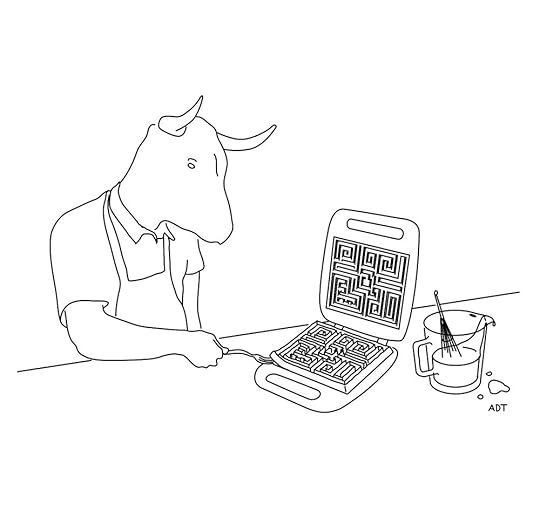
Adam Douglas Thompson
Image: Adam Douglas Thompson, The New Yorker

Here’s my advice and the three-word version of my review: read this book.

There are some excellent reviews already on Goodreads about The Minotaur Takes a Cigarette Break, and I don’t have an especially brilliant addition to those. What I would say, though, is that the book is worth reading because the writing is sublime. It’s at turns funny and tragic. It engages our empathy in a way that reminds us — however uncomfortably — that we, too, are instinct-driven animals lurking beneath the more refined parts of our neocortex; that we are somewhat freakish and terribly vulnerable; and that, frequently, we are wholly or partially inadequate in managing our lives and loves. It’s also viscerally disturbing in parts, as many reviewers have pointed out.

Side note on the visceral disturbances: There is a total of one sort-of-sex scene in this book. Crossing as it does the beast-human line, it could easily cause some readers to toss the book aside as grotesque and repellent. To be sure, the way the scene ends is distressing, but not for the reasons one might think — and I won’t explain that here because it’s the anti-climactic climax of the book. But the achingly tender good will with which the girl and the Minotaur approach each other, sadly fumbling towards love, was beautiful to me (and I assume to many others).

The reason I mention this is because sex scenes — and even sort-of-sex scenes — are notoriously difficult to write, even for very good writers, and it requires a great deal of generosity on the part of readers not to say, “Well, that was stupid-awful-unrealistic-boring…” It speaks highly of Sherrill’s sensibilities and skills as a writer that he handles even this delicate and difficult material with a deft touch. The semi-sex is messy, awkward, and unnatural; but the writing is none of those things.

Sherrill is an eloquent, reflective, and subtle writer who pays close attention to detail, and to whom the words chosen matter a great deal. He is trying to do more than just entertain us. He shows us a microcosm revealing some of the more harrowing, cruel, and disgusting aspects of humanity, while simultaneously (and there’s the hard bit) showing us that there is still the possibility of redemption — or at least momentary reprieve — through acts of kindness, compassion, and love. Readers may feel a whole slew of conflicting emotions both during and after reading Minotaur, and may come away from it thinking, “What did I just read?! Am I okay with that? Should I be okay with that? Does it matter either way?”

Sherrill’s romantic anti-hero, the Minotaur, is as clumsy in his expressions of love as he is in other aspects of life. In such passages as I’ve mentioned above, Sherrill’s prose sings with an emotional and sexual authenticity that I found riveting. One needn’t use a lot of words to achieve this kind of gutsy realness, but they have to be the right words at the right time. The words matter.

Part of the reason Sherrill can depict the agony and ecstasy of romance, love, and lust so well is that his Minotaur is not presented solely as an archetype. The Minotaur is an archetype, yes, but he is also a person and a complicated one at that. We believe in the Minotaur and want him to come out okay in the end, even as we struggle with some of the choices he makes — or fails to make — due to his crippling inability to cope with human situations in a fully human way. (Of course, many humans share this inadequacy, too, which is one of Sherrill’s points.)

Sherrill has tethered the Minotaur myth to a post of gritty reality to hold taut our suspension of disbelief. The book is replete with details of daily lives lived at the grubby end of the socio-economic spectrum: poorly paid but all-that’s-available work; grinding poverty; exhausting heat and squalor; the repetitive and tedious chores required to maintain one’s physical existence and bodily integrity; the force of will it takes to keep up decent relationships with neighbours, whose own lives seem as flimsy as the worn out trailers they live in. Still, it’s community. And there’s hope in that.

Some reviewers have described the book as slow, as plodding, or as dull; but I did not find it so. It is essential to the book that we feel the day-to-day reality of the Minotaur’s life. As Sherrill explains it, an old professor of his once taught him that “the more outlandish the premise is, the more grounded the other elements must be.”

I had not heard of Steven Sherrill or this book until I read some reviews on Goodreads, but as I read his biography at the end of the book, I was not surprised to learn that he is a poet. I had wondered, as I read The Minotaur, whether the poems in the book were his own. Turns out, they are. They are worth the price of the book on their own. But read the whole book, because of the words the words the words. How they are arranged on the pages.

Below, you can enjoy the original poem by Sherrill that inspired his book. Also, there is an Audible version of the book, read by Holter Graham and part of the Neil Gaiman Presents series of audiobooks, that might be worth hearing. I haven’t heard it myself, so I cannot say what it’s like.

The Minotaur Takes A Cigarette Break

Sorely needed because, for the umpteenth
time since landing a job as line-cook
at the Holiday Inn, those damn horns of his
have been a problem. It’s the pots
that hang overhead; he keeps punching
holes in them, Management is pissed.
The Minotaur sits on an empty pickle bucket
blowing smoke through bullish nostrils.
He lows. He laments. He can’t remember
whether the Stuffed Flounder gets béchamel
or hollandaise. Moreover, the heat chafes.
About that time he spies her coming
down the ally, that new waitress the whole
kitchen is talking about. He almost gives her
the once-over but can’t get past her breasts.
The Minotaur is a tit man. — I’m a tit man–
he mouths to the Fry Cook. — What’s that mean;
You’re a tit man? — they ask. The Minotaur
can’t answer. He sits indignant, a convicted
it man, picking at the dried gravy
stain on his apron. Feigning indifference
he nearly misses the miracle beneathing her,
this apparition in slinky black.
But as she hoofs her way up the back
steps he can’t help but notice those fine shanks.
And what offers them up is not the sensible pump,
is not the stiletto heel, is nothing less
than cloven. “Things are looking up,” he thinks.
Profile Image for Scott.
323 reviews401 followers
February 20, 2017
description

The Minotaur lives... in a rundown trailer home.

Five thousand years after his starring role in Greek mythology The Minotaur (yes, that Minotaur - the half-man half-bull from a labyrinth in Crete) is working cash-in-hand as a chef in a greasy Southern-US steakhouse where he is known simply as ‘M’. This is the setup for Steve Sherrill’s The Minotaur takes a Cigarette Break, and it is a wonderfully inventive beginning for a thoughtful novel that ranks among my personal favorite reads.

This is The Minotaur as he has never been imagined. The raging, flesh-eating horror that Theseus (allegedly) slew in the labyrinth has been tamed by experience and the hard slog of millennia. The slavering beast is gone, and the harsh mother that is five hundred decades has gestated a quiet and kind creature who seeks friendship and meaning in an endless existence.

And so, we find the Minotaur, with his beat up old car, living in a trailer in the Southern USA, working six to seven days a week in Grub's Rib, an establishment known for the alleged “50 items” in their salad bar. M works hard, overcoming the clumsiness inherent in his half-bull frame, trying to avoid catching his horns on anything, and generally trying to stay out of trouble.

Life as deathless bull-headed chef isn’t easy, and both the past and the endless future weigh heavily on M:

“The Minotaur is self-conscious about his breath. The Minotaur lacks confidence in his penmanship. Over time the Minotaur has learned to read, has even been able to make the slow laborious transition from one language to another as cultures die off and fade away and as he moves from place to place. But the Minotaur has never been able to rise above rudimentary skills. Most books seem ridiculously small, and the physical act of finding a comfortable sight line over his massive snout frustrates him. Nevertheless the Minotaur is haunted by the idea that books and reading might make those vast stretches of time that loom before him more bearable.”

The Minotaur is scarred by eternity, from a long life of moving from place to place for thousands of years, plying the always-in-demand trade of cooking, never really fitting in or being close to anyone. His bulls head, with its thick bovine tongue, makes communication challenging for M, and he is painfully self conscious, longing for closeness and friendship with others at the same time as he fears it.

This is a story of great pathos and gentleness, a delectable slow-burn of a story that is hypnotic in its rhythms and its blend of slow southern minimum wage life with M’s struggles, sadness and hopes. Sherrill will make you care for M, and he will make M’s hopes your own. By the end of the novel you’ll be cheering for The Minotaur to break out of his isolation, to make the connections he so deeply craves.

As you can probably tell, I really liked this book. The Minotaur takes a Cigarette Break is more than just a great story- it is also a story well told. In the hands of a lesser writer this book could have headed down a kinetic, thunderbolts and grand-conspiracy potboiler route. Under Sherrill’s careful touch this a beautiful story of being different, of friendship and trying to find a place in the world. I’ve given this book as a gift, and I’ve encouraged many others to read it. It’s real gem, a thoughtful, smart and memorable story that is like nothing else I have read. in short, it’s genuinely special, and I loved it.
Profile Image for Mary.
475 reviews945 followers
April 15, 2013
Problems arise when the monster is humanized.

Our gentle giant, of half-man half-bull configuration, lives quietly in a sun burnt, fly-swatting trailer park of the American south. He’s lived everywhere at least once. He’s watched us all evolve and devolve. He fixes cars. He carves beef. He yearns.

The story trickles like a stifling summer afternoon. From the squeaking vinyl seats in the car, the lack of ventillation in the trailer, the mini-golf and strawberry shakes on a balmy evening. I just simply loved reading this. I loved the crystal clear restaurant kitchen and trailer park yard and the way I seemed to feel almost as icky and bothered as the characters.

And though there were many lessons to take as the human part of M struggled with weaknesses much too human for the bull part of him to comprehend (like, why is acceptance so important to us? In the Minotaur's mind the allegiance of men is pathetic. Is terrifying. Is seductive. Is unattainable.), I was left to ponder just what level of inappropriate it was that by the final page I was really craving steak.
Profile Image for Bill.
308 reviews301 followers
February 21, 2011
this is yet another fabulous book that i found out about while browsing through goodreads. just based on the title alone i had to read it.as neither my local library or my local bookstore had it (what a surprise), i immediately got in my car and drove to a library that is one hour away from where i live, specifically to get this book. while i was there i took out 15 other books, but that's another story.

this book is 312 pages long and i lay on my couch and read the whole thing in one sitting. i didn't get up to eat or drink and i don't think i even went to the bathroom. that's how great i think it is.

first off, it's one of the best titles i've ever seen for a book. if that doesn't grab your attention, i don't know what will.as for the novel itself, amazingly enough, it is actually about a minotaur.just called M throughout the book, he has the body of a man and the head of a bull, and he works as a line chef in grub's diner.nothing surprising about that is there? or , that in his spare time, he fixes cars?what about the fact that he's 5000 years old and immortal? after all, warren zevon saw a werewolf drinking a pina colada at trader vic's,so none of the above should seem out of the ordinary, should they?


as well as his physical condition, he also can't talk very well, so these two attributes combined render him very shy and inarticulate. and his horns have a bad habit of sticking into things that they shouldn't. as a result, he is almost continually having to endure shit and abuse from the "normal" human population, just like anyone does who's different or shy in real life.i know this from personal experience.

this is quite simply a brilliant novel, exceptionally well written, especially for a debut novel.i'm not going to tell you anything more about the plot or how the book ends, you'll just have to read it for yourself. and i strongly recommend you do so.i hope the author writes many, many more books because i will read them all.
Profile Image for Mark.
180 reviews84 followers
November 11, 2012
I am the Minotaur.

In 1990, when this book is set, I was twelve-thirteen years old. I was just entering middle school. Sitting there amid the wide wooden bleachers where my folks had once sat during high school pep rallies (the school downshifted to a middle school the year after my folks graduated), I couldn't help but imagine what it would be like to know these people sitting around me, people I had already traveled with through six previous grades (counting kindergarten). Around me there was nervous chatter, who was going out for cheerleading, who was sure to be the quarterback for the junior varsity football team. It was nervous, yes; but it was assured. I sat and listened, and the only thing I could think was: Get me the hell out of here, grade school was hard enough. Oh, grade-wise, it was easy enough. So easy it was usually dull. But socially? No way.

While I contemplated these things, a mythic beast was traveling the American south, a long way from "home" (if home he had), and besides geographically, the only thing that separated us was a gulf of some four thousand nine-hundred eighty-seven years. Because emotionally, mentally, we were right there, occupying the same small quad of space reserved for the hopelessly awkward. Perhaps that's why we were all continually falling on our faces, all trying to occupy that same, small metaphysical space?

Having just finished Paul Murray's phenomenal Skippy Dies, I thought there would never be (or possibly far, far off) another character with whose awkwardness I felt so connected. But fate, with it's awkward, bovine eyes saw fit to share with me the wonderful, heart-wrenching story of the Minotaur. I would like to thank Madeleine for her beautiful review and recommendation of this novel.

I hesitate to mention anything about the plot that couldn't be gleaned from a quick perusal of The Minotaur's GoodReads page because part of the magic is, like living inside this awkward skin, never knowing what to expect. For those that found themselves sitting there among the bleachers, discussing nervously with their friends who was going out for cheerleading, and leaning back, tossing a band of well-brushed hair behind her shoulder, to ask the group of boys just behind her if they've decided yet who will be the quarterback, for those who were or sat among these people, be forewarned: you may not understand. It may not be in your capacity to experience or fathom the sense of awkwardity that has hounded the other side of life, almost since the day we were born.

But for those who understand the Minotaur's plight all too well, this will read like a secreted journal of your own life's reckoning.
Profile Image for Keith.
Author 10 books287 followers
February 5, 2009
This is the second book I've picked up at Barnes and Noble recently, read the first page and didn't immediately vomit blood. Then I came back to the store a second time, read more and still did not kill myself. I regard this as an overwhemingly ringing endorsement, and shocked myself by actually buying the thing. I mean, it has a trendy title and cute cover and everything! And it's written in the present tense!! What the fuck am I doing???

Goddamit, I will be eating buckets of my own ejaculate blended with a smooth puree of pages from McSweeney's in no time.

UPDATE.

So I finished it. I feel weird about really liking it, but I really liked it. I shouldn't have -- it's sort of slow and plotless and is basically equal parts Sling Blade, Edward Scissorhands, Powder, and whatever other ugly-freak-we-see-ourselves-in story you can think of. So really, it should have been no better than an overlong 80's movie, meaning that at its best you could have called it 'well-crafted' and been done with it before real praise got handed out.

However, for whatever reason, the book is good. Seriously, it has no real right to be. But it's frustratingly readable, frustrating soul-pokey. I actually feel...blech...effected by this book and I'm not quite sure why.

I will say that every time you think you know what the next sequence in the book is going to be like and you've worked out how that's going to narrow the focus of the story, you're wrong. And that's a clever trick. It may be enough that your brain has to work so hard to imagine the Minotaur amid the trailer-park mundanity that the book pushes you along despite itself.

But I take heart in the fact that this book has the shittiest, most ill-suited cover in the world. The appalling lack of good sense in this regard brings a sort of everyday realism that makes this otherwise ephemeral story more palatable, and if you see the unspoken metaphor I'm drawing here between the physical book and its main character, hooray! Snaps for you. Now go back to your McSweeney's -- I hear all six copies of their new Encyclopedia Craptannica multi-volume new issue have sold out, but they're going up on Ebay already so you better run.
Profile Image for Jeanette.
4,088 reviews837 followers
December 9, 2018
Oh I so enjoyed reading this book! For that aspect it was 5 stars. For all else 4.5 stars. The only reason I didn't give it the full 5 star perfection was that its base premise is a difficult cognition onus. Most readers won't connect with it to a full extent, IMHO. Yet I did nearly immediately. And the technical or mechanical skills descriptions which comprise such excellent precise action processes within this book will turn off many other prospective readers. Not only in their length but for their placements as the core of these depicted lives. Ideas and "theory" erudite prone readers- those of either literature, psychology, philosophy habit common fodder fare for first and primary and all "essential" considerations! This is the opposite copy. This is a tribute to the hands and the complex spacial skills. Supreme!

M is one of the most drawn and exquisite characters I have come across in years and years within all my reading. And he's male too. That's a surprise to me. A worthy and wonderful surprise that I could seem to "fit" him into this composite quite easily too.

Thank you to the GR friends whose reviews set this read up for me. It's one I would never, ever have ventured into by the trailers or descriptions. Thank YOU!

Telling you about this quirky book? M is the Minotaur from Greek mythology. Having just read the Miller book Circe- it couldn't have come at a better juncture, either.

He's many thousands of years old but works as a line chef in a North Carolina Southern USA Grub diner. He lives in a trailer park and fixes cars and other handy jobs as a second income. And he becomes smitten. If you liked "Last Night at the Red Lobster" - you will more likely be apt to enjoy this one. It's real world and everyday homo sapiens marvelous. From its bullying to its kindnesses to its bad days of kids never getting into the car. The ones all parents and most workers of every physical vocation know. Plus team worker and boss connections supreme. Cecie was a stitch.

What did I love the most? M's core of improvement from his beastly past. And his beauty and bath routine. And his junk yard search for a universal joint. And his accident answer mentality. All of him. Even his poor memory of not thinking about all those young virgins and handsome young men he ate in the labyrinths of stone- but leaving the "guilt" behind. And his ability to refrain from letting the taunts "get" to him.

This one makes my best of 5 for fiction category of 2018. Despite it not getting that 5th star.

Watch out for those horns!
Profile Image for David.
Author 20 books403 followers
January 15, 2016
This fourteen-year-old book was "discovered" by Neil Gaiman, and thanks to his project of putting underread books on Audible, it has become available to a wider audience, which is how I came across it.

A minotaur - not just a minotaur, but The Minotaur - is now working as a line cook at a steakhouse in the South. What is this nonsense? Is it some deeply metaphorical new take on the Theseus myth - Ovid by way of Faulkner? Is it Southern magical realism? Is it literary bizarro fiction?

Maybe it's a little of all those things, but mostly it's a story about the human heart (even if that heart is half bull's) and loneliness. The yearning for human contact. The way small moments can register large for the poor and working class who have little in the way of luxury, recreational time, wide circles of associates, and opportunities to go on fun-filled vacations. They live in trailer parks, they work paycheck to paycheck, they make bad choices in life and love, often because their menu of choices is pretty damn limited, and so a little thing like a hand placed over yours can take on Homeric significance, and an investment in a corn dog trailer can represent the sailing of the Argo.

Okay, I am probably stretching my metaphors a little too far there.

The Minotaur (he has no other name, though his friends and coworkers call him "M") has wandered the Earth for five thousand years. This isn't your typical fantasy story about an immortal, mythological being, though - he's simply existed, in all that time, and acquired no great wealth or power or mad skills. If he's met any famous people since Theseus, it's not mentioned. And the "magical realism" is in the way his existence is simply accepted. People react to his bull-headed appearance, but only the way they might react to any unusual, freakish person - no one ever says "Oh my God, that guy has a bull's head!" or "Whoa, it's a minotaur!" They just tell him to watch the horns (after five thousand years he still seems to have trouble maneuvering around spaces built for human heads) or, if they are of a mean and taunting disposition, moo at him while he's on a miniature golf date.

So, this story is about a minotaur (The Minotaur) who's settled, for the moment, in the South, living in a trailer park and working at a steakhouse. He is handy with engines and knives. And he's lonely. He's had lovers before, and he remembers, very dimly, the days when he dined once every seven years on virgin youths. But that ancient, immortal capacity for rage and evil is like an old Greek ruin, still visible, maybe possible to excavate if an archeologist were so inclined, but to all appearances it is a dead and ancient thing seen now only in outline.


The architecture of the Minotaur’s heart is ancient. Rough hewn and many chambered, his heart is a plodding laborious thing, built for churning through the millennia. But the blood it pumps – the blood it has pumped for five thousand years, the blood it will pump for the rest of his life – is nearly human blood. It carries with it, through his monster’s veins, the weighty, necessary, terrible stuff of human existence: fear, wonder, hope, wickedness, love. But in the Minotaur’s world it is far easier to kill and devour seven virgins year after year, their rattling bones rising at his feet like a sea of cracked ice, than to accept tenderness and return it.


The Minotaur has a bit of a crush on a waitress named Kelly. He wants a relationship, obviously, but does not know how to initiate one. (After five thousand years, this bull still has got no Game.) But things do indeed proceed towards the inevitable- well, you know you were wondering this, right? Is minotaur sex bestiality? It's actually, while certainly not the tenderest part of the book (in fact, things don't really go well), neither gratuitous nor lurid.

It remains hard to describe this book, because it really is just a bit of close-up human drama, with a main character you will find it easy to root for, so earnest and ancient and sad is he. Who'd have thought someone could write a Southern literary novel about a minotaur who just needs a hug? So read this for the excellent writing and the characterization (and I should note that part of the characterization is of the food the minotaur prepares and serves — seriously, you will be able to smell the onions and have a hankering for a nice juicy steak, which is kind of ironic considering who/what the protagonist is...). But be aware there isn't a big plot here — it's a slow story about a guy with horns. Don't expect Heracles to show up for a climactic wrestling match. You might spot a few other mythological figures here and there (blink and you'll miss them), but this is not an adult Percy Jackson novel.

I also have to say that having listened to this as an audiobook, I never thought you could put so much expressiveness into a grunt — grunts making up about 90% of the Minotaur's dialog. 4 stars for the story, but 5 stars for the narration — I suspect you might actually be missing out if you read it in print.
Profile Image for rachel.
831 reviews173 followers
March 5, 2015
Recommended to me by those wizards of random good taste over at Metafilter, this is another book that has scant ratings/reviews and which I think everyone should read anyway. It's weird and kind of ugly in parts. The main character is M, the Minotaur, living in the present day American South in a trailer park, working as a line cook at a steakhouse and falling in love with his co-worker Kelly, a new waitress. He spends his free time fixing cars and doing odd jobs for the owner of the park complex. As expected, some people are nice and acclimated to him (for the most part without really being his friend) and some are...not.

Along the way, the Minotaur has frequent flashbacks to his life in the labyrinth, which are ecstatically written and juxtaposed with his current life of endless loneliness. I typed up some of these passages so that I would remember them, but of course can't find them now to quote as PROOF that you should read this. You will have to take my word for it.

Perhaps the thing I liked best about this book is the way the Minotaur is always realistically shown for what he is: part man, mostly bull, a mythological monster. He speaks mostly in grunts and later, in the name of his love, Kelly. His ability to form words is clumsy. His body is top heavy thanks to his bull head and horns. The (relatively graphic, if I recall correctly) sex scene later on in the book is honestly off-putting -- although M is a very sympathetic character -- because of sheer biology. But the book doesn't shy away from that; it forces us to confront the grotesque even in great sympathy to challenge our ideas about what and how we choose to alienate.

And again, the writing is impeccable. Just sayin'. I don't know who Stephen Sherrill is and the ratings of his other two, more recent efforts aren't very good, but a Google search shows me he teaches at a Penn State campus only 4 hours away. Teach me to write just like this book, please?
Profile Image for Kaila.
927 reviews116 followers
April 17, 2020
Nothing happened and there was a lot of gross sex talk. It is full of paragraphs of useless details.

The Minotaur takes a couple heads of cabbage from the cooler, makes quick work of shredding them. In a wide stainless-steel bowl he dresses the slaw copiously with mayonnaise, then with cider vinegar to cut the heavy mayonnaise, then a palm full of sugar to counter the vinegar. The Minotaur finishes the slaw with salt, pepper, some dried scallions and a can of stewed tomatoes drained and chopped. Stirred in, the bits of tomato tend to rise to the top, like vibrant little hearts swimming in the viscous dressing. Hernando agrees that they may as well fry up some shrimp for the employee meal.
That level of detail could almost be charming if accompanied with some poignant melancholy thoughts on life as an immortal being. But instead, the Minotaur is bogged down in details - and descriptions of tits - for the entire book. I wanted it to mean something about the loneliness of modern life. Instead I'm just vaguely disgusted.
Profile Image for mark….
102 reviews32 followers
September 9, 2021
Another already-read discovery. Found several this year, I just mark them as I find them. This was a quirky but good read. A favorite of Food Network’s Alton Brown btw… mark
Profile Image for Suzanne.
499 reviews292 followers
February 15, 2015
The Minotaur has some trouble seeing at certain angles because of his very broad nose, is always catching his horns on things, and communicates mostly in grunts. But he manages to hold down a job as a cook at a popular neighborhood steakhouse in North Carolina and gets along well with his co-workers (most of them anyway). In his spare time, he works on old cars at the trailer park where he lives.

Steve Sherrill has created a sweet relatable monster, alien and alienated, out of place and out of time, and so achingly lonely. How he ended up in the American South is never explained, nor is how he came to be so diminished from the being that used to eat seven virgins for breakfast. In spite of his creature-status, 5,000 years of living, with all its travails, has left M surprisingly passive. His extreme vulnerability, his imagining himself in others’ cozy domestic scenes, his reaction to the touch of a girl he likes, his self-consciousness, made me feel protective and apprehensive about his ability to defend himself when he needs to. I worried about him.

M drifts along in life, rarely evincing a need to try to control or steer his own fate. And yet . . .

“Out of necessity there is a resigned quality to the Minotaur’s life, but resignation is not without a degree of hope, maybe even faith. For as long as the Minotaur can remember – no, for much longer than he can remember – he has risen every day aware of the possibility of change. Some would call him gullible. The truth is, there are days on end when he would gladly barter some of his hope for the arrogant cynicism of people like Shane and Mike."

It’s hope that gets him into trouble in the end. And the end of the book left me feeling ambivalent. Even having accepted M’s social ineptitude and total cluelessness about many things, the Minotaur’s behavior toward another character was appalling enough to leave me with many questions. His reasons become clear, but do they make his behavior excusable? It is ambiguous. So too is the final lack of clarity about whether his plans are fruitful or whether they backfire. Does he get his heart’s desire, or is his semi-human nature always going to trip him up? And are my expectations and standards for him reasonable, given his nature?

In spite of the discomfort of the ending, I enjoyed the book very much. The writing is really wonderful, although there is a little too much car repair talk for my taste. But overall, a great reading experience. Light, but not light-weight.
Profile Image for Jan Rice.
585 reviews517 followers
September 20, 2017
I guess I read this in the early aughts; the paperback edition came out in 2002. I had lent it, which I then proceeded to forget, which meant I spent some time looking for it when some friends were discussing on Goodreads. Then it was returned. Although I have no (real) urge to reread it, I have had to keep it a year or two since getting it back. Yesterday, finally, out it went to the Little Free Library.

I still have some memories of it, which is a plus, but don't remember its being revelatory, galvanizing or, really, satisfying. So changing that four I'd given it whenever we discussed it to a three (although admittedly I read it a long time ago and could have felt different about it later).

There's a sequel! I remember seeing that.
Profile Image for Amanda M. Lyons.
Author 58 books158 followers
May 23, 2010
M is the minotaur of legend 5000 years down the road and largely diminished from the mythical being he was before this all began. Now he lives in a trailer park meting out a less than involved existence as a cook in a local rib restaurant and struggling to socialize on even the smallest scale. It is this inability to cope with the modern world and it's social mores that often comes to frustrate and confuse him.


I wanted to find out this was a great book. It certainly had a charmingly eccentric title and the writing was technically good but in the end there isn't much I can say about this book that makes it worthy of reading.


Had it made any major revelations as it played out I could have appreciated this book more but it felt very much as if the author had taken the dullest least involved parts of the book and made them into a novel independent of the major plot moments that make a story worth reading.


Don't get me wrong I appreciated the writer's style but in many ways the plot never went anywhere (in fact the most exciting point happened in the last 15-20 pages at which point M has become a somewhat less than likable character) and tended toward detailing the mundane and real aspects of life. I often hear readers saying that books aren't realistic well if you think that's what you want in a story you may want to try this one. I'm sure it will cure you of that illusion.


Profile Image for Deb Jones.
805 reviews106 followers
March 22, 2019
I've always had an affinity for the underdog or those on the margins of society, so I found The Minotaur Takes a Cigarette Break to be an emotional journey. Written in everyday prose, the reader experiences first the downhill slide of the Minotaur's life, then the more positive aspects of his life as he becomes open to the possibilities.
Profile Image for Christopher.
Author 1 book60 followers
May 6, 2013
(Edited to repair a glaring omission!)

(This turned out to be the longest review I've written and for a 4 star book!)

Let me state that td has written the penultimate review of this fine book and I won’t dare to compete with her depth of comprehension (her review was the whole reason I even purchased the book). So, I thought I’d take a slightly different tack in this and try to understand who and what the Minotaur is (he does have a name, by the way). However, let me preface my own meanderings here with a couple notes:

First, the “sex scene” is not really a sex scene. There are a handful of other “scenes” within the book that sensitive readers could somehow find arguably more offensive so don’t let the rumor of bestiality turn you away.

Second, Sherrill is NOT Gaiman (again, see td’s review).

Now, to begin, the Minotaur is not a metaphor. He is not symbolic of the human condition. He is not even an anthropomorphization. He is an actual flesh and blood immortal living in a trailer park in North Carolina. And it is barely out of the normal. The sooner you accept this, the sooner you will start enjoying the book. However, in his 5,000 years, he’s obviously begun a process of devolution in which the powerful qualities of the flesh-eating terror we all knew and loved have been worn down and diminished before the weak though relentlessly steady aspects of his humanity. Yes, I groan to say it because it sounds so corny but in most ways he has become just as (if not more) human than modern man. We are all the lesser when we lose our monsters:

“There was a time when the Minotaur and his ilk were important, creating and destroying worlds and the lives of mortals at every turn. No more. Now, most of the time, it is all the Minotaur can do to meet the day to day responsibilities of his own small world. Some days he can passively witness the things that go on around him. Other days he can’t stomach any of it…”

Yet, biology attests that his old ways are not so easy to ignore or forget:

“The architecture of the Minotaur’s heart is ancient. Rough hewn and many chambered, his heart is a plodding laborious thing, built for churning through the millennia. But the blood it pumps – the blood it has pumped for five thousand years, the blood it will pump for the rest of his life – is nearly human blood. It carries with it, through his monster’s veins, the weighty, necessary, terrible stuff of human existence: fear, wonder, hope, wickedness, love. But in the Minotaur’s world it is far easier to kill and devour seven virgins year after year, their rattling bones rising at his feet like a sea of cracked ice, than to accept tenderness and return it.”

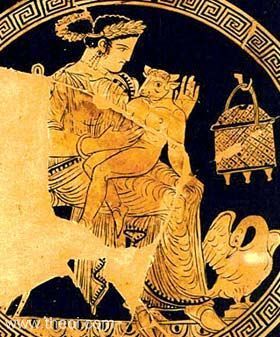
Perhaps a short biographical note and a cute picture of the Minotaur as a bouncing baby on mommy’s knee will help overcome any obstacles.


According to Apollodorus in his Library of Greek Mythology:

…Minos wished to reign over Crete, but his claim was opposed. So he alleged that he had received the kingdom from the gods, and in proof of it he said that whatever he prayed for would be done. And in sacrificing to Poseidon he prayed that a bull might appear from the depths, promising to sacrifice it when it appeared. Poseidon did send him up a fine bull, and Minos obtained the kingdom, but he sent the bull to the herds and sacrificed another. Being the first to obtain the dominion of the sea, he extended his rule over almost all the islands.

But angry at him for not sacrificing the bull, Poseidon made the animal savage, and contrived that Pasiphae should conceive a passion for it. In her love for the bull she found an accomplice in Daedalus, an architect, who had been banished from Athens for murder. He constructed a wooden cow on wheels, took it, hollowed it out in the inside, sewed it up in the hide of a cow which he had skinned, and set it in the meadow in which the bull used to graze. Then he introduced Pasiphae into it; and the bull came and coupled with it, as if it were a real cow. And she gave birth to Asterius, who was called the Minotaur. He had the face of a bull, but the rest of him was human; and Minos, in compliance with certain oracles, shut him up and guarded him in the Labyrinth. Now the Labyrinth which Daedalus constructed was a chamber “that with its tangled windings perplexed the outward way…”


If you are a member of Goodreads (and it appears you are), you are probably fairly well read and already know what happens after that. However, it’s obvious that the original mythology is slightly incorrect because the Minotaur is still alive lo these many years later, despite rumor of having been slain by Theseus. [Edited] Sherrill, unfortunately, never gets around to explaining what the real story was except that the Minotaur is simply immortal Sherrill does explain how the Minotaur was spared from Theseus' club in a bit of poetry in the Prologue though his immortality remains unexplained (like the several other Greek contemporaries of his that make cameo appearances such as Medusa and Hermaphroditus; Sherrill does neglect to explain how the American South came to be the coincidental gathering spot of these characters but it doesn’t detract from the story of our hero). So being immortal, he doesn’t fear death, but he is still afraid:

“…not of death, obviously, but of something else. Ridicule. Embarrassment. Humiliation. Misunderstanding. Injustice. His own potential for tiny rages. Maybe that most of all. All these things can seem, in the moment, worse than dying, particularly if death isn’t an option.”

And exactly like the Labyrinth in which the Minotaur was first placed, Sherrill leads the story through a wandering path where excitement is rare but it is genuine and sudden and takes the reader to an unavoidable destination. Throughout the tale, despite his thousands of years of experience, the Minotaur is constantly puzzled by human behavior; by man’s ability to avoid the important questions, by his ability to treat others with such impervious cruelty, and yet still have the ability to treat things not human with so much emotion, something that he finds “...baffling, enviable, and tinged with hope.”

The book is not slow or grinding in the least. The work runs at its own pace for a very good reason: It is beautifully written. It is a true credit to Sherrill that he can create such excellent dialogue from a creature who’s curling lips, bovine teeth, and thick tongue limit most of his linguistics to glottal Unnng’s and Ummhm’s.

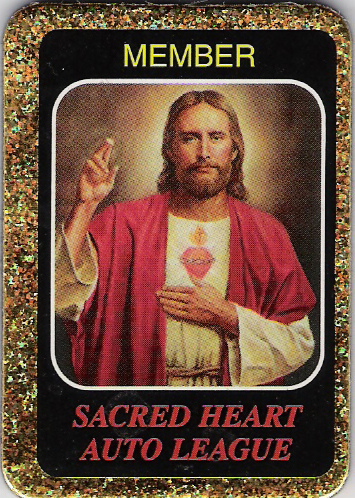
Something that gave me a nice surprise chuckle was the Minotaur’s enrollment in the Sacred Heart Auto Club. Yes, it’s a real organization (actually called the Sacred Heart Auto League) and it’s still around today. As someone interested in all things Catholic, I’d already known about it but I can’t say I’ve ever known anyone else that did. What good southern novel doesn’t contain at least one Catholic element in it even if it’s for comic relief?


Perhaps I’m being picky, but the single flaw I find in Sherrill’s work here is what prevents me from giving the book the full five stars I want to give it: his departure from the literary form from which he drew his title character, and it shows especially in the final paragraph of the book:

“There are few things that he knows, these among them: that it is inevitable, even necessary, for a creature half man and half bull to walk the face of the earth; that in the numbing span of eternity even the most monstrous among us needs love; that the minutiae of life sometimes defer to folly; that even in the most tedious unending life there comes, occasionally, hope. One simply has to wait and be ready.”

To me, Sherrill has made of the Minotaur a fable. A tale with a moral. There’s nothing wrong with that, and some reviewers (including td) really latch onto it. However, the tale of the Minotaur stems from mythology, a world in which the inhabitants are in no way in control of their own fate but instead at the will of capricious and whimsical gods and goddesses. I’d have rather not had an explanation given to me. To have that at the end of an otherwise fantastic story was a minor disappointment.

Since I intend to stay true to my vow of not giving out 5 star reviews willy-nilly anymore, 4.4999… stars.
Profile Image for Astrid Inge.
345 reviews3 followers
July 9, 2025
5000 jaar geleden was de Minotaur ('M' in dit boek) opgesloten in het labyrint en gedood door Theseus. In dit verhaal leeft hij nog gewoon en woont en werkt hij in de VS.
Het leven als half stier, half mens valt niet mee. Door zijn hoorns is M topzwaar en praten is moeilijk voor hem. M is eenzaam en heeft behoefte aan wezenlijk contact en aanraking.
Dit verhaal is geen literair hoogstandje maar wel heel origineel en leuk om te lezen. M is aandoenlijk onbeholpen en ik heb een grote zwak voor hem.
Profile Image for Katy.
1,293 reviews307 followers
October 9, 2012
Please note: This review was written in 2007, so please don't judge by my current format.

Disclosure: I picked this up on a whim with a gift certificate I had. I owe no one anything, but like to provide an honest review.

My Synopsis: This was a most intriguing book - I would go so far as to say it could easily become a classic of modern surreal literature. The Minotaur survives to this day, where he is a cook in a restaurant somewhere in North Carolina. Other immortals live and work among the mortals, such as Laurel, who is met during a trip to Florida taken by M and his landlord Sweeney. Interestingly, it seems that while people are occasionally taken aback by the Minotaur's appearance, no one seems terribly surprised by his presence.

My thoughts: I felt that, to me, this work spoke to the fact that there is within all of us a little bit of the freak that causes us to feel outcast and alone; this allows us to empathize with M. He lives very much in the "now" and has tended to forget much of his past and this is shown - among other ways - by the use of present tense in the narrative. M's search for love and acceptance is heart-breaking and heart-warming at the same time.

Definitely an interesting bit of literature for anyone who is looking to broaden their horizons a bit.
Profile Image for TheGirlBytheSeaofCortez.
170 reviews
September 29, 2009
One sleepless night almost a year ago, I decided a comic novel would be just the medicine I needed. Something light and funny, I thought, would take my mind off the end-of-winter blahs and put me in a better frame of mind. Steven Sherrill’s The Minotaur Takes a Cigarette Break seemed the perfect thing, but was I ever in for a huge surprise.

I expected The Minotaur Takes a Cigarette Break to be sort of a campy comedic book, a romp, something to make me laugh, and it does have its laugh-out-loud moments. However, The Minotaur Takes a Cigarette Break is far more bittersweet, dark and tenderly moving than I ever expected. By the time I finished reading, I wasn’t smiling; I had tears in my eyes.

The Minotaur Takes a Cigarette Break is a little gem of a book, a quiet, understated masterpiece that hasn’t received the attention it deserves because, I think, it isn’t a “big book.”

The Minotaur of the title is the Minotaur of legend, that half-bull, half-man who was banished to a labyrinth built by Daedalus on the Greek island of Crete. The son of King Minos’ wife, Pasiphae and an ivory bull given to her by Poseidon, most of us thought the Minotaur had been done in by Theseus, but Sherrill lets us know this “ain’t necessarily so.”

The Minotaur is alive, if not totally well, and he’s living in North Carolina. Living in North Carolina, working as a line cook at a steakhouse known as Grub’s Ribs and living in a boat shaped trailer in the Lucky-U Mobile Estates. This book covers a two-week period in his never-ending life.

Lest you have any doubt, the Minotaur has changed quite a bit during his 5000-year sojourn on Earth. He no longer devours virgins and he’s no longer someone (something) to be feared. Instead, the Minotaur has become a rather regular guy, who, like the rest of us, is just taking it day by weary day, trying to get by. He doesn’t have a lot; his television has a coat hanger for an aerial and the Minotaur has even taught himself to sew so he can alter the necklines of the shirts he buys to fit his “bullish” head. Now known only as “M,” the Minotaur drives a 1975 Chevy hatchback and he works the three to midnight shift, something that suits him just fine because cooking is one of the few joys in his lonely, isolated world.

Life isn’t easy for M. I mean, come on, how would you feel if you had to go through life with the body of a human and the head of a bull, complete with horns? Surprisingly, M is accepted by most of the inhabitants of his little corner of the world, for who he is and what he is. As the book opens, M is taking one of his many cigarette breaks, in back of Grub’s:

The Minotaur sits on an empty pickle bucket blowing smoke through bullish nostrils. He sits near the dumpster on the dock of the kitchen at Grub’s Ribs smoking and watching JoeJoe, the dishwasher dance on the thin strip of crumbling asphalt that begins three steps down at the base of the dock…The Minotaur doesn’t like to smoke but smokes anyway, smokes menthols because he likes them even less….

The Minotaur, you see, is just an ordinary guy, trying to fit into a very ordinary world. And, for the most part, he does. He smokes because he thinks it will make him more “normal,” more accepted by those around him. Most of the people around Grub’s and the Lucky-U pay little attention to the Minotaur. Perhaps they recognize something of themselves in him. After all, we’re all a bit of a misfit, at least in some ways, we’re all misunderstood, at least on some level, and we all feel, at times, as though we’re a bit of a “freak,” just like the Minotaur.

M doesn’t interact with the other characters in the novel too often. After all, when it comes to social skills, he’s really pretty inept. He lives his life quietly, loving, not only cooking, but also, tinkering. Tinkering with cars, with clocks, with his clothes, with his “transitional skin” where his bullish head joins his human body. And at times, the past does come calling and he gets a hankering or two for one of those virgins of yore. M has had lovers, lovers who’ve “run the gamut in species, gender and degree of consent and reciprocity.” He’s come to be very open-minded where sexuality is concerned.

The Minotaur may be open minded, but finding love, or even a lover, isn’t as easy as it used to be…at least for M. However, when Grub hires a new waitress named Kelly, who feels as though she’s something of a misfit, herself, M sees possibilities. Oh, not possibilities of ensnaring another victim; those days are over, but the prospect of really finding, for the first time in his life, something that resembles true love.

Although one might expect a book featuring the Minotaur of legend as a metaphor for existential human “aloneness” to be “gimmicky” and a bit ponderous, quite the opposite is true. Sherrill has done such a marvelous job in bringing the Minotaur to life and in endowing him with very human qualities. We come to see him as “one of us”, as just another guy, trying to fit in. M is really “Everyman,” and that’s one of the reasons we find it so easy to identify with him:

This is a slow paced book, one that is almost without plot, one that chooses instead, to explore the universal themes of loneliness and alienation, yet it remains surprisingly light on its feet. Sherrill achieves story tension, not through manipulation of plot, but through manipulation of pace. And even though the book is, much of time, dark and bittersweet, Sherrill hasn’t forgotten how to be playful. If you’re a careful reader, you’ll find other mythical gods in this book. There’s Pan, stuck in a scrapyard; there’s Medusa; the wood nymph, Daphne can be glimpsed at the till of a Georgia truck stop; there’s even a nod of parody to Antigone.

Although Sherrill never lets his story slip into sentimentality, he’s managed to create a Minotaur who is, perhaps, more human than humans. We really care about this guy; he really works his way into our heart. We want the best for him, but like M, we feel more resigned to his fate than optimistic, for woven throughout the narrative of The Minotaur Takes a Cigarette Break are passages that let us know something about the dreadful burden of immortality. The Minotaur has seen it all before and he’s going to see it all again. And again. And again. And again:

The Minotaur Takes a Cigarette Break is a book that does a marvelous job of combining the mythic with the mundane, much in the way Big Fish and The Watermelon King do. It is, however, easier to understand and more human than Big Fish, or at least it was to me.

None of us, I’m pretty sure, have the head of a bull and the body of a human, but we all struggle with our limitations; we all sometimes feel like a misfit; we all do our best to get from day to day. As the Minotaur puts it:

There are few things that he knows, these among them: that it is inevitable, even necessary, for a creature half man and half bull to walk the face of the earth; that in the numbing span of eternity even the monstrous among us needs love; that the minutiae of life sometimes defer to folly; that even in the most tedious unending life there comes, occasionally, hope. One simply has to wait and be ready..

If only it were that simple. For M, and for us.
Profile Image for Amanda Brookfield.
Author 34 books103 followers
March 1, 2019
One of the reasons I distrust the algorithmic nature of our virtual world - "You enjoyed that book, so maybe you will enjoy this one?" - is that, if we are not careful, our tastes are funnelled down ever narrowing pathways instead of being opened up to the expansion and experience of new flavours. That luxury of serendipitous encounters, the potential pleasure of being jolted out of our comfort zones is far more likely to flourish if we keep the door open to more random recommendations. So no, it was not a screen pop-up that drew my attention to Steven Sherrill's extraordinary debut novel, 'The Minotaur takes a Cigarette Break', but a recent acquaintance - a real, live, human being, with discerning, but completely different tastes to mine. On top of which there was the pull of the title. I mean, THE MINOTAUR TAKES A CIGARETTE BREAK...? How could one not give it a go?

I had expected metaphor, but I could not have been more wrong. The Minotaur in Sherrill's book is the real deal - classical half-beast half-man, alive on the planet for some five thousand years, and spending his days fixing up cars and working as a line chef at Grub's Rib in North Carolina. The incongruity is delicious. Best of all, the Minotaur, while trying to take care of the needs of his curious body - oiling his horns, scrubbing at his thick fur - is also trying to be a good worker, to do no inadvertent damage with his muscle and bulk; in fact the main quest of this once mighty, fear-inducing beast, is to pass through the world without causing ripples, to keep his past exploits deeply buried and his animal instincts safely tethered.

If this sounds crazy, then I can assure you it doesn't read that way. Instead, Sherrill skilfully draws us into every physical detail of the Minotaur's daily life and its practical challenges, opening up our sympathies as this fallen demi-god struggles to manage delicate tasks, to do no harm with his formidable inbuilt weaponry, and above all, to be accepted. The Minotaur may have 'beastly' instincts - lust and the desire to do violence lurk, ever-present; but he strains every sinew to curb such impulses rather than release them. He knows his glory days are over. The world is 'civilised' and he longs only to fit in.

The irony of course, threaded through the narrative with mounting menace and poignancy, is that the human world is not civil. Apart from a few stand-out souls - the Minotaur's boss and a couple of co-workers - who treat him decently, taking him for what he is, deploying his talents and his willingness to work hard, the majority of folk have crueller, more twisted hearts. Sherrill works this tension beautifully as his story builds, intensifying the strain on the Minotaur until it seems that loss of his hard-fought control and the release of his inner brute depravity are inevitable.

Chief among the surprises of this novel is the way our sympathies are stoked for so unlikely a protagonist. Sherrill is masterful in this regard. The more the Minotaur's world threatens to implode, the more we want him to remain safe, to excel, to be allowed to be his best self. We also, increasingly, want him to find companionship and love - some consolation for the loneliness of five thousand years of being an immortal among mortals. There are in fact no shortage of women who desire the Minotaur. Men too. He embodies brawn on an epic scale, a sense of locked power which the animal in every human wants to unleash. But will that unleashing be his undoing?

The answer to such questions shimmers out of reach until the final pages. Barring one late minor plot contrivance, the wait is rewarded with the most uncompromising and satisfying of endings. So take a cigarette break with the Minotaur. No love of smoking required. You may be astonished at how much you enjoy it. -
Profile Image for Peter.
736 reviews113 followers
October 22, 2023
“The architecture of the Minotaur’s heart is ancient. Rough hewn and many chambered, his heart is a plodding laborious thing, built for churning through the millennia. But the blood it pumps—the blood it has pumped for five thousand years, the blood it will pump for the rest of his life—is nearly human blood. It carries with it, through his monster’s veins, the weighty, necessary, terrible stuff of human existence: fear, wonder, hope, wickedness, love. But in the Minotaur’s world it is far easier to kill and devour seven virgins year after year, their rattling bones rising at his feet like a sea of cracked ice, than to accept tenderness and return it.”

Five thousand years on from apparently being killed by Theseus the Minotaur or M as he is known by his colleagues has escaped the labyrinth and is now working as a line chef in North Carolina. M leads an ordered lifestyle in a shabby trailer park, keeping to himself , keeping his horns down and simply trying to fit in in this new town.

Virtually all the characters in this book are regular, everyday, hard working, lower-middle-class human characters struggling to bring in a regular pay check, people are fired and new ones hired, some are cruel some are kind, some get injured at work, some move homes but all are simply trying to keep a roof over their heads and make a life for themselves. M is no different.

M is the proverbial elephant in the kitchen. He is the person people try to talk down to or ignore, the guy whom the bullies like to try and poke fun at and belittle. But despite his unfortunate deformity he pays his rent, fixes cars on the side and helps out his colleagues and neighbours. Whatever his past, he is now part of the great human herd trying to survive. He isn't going to die but he's got to make a living. M is a team player, who is good at what he does but different nonetheless.

Home is little better, an under-furnished trailer shaped like a boat. Most of the time, it is all the Minotaur can do to meet the day-to-day responsibilities of his own small world. Though a hybrid, M feels with the emotions of a man. He has needs and longings but his deformity makes them almost impossible to meet. He suffers in near silence, unable to escape and compelled to live on. His bargain with Theseus was no bargain. He endures and we are sad for him.

'The Minotaur Takes A Cigarette Break' is well written. The first half of the book is rather slow, mundane and nothing really happens but the second half kicks into gear; we know that M's life is about to change but whether or not its going to be for the better is kept under wraps. There are some funny scenes and there some sad scenes, it speaks of a world that seems unchanging from the outside but as human beings we know that that is never really the case. Sherrill doesn't try to give the reader any glib answers or pass judgments but gives us a new way to think about what it means to live within visible limitations. M has neither freedom nor hell but a limbo that stretches in time without end.

This book is about what it means to be human and the use of a Minotaur in this way is an interesting device and really wasn't what I was initially expecting. If you want a fast paced plot then this really isn't for you but if you prefer your action slower and more considered then it's worth giving this novel a go.
Profile Image for John Wiswell.
Author 68 books1,012 followers
April 9, 2014
In a very rough emotional patch of my year, this novel calmed me down. You can’t underrate such a gift from fiction. The Minotaur Takes a Cigarette Break is at first a Magical Realist tale of the Minotaur living as a short-order cook in a trailer park, a mythical being seamlessly blending in with rednecks. He’s got a crush on Kelly, a co-worker, and struggles to fit in with his hornier and more rambunctious neighbors. The immediate grip is figuring out how this world works: why a Southern dead-end town with no other fantastic elements seems to entirely take his existence in stride, so much so that his biggest problems are existential ones rather than a mob with pitchforks.

That’s what drew me in. It’s almost a sweet story, with the greatest cruelty being co-workers getting the Minotaur to admit he’s a “tit man” just as a woman walks into the back. And that’s a joke, if a hurtful one. The emphasis then is on his psychology, deftly skipping how the heck he left his Labyrinth and instead came to live in the U.S. five thousand years later. There’s a beautiful chapter on him lying on his bed, tracing the scars that separate where his bestial and human parts merge. He’s not as intelligent as he wants to be, not even with thousands of years of experience, and has such trouble with speech that he often communicates through grunting. And no one minds. The trailer park has adapted to him as easily as to a guy with glasses.

Sherrill here has accomplished some of the most evocative food writing I’ve ever read. Part of this is that he’s writing what I’m familiar with, as the Minotaur cooks crepes from a specific thickness of batter and to a specific shade of color, and every time Sherrill catches a familiar smell or visual cue of diner food. And yet it’s also that he’s so tactile about it, and makes it such a part of the Minotaur’s routine that we feel how little must be in his life. It’s comforting and disquieting at the same time.

Eventually we get glimpses of other fantastic elements. Driving home, the Minotaur witnesses something gigantic fleeing the scene of a hog murder, and yet that’s dropped immediately; he has no keener sense of what it is than you do when you pass an oddity on the highway. There’s the desire for it to sprout into a plot, but this is too much of a Literary novel for that. It’s too calm, too introspective even to have him meet another great monster on a back road.

Instead what the Minotaur seeks is the impulsiveness in others, particularly Kelly, in what feels like a trope of LitFic. We’ve had ample male authors who use a female love interest as a crucible, as a reflection for what a man lacks and what he wishes to achieve. In a Genre book, it’s almost funny to read it so plainly exposed, and the novel is as sincere about the Minotaur’s fascination as Thomas Mann was in Death in Venice (though that was a boy rather than a grown woman). What sets it apart isn’t Genre convention, but that Sherrill writes Kelly as a somewhat quirky and rounded human being rather than as a design to be conquered.

If it’d gone another fifty pages I would have gotten disenchanted with the listlessness and angst of the Minotaur, but at this length, it’s just right. It’s his impossible existence among people that the New York literary establishment try to pretend don’t exist. Life among the myths.
Profile Image for Emily .
950 reviews107 followers
February 4, 2020
Hated it. I would have quit that book early on except it was a buddy read with a friend (who also didn't like it but read through to the end). The book is super boring. There is no plot. Nothing really happens. Just tons and tons of boring details. I have no idea why this book has a bunch of 5 star reviews.
Profile Image for Lynn.
1,608 reviews55 followers
September 30, 2014
Life can be lonely and difficult for everyone at times, just think if you couldn't see what was right in front of you, if people thought you were a freak, and you ran into the same dead-ends.....but for eternity. The title got me to look at this book....I'm so glad!
Profile Image for Alex George.
191 reviews4 followers
June 18, 2020
Go on then this can have 5 stars!

Magnificent. A pretty damn incredible slab of realism presented through the most surrealist lens imaginable. Great characters, so much amazing, unique detail in every chapter. Works like a really beautiful collection of little stories as well as an expertly crafted whole, slowburn narrative that all BLOWS UP perfectly. Fackin CHILLS in the final run-in!!

Big Steinbeck vibes, in terms of story structure, stunning prose style, and its grounding in American working class reality. God I love North Carolina lmao

That's our main course and its scrummy asf. But for sides we also got some peng explorations into 'Why Straight Men Be Like That?' as well as some GORGEOUS hospitality staff dynamics, makin me all nostalgic for White Cross God shit damn.

Inject it into the veins!!!!!!!
Displaying 1 - 30 of 734 reviews

Can't find what you're looking for?

Get help and learn more about the design.