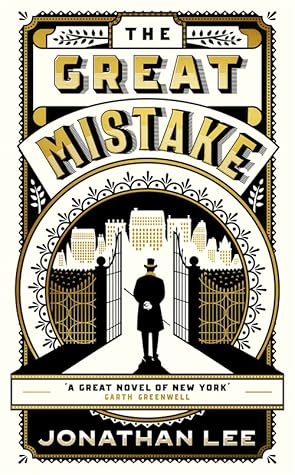
The auguring title promises several meanings--some which are specified and some that readers will identify while reading. The unlucky protagonist, octogenarian Andrew Haswell Green, is shot dead on page three in front of his house on a Friday the 13th in November, 1903. Who is Green? A civic leader responsible for some of the most well-known public, cultural, and green spaces in New York--including the Greater New York consolidation with Brooklyn dubbed by some as “The Great Mistake of 1898.”
But this book isn’t a Wiki entry, it's about an incongruent life. Lee's subject matter and the shooter (especially the shooter) by definition (a Black man) is way controversial to this day and age, and yet the author didn't shy away from it. I felt relaxed reading it because I knew that Lee was not trying to throw shade on people--only ourselves, when we repress our authentic lives. (It's not cliché in Lee's hands).
Is there a scandal? This is what Inspector McClusky needs to determine. The president of the U.S. praised Green and is demanding justice. But scandals “were always looking for ways to spread their mass.” The president “did not want to get his shoes covered in shit, and Inspector McClusky did not want to lick them clean.” The killer is known; the motivation remains opaque, but full of possibilities, limited only by the imagination and the racial prejudices of the time. Lee is so utterly droll!
The chapters alternate between the present (mostly the murder investigation) and Green’s past, starting with his childhood on a farm in Worcester, Massachusetts, and up through to the finale of revelations. However, if you are seeking a tense thriller or cat and mouse adventure, look somewhere else. This is primarily a portrait of a lonely man who remained a cipher to himself, most of all. He kept his emotional aspirations so private that they were never fulfilled.
It did take me a minute to engage and see how powerful this story is done, as the entire history, facts, and setting needs laying out, and then the fictional elements, which are truer than fact (or need to be, if you want to be convincing). If that sounds confusing, let me clarify. Green is an obscure person, except for his civic life and tragic death. The author filled in the details to give the man, celebrated by his contemporaries, an inner life. Green did keep a diary of his time in Trinidad as a young man (one of the key and shining chapters for me), but for the most part, Lee created the persona out of the man, and it is highly persuasive.
I went all in after reading a vintage Lee scene with an elephant that…well, really exposes the elephant in the room! I read the scene twice--it was that impressive and animated. I only wish there had been more exquisitely rendered scenes like that. In some ways, I liked his earlier HIGH DIVE a bit more for its immediacy and intimacy. THE GREAT MISTAKE is paced and depicted at a remove, purposely, I'm confident. A few times it flattened the story, or threatened to, and required my patience to get into it. But I was rewarded, duly.
So who is Andrew Haswell Green, the man? That is for the reader to discover, although it isn’t particularly cryptic, at least not his individual nature. What Lee did was explore why Andrew Green did not pursue his individual longings and life, and how it relates to his background, his father, and his many siblings. The author also included characters that were the antithesis of Green in order to enhance the theme of incongruity to oneself, i.e. Green's repressive nature. At the same time, he insisted that the corruption in the city be decontaminated. He became the city comptroller, which fit well with his incorruptible nature.
Staid, solid, a man who was yet a shadow of himself. Highly recommended for lit lovers! Don't read the Wiki entry until you finish the book, because it will give away the "motive" of the killer, and some truly great mistakes therein. A bit slow at first, and the ending just sort of loses steam, but worth the read. Droll, sublime, and might even be mistaken as a romance of early 20th century New York. 4.5 rounded up