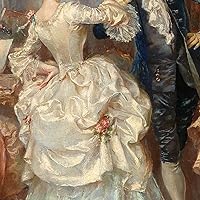
Epouse de Louis XIII, mère de Louis XIV et régente pendant la minorité de celui-ci, doña Ana Maria Mauricia d'Espagne (appelée Anne d'Autriche) a dirigé la France pendant près de vingt années (1643-1661). Pourtant, on a retenu le plus souvent les aspects les plus insignifiants ou les plus anecdotiques de sa vie, par exemple ses amours (réelles ou supposées) avec Buckingham et l'affaire des fameux ferrets ; on s'est également donné beaucoup de mal (en vain), pour connaître la nature exacte de ses relations avec le "second cardinal". Sur son rôle politique , en revanche, peu de choses, faute d'avoir examiné de près les archives espagnoles et d'avoir soumis à une critique rigoureuse la demi-douzaine de Mémoires célèbres qui servent habituellement à faire l'histoire des décennies 1640 et 1650. A partir d'une information très complète et dépourvue des préjugés nourris par les Français, l'Américaine Ruth Kleinman présente une tout autre Anne d'Autriche. Elle dépeint la métamorphose d'une très jeune fille arrivée à la Cour en 1615 en une reine longtemps incapable de donner un dauphin à la France, souffrant du caractère ombrageux de son époux et victime des manoeuvres d'un Richelieu acharné à sa perte, puis en une mère et en une régente sûre d'elle faisant passer les intérêts de son fils et de sa patrie d'adoption avant son attachement à sa famille espagnole. Sans Anne d'Autriche, qui soutint Mazarin imperturbablement, il n'y aurait point eu de paix signée en Westphalie (1648), et le royaume de Louis XIV serait parti à la dérive sous les coups d'une Fronde divisée en factions irréconciliables.
Ruth Kleinmann est professeur d'histoire moderne à la City University de New York.
This book has a few insights, but overall this was a failed attempt to present this historic figure in a too positive light at the expense of some others, including Louis XIII, Anne’s husband, Marie de Medicis and even Henri IV. Anne’s mistakes are glossed over. The way this author describes the future Louis XIV’s education is simply wrong. It’s a pity that readers of this book will be left with an obviously warped view of history.
Anne of Austria didnt leave much behind of her life, unfortunately, and she is also often overshadowed by the much more well-known men in her life - Louis XIII, Cardinals Richelieu and Mazarin, and of course her son, Louis XIV.
Nonetheless, Kleinman still manages to bring the queen to life. Though there were a few spelling errors (probably from printing mistakes), the biography is highly readable, and Kleinman manages to present her information in a way that is clear, concise, and easy to understand. Personally, I would have liked a few maps or images to be included for clarity or reference, but perhaps that is a sign of its age (it was published in the '80s) rather than anything else.
Recommended for those with an interest in the period or even Anne herself.
Kleinman turns in a nice, workmanlike biography of someone who left little evidence of her interior life. Occasionally Kleinman allows herself to be a bit frustrated by that. There are three 800 lb. gorillas in the room in a life of Anne of Austria --- Richelieu, Mazarin and Louis XIV. Reading this book is a bit like watching a production of Hamlet that stars the best actor in Tulsa, Oklahoma as the lead, with the supporting roles played by Olivier, Gielgud and Richardson. I mean, I'm sure the guy would be decent, but who would be watching him? Anne spent her entire married life waiting to bring forth a dauphin (it took her 25 years, but it was Louis XIV, so, you know, worth it), and then spent the next fourteen making sure that he succeeded to his throne unimpaired by a rebellious nobility. Kleinman tries to make the case that it was Anne and not Mazarin who accomplished that, but it's a little unconvincing. There is also the fact that mid-17th century French politics was a welter of passions, double-crosses and for lack of a better word, idiocy.
Also, the book has no illustrations at all. What is up with that?
A fulfilling read. Lots of historical and political information, written in plain English, and very easy to follow. The one disappointment is that Anne left very little of her own voice behind, so she is mostly explored through her actions and reaction. I appreciate that though the author tries to express those unknown feelings, though she always takes pain to show that those ideas are her own conjecture. I also liked that the book presented the whole court in relation to Anne. I still can't really imagine her day-to-day life, but I have an idea of it. But royals are not like us, so it's not like I can really relate to any of them.
I'm stunned with myself that I actually attempted to read this...a SCHOLARLY biography? What was I thinking?[return]That being said...It was fascinating and incredibly well written. I've always loved Anne of Austria (ever since I saw The Three Musketeers with Chris O'Donnell) and this just strengthens my love and admiration for her. Brilliant book!
there's little enough in English on 17th century France, much less ones that provide a window on individuals, their motives and desires. this not only accomplishes that it does a good enough job of working with sources that even without being able to read French or Spanish, you still feel confident of her conclusions. highly recommended.