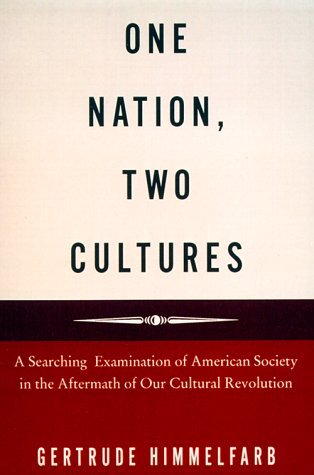
In One Nation, Two Cultures, one of today's most respected and articulate cultural critics gives us a penetrating examination of the gulf between the two sides of American society -- a divide that cuts across class, racial, ethnic, political, and sexual lines. While one side originated in the traditional idea of republican virtue, the other emerged from the counterculture of the late 1960s and has become the dominant culture of today.
In clear and vigorous prose, Himmelfarb argues that while the dominant culture pervades journalism, academia, television, and film, a "dissident culture" continues to promote the values of family, a civil society, sexual morality, privacy, and patriotism. The clash between these two cultures affects all areas of American society.
Despite her forceful critique, Himmelfarb sees encouraging signs for the future of American culture. She explores the place of religion, family, and the law in American life and proposes democratic remedies for the nation's moral and cultural diseases. Though there are many legitimate grievances against government, she contends, our citizenry cannot afford to delegitimize it. And she concludes that it is a tribute to Americans that, without serious social strife, we remain one nation even as we are divided into two cultures.
One Nation, Two Cultures is a stimulating work, one sure to provoke lively discussion and controversy.
Gertrude Himmelfarb, also known as Bea Kristol, was an American historian. She was a leader and conservative interpretations of history and historiography. She wrote extensively on intellectual history, with a focus on Britain and the Victorian era, as well as on contemporary society and culture.
As a cultural artifact, One Nation, Two Cultures is fascinating. Written in 1999 with an afterword for this edition from 2001, it is a manifesto for conservative culture in the United States. Of course, anyone attempting to predict the course of human events is on a fool's errand (and she admits as much), but it seems to me that Himmelfarb was particularly gullible in her belief that the currents she perceived at the turn of the century were a harbinger of what was to come.
But her lack of prescience is not what disturbs me most about this book. Rather, it is the incessant drumbeat throughout for, to my way of thinking, a rather sinister form of cultural and moral control that is to be imposed upon us all by the "right-thinking" people of the religious minority. And much of her logic is contradictory, deploring government interference on the one hand, yet calling for governmental enforcement of codes of conduct and morality on the other.
And, of course, there are all the usual dog whistles here. We now know that "family values" is code for homophobia; that "welfare reform" is a largely racist construct, deploring the perpetual dependence of people of color on government assistance, as if this dependence was caused by the programs themselves rather than the persistent racism of the culture. She also seems to love to cherrypick her statistics and examples to fit her thesis. This goes on throughout the book and is so blatant and laughable as to undermine her entire thesis.
But what strikes me as strangest of all here is that all Himmelfarb seems capable of doing is deploring over and over again. She finds so much that is regrettable in our culture and wishes it were not so, but this is not a very fruitful mode of thought unless one has a course of action to propose, which as far as I can tell, she does not. The way to bring about this culture shift, if one considers it to be desirable, is to build the structures (churches, organizations) that support your values and then make those more attractive than the alternatives. But to advocate imposing your will upon others through some sort of moral policing is simply insidious. She does not suggest this directly, but does insinuate that, for instance, abortion laws should be strengthened in all of the ways we have seen tried in conservative states: limits, parental consent, consultations, and waiting periods, all of which simply serve as obstructions and de facto prohibitions, in particular for those without the societal or financial means to overcome them, which once again targets the poor and undereducated.
I, too, deplore abortion. I think it is unfortunate that anyone ever feels the need for one, and am even more distressed that it seems to be used quite often as a secondary form of birth control. But my solution is to make the moral choice never to have one myself. Of course, being a 60-year-old man makes this doubly absurd, but I hope my point is clear: I have made my own moral choice, and don't feel the need to impose that choice on others. If I feel strongly about this issue, I can advocate for education and more readily available birth control. But to place artificial barriers between a woman and her right to choose abortion is itself immoral, both because I have no right to impose my values on others and because of the long history of illegal and dangerous abortions that preceded their legalization in this country.
And, yes, I realize that the imposition of societal values does occur. It is after all, illegal to murder and rape, and these are not purely objective choices. Rather, they are the declaration by society that some values are so universal as to be codified in the law of the land. I think she is correct to say that, "legislation, judicial decisions, administrative regulations, penal codes, even tax codes are all, to one degree or another, instruments of moral legitimization—or illegitimization." But to place abortion, school prayer, welfare dependency, promiscuity, and other more ambiguous choices and programs into the realm of "moral and cultural disorders of democracy itself" and to imply that this requires anything other than the individual choice to live a moral life and make that life as attractive as possible seems to me a dangerous path upon which to trod, one that leads to the imposition of less-universally held values upon society and its members.
I admit there is much to agree with here. It is indeed a sad statement on our moral and ethical decay that our culture has become so crude, vulgar, profane, violent, and sexualized that it is difficult to know what kind of long-term effect these may have on the young minds developing in their shadow. It is hard to disagree with the statement that "today more than ever we have need of a mediating structure between an unrestrained individualism and an overly powerful state." Also, that "the self-control and self-discipline required for self-government [is] an essential attribute both of those who govern the republic and those who are governed." But to suggest, as she does, that the solution is the church (by which, despite her protestations to the contrary, she means the Protestant, traditional, Christian church) is to veer far off the track of what could possibly bring about the desired change. So much of what she does is harken back to a past long past and never to return. And good riddance.
Himmelfarb examines statistical evidence to uncover the true state of the union. She uncovers facts about the division that is threatening civil society. It is difficult to miss this divisiveness, because it is everywhere. What is surprising is what the two sides have in common. Nearly everyone seems to agree that America has decaying moral standards, and that relativism is the cause of this erosion. However, the increasing secularization of society threatens to undermine those standards further. Himmelfarb predicts either a resurgence of religious fervor, like that which occurred with the Great Awakening, or a complete secularization of society until all ethics are completely destroyed. From what I see, that is already occurring in some places--chiefly in the larger universities. There you will find students whose ethical foundations have been so undermined that they state that they cannot judge others even when confronted by such horrendous deeds as the Holocaust. Yet, these same students will spit their vitriol at anyone whom they judge to be intolerant, which ends up being anyone who holds an opinion differing from their own.
Came across this book at a local used bookstore and decided to give it a go. Overall I am glad I did. I thought the book presented some interesting discussion on American culture, our value system, morality, and the gaps therein between traditional systems and emerging progressive/liberal movements. There was also a great section on capitalism, and free markets and some of the unintended results of those systems. The book explores the roles of government, families, and various social institutions in a concise and logical manner. Good read for anyone interested in American culture, government, sociology...
I found this book exceptionally clear, dispassionate, yet principled. Of course, she is a noted conservative cultural commentator, but her prose does not come off snarky or rhetorical. Her arguments are cogent and well documented, and do not simply let conservatives off the hook. She argues that conservatives need to set forth a more positive view of government, to not attempt to "illegitimize legitimate government". Leveled at liberal secular elitism, she argues for a more robust civil society grounded in civic virtue and morality, not merely "non-judgmental" civility. A good, brief read, that challenges without offense.
This book was a decent exposition on American culture and the society wide normative conflict that's existed post 1960's cultural revolution. Mrs. Himmelfarb certainly exudes some conservative get-off-my-lawn sensibilities but one can't help but acknowledge, after reading her narative, that moral decay is indeed detrimental to civil society. However she really only touches on a single perspective - hers - and fails to comprehensively address the consequences of religiosity, negative and positive, throughout history and across societies. This book is interesting but lacks a well roundedness and depth that would instantly give more credence to the analysis.
But, this is another example of a conservative completely unprepared for the corruption in the U.S. and the active, evil intentions of the Left to destroy it.
As such, a lot of it reads very Pollyanna-like.
Yes. The Left really is that evil. 100 Million dead under Communism.
No excelente livro “Uma Nação, Duas Culturas”, a historiadora Gertrude Himmelfarb rastreia a história da polarização cultural. Nos EUA, nas décadas de 1920 e 1960, houve momentos de “revolução cultural” que deram origem à polarização entre uma cultura “tradicionalista” e outra “progressista”.
Contra o Ocidente “vitoriano”, surgiu uma cultura de frouxidão dos padrões morais e de crítica a valores tradicionais. Houve uma desestabilização de hábitos e princípios tradicionais e do respeito às autoridades e instituições, vulgarização da alta cultura, descrédito da normatividade da família tradicional.
As virtudes tradicionais de trabalho, temperança, autodisciplina foram abaladas por vulgaridades, normalização da violência e promiscuidade moral. Apesar de a cultura tradicional não ser perfeita, a destruição de seus valores possibilitou o surgimento de uma cultura frouxa e o fortalecimento do Estado-babá.
Tem havido tentativas da cultura tradicional de restaurar a sociedade civil (mediadora entre indivíduo e Estado) para fomento das virtudes. Poderia a sociedade civil consertar o tecido moral? Ocorre que várias instituições da sociedade civil foram minadas pelos valores de frouxidão moral.
Nesse cenário, apenas aquelas instituições que rejeitaram o relativismo ético e cultural podem contribuir para repor o tecido moral. Para que a sociedade civil conserte o tecido moral, “é necessário que se reformem suas instituições, tanto estrutural quanto moralmente” (p. 82).
Ademais, as leis do Estado precisam contribuir na validação moral do que é justo. Elas não devem ser instrumento para imposição da vontade subjetiva das elites. Por outro lado, o respeito e civilidade no trato das autoridades precisam ser restaurados, sob pena de chegarmos à barbárie.
Por fim, é fundamental reconhecer o papel dos valores religiosos na restauração dos valores morais. A boa prática religiosa reforça virtudes morais e cívicas, fortalecendo a liberdade e a ordem.
A polarização cultural é um fenômeno que não pode ser superado. Apesar de estarmos em um mesmo hemisfério, existem duas culturas com diferentes valores morais. E o mundo ocidental precisa escolher seu caminho cultural: valores tradicionais ou frouxidão moral.
For someone who is supposedly a respected cultural critic, I didn't find her analysis very well done, or her optimism for the future realistic.
The book has the following chapters: 1. A Historical Prologue: The "Vices of Levity" and the "Diseases of Democracy" 2. Civil Society: "The Seedbeds of Virtue" 3. The Family: "A Miniature Social System" 4. The Law and Polity: "Legislating Morality" 5. Religion: "The First of their Political Institutions" 6. The Two Cultures: "An Ethics Gap" Epilogue: Some Modest Predictions
A book written bemoaning the disappearance of traditional norms, values and civil society without reference to the rise of narcotics, globalism, wage stagnation, or automation. In other words the people changed the world did not. Written as the last century faded, one can only hope that such a dismally miopic book will likewise sink into the recess of time, without resuscitation or rediscovery.
Himmelfarb presents statistics that support conservative values such as intact families with a mother and a father. Her arguments are sound, which is refreshing when compared to the arguments commonly put forth to support these values. However, the format is intimidating for the less-scholarly, and the same information could be made more readable (and should be).
This author tries to present a balanced discussion of values and ethics, documenting the range of differences among Americans. but she is a conservative and this comes out time after time. Not that there is anything wrong with that. I try to be as tolerant as the next person.