Now, I'm not much of a true crime reader. Let's get that out of the way. Because if you're into that kind of thing, you'll likely love this book, because you will be able to relate. Me, not so much. I find the genre exploitative and of questionable taste; to go and turn the very worst experience someone can have (and I mean the victims as well as their families, friends, colleagues, neighbors, anyone who suffers the fallout of the actual deed) into entertainment fodder (because let's face it, nobody reads this stuff for scholarly purposes) and, by extention, into nice hard cash for themselves... nah. Not. My. Thing.
But this autobiographical (!) graphic novel sounded like, um, not fun exactly, but maybe the author might take a similar approach to herself and her outlook on things as Alison Bechdel did with "Fun Home"? Like, turn a sharp eye on why we are the way we are and why we do things and find a lot of absurdity and heartbreak and humor along the way?
Yeah, well, I guess that joke was on me. Because this book is on True Crime, and how fun and fascinating it is in all its shapes and sizes, and what a cool and crazy chick the author is for loving it. I think "oh dear" sums it up pretty nicely.
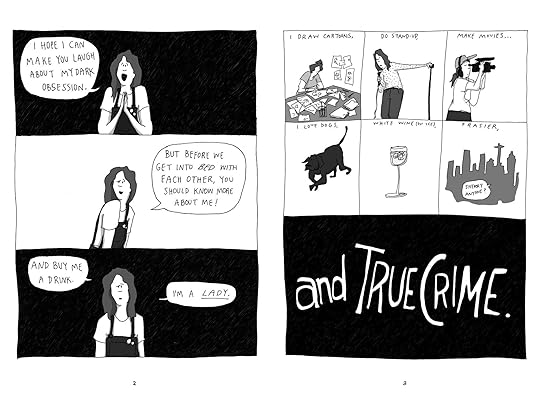
In fact, about half of the book is spent on cataloguing the author's idiosyncrasies -- that she loves the 1970s and has loads of obsolete technology in her apartment; that she was a precocious "old soul" type of kid who watched "The First Wives Club" on opening day, when she was, apparently, five years old; and, unsurprisingly, that she can't tell a story. It looks like she did some stand-up comedy as well, with laugh-out-loud lines like "Hope to be murdered someday!", which struck me as something only a truly vapid person would say or even just consider funny. (That same less-than-juvenile kind of humor shows up again in the section dealing with the Zodiac, where she inserts herself into the action with the types of funny questions and quips and asides that would make an 8-year-old groan. God help us.)
As for actual True Crime, we get the usual suspects -- the Zodiac, Ted "Enough Already" Bundy -- as well as, for some reason, Tom Capano and that wife-and-unborn-baby killer Scott Peterson; I'd be tempted to skip over this whole section, because it really brings nothing new to the table, were it not for some misplaced righteousness, or may I even say hypocrisy. Because the author quite correctly points out that it's the white serial killers that get all the love, while you can literally kill 60 people (Wikipedia lists an even higher number) and not enter public lore just because you're a POC, which really is totally unfair and everything. Which in itself is quite an, er, interesting line of thought, I guess, but does the author anything to "rectify" this injustice? Does she hell. We get a little side panel showing the mugs of six Black serial killers and one tiny mention of the Night Stalker as well as some fairly lame lip service as to how media coverage of violent crime is historically racist, but Ms. Campbell herself is covering only white perps and victims, so moaning about lack of representation feels a bit icky.
Which brings me to my main issue with "Murder Book".
The way the author talks about the victims is for the most part as callous as it is puerile. Take for example the panel that ticked me off the most, on page 48, which shows David Farraday and Betty Lou Jensen, the Zodiac's supposed first victims, leaving the burger place where they just had their first (and final) date with this happy exchange: "Where next!?" "Our untimely demise!" Just in case you're a bit fuzzy on the details, these are two kids, 16 and 17 years old respectively, real-life teens who died a brutal, senseless death, terrified and in pain and alone; an act that shattered their families and traumatized their friends to this day. There are people out there who still miss these kids. So yeah, let's please joke about it. Show the world how super quirky you are.
This display of utter callousness is then followed by a hypocritical spread on how it's really "all about the victims" for the author and "what lovely young kids these two were", which actually made me puke in my mouth a little. Because, you know, actually it's not about these or other lovely murder victims (it never is, to be fair; it's just the way this whole genre works -- the victims are just the fuel that keeps the sensationalist machine that is True Crime running), it's mostly about how endearingly weird and quirky and flat-out fascinating-in-that-bumbling-cutesy-dumb-way the author is, and it's just as "ugh" as it sounds. Also, it's about her family, mainly her mom. Who is also into true crime. So if you're interested in two not overly interesting women talking about other people's tragedies like it's some sort of competition set up for their amusement, well, here you go. Along the way, lots of wine gets drunk (on ice cubes -- WTF) and passes made at unsuspecting guys in bars; there's some bonding over shared True Crime passion and lots and lots of toilet sessions, as the artist seems to have a weird obsession with drawing herself on the bowl. (All that watered-down wine, I presume.)
On the technical side, I was not impressed with the artwork. That kind of style probably works fine for a New Yorker cartoon, but at 330+ pages I found it fairly unfriendly on the eyes. Same goes for the lettering, which is truly atrocious. There are some attempts at true-to-life drawing (most of the victims as well as, strangely, Jake Gyllenhaal, Dick Wolf and the cast of Law & Order), none of which do their subject any justice at all; their only purpose seems to be to show up the artist's limitations, at which they admittedly succeed well. Ever scribbled a face in your notebook with your ballpoint pen instead of paying attention to algebra? Yup, that's the skill level I'm talking about. Just try and put names to those celebrity portraits; I dare you.
All in all, this was fairly disappointing. I would have liked some exploration on a personal level into what it is that intrigues so many readers, the vast majority of them female, about depictions of real-life violence against women, and how they justify (even just to themselves) supporting that blatant exploitation of other people's tragedies and pain for their own entertainment. It's obvious that something about the idea of women meeting brutal ends at the hands of men and the feeling that in our society, this could happen at any time, in any place, to anyone, deeply resonates with the author, who claims to consume nothing but True Crime; unfortunately, she never explores those deeply subjective, personal issues in any depth, instead going for stupid jokes and over-the-top antics, completely devaluing her concerns in the process. Behind all the not-funny banter and me-so-crazy deflection, there is another, deeply personal story we only catch fleeting glimpses of -- Ms. Campbell, in passing, mentions eating disorders, body issues, unhealthy relationships, and general, therapy-level anxiety. Add to this her obsession with violent death, and you have a woman who clearly has much more to tell than she does in "Murder Book"... once she feels like shedding her clown costume and finds the courage to step out into the open.
I'd like to thank Netgalley and the publisher for the opportunity to read an ARC of "Murder Book" in exchange for an honest review.