Named one of the Top 40 Horror Books of All Time by the Horror Writers Association, Some of Your Blood begins with a confidential folder belonging to army psychiatrist Philip Outerbridge. Inside this folder are the letters, memos and transcripts for a young soldier named George Smith, a quiet young man with a terrible past and a shocking secret. As Outerbridge conducts George's therapy, he gradually discovers the truth about George's traumatic childhood, his twisted romance with an older woman named Anna, and the unusual obsession George keeps hidden from the world. With the masterful touch that earned him the Hugo and Nebula awards, Theodore Sturgeon creates a character capable both of unsettling violence and irresistible humanity.
Theodore Sturgeon (1918–1985) is considered one of the godfathers of contemporary science fiction and dark fantasy. The author of numerous acclaimed short stories and novels, among them the classics More Than Human, Venus Plus X, and To Marry Medusa, Sturgeon also wrote for television and holds among his credits two episodes of the original 1960s Star Trek series, for which he created the Vulcan mating ritual and the expression "Live long and prosper." He is also credited as the inspiration for Kurt Vonnegut's recurring fictional character Kilgore Trout.
Sturgeon is the recipient of the Hugo Award, the Nebula Award, and the International Fantasy Award. In 2000, he was posthumously honored with a World Fantasy Award for Life Achievement.
I always have had a respect and love for older horror stories. I find it fun to read them and then speculate on what modern tales might be based upon these older works. In this case, I can see an even older story (Dracula) within. But what this book does is turn that classic tale upside down. In fact, I don't even consider this to be a true horror story.
This short book, originally written in 1956, is told mostly through letters back and forth between an overworked Army psychiatrist, (Doctor Phil!), and his superior. The letters discuss one "George Smith" who was arrested and thrown into the psych ward for punching an Army officer in the face after the officer questioned him about a letter he mailed. No one knows exactly why because that officer is now dead and no one knows what happened to the letter. Unfortunately, George is forgotten for about three months and now Dr. Phil's boss wants him to be released before anyone finds out about the Army's neglect.
Doctor Phil needs to find out a little something about the patient before releasing him, so he begins by having him write out a bio in the third person. This is where things get very interesting. The patient uses the name George Smith in his bio which consists of not only horrible grammar, but also horrible tales from George's past. From there this story takes off in a completely different direction.
That's all I'm going to say about the plot. However, I will make a few observations here, that you can take or leave at will. First off, there is a lot of humor in the letters between Dr. Phil and his superior. I think their discussions were very subtle, but added a lot to the tale. Some readers might get bored with their exchanges; I did not.
Highly recommended!
This entire review has been hidden because of spoilers.
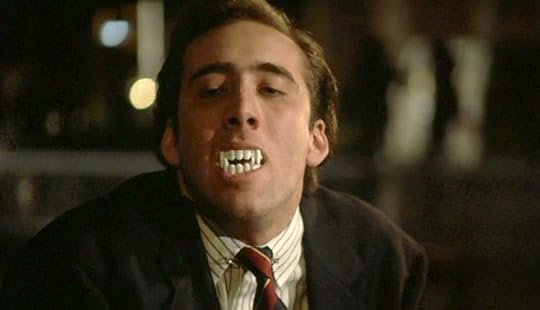
Theodore Sturgeon’s 1961 psychological thriller reminds me of the films Birdy (Alan Parker 1984) and Vampire’s Kiss (both featuring Nicholas Cage) because of the subject matter; but this never goes over the top and Sturgeon’s great ability to produce an understated and minimalistic page-turner is in rare form. Presented in epistolary novel form, written as a series of documents – was this a tribute to Bram Stoker?
This is also reminiscent of the The Great God Pan in its subtle, almost peripheral, introduction of horrific elements.
'Some of Your Blood' by Theodore Sturgeon is a VERY disturbing book. A backwoods, undereducated kid is raised in a miserable, shabby home with a mean drunk of a father and an abused, arthritic mother. Life is hellish, but it's all George Smith (not his real name) knows. There are days with no food on the table, and days when he hides in the woods to escape his father's drunken rages. His life is so meager and mean that when he is sent to a troubled children's 'prison' for two years for burglary, he feels really pleased with the clean bed and the three meals a day. He actually finds school a joy for the first time since the teachers take the time to bring him up to speed.
In time, his mother dies and then his father, but the damage is done. He goes to live with his aunt and uncle.
George was always a terrific hunter of small animals, and when hunting one day, he meets a woman. So, he, at age 16, secretly begins to date an equally unloved and unlovely 24-year-old neighbor. He really needs her when he is upset by feelings of being lonely.
From his story, it becomes clear he's a sociopath. He made a decision to never talk unless he must, so he is an unknown mystery to most except to the locals who know his parents. But even they know nothing of his hunting.
When he impregnates Anna, the neighbor woman, he decides to enlist in the Army. It's another place he feels safe. Then it all goes off the rails.
The novel is very short and and can be read in one day. Most readers either know the secret because the book has been out since 1961 and is a classic, or have read it, but I'm not going to reveal it anyway. (Even though the cover blurbs give it away as well.) It is a very well-written book, but unfortunately it is dated. I'm sure sensitive readers, if they make the error in judgement to read this, will be affected by the horrific story, but for those of us into horror or hardcore detective novels it's not a startling or unique read for the 21st century. I should mention it is not paranormal in any way, but it is written as if it were a true story from a real case.
This is an older short story that GR says was first published in 1956. Admittedly, I haven’t read much in the way of classic horror and I wasn’t sure the story would work for me. I guess I was expecting it to be dry and slow. What I found instead was a deeply disturbing story with many images that will linger with me for months to come.
This story is about a soldier who calls himself “George”. George is being held in a crowded military psychiatric ward for assaulting a superior. It seems he’s been forgotten there though and they really need his bed for another patient. Psychiatrist Dr. Phil is tasked with going over his case before his release. What he discovers is bizarre and chilling.
George’s story is told in various ways. He writes his own biography for the doctor which takes up a large chunk of the book. This part explores George’s sad, desperate childhood growing up poor with a sick mom and a mean ass drunkard father. I listened to this on audio and narrator Malcolm Hillgartner does an amazing job with these characters, especially George. Initially, I found George’s section sad but as he revealed more tidbits about his past, I could see that he was developing some very dangerous tendencies and a simmering anger that turned my feelings of sympathy into repulsion. The narrator gives him the perfect backwoods voice that wasn’t over the top but yet remains vastly different from the more cultured tones he gives to the psychiatrists. The rest of the book consists of interviews with the doc and George and letters between the doctors as they pick and prod into George’s past in order to figure him out. These two doc’s are quite the characters. The witty back and forth banter between them added some much needed humor and I found them both highly amusing despite the dark subject matter they were discussing.
George’s affliction is bizarre, to say the least, and I refuse to think about it too much because it freaks me out. I highly recommend listening to this on audio, if you can, because the narrator adds so much life to the words.
I will leave you with my favorite quote from George:
“The world would be a whole lot less trouble for everybody if most people would just not talk so much.”
Big George didn't have fangs, nor did he sleep in a coffin. But big George did like to drink blood. It is discovered by an Army psychiatrist that this soldier has some serious issues and that he has a deadly past. George had an abusive, drunken father and developed an unnatural taste for blood from his mama's breast. Aside from this upbringing I get the feeling that Big George was probably still going to grow up a few clowns shy of a full circus, but the overall combination was one that created a mindless monster that might be a combination of Frankenstein and Dracula.
The most disturbing part of this story was a scenario in which, it wasn't the details, but rather what was not said. That poor boy in the snare. Theodore Sturgeon left us to our imaginations with that one.
This is an old classic, and good, but don't approach it with any stereotypical vampire ideas or you will be disappointed.
Written in 1961, Theodore Sturgeon's Some of Your Blood, is both a unique take on the vampire story (which is damn near impossible) as well a product of its times. But that doesn't mean it's dated. Generally, the story holds up quite well. References to Korea, Masters and Johnson, Havelock Ellis, human sexuality studies, and various breakthroughs in psychiatry keep coming up. And for good reason, since the story of "George Smith," a disturbed American soldier, is basically an unofficial case history, revealed via a series of letters primarily between Smith's doctor and his commanding officer. The main letter however, and longest section of the book, is told by Smith himself. It's a remarkable piece of writing, and one where you have to play close attention. "Smith's" condition is both revealed and cloaked at the same time. To my mind it's quite a high wire act. "George Smith" is an original wild child of the hills, but one who has had a horrible childhood. How he copes and adapts to this brutal phase is, well, the sad story of his life. The economy of the writing is remarkable, but what mars the performance is how Sturgeon booksends the tale with a silly message to the "reader." Also, the ridiculous real name for "George Smith," which is revealed late in the book. It's like Sturgeon couldn't resist a wink at the reader. In something this lean, it simply breaks a compelling spell.
Superb work. Like any other novel by Theodore Sturgeon that I've read, this is a literary masterwork, original, dark and deeply unconventional. Sturgeon wrote more with his guts than with his mind, and he was able to create dream-like stories that spoke straight to your subconscious, whether simply weird dreams or flat-out terrifying nightmares. However, he never lost a great sense of balance, an elegance in his writing, and a sense of beauty.
Sturgeon has often been expressing his annoyance with social mores and conventions, and in this story he is at it again, through a main character who is a prototype of the pure, natural man, clean of social rules and acquired behaviors or pre-fabricated thoughts. This love for the uncommon is typical Sturgeon. A writer of the greatest originality, and an anticonformist to his bones. An example? He used to walk around naked in his LA house, because "why wear clothes, if they are purely a useless habit imposed by society?" and apparently he would ask that his whole family would do the same, too.
"Some of Your Blood" was written in 1961. It's about a soldier, George Smith (not his real name), who is locked up after a brief scuffle with a superior officer. George undergoes a psychiatric evaluation where Dr. Phil Outerbridge learns about his life and the horrible, hidden secret that shaped it.
An interesting premise, to be sure, but the appeal of the book is in Sturgeon’s application of the craft, in other words: the execution. And it works SO well.
The book is organized into a series of letters, memos and transcripts that chronologically detail the story. The first half of this book is essentially George’s seemingly innocent biography. The second half is correspondence between doctors about George's condition. Slowly, the persistent Dr. Outerbridge uncovers George’s horrifying secret.
P.S. Many reviewers here happily gave away this secret in their review without calling out the spoiler, so if you haven't read the book yet and plan on reading it, do not read the reviews here.
P.S. this edition has the absolute worst cover that I've ever seen.
One of the best Science Fiction novels ever. Science fiction, you say? Well, yes. Because this novel basically predicted the kind of "Mind Hunter" style criminal profiling that was innovated in the 1970s and became famous in the 80s and 90s.
In fact, in this novel the lead doctors sit down and chat with a serial killer in very much the same way John Douglas interviewed serial killers.
As a way to gain insight into their behaviour and reveal their life experience that helped develop their criminal designs.
The book has quite a bit of empathy for its horrific subject and that empathy makes its commentary all the more difficult to dismiss. It shows you the perspective of a monster and convincingly puts you in their shoes, allowing you to see the patterns of their psychopathy.
A quick and terrifying tour of one man's personal hell. Decades ahead of its time, disturbing in its accuracy and still relevant to this day.
Sleepless nights are perfect for reading and since this book was close at hand, and because I couldn't fall asleep last night, I started it. Then after reading the first few paragraphs, I got up, went downstairs with pen & notebook in hand because I knew this was going to be something intensely different than normal and notebook-worthy, and sat and read slowly for hours before I absolutely had to stop. Then I picked it up again today and finished it.
I have to digest what I've just read before posting about it, but quite frankly, it blew me away. Sheesh!
theodore sturgeon has always fascinated me, although i've never really liked any of his books. i love his short story "the man who lost the sea," but the longer stuff always kind of bored me. it always gave me the sense that he'd rather be writing short but felt he had to pad the thing out so he could make some money off it. which, hey, is probably true. and i can't really say that i blame him.
anyway, this book didn't feel that way at all, which is strange because it is transparently padded. it's the story of a (perhaps) psychotic man told through an exchange of letters between army psychiatrists, discussing the case files, some of which are written by the subject in question as the "my life story" part of the exam. it's only 140 pages long and much of that is comprised of salutations, closing remarks, and editor's interjections. there's an experimental feel to the novel, a patchwork-cubist kind of aspect, but sturgeon keeps everything moving relentlessly forward and as a result it's a page-turner... an epistolary freudian mystery-suspense novel about a guy named bela who, maybe a spoiler, drinks blood. it's also a love story on multiple levels. i've really never read anything like it. (i mean, there's a Child of God thing happening, and also a jim thompson-esque feel... but it's way beyond either of them in terms of surprises, both in subject matter, plotting, and emotional scope. i mean, this is one disturbing book (it's routinely listed as one of the best horror novels ever written, despite the fact that it's not a horror novel) but somehow you come out of it feeling strangely good and hopeful about the human race.)
some facts i like about theodore sturgeon:
1) he changed his name to theodore to match his nickname ted (his actual name was edward). 2) he wrote the first (though unproduced) star trek episode to ever mention the prime directive. 3) he's the guy who said "90% of everything is crap." (hemingway said "the first draft of anything is shit.") 4) he's the guy vonnegut modeled kilgore trout after. 5) he was a relative of ralph waldo emerson.
I have chosen to put this book on no shelf aside from my "read" shelf. Maybe if I had a weird fiction shelf it could go there...but maybe not. I mean the story is not outside the realm of possibility. Sadly, today it may not be all that strange.
However, if I had a "Disturbing Fiction" shelf, yeah it would go there.
As I have said before, countless times, this is an...interesting book.
I am not going to go into the plot, I'm simply going to say it's very well written, it has a coherent plot line, a narrator who may or may not be reliable, and has a very well done epistolary construction.
So, recommended, enjoy...well, "enjoy" may not be accurate but, you know get drawn in.
----------------------------------------------- PERSONAL NOTE: I really need to read more of this author. [1980] [27p] [Horror] [4.5] [Recommendable] -----------------------------------------------
Definitivamente tengo que reseñarlo, más adelante.
----------------------------------------------- NOTA PERSONAL: Realmente tengo que leer más de este autor. [1970] [27p] [Horror] [4.5] [Recomendable] -----------------------------------------------
I never would have come across this book if it wasn't on a Goodreads list for one of my challenges I'm doing right now. I'm glad I was able to read it, and thought it was a great read and deep dive into the human psyche and how our environment can affect how we turn out. I loved that the story was told in a series of letters, reports, and written stories. I felt really bad for George, and was so glad his psychiatrist did not give up on him and found out what his major issues were. There wasn't really a lot of gore in this book, so I would recommend it to anyone that enjoys exploring the human psyche.
Theodore Sturgeon wrote some of the best and most formally inventive sf of its day. But remember, Sturgeon's Law states. "90% of everything is crap." This book is by no means crap, but it has a couple of stylistic choices that put it pretty far down on the Sturgeon list as far as I'm concerned.
Letters between doctors, transcripts of psychiatric sessions, journal entries -- these are Sturgeon's nod to Bram Stoker's epistolary construction of Dracula. And it all works well except for a long, narrative section that is supposed to be the patient, George, writing his life story in the third person. George turns out to be an excellent writer, a natural storyteller, and Sturgeon requests an enormous willing suspension of disbelief on the reader's part if we are to find this conceivably the work of the character. The exposition is necessary, and maybe there was really no other way to handle, but George is quite the stylist. What works much better is the psychiatrist's ability to take his story, detect the gaps and lies in it, and pull those from George using hypnosis, that tried and true technique certainly practiced more and with better success in fiction that anywhere else.
George drinks blood. I don't think that's a spoiler given the book's title and references to vampires all over the back cover. Further details, on the other hand, are genuinely creepy and convincing as pathology. George is not well. He is glad that his doctor is going to fix him up, but I doubt that he will be leaving the institution anytime soon. Or I would hope not.
Some of Your Blood is a quick read that effectively presents some really disgusting material in such clinical format that some of it takes a moment to really sink in. George is a kind of innocent, but one that you would want to keep locked up for life.
Sturgeon's other stylistic blunder is a prologue and epilogue in which he addresses the reader and frames the novel in what sounds like one of Boris Karloff's commentaries on Thriller, It's beneath him, or maybe i'm pretending that the novel doesn't have the pulpy origins it does.
Short novel told through letters, interview transcripts and a "diary" of sorts, about a patient in a VA mental ward. Lots of psychology and disturbing confessions. This novel by Sturgeon was published in 1961 and is similar to Matheson's I AM LEGEND in taking a modern, scientific approach to an old horror tale. There is some pretty disturbing stuff in this book, considering the year it was published. It's an example, for me, about what "genre" writers were doing while the mainstream lit crowd wasn't looking.
Stoker's "Dracula" was perhaps the first modern novel bringing the vampire to...life (ok, bad pun)....and, coupled with 100s of movies - we all know what a vampire IS - a reanimated corpse, who lies within its coffin during the day, rising at night to suck the blood of the living.....
But...just BUT......suppose everything we knew..or thought we knew - was wrong. Perhaps the vampire looks like the rest of us..maybe not a European nobleman - maybe he doesn't sleep in a coffin, or change into a bat - but he still drinks blood.
Originally published in 1961, "Some" is the story of "George Smith" - who is accidentally discovered after penning a short letter to his beloved. I was fascinating with the use of psychology and various tests (still in use today) to delve into "George's" subconscious.
No denizens of the "Twilight" series within.....
Although out of print, used copies can be readily found thru ebay and amazon.
Excellent as always in prose and the observation of misfits of our society. Yet the psychological horrific impact this story may have had in the 60ies can't compete with nowadays sensitivities. I'd say it is a great read for readers who can immerse themselves in Sturgeon's outstanding writing (like myself), but it certainly is boring for readers who look for an exciting plot.
I read a lot. I have never consciously sat down to consider the numbers, but I can safely say: It's a friggin' lot. Even while I am working on my own fiction and reviewing for the peeps, I read. I try to keep the idiot box turned off as much as possible in order to get a good 1-2 hours of reading in every night. I think it keeps the brain sharp when it comes to abstract concepts. Reading requires visualization, which requires thinking.
have been asked fairly often, "What do you read besides review books?" Well, I have a Goodreads page and an Amazon page where I review and rate traditionally published books, but I thought I might share some of that over here as well. We are all readers as much as we are writers, and discussing literary tecnique is one of the many things we do here at the peeps.
At the moment, I am in between review books. I have a review that posted last Friday and another book to begin next week. In the between time, I am reading Some of Your Blood by Theodore Sturgeon. It's different and very disturbing. As of the initial writing of this post, I was about 30 pages in, and while the corn-pone dialect is bothersome for me, I liked where the story was going, so I decided to stick it out. Here is the Blurb:
Theodore Sturgeon's dark and foreboding look at the vampire myth was an instant classic when originally published in 1956. When George Smith is arrested for assaulting a senior officer, a military psychiatrist is assigned to the case. The secret of George's past is unearthed, and a history of blood lust and murder. Innovatively told through letters, interviews, and traditional narrative, Some of Your Blood effectively portrays the tragic upbringing of George Smith to his attempts at a stable life and the great love of his life to his inevitable downfall. Millipede Press is proud to present this masterpiece of macabre literature in a brand new edition.
Over the weekend, burdened with a particularly heinous bout of insomnia, I finished the book. The take on vampirism was indeed unique, one of the best I have read, but that wasn't what struck me most about the "story." This was as far from traditional storytelling as one can get, and would probably have lesser experienced literary critics up in arms. There is only one traditional scene to speak of and that doesn't appear until the very end of the book, which is only 143 pages in total. Dialog is practically non-existent for the exception of two interviews between patient and psychologist, and the remaining narrative is completely exposition. As far as character arc goes, well, don't look for growth here. The monster is created and subsequently remains a monster.
There are a lot of different telling techniques used here to great effect. The book begins with a series of letters back and forth between a couple of Army psychologists who have initially conflicting views on a patient by the name of George Smith. Smith was thrown into lock-up for punching an officer who had become alarmed by a letter Smith had attempted to send home to his girlfriend. The book then flows into a third person narrative of George's life, written by George as instructed in the course of this therapy. Everything seems pretty standard fare for an abused backwoods undereducated -- possibly mentally retarded -- child. But ... nothing should be taken at face value here. Intuition plays a huge role in this story. The intuition of one psychologist who wouldn't give up digging until George's pathology, in all it's horror, is finally laid bare. We don't even know what the letter to his girlfriend said until the very end of the book. Every move each character makes is based on gut instinct. Everyone is speaking in code, hiding and yet revealing their intent at the same time. This is what gives the book its brilliance, not the gripping action, of which there is almost none, but the characterization. The style is very reminiscent of Stoker's Dracula, and George Smith was nothing less than Frankenstein.
Put all your notions of storytelling aside and pick this one up. Its nature is entirely subliminal versus visceral, and it strikes to the core. Very frightening, and yet in the end, disgusted, our sense of humanity shattered, we can't help but feel for George.
A quick emotional read. Shocking in some parts. I liked that it was told in different formats. An interesting take on the "vampire". But can we really call George that? Or is he just mentally deranged and likes blood?
This book is unlike anything I have ever read before, but it did remind me of two classics: Dracula (both in epistolary structure and subject matter) and Of Mice and Men (the developmentally stunted main character/unreliable narrator even gives himself the name George) It's primarily a psychological (extremely Freudian) study of a troubled, violent soldier, told through an invitation to the reader to examine the Army psychologist's case files. The bulk of the book is the subject's personal narrative written in the third person, about "George Smith". The final third of the book is a series of letters between the psychologist and his commanding officer, detailing his methods and analysis and conclusions, and the CO's struggle between reigning in his friend's obsession with the case and his own fascination with it. By the time the significance of the title is revealed the doctor, the CO, the social worker, and the reader have all been wrenched through the emotional wringer. It's billed as one of the 40 greatest horror novels of all time. As someone who has little interest in gore and great interest in the psychology behind sociopathic behavior, it is right on the money for me. I listened to an audiobook version which was very well read, but I imagine actually reading the text on paper with the stilted grammar of the subject's story might be even more haunting. This book was nothing at all like what I expected from Sturgeon, having read one other novel (Godbody) and a short story collection. It's very exciting to discover an author who is so masterful in many varied styles.
In the 1978 horror movie "Martin," writer/director George A. Romero presented us with a young man who enjoys killing people and drinking their blood, but who may or may not be a so-called "vampire"; the film is wonderfully ambiguous all the way down the line on that score. Seventeen years before Martin skulked through the dreary suburbs of Pittsburgh, however, another unconventional vampire was given to the world, in the pages of Theodore Sturgeon's "Some of Your Blood." (Actually, an apology may be in order right now, as that last is a bit of a spoiler; the sanguinary habits of the central character of Sturgeon's novel are only revealed toward the story's conclusion. However, seeing that the back cover of the book's current incarnation, the one from Millipede Press, gives away even more spoiler details than this, perhaps I may be excused here.) Theodore Sturgeon, of course, is a writer perhaps more well known for his sci-fi and fantasy work; I know it surprised me to find an article lauding this book in the excellent overview volume "Horror: Another 100 Best Books," in which writer Peter Atkins calls "SOYB" "an almost unacknowledged masterpiece of unflinchingly dark vision." But having read and been a fan of Sturgeon's sci-fi classics "More Than Human" and "Venus Plus X," and been blown away by his shockingly clever short story "The Perfect Host," perhaps I shouldn't have been so surprised at how fine a book "SOYB" has turned out to be.
Like that most famous of vampire novels, Bram Stoker's "Dracula" (1897), Sturgeon's novel is an epistolary affair; not solely taken up with letters and diary entries, it also includes medical transcripts, notes between two Army psychiatrists and, most fascinatingly, a third-person account by our blood luster himself. Self-given the pseudonym of George Smith (it is revealed at one point that his actual name is, uh, Bela), he has been in an Army psychiatric hospital for three months, following a seemingly unwarranted attack on a superior officer. George, in the book's most compelling section, tells us the story of his life, all 23 years of it, in his barely passable English. He'd lived with a sickly mother and brutal, drunken father in a backwoods Kentucky cabin; a hillbilly, I suppose you might call him. Following a terrible childhood, George had gone on to reform school and service overseas in the Army, until an intercepted letter that he'd written to his girl back home precipitated that brawl and his subsequent incarceration. Now, as the two psychiatrists send each other memos and George undergoes hypnotherapy, perhaps his inner secrets will soon be revealed....
"SOYB" is ultimately a very sad book, with George almost coming off like a Norman Bates type, but with a mania of a different sort. His blood lust is explained with a convincing rationale, and some of the events that he is said to have perpetrated ARE fairly horrific. George is not a vampire in any conventional sense; just a kid who, because of his regrettable upbringing, developed an occasional taste for the red stuff. Sturgeon tells his tale wonderfully, employing different voices (lunkheaded for George, wisecracking and clinical for the two shrinks) and revealing his central character's secrets slowly, like the gradual peeling of a very sick onion. George is a very realistic creation, a most credible bloodsucker, which almost makes him a scarier proposition than the more fanciful vampire of myth. As Atkins tells us, "the book recasts an ancient bogeyman as a terrifyingly and truthfully rendered contemporary monster." It is not a perfect book, however. At one point, we are told that George's father's sister has a farm in Virginia; a little later, we are told that it belongs to the mother's sister. But actually, whether this is a slip on the part of Sturgeon or on the part of George, it is impossible to say. The book is a very compact affair, less than 150 pages long, but tells a memorably chilling tale within that short compass. And, oh...you should just love reading that letter of George to his girlfriend; the one that set off all the ruckus!
The previously mentioned Millipede Press edition of this book is a very good deal for the reader, too. Featuring not only the short novel, this volume also provides a most amusing introduction by horror writer Steve Rasnic Tem, as well as a short story by Sturgeon, on a similar theme, entitled "Bright Segment." This tale originally appeared in the July 1960 issue of "Shock" ("The Magazine of Terrifying Tales"), and deals not with another hemoglobin guzzler, but rather, with another big-boned, social misfit/lunkhead. In this memorable story, a simpleminded man--his boss refers to him as an "orangutan," and we never do learn his actual name--takes in a grievously injured young woman who he finds lying in the gutter. He operates on her and nurses her back to health, her bedridden, silent presence being the so-called "bright segment" of his lonely life. But problems arise when the woman is well enough to leave, leading to a memorably grisly conclusion. Here, we again have a psychologically damaged man, a simpleton, really, whose ill treatment in previous years has resulted in a decidedly oddball, social outcast. It is a wonderful piece from Mr. Sturgeon, at once touching and shocking, and serves as a nice coda for this most fascinating volume.
Novella of a correspondence between two psychiatrists regarding a patient in army custody. Not only a great story, but a little bit of 4th wall play when Ted gets flustered at us and scolds us for being interested in the tragedy.
So I'd been looking for a copy of Some of Your Blood for a while now: I noticed that Amazon had it for a dollar recently, in Kindle format, but I hate paying for digital books - so I kept looking. Turns out, I wasn't exactly stumbling over piles of Sturgeon books anywhere. There are all kinds of first editions and collectors copies hanging out at Half Price Books, and a few collections of stories at Barnes and Noble, but damnit, I only wanted this one fucking story.
I ended up buying a mouse-chewed, musty, yellowed copy off of ebay for three dollars and shipping. Incidentally, about seven times what I would have paid for that digital copy off of Amazon. Shitballs. Well, I like the way musty, mouse-chewed copies make me sneeze and irritate my eyes and stuff - that's the bonus that I'll pay shipping for... totally worth it.
I'm only sort of kidding.
I'm also still looking for a copy of When You Care, When You Love (as referenced in Roberto Bolano's The Savage Detectives). I'm fairly certain that I will only find that in digital (I believe it's available on the Google Play store), or in a collected edition (The Nail and the Oracle). So, no charming water-damaged copies or anything. Bummer!
Anyway, I breezed through Some of Your Blood in about three hours - being a short novella, this doesn't make me a super speedy reader or anything (on the contrary...). It's just a super fucking gripping story - and it has a ton of my favorite elements from TWO genres: southern gothic, and horror. Awesome, right? Totally up my alley. Plus - there are some very interesting analytical elements at work. AND, atypical representation of a "vampire" (c'mon, you knew what the book was about - that's not a spoiler).
This is my first foray in to Theodore Sturgeon - I'm doing my best to dig through a giant back-log of "to-read" entries involving foundational science fiction and fantasy at the moment, and the quicker reads are a priority. This was totally quick, and very easily digested. As Al, the colonel in the novel states, the writing is a bit strange and unconventional... but it makes sense, and you know exactly what the narrator is talking about. The correspondence between the two military doctors is also QUITE fun - what I really appreciated in this regard is that the language doesn't in any way feel dated. This has been one of my primary struggles with a lot of older writing recently - the slang and jargon just don't flow well anymore! Thankfully, Sturgeon somehow managed to avoid that particular morass, and I totally appreciate that. His writing is succinct, and it has an excellent flow.
I'm not going to say that this is the best thing I've read this year - it's not, and I totally don't want to jinx the rest of the shit I have on my reading list for the year... plus, I have four books of Saga on the way, I don't think anything is going to beat that series - BUT, Some of Your Blood is REALLY good (I'm wavering between a 4.5 and a 5, so I'll just round up). Buy your own mouse-chewed copy, if you're lucky enough to find one, because it's totally worth owning, and definitely going to be one of those books that I'll personally be re-reading (those are rare for me). Definitely recommended.
Theodore Sturgeon's SOME OF YOUR BLOOD suffers from the DRACULA syndrome. That's not to say this is a vampire story. It isn't. However, DRACULA was primarily written in a journal format ... and while that should provide closer access to the thoughts of the characters, it also kept the story more at arm's length so that I was less involved.
Sturgeon's book is comprised of documents. Most of these consist of a large journal entry and various psychiatric reports. In a way, it unfolds a bit like the play, EQUUS, in which the therapy sessions are designed to uncover the mystery of what happened. Of course, EQUUS also had characters who questioned themselves and the entire concept of what was "normal," so it worked from an enriched playing field.
The focal point of this story is a report folder detailing an incident in which a soldier attacked an officer for a seemingly inoffensive question. The psychiatrist tries to explore the he background that caused the inexplicable ... and unnatural ... events.
Unfortunately, we never meet any of the characters in the story. Instead, we have darkly humored letter exchanges, transcripts of interviews, and an extended autobiography written by the patient at the request of the psychiatrist. It wasn't uninteresting, but it also wasn't thoroughly involving.
This was especially surprising to me because Theodore Sturgeon wrote two of the most famous episodes from the original STAR TREK television series. One was SHORE LEAVE in which the crew literally experience anything they can imagine while on the surface of a planet. The other was AMOK TIME, in which we learn of the Vulcan mating cycle ... and first see the famous Vulcan hand salute. He was also credited with creating the Vulcan phrase, "Live Long and Prosper." These were highly entertaining shows.
I believe that SOME OF YOUR BLOOD is worth reading. It just could have been so much more engaging.
This isn't the horror novel I thought it was going to be and it's not the "straight crime" novel that the blurb on the front claimed it to be. In fact I'm not really sure how to classify it but maybe I shouldn't worry about it.
There were elements of horror, there's a kind of non supernatural notion of a vampire here, and there are crimes but this doesn't start with the crime and then try to work out who did it, rather it starts with the perpetrator and then tries to find out what it is he did (and why).
The narrative is presented as a psychiatric case file on which you, the reader, are snooping on, with mail correspondence, interview transcripts and essays attached.
Quite an interesting and somewhat different tale by an author known primarily for his science fiction.