NEVER-BEFORE-PUBLISHED RESTORED EDITION FROM EDGAR RICE BURROUGHS, INC.
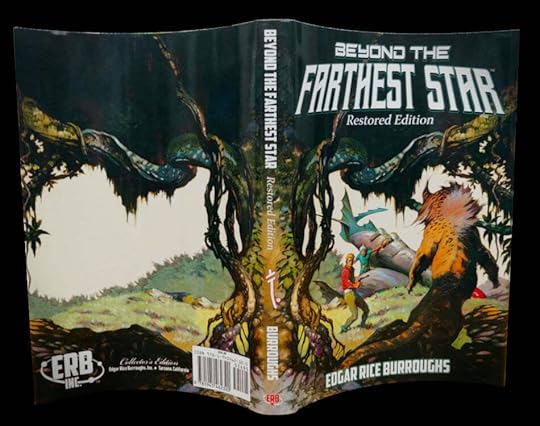
In 1940, as the world hurtled into the darkness of global conflict, Edgar Rice Burroughs turned his legendary writing talents toward an interstellar tale of wonder and adventure set on a war-racked planet-one whose star was so distant that it was invisible to the Earth's most powerful telescopes. Featuring a protagonist who is transported to the planet Poloda by means reminiscent of John Carter's projection to Mars, Beyond the Farthest Star is set in a wholly unique solar system in which all the planets are aligned in the same orbit and connected by means of an atmosphere tube that allows for potential travel between worlds via airplane.
What has been unknown to readers is that the 1941 Blue Book magazine publication comprising Part I of Beyond the Farthest Star was heavily edited, with a substantial number of line edits on almost every page and several lengthy and meaningful passages-some more than a page long-excised throughout. That altered and abridged text was used as the basis for all book editions of the novel-until now. We are pleased to announce that we have gone back to Edgar Rice Burroughs' original typescript from our archives in Tarzana, California, and restored the author's preferred text of the novel in Beyond the Farthest Star: Restored Edition. Now, for the first time, enjoy this classic science fiction adventure in the way that Edgar Rice Burroughs intended it to be read!
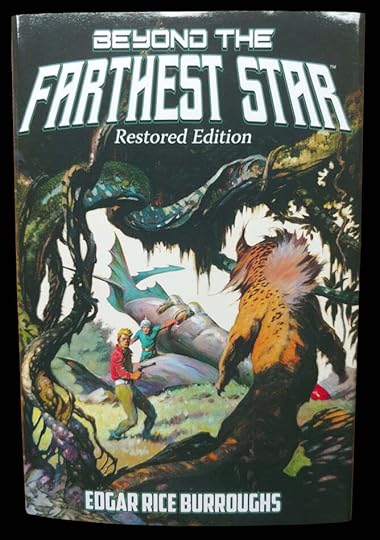
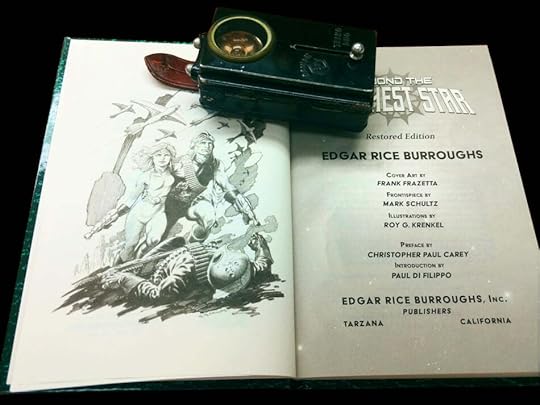
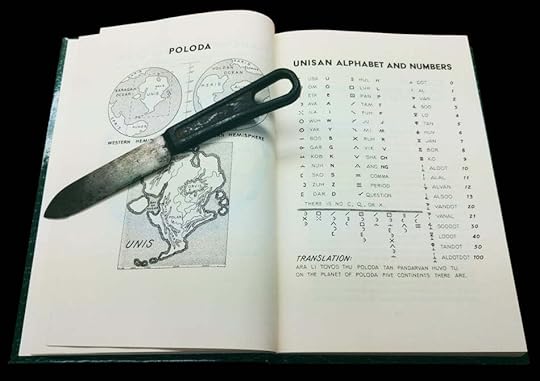
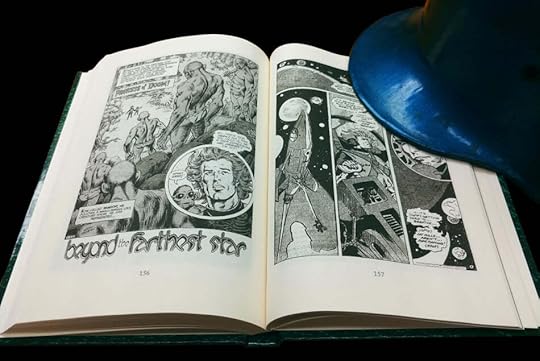
Beyond the Farthest Star: Restored Edition features a newly commissioned frontispiece by renowned artist Mark Schultz; classic interior illustrations by Roy G. Krenkel; an introduction by noted science fiction author Paul Di Filippo; a preface by ERB, Inc. Director of Publishing Christopher Paul Carey discussing the restorations to the text; maps of the planet Poloda and the Omos star system; a diagram of the Unisan alphabet and numbers; and an extensive section of rare and previously unpublished bonus materials mined from the archives of Edgar Rice Burroughs, Inc., in Tarzana, California.
A PLANET IN PERIL
When Nazi warplanes blast an American fighter pilot out of the sky, he awakens not in the expected afterlife but on a far-flung planet-one of eleven interconnected worlds hurtling around a strangely constructed star system. On Poloda, he earns a new name-Tangor, one who came from nothing-and a new home among the brave people of Unis, a nation locked in perpetual war against the brutish, totalitarian Kapars. But when news comes of a powerful invention that could turn the tides of the conflict, Tangor must undertake a daring undercover mission behind enemy lines. There, in vile Kapara, he will not only risk life and limb, but also brand himself as a traitor in the eyes of his newfound friends, as he continues his fight for freedom beyond the farthest star!
Beyond the Farthest Star: Restored Edition (c) 1941, 1964, 2021 Edgar Rice Burroughs, Inc. All Rights Reserved. Trademark Beyond the Farthest Star(TM) Owned by Edgar Rice Burroughs, Inc.
Edgar Rice Burroughs was an American author, best known for his creation of the jungle hero Tarzan and the heroic John Carter, although he produced works in many genres.
“They were all dressed in drab, gray uniforms that looked like coveralls, …”
“… and they wore gray metal helmets that covered their entire heads and the backs of their necks, leaving only their faces exposed … he turned and spoke to his companions in a language I could not understand; it sounded to me something like the noise that pigs make when they eat.”
Some good, some not so good, and a lot of in-betweens!
On the plus side, BEYOND THE FARTHEST STAR can probably be considered a literary fore-runners in the use of “portals” – purely fantasy, with absolutely no attempt at explanation or providing any hypothetical science for their existence of their operation – to transport the novel’s hero from one place (the losing end of a WW II aerial dog fight outnumbered and outgunned by three Messerschmidts) to another (Planet Poloda, 450,000 light years from earth and plagued by endless internecine warfare). The reader will be entertained by plenty of swashbuckling derring-do, good deeds, bravery and heroism even if it is tinted by the perennial misogyny that fills the pages of this type of mid 20th century novel. The protagonist, unnamed on Earth but called Tangor by the Polodan locals who adopt him as one of their own, never strays too far from ERB’s obvious stereotypes of Tanar, Carson Napier or the much better known John Carter and Tarzan.
On the negative side, BEYOND THE FARTHEST STAR is an in-your-face piece of anti-Nazi propaganda that is too stilted to remain entertaining. It’s just all too obvious and too much, so negative and intentionally hateful and demeaning as to resemble a child sticking out its tongue and blowing a raspberry.
I’ll admit to laughing out loud at ERB’s astonishing bit of foreshadowing prescience when he commented on the virtues of the Polodan government system in which their political candidates were expected to demonstrate and prove a certain level of common sense and intelligence:
“I could not but compare this system with our own, under which it is not necessary for a Presidential candidate to be able either to read or write; even a congenital idiot could run for the Presidency of the United States of America, and serve if he were elected.”
Wow … if only he had known the reality that was to come!
P.S. It occurred to me to wonder if WW II Allied airmen called German Messerschmidt pilots " Nazi Fokkers"!
One of Burroughs' last stories and in this one we leave Mars, Venus, and the rest of the solar system to go to Poloda, a planet 450,000 light-years from Earth. Our hero is killed in World War II and awakens on Poloda where he is named "Tangor." It turns out there's a world war going on there and Tangor gets involved. Really a so so story from ERB, but what's most interesting is that for this story he created a completely new solar system, with eleven planets circling the star Omos, Poloda being one of the eleven. A lot of worlds to explore, but Burroughs wrote one novelette set in his new world that was published in his lifetime, and the second was published only after his death, the two novelettes published together as "Beyond the Farthest Star." Too bad we don't get more adventures of Tangor as he explores the planets of the Omosian system.
A perfect meld of war, sci-fi, action, and adventure. Definite Roddenberry vibes in this fun little novella. I will hold out hope that the final half is one day discovered.
Shot through the heart, his fighter plane falling to certain death, a man suddenly finds himself on the distant world of Poloda - 500,000 light years away. With not one word of the language, in a world at war, he nonetheless finds himself a place among the brave citizens of Unis.
It's a bit of a surprise to find Edgar Rice Burroughs conversant with calculation of light years. There's no good reason he shouldn't be, but I've always thought of him as the fantasy end of science fiction, or even science fantasy. The issue isn't too distracting, however, since the rest of the story is ERB pulp through and through, with a strong tinge of WWII.
Written toward the end of Burroughs' life, and doubtless intended as the start of another series, the book consists of two novellas meant for serialization, and with fairly abrupt endings. The plot is thin, and draws on one of his favorite themes - a capable Earth man suddenly transplanted to strange locales, where thinly-clad women admire his genius.
In this case, the country of Unis (representing Good) is at total war with Kapar (which is greedy, rapacious, violent, and fearful). In case you should miss it, Burroughs takes care to point out similarities with Nazi Germany (the book was written in 1940, and presumes war with Germany into 1989). While initially I hoped for a little subtlety and surprise, the Kapars are just as evil as you might expect. I presume it was cathartic to write, and perhaps cathartic for Americans to read, but the story lacks anything approaching subtlety.
Burroughs stretches the capable hero point more than a bit - an ace pilot whose reaction to death is largely 'oh, well', his protagonist is also a designer of experimental engines, and is quite capable of clearly establishing his location as half a million light years from Earth, based on his intimate knowledge of the characteristics of distant galaxies. Very John Carter, in other words.
All that said, the book is a fairly fun read. There's a pretty strong sexist tone throughout (strong women are the ones that don't cry for their fallen men), and more than a hint that blood breeds true, but that's par for the course with Burroughs. If you can set that aside, it's fast-moving and reasonably rousing. Set aside your desire for black and white to have tinges of grey, and it's clear-cut action/adventure.
Burroughs sets each of the two sections off with an unconvincing explanation of ghostly hands typing the story for him. It allows him to start the second with a quick summary of the first, but is otherwise just a distraction.
I can't say that Burroughs became a substantially better writer between Barsoom and Poloda, but certainly the action is clearer. The story has its drawbacks (sexism, lack of realism, blunt wartime references, chopped ending), but it's lively and unexpectedly funny in places, and if you enjoy Burroughs' other work, there's no reason you shouldn't enjoy this as well.
In this one, ERB wrote the first two stories of a new series of which he only completed the ones in this book in his lifetime. The hero, Tangor, was a fighter pilot shot down and apparently killed, by the Germans in the early days of World War II, who awakens on a planet named Poloda which is thousands of light years from earth and where he is named "Tangor" by the locals. His Earth name is not given. He goes on to have adventures typical of ERB stories. There are two cities, Unis which is the city of the good folks, and Kapar, which is based on Nazi Germany.
Found this gem in the bottom of a box at my local used book store.
Expectations exceeded content.
Initially everything felt rushed. All of the frame work that Burroughs normally sets up was hastily erected. The curtains are raised and everyone moved through the paces.
Not bad, just not Burrough's finest.
Beyond the Farthest Star mainly just leaves you wanting more.
Recommended to those who love Sword & Planet books. Just don't expect too much. Expect to leave the table unsatisfied and left wanting.
It's astonishing how briskly this book moves. Burroughs outdoes himself in getting through his usual framing device, this time not bothering to conceal its essentially magical nature, and then dispensing with all the preliminary hey-how-did-I-suddenly-get-here stuff, and then into the story proper.
The contexts of the two halves were what struck me, with the earlier section--written 1941--deeply influenced by the bombings and air combat of World War II, and the posthumously-published later half being a meditation on the rise of the Soviet Union and the dehumanizing existence under a police state. Both take the developing situations to the logical extreme of total war or 1984-boot-in-face-of-humanity.
This is the only time I've seen Burroughs tap so deeply into real-world events, and it appears that his hero becomes his voice, expressing either a weary dismay at the waste and loss of warfare, or a sad contempt for the paranoia and easy betrayals and inherent illogic of a totalitarian state.
I was very pleasantly surprised by this book. I had recently become quite disenchanted with Burroughs' Princess of Mars series as it seemed to have become by the third installment an endless cycle of fight, win, have loved one kidnapped, rescue them, discover more scary aliens, fight, etc. and I expected this book to be more of the same. Particularly when it began in much the same way: our hero is mysteriously transported via unexplained means to another planet which is remarkably similar to ours in that the environment is hospitable and the natives are pretty much homo sapiens. If one can suspend disbelief enough to buy that, well, there is very little that is still unbelievable. Fortunately, this book diverged from that other series almost immediately. While the culture our hero is thrown into is at war, it is not necessarily because they are a war-loving people. They are forced mostly into self defense by the other society of the planet who are if not all-out war-lovers, are at least in no mood to stop until every other nation is obliterated. As the book was written in 1941, it might not be too hard to guess who this is a thinly-veiled reference to. Our hero is not gifted with any supernatural powers (a la John Carter's ability to jump really, really high because of Mars' lower gravity and his over-developed Earth muscles), he's just an ordinary fighting man who might as well go to service in his new nation. They seem like they have a righteous enough cause. He is extraordinarily lucky, returning from several missions that were expected to kill him. As mentioned in the forward, Burroughs did quite a bit of world-building, note writing, and outlining, probably intending to turn this into a new series. Unfortunately, only two parts were completed, the second of which was not published until 1964, posthumously. I would very much have liked to know what happens to our hero next, and the end of this volume, which contains both parts, definitely set up the sequel.
Tangor's one and only planetary adventure (actually two short adventures) which might have been an interplanetary one had Burroughs lived to write more of it.
Fans of Barsoom and Amtor are very rapidly introduced to a WW2 fighter pilot killed in aerial combat who wakes up alive and naked on planet Poloda where he shortly becomes a citizen of a country called Unis which is locked in a century long war with Kapara. On Poloda they wear sequened jumpsuits and fight in planes that are kinda like B-17s. In fact, we get a lot of WW2 preview stuff, including prison camps.
Like a lot of late Burroughs, this is an unfinished work meant to launch a longer one (see “John Carter of Mars” and “The Wizard of Venus”). The 2nd half, “Tangor Renturs”, was unpublished during Burroughs life, which is tragic partly because it is the better half of this book.
This is not the wide-eyed Burroughs of the 1910 who brought you “A Princess of Mars” and “The Return of Tarzan”, but it is the reliable 1940s Burroughs who brought you “Llana of Gathol” and “Carson of Venus”. Much like “Carson of Venus” (and to some extend “The Moon Men”), our hero has to infiltrate a country in the iron grip of fascism. The picture is very complete with secret police, prison camps, a total focus on war, indoctrinated children. Hell, it almost echoes Orwell in bits there, except it's still Burroughs so Unis is unquestionably good and Kapara is perfectly evil.
The first half of the book has some heroic war stuff and dogfights, but not much of a continuous thread to it. I kept waiting for Tangor to crash land in Kapara and deal some hurt to the enemy in person, which the second half sort of delivers.
I'm happy I read this, as haphazard as it sometimes is (dead authors can't edit), although it does show the late Burroughs tendency of having the hero do less in the way of manly hero fighting and do more in the way of snarky comebacks and remaining largely passive. I would have liked some more stuff in the way of weird pseudoscience and sword-fights, but this still has a whole new planet in a far off solar system.
I give high marks for the grueling portrait of the fascist state, much like we saw with Burroughs parody of the nazis in “Carson of Venus”. Tangor doesn't get to squeak by on his wits all the way, but gets a round in the torture chamber!
If Burroughs had a chance to writes a part 3 or 4 and had been alive to edit this, I think this would have been a perfect example of his planetary adventure. As it stands, it is still a ton of fun.
Wow, the social commentary on WWII between the 2 sides was incredibly prevalent in the first half. Only the touch of science fiction and a world thousands of light years away gave this book a feeling of political prose and adventure. The second half felt entirely different with a focus of spy intrigue and modern era of the 1950’s. The focus of prison encampment on the second half felt entirely different than the first half with dogfights in the air and the main character learning the culture of the society he was fighting for. This is war: that is the theme. I was interested, and such a small book held my interest. It was ok, and i was able to look past some of the issues.
Recently, I read my Collector's copy of Edgar Rice Burroughs 's, Beyond the Farthest Star: Restored Edition. This one is definitely worth picking up if you haven't yet snagged a copy. I sat down over the holiday while it was still fresh and jotted down some thoughts on one of my favorite ERB stories, and what is now my favorite version of it.
***************************
Like many, I devoured every Burroughs novel I laid my hands on as a kid, oblivious of the fact that I was reading a different version from what ERB submitted. Sometimes the changes were made by him at the request of the editor, sometimes they were made by others who felt they could do a better job than the man who wrote the manuscript. Knowing that now, I enjoy reading the author-preferred versions of my favorite novels, and if they’re available, I buy them. One of the most enjoyable of these has been Beyond the Farthest Star: Restored Edition.
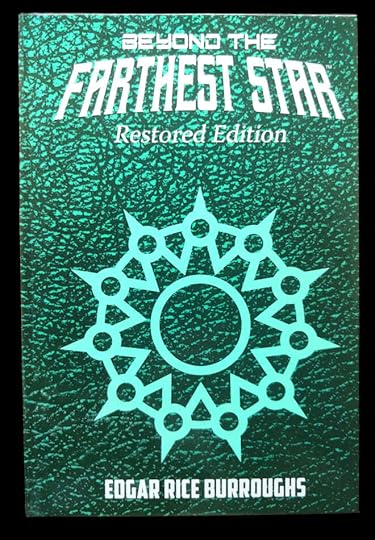
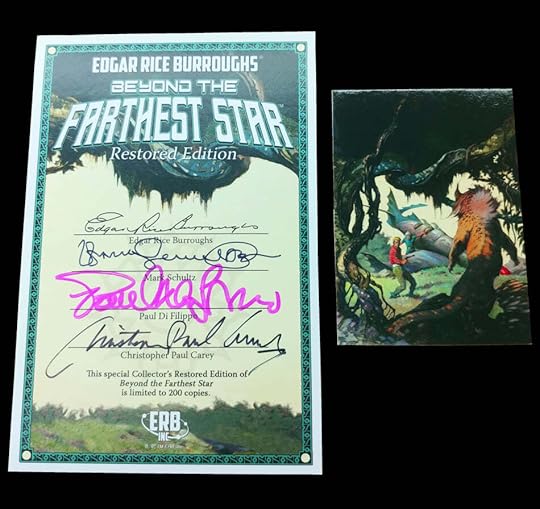
This novel was available in paperback, hardback, Audio CD, and a Collector’s edition of 200 copies; this review is of the latter. In these restored editions it’s crucial that the reader understands the changes, and Christopher Paul Carey’s preface does an excellent job here. To produce this text, Cary visits the Holy Grail of Beyond the Farthest Star . . . ERB’s original manuscript.
Also present is a slick Introduction by Paul Di Filippo, maps, sketches, illustrations, a Unisian alphabet table, and much more. The bonus material is out of this world, giving the reader a glimpse of just how far Burroughs was willing to go when he researched for a novel.
***************************
This edition is the one I would recommend whether one is familiar with the novel or not; actually, one is to be envied if they are reading for the first time this story of a WW2 dogfighter who stops a bullet from the machineguns of a German Messerschmitt; a hero who remains anonymous but for the name Tangor which he is given by the people of Unis after miraculously awakening on their planet, Poloda.
Tangor trades one war for another when he arrives on Poloda, which is, “450,000 light-years from Earth.” It’s a grim world, locked in a century-old conflict instigated by the people of Kapara. The conflict has destroyed the surface cities, condemning the population to live underground where they are safer from the depredations of enemy bombers.
Burroughs summons his dislike for two powerful dictators of the time—Hitler and Stalin—merging them into a heartless tyrant called the “Most High.” Equally monstrous is the Zabo, the secret police of the Kapars (imagine a combination of Germany’s Gestapo and the USSR’s “People's Commissariat for Internal Affairs,” the NKVD, and you have the Zabo.)
But although ERB utilized real-world elements in the story, there is never any doubt but that one is on Poloda; one example of this is his naming convention. Ed excels at inventing interesting names for his people and places; Poloda is no exception. One needn’t worry of feeling that they’re in Moscow or Berlin when Tangor infiltrates the Kaparan capital; rather, one feels that they’re in Ergos, sitting before the Most High, and only a wink away from death.
A man from Earth suddenly finds himself in a strange world on a far-out planet. Where have we heard that before? Well, this novel is actually in two parts. Part one is typical Burroughs fare - lots of action, and strange creatures. In part two the main character travels into enemy territory and it becomes more of a spy novel. Not Burroughs' best in any way, but still an enjoyable little novel.
As a fan of Edgar Rice Burroughs' John Carter of Mars, it's high time I read some of Burroughs' other interplanetary adventure fiction. These two novellas are full of derring-do, heroism, and a pretty solid critique of despotic regimes.
I wonder where Burroughs would have taken the character had he not passed away before writing any further adventures of the former Earthman called Tangor on the planet Poloda.
Just finished reading the restored edition, which restores this classic story to the way ERB originally wrote it. It's been a number of years since I last read the two parts that make up this story, and can't really tell what has been restored, but it still was a very enjoyable read. Too bad ERB did not write more stories about Tangor's adventures on the planet Poloda and its 100 year war.
This was great. I'm a fan of Edgar Roce Burroughs and this definitely has a similar feel and hero like Tarzan or John Carter...but the story also feels a little darker, more commentary on the subject of war, etc. It also feels...incomplete...like it stops mid-story without resolution. But I still enjoyed it just as much as any other Edgar Rice Burroughs story. I just wish there was more of it.
One of my favorites from burroughs, really has some unique science fiction ideas, and portrays great thought out characters. I believe he never finished the second version of this book "a return to" but some of that has been published as well.
“Beyond the Farthest Star was first published in The Blue Book Magazine, January 1942. It was written in 12 days a week after he completed “Men of the Bronze Age” in October of 1940. Tangor Returns was written in only 5 days -- December 17-21, 1940. It’s first publication was 24 years later in Tales of Three Planets, a hardback edition by Canaveral Press, April 27, 1964. It was published with Beyond the Farthest Star, "The Resurrection of Jimber-Jaw", and The Wizard of Venus.”
First thoughts:
I liked this little collection. Easy to read and before you know it you’re done. A man gets killed in a plane war with a German fighter plane and ends up on a planet 400,000 light years away. Somehow he reaches out to ERB and has him type out his life’s story. How he was appearing on the country of Unis on the planet Polodar, how he fights with the Kaparas, and lastly how he decides to go to another planet to help the Unis folks migrate there.
All the planets in their system are covered with an atmosphere between planets, so it’s possible to fly to another. This never happens. Apparently there was supposed to be a sequel but was never written.
ERB writes some pretty interesting stories. The hero has never a dull moment. Clearly the stories are parodies of the Nazi versus the West way of life. The Kapara live under constant suspicion and oppression which the Unis live like the West.
Not as entertaining as John Carter or Carson of Venus and definitely not on par with Tarzan. Still, pick up a copy and be entertained.
In mijn jeugd kwam ik hooguit eenmaal per jaar in de stad. Buiten de bibliotheek bestond het aanbod aan boeken slechts uit de avonturenverhalen bij de dorpsspeelgoedwinkel. Zo werd mijn fascinatie voor (pulp-)sf gewekt. Zo’n halve eeuw later, met meer literaire bagage, schafte ik een aantal dunne boekjes aan van Edgar Rice Burroughs, de schepper van Tarzan. Hij heeft naast Tarzan nog een aantal sf-series geschreven, waarin de (blanke) held afreist naar een andere planeet of het binnenste der aarde. Hier treft hij naast monsters altijd ook een mensenras aan inclusief (meestal op de eerste bladzijde) zijn toekomstige partner, zonder uitzondering een blanke, roodharige schone. De rest van het boekje gaat dan over de plotloze Strijd zonder Vrees tegen de kwaadaardige vijand en/of monsters. Binnen enkele bladzijden vreselijk saai. Zo ook in dit boek, met echter een verrassing in het tweede deel (feitelijk deel 2 in een nieuwe serie, gevonden in zijn nalatenschap, maar geschreven in 1940). In dit 2e deel is de Held als spion in een dictatuur beland, alwaar hij regelmatig wordt opgepakt en verhoord. Die constante dreiging is behoorlijk spannend. Daarom toch een extra ster voor dit verder vreselijk irritant verhaal.
Published in 1976, 'Beyond the Farthest Star' contains two novellas making up up all of a still-born series seemingly planned by ERB. It has the usual plot setting familiar to followers of Carter or Carson - the main character finds himself transported in the blink of an eye to another world, and does his stuff. It didn't work quite as well in my opinion - there are way too many misconceived attempts to use variations of WW2 technology in ways that even the strongest 'suspension of disbelief' thought processes can not ignore. At best, it is a watered down attempt to recycle old ideas, and pays the price.
I am so enjoying Edgar Rick Burroughs books. This one was written during or just after WWII, so it is one of the author's more recent books. I really like his imagination. Not a very long book, but it sure is a fun read. If you do not like Sci Fi at all, then you will probably not like this book either. Even with realistic fiction, there is always something that is far fetched. In this book, a human from Earth traveling hundreds of thousand light years when he dies.
This is my favorite of Edgar Rice Burroughs books. I doesn't go to far but also stretches the limits of what possible. The Zapo share many similar characteristics with the gestapo of Nazi Germany and much of the book is probably based off of what the world might of been if World War ll had been worse.
Burroughs wrote part I in 1941, as the world was getting impacted by WWII. He left notes for an unfinished second part. This audio book version includes both parts, as well as could be done. It also ends on a cliffhanger, with the hero taking off on a continued adventure. Pretty well read, but the narrator seems to use Japanese stereotype voices for the villains.
I really enjoy some of Burroughs series, but this one just didn't go anywhere. I think some people might enjoy the 'behind enemy lines' stuff, but not really for me. Mostly I just felt sad for the guy.
One of the later novels by Burroughs who had by now tasted some of the horrors of war as a Correspondent. He had become more cynical, more realistic and paradoxically more fantastical. Love this book and it has one of the most emotive cliffhanger ending sentence.
3.5. i’m always amazed by authors who can move stories along at such breakneck speed. in this case, a little too breakneck, but still impressive how much world building is done in 125 pages. the warfare was boring but luckily only a couple pages.
The Soviet metaphor was interesting, and the pace of the book was excellent. It only loses a star because it is clearly part 1 and 2 of something larger and does not end satisfyingly.
Plot holes 2 semi's could drive thru ,but I loved the book. All the adventure is too convenient and everything just falls into place. Has a charm that I cannot explain.