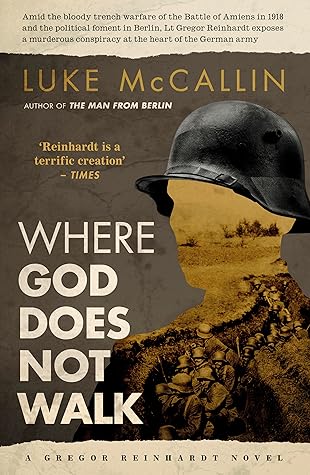
I’ve been a fan of this series ever since I read the The Man From Berlin in 2016. I then read, in quick succession, the next two in the series, The Pale House and The Ashes of Berlin. And that’s where, much to my disappointment, it seemed the adventures of Gregor Reinhardt might end. (I’ll admit to having developed a bit of a crush on Reinhardt by that time.) So you can imagine how thrilled I was to learn there was a new book on the way and that it was a prequel as I love a good prequel.
A prequel obviously presents both opportunities and challenges for an author. The main challenge is that the author can’t change what will happen in later, already written, books. So it’s no spoiler to say the reader knows that, however dangerous the situations in which he finds himself – and they are often extremely dangerous – Reinhardt isn’t going to die in Where God Does Not Walk. But, of course, he doesn’t know that and thanks to the skilful writing of the author, Reinhardt’s many dices with death don’t lose any of their impact, tension or excitement.
On the other hand, the main opportunity presented by a prequel is the ability to delve more deeply into the past of the main character, to explain the background to decisions or actions they may take in later books, and to fill in more of their back story. Where God Does Not Walk does that in spades, taking the reader back to the First World War and introducing us to a young Gregor Reinhardt, only nineteen years old but already battle-hardened. From the off, he shows early signs of the intelligence, curiosity and, let’s face it, rather dismissive attitude to authority he displays in later books. However, what he also shows is a fierce loyalty towards the soldiers he commands, a strong sense of justice as well as a remarkable ability to survive the most perilous of situations. I also loved the first appearance of small details, such as a watch, that readers who’ve read the previous books may recognise.
If you’ve ever wondered what it must have been like to serve in the frontline in the First World War then this book will leave you under no illusion that it was hell on earth. The descriptions of the result of artillery and machine gun fire on human bodies leave little to the imagination. In one memorable scene an appalled Reinhardt, looking around at the severely injured soldiers in a casualty clearing station, wonders at ‘such a butchery of men’. However, if anything, the most shocking thing is the seemingly casual attitude of those who put soldiers into situations where they know few will survive intact, if at all. ‘Men die in all kinds of ways, for all kinds of reasons. Some of them are avoidable. Some of them are accidental. Many of them are stupid. Many are unthinkable’. The book also explores the psychological effects of war, exposing some of the crude treatments inflicted on those suffering from what we would today recognise as post-traumatic stress.
It’s clear a massive amount of amount of research has gone into the book and from time to time I did find I needed to refer back to the list of characters at the beginning of the book to remind myself who was who and what position they occupied in the military hierarchy.
Of course, Where God Does Not Walk also incorporates an astonishingly complex mystery that had me perplexed for most of the time – as was Reinhardt too for a large proportion of the book. As he becomes involved in the investigation of a series of gruesome murders, Reinhardt lurches from one violent confrontation to another as he attempts, in any way he can, to tease the truth from those reluctant, or too afraid, to reveal it. As hints of a conspiracy emerge that may involve some in the highest level of the country’s institutions, there are also signs of a nascent anti-Semitism.
If you’re new to the series, Where God Does Not Walk is the perfect place to start, although I warn you you’ll probably be adding the other books to your wishlist by the time you finish it. And it gets better because the author promises us this is just the start of a new cycle of books taking Reinhardt from where we leave him in this book up to the point we meet him in The Man From Berlin.
Where God Does Not Walk is both a complex thriller and a stark and, at times, unflinching exposition of what it was like in the frontline during the First World War. As one character observes, ‘No man survives a war and is the same man he was at its beginning’. Welcome back, Reinhardt.