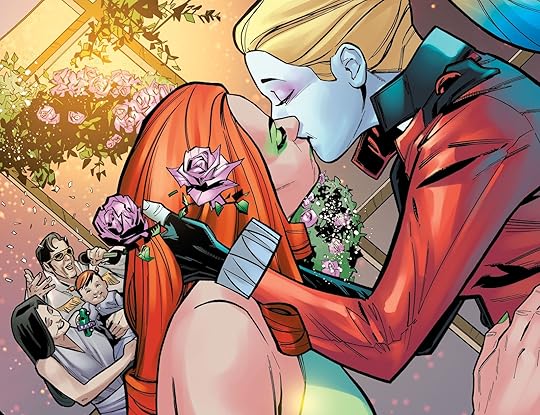
Legacies have the potential to become a bad joke passing on from one homicidal jokester to the next. Or to set up an environment of inspiration for heroes from generation to generation. This tale immediately starts out with great words against tyranny and how it begins with words of promise that the people want to hear, denouncing the censoring of criticism instead of embracing it. The irony is how so many in the comic industry, among other mediums, tend to gravitate towards this exact landscape of an echo chamber and promote virtue-signaling ideas that would censor dissent and criticism of their ideas of being empowered. As the story plays out, it becomes a cliché of Batman and Superman's legacy and history being an object of critique while the toxicity of Harley and Joker, along with Ivy forcing herself on others, becomes one of empowering the mentally/emotionally unkept. DC villains are honestly written now as toxic psychopathic men and healthy fighting women with an honorable cause to chase after. The older era of bad men and women versus good men and women is muddied to accommodate modern ideas of identity, ideas that seem to shallowly address something that deserves deeper dives. The legacy of classic comics seems to inspire heroism more while the legacy of modern comics seems to exhibit self-pain, cliché, and mental instability. Here, the horror of Hitler's conquest (akin to Poison Ivy's call to change the environment to her liking and Joker's desire to be powerful) is rewritten to accommodate the effects of the Amulet of the Lords of Chaos. As if the war wasn't humanity battling itself, good and bad, with people who really experienced the trauma and torture, but instead being orchestrated by an ancient Egyptian amulet that possesses whom it will. Hitler, in this version, didn't kill himself because his mentally unstable power trip had come crashing down and he knew he would be punished greatly, he killed himself because a Nazi spirited possession of Adolf's mind. The art of Rogê Antônio and Cian Tormey is good, the star of the show here. Tom Taylor's story has some interesting points and some lackluster moments, and he can clearly enthrall the reader. I'm not familiar with Wild Cat, but the older era feel of Gotham and noir and pulp detective stories were the better part of this with him and Batman, in contrast to the more modern fads incorporated, and to sum up ever-changing legacy where what once was becomes redefined for the newer crowd, with Wikipedia's own edits: "Modern depictions of Wildcat show him to be a rowdy, tough guy with a streak of male chauvinism, leading to frequent clashes with the relatively progressive Power Girl, as well as exploring some of the character's insecurities."