
Jump to ratings and reviews
Rate this book

The War on Music: Reclaiming the Twentieth Century

Rate this book
A prominent conductor explores how aesthetic criteria masked the political goals of countries during the three great wars of the past century

John Mauceri offers a lively and passionate reassessment of classical music in the twentieth century, in which he argues that the history of music during the last century was shaped by its three major World War I, World War II, and the Cold War.

The War on Music unlocks the mystery of why classical music seemingly produced so few eternal works after 1950, whereas other arts—popular music, Broadway, literature, painting, architecture, theater, cinema—have given the world myriad beloved and highly regarded masterpieces; why the composers considered the future of classical music in the 1920s disappeared from being performed after World War II; why the most heard symphonic scores of the century—music for Hollywood films—became the subject of brutal denigration and dismissal; why the avant-garde of the pre-World War I became the new lingua franca of the Cold War period in the West, and any music that veered from its requirements removed from being performed.

Mauceri follows the data to demonstrate how the politics of global wars used an artform that many might consider unimportant—classical music—as a potent and effective symbol, target, and weapon. Based on more than a half-century of music making and discovery, The War on Music is a plea to return the suppressed repertory—beautiful and unique expressions of humanity—to our concert halls and opera houses, much as the artwork stolen by the Nazis continues to be returned to its rightful owners.

248 pages, Hardcover

First published April 26, 2022

33 people are currently reading
285 people want to read

About the author

John Mauceri

34 books20 followers

Ratings & Reviews

What do you think?
Rate this book

Friends & Following

Create a free account to discover what your friends think of this book!

Community Reviews

5 stars
44 (38%)
4 stars
41 (35%)
3 stars
17 (14%)
2 stars
10 (8%)
1 star
2 (1%)
Displaying 1 - 16 of 16 reviews
Profile Image for Alan (the Lone Librarian on semi-hiatus)) Teder.
2,756 reviews271 followers
July 2, 2022
What Happened to 20th Century Classical Music?
Review of the Yale University Press hardcover edition (April 26, 2022)
It is still viewed as modern, even though its sounds were first heard in the 1940s and then almost without exception in the 1960s, with the music of Stockhausen, György Ligeti, and Krzysztof Penderecki. It is the music many people find absolutely insufferable after two or three minutes. A significant number of music lovers have been taught - and believe - they just aren't smart enough or trained enough to understand it.
Conductor and author John Mauceri makes some sweeping generalizations in order to get his thesis across in The War on Music. He still makes a strong case for how the politicization of 20th century classical music during & after the century's three main war periods (i.e. WWI, WWII and the Cold War) caused a fracture in its natural evolution and its crowd pleasing appeal.

The main thrust of the argument is that when the totalitarian regimes of Communist Russia and Fascist Italy and Germany chose to accept only nationalistic music which supported their regimes and to discourage or even outlaw other music and composers it caused an opposing effect in the countries who fought them. Music institutions, educators and their students, arts & funding organizations instead adopted increasingly experimental and atonal styles as if to show how liberal and free-thinking they were. When Russian Communists only accepted "socialist realism" (read that as 'music & art that regular people could understand') and Nazi Germany banned Jewish composers as being Entartete Musik (German: Degenerate Music). the Allied / Democracies countries in opposition chose anything that signified freedom, including freedom from tonality.

The further effect of this polarity was that many composers who escaped those totalitarian regimes came to America and became film (Hollywood) and theatre (Broadway) composers. The composers who stayed behind were often labelled as collaborators who gave in to totalitarian demands. Paradoxically, both of these groups were sneered at by the elites afterwards. The Hollywood & Broadway composers were dismissed for being too "popular". The "collaborators" were dismissed for writing simplistic, nationalist dreck. All of this without even giving the music itself a proper hearing. The result is that an entire two or three generations of composers have been erased from the popular repertoire of symphony orchestras and opera houses. It is a simplistic argument I know, but look at your local symphony or opera house and see how much 20th century repertoire they play. It is likely only a token amount if any. They don't play the modern composers who wrote tonal music and the audiences don't enjoy the academics who wrote the atonal works.

Mauceri is especially advancing here the music of those composers whom he himself has promoted, conducted and recorded during his career. These are figures such as Erich Wolfgang Korngold (1897-1957) and Kurt Weill (1900-1950) and others. But he does see some positive signs that revivals and/or re-examinations of the unknown repertoire are gradually taking place everywhere. The recent surge of interest in the music of Mieczyslaw Weinberg (1919-1996), being a prominent example.

Mauceri is rather dismissive of Minimalist music (i.e. Reich, Glass, Adams, et al) which likely began in opposition to the increasingly academic and stilted atonal music of the 20th century. He only allocates a single page to those composers. He also ignores the diversity of other branches of classical music that have begun and grown as a result of the main schism. These are things such as music on period instruments, ensembles devoted to baroque & renaissance music and a return to traditional and roots-based music i.e. music inspired by folklore and folk music. Those aren't his theme of course, but there were some positive aspects to the variety that has resulted.

So it may be a simplified thesis, but Mauceri makes the argument very effectively and I did learn quite a lot about many composers about whom I previously knew very little.


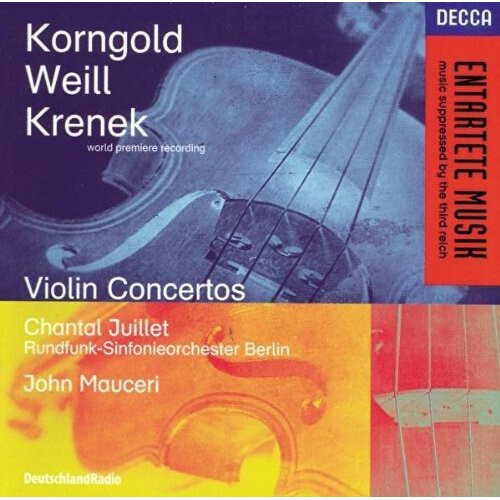
CD Album cover of one of conductor John Mauceri's recordings for London Decca's Entartete Musik series. Image sourced from Discogs.

Other Reviews
Who Killed Orchestral Music? by Tom Teicholz at the LA Review of Books, June 29, 2022.
Songs Without Listeners by Barton Swain at the Wall St. Journal, June 17, 2022. [Note: Link goes to PressReader rather than the Wall St. Journal]

Trivia and Links
There is an extended interview/discussion with author John Mauceri about The War on Music on YouTube which you can watch here.

There is a John Mauceri topic channel on YouTube which has several of his recordings, including some of the Entartete Musik albums, which you can listen to here.
Profile Image for Leigh.
63 reviews8 followers
July 1, 2022
Very readable and persuasive! I have some quibbles because this is a topic I’m passionate about, and Mauceri’s book made me more passionate, which I’m sure would please him.

It feels underbaked when it could have been monumental. His initial thoughts on Wagner and Brahms, and the loving accounts of Stravinsky and Schoenberg, were great — setting up expectations for the rest of the book that were surprisingly underserved. Even the neglected composers that he’s supposed to be championing as the whole point of the book don’t get the kind of lengthy and passionate treatment as he gives to The Rite of Spring. How does it feel to conduct Korngold? What are the best parts? What’s so great about Mascagni? Or for that matter, why should we listen to John Williams? He spends so long arguing for his RIGHT to make that case, and very convincingly, that he runs out of room to actually make the case! He wants institutions to program this stuff, musicologists to dig through the archives and salvage lost gems, and general readers to listen to it with fresh ears — all well and good but come on, brother, give us a top 20 suggested discography at least.

Film and video game music is consistently heralded as a crowd-pleaser and not (refreshingly) merely a guilty pleasure — so where’s the Rite of Spring treatment for either of those? Which film composers are important and why? We get about a dozen names in passing but never the real analysis that he argues they deserve. Game music is even more underserved, despite his bright-eyed claims about it being the future of music — the early decades of the medium are completely brushed off as “bleeps and blurps” (a truly disappointing bit of snobbery from this self-styled champion of the people), while the handful of names mentioned might as well have been thrown in by some millennial assistant, as there’s no evidence that Mauceri ever listened to them.

He also pulls his punches when it comes to his villains. If you’re going to argue that for 100 years the wrong people have been winning all the prizes and all the commissions and all the endowed chairs in composition, give us some names. Show us some evidence. The data would strengthen your argument! Which operas have been beloved perennials at the Met year after year, and which ones have sunk like a stone after their debut seasons?

Mauceri also never presents a satisfactory theory of what kinds of music get included or excluded in his analysis. He’s absolutely right that “West Side Story” is a better representative of 1957 than Stockhausen’s “Klavierstück XI” (or Dialogues des Carmelites by Francis Poulenc, a fascinating composer almost completely unmentioned here) but let’s not kid ourselves — 1957 was the year of “Jailhouse Rock”! And five Miles Davis albums. I’m all for arguments of inclusion and debates about where the popular demand went, but you can’t have a serious conversation about musical tastes in the 20th century (especially wrapping yourself in the flag of “what the public wants actually does matter”!) without reckoning with popular music. You just can’t.

There are a few troubling tells in his handling of Black musicians — Hans Zimmer is called “German” while Lebo M is merely “African” (not a nationality); and the opening paragraph of Chapter 11 is pretty clumsy in its attempt to acknowledge the role of slavery in creating American music. And as usual, gender and sexuality are not represented super well.

Also if I were a contemporary classical composer attempting to write things that people like — an Eric Whitacre type — I’d be super pissed to be left completely out of this narrative.

Still, for what it is — a jeremiad aimed at the elite institutional consensus, but written for a popular reader, and intended to start conversations rather than finish them — it does the job. I’m fired up to rewrite the canon and trace new lines of continuity!
Profile Image for Pat.
8 reviews
May 14, 2022
Super interesting read on a subject I’ve not too much exposure to. Great read and story
Profile Image for Illiterate.
2,839 reviews57 followers
December 31, 2023
I find atonal music hard going. Perhaps that’s why I like Mauceri’s argument that its rise owes more to geopolitics than its intrinsic interest or appeal.
Profile Image for Bri.
442 reviews1 follower
October 20, 2022
This book crystallized the faint suspicions I'd harbored my entire life about music - classical music in particular. I am an amateur musician in the truest sense of the word: I love music, make no profit from it save my own satisfaction, and have nourished an abiding love of music and music-making since childhood. I fell hard and fast for John Williams' scores, Rodgers & Hammerstein's musicals, and played in bands and orchestras from middle school through college.

In college I took music theory courses and encountered music as an elite academic subject for the first time. It was a sobering experience: the composers-in-residence taught and made music that was, to my ears, incomprehensibly unpleasant. The music emerging from the ivory tower was frankly hideous to listen to, and wondered at the gap between the giants of classical music and modern composers (unimportant but pompous). Where had classical music - the good stuff - disappeared to?

This book has the answer to that question, set in proper historical context. In the process Mauceri legitimizes film music, musicals, and even video game music (and pop music to some degree, although Mauceri primarily is interested in symphonic music). What I love most is his resurrection of the idea that music can and should speak directly to the listener, without academic or intellectual middlemen.

I love this quote in particular: "Creating art that abjures comprehensibility is not only unsociable, it runs counter to the way humans hear and process sounds." Take that, art/music snobs!

Profile Image for kac attac.
24 reviews7 followers
July 7, 2023
Scattered amongst the howlers is a story that deserves to be told. Two stars for that story, zero for its rendering here.


This review is both too long and too vague. I blame the bullshit asymmetry principle.


+=+=+=+


There are some notes and citations at the end, but really this is a polemical work and not a scholarly one. It is a mad dash on the hamster wheel for Mauceri, who repeatedly stakes out some patch of moral high-ground only to tell on himself later. Even the digression on sour liner notes is recapitulated when, in the acknowledgments, he says, "Many peers have read this manuscript, some of whom were enraged. ... What was hated—and why—taught me a great deal." One can only hope. But for now he has merely doubled down, as any polemicist must.


The first tell: he finds it "ironic that Hanslick's anti-futurist conservative philosophy was subsequently taken up by the modernists of the twentieth century." There shouldn't be any irony in this for someone who is willing to dispense with the myth of progress and the top-down critical diktats that perpetuate it, nor for someone who maintains that "Human nature—why we make and listen to music, and how we perceive sound—does not change." The fluidity of radical and reactionary positions over time is an old story. Ditto the cyclical threads of history generally. This could be because "human nature" is a bounded diversity rather than a predictable formula. Mauceri's attempt to reduce "how we perceive sound" to just such a formula is embarrassing and undercooked. His definition of "anti-aesthetic" as "not tonal and not sounding like a continuity of the past" wouldn't pass muster in a freshman seminar. Someone (perhaps an "enraged" reader of an early draft) has impressed upon him the need to signal his awareness of something called "the intentional fallacy," but he is quite willing to commit this fallacy even so. I could continue a long list of howlers, but I stopped logging them because there were too many.


Suffice it to say that the unexpected reappearance of the "absolute music" subtrend becomes "ironic" only after it is given a genetic, top-down explanation and an ultimate test (the Wisdom of Crowds) which it is bound to fail. "Movies," in contrast, "can be seen as an expression of what music was already doing in people's minds," that is, what it was doing even before the advent of self-conscious "program music" or the invention of cinematic technology. I think this latter approach is generally the right one. I am unsure why it can be applied to the meat of the "human nature" bell curve but not to the tails.


I am not here to promote twelve-tone music. I don't listen to much of it. I do think that the high-modernist conceit to "absolute" or "pure" art has always contained within itself a populist antithesis, and that this still, now, has not been properly reckoned with. If we're more sporting towards Hanslick and/or the Modernists, we might venture that, like those early program music composers he so detested, Hanslick was already onto a few things that had implications far beyond what he, in his time, was able to imagine. Forget Bach, Beethoven and Brahms, I'm talking about Augustine ("Try to build up yourself, and you build a ruin"), Otto Rank ("arguing theoretically back from the contemplator to the creator...is a fallacy"), Lewis Mumford ("to have the right amount of the right quality in the right time and the right place for the right purpose is the essence of morality"), Susan Sontag ("The world, our world, is depleted, impoverished enough. Away with all duplicates of it, until we again experience immediately what we have"), and especially Christopher Lasch ("The liberal principle that everyone is the best judge of his own interests makes it impossible to ask what people need, as opposed to what they say they want").


Self-styling and storytelling are not right for every time and place. It is possible to have too much of them. Most people say they do want these things, lots of them, always and everywhere; yet sometimes it is obvious that this is not what they need; and if not then someone else has to be the one to tell them. When the more powerful make such declarations to the less powerful, this evinces "elitism." This is an unfortunate wrong turn that many avant-gardists have taken. This charge of "elitism" misleads many observers, however, into an overcorrection towards that good old "liberal principle" of rational self-interest, at which point, just as Lasch feared, no one can criticize or make demands on anyone else. But really it is the people around us, our nonelite peers and relations, who are our most able and most just critics. Because they have some skin in the game and a view from the outside, they usually know us better than we know ourselves. This is a core finding both of classic psychoanalysis and modern social psychology. When our story doesn't add up, they are first to notice. We should want them to tell us.


On this point, here is a genuine irony: Mauceri resents music becoming "a pawn in the chess game of politics" yet he is pleased that "music has always had a narrative propensity." He breezes along as if these were different things. Really, the first can't happen without the second. What is the politicization of music but the accretion at scale of many individual stories people tell themselves? Because the 2010s and 2020s have seen music and art getting politicized in new and insidious ways, a book such as this might have at least made mention of that unfortunate reality and pointed out parallels (or the lack of them) with prior history. In any case, it's not hard to see why the conceit to "absolute music" would be attractive, if not as a viable countervailing force then at least as a symbolic gesture of abstention from today's faux-activist clown show.


Another irony, then, (if it is not simply a self-contradiction), is that Mauceri ends up more than halfway to an "absolute music" platform despite unfurling a series of platitudes in favor of the "narrative propensity." "In some respects," he writes, World War II "is a war that never seems to have ended." "Hostilities" evince merely "a euphemism to represent armies standing down," for they "clearly continued—and will continue as long as there is memory." He is banking on the cleansing effect of time to wash away those memories: "Perhaps the simple answer to this complicated story is; play the music." Bravo, Maestro! But the mere assumption that this is possible cuts against any simple parallelism between composition and reception.


And finally, the big tell: this is a leap he is prepared to make only when it serves his polemic, and otherwise not. With Stockhausen, e.g., the simple parallelism carries the day. "Look carefully at a photo of Cologne in 1945 and imagine a motherless seventeen-year-old," surrounded by devastation and "self-punitive architecture that was being constructed" amongst the recovery effort. "The horrors of war made beauty inappropriate," hence "this dissonant music is redolent of loss." With Respighi, meanwhile, the simple parallelism is nowhere to be found. Even before the first World War, Respighi "was already composing exactly what Mussolini wanted." How or why is not mentioned. Respighi thus never joined the Fascist party because he "did not need to." His music was able to enter the fringes of the canon while so much else was suppressed after the war. Very interesting developments here, but somehow not interesting enough to warrant "looking carefully" at teen Respighi's architectural habitat or his parental situation. Stockhausen's music merely reflects his life experience while Respighi's music transcends his. We are to remember one biography and forget the other. Why should that be?


Anyway, "perhaps now that you know this story" of Stockhausen's early life, "you will open your ears to what he left us." Perhaps. But elsewhere Mauceri's aim (which I endorse) is to dethrone precisely this kind of insider trading. "Ask most people about art, especially classical music, and you will get something like, "I really don't know anything about it." Here's the secret—you know everything you need to know about it." Bravo, Maestro! But if listeners already "know everything they need to know," then what's with the "motherless seventeen-year-old" bit?


There are plenty of people around today, both young and old, who would not go near anything that was "exactly what Mussolini wanted." If they were told that any old minor dictator had used toilet paper, they would want to stop. Of course this is absurd, and so is Mauceri's reaction to conducting Stravisky's Sacre. At one juncture, he claims to feel that "part of me is committing a violent murderous act, while another part of me feels as if I am literally being hit eleven times." This is how he "feels" during a made-up piece of music written around a made-up story. This is supposed to be another illustration of "the eternal adolescence of the avant-garde" which they themselves are bound to outgrow: "I never wished to go there or be that person again—and, it should be said, neither did the composer." What it really shows is that there were millennial snowflakes long before the turn of the millennium.


+=+=+=+


Here is the money quote from Wimsatt and Beardsley's original paper on "The Intentional Fallacy":


"Is not a critic," asks Professor Stoll, "a judge, who does not explore his own consciousness, but determines the author's meaning or intention, as if the poem were a will, a contract, or the constitution? The poem is not the critic's own." He has accurately diagnosed two forms of irresponsibility, one of which he prefers. Our view is yet different. The poem is not the critic's own and not the author's... The poem belongs to the public, it is embodied in language, the peculiar possession of the public, and it is about the human being, an object of public knowledge."


Mauceri of course emphasizes the public-as-market, but the market is only one aspect of the broader public order. Artworks "belong to the public" in W+B's sense above whether or not they find success in the market. This includes avant-garde works.


As I tried to show above, being against elitism in such matters is more straightforward than being for populism. Uncritical acceptance of the Wisdom of Crowds is merely another "form of irresponsibility." The crowd doesn't care about what we need or how much of it. Our peers and relations would have a better idea; but that is a village populism which has become unavailable to many people. By the same token, so-called Cancel Culture shows that the widest market success can be strongly countervailed by the soft power of a much smaller number of people, in which event the artwork-as-market-commodity has ceased to "belong to the public" even in that limited capacity.


If it seems absurd to apply such deathly serious logic to some offhand remarks about Respighi and Stockhausen, that's because the stakes there are so low. The earth won't fly off of its axis if there were, in fact, other decisive factors in Stockhausen's development besides the ones Mauceri gives, nor if the ones he gives were not actually as decisive as he says. But the artwork now belongs to the critic, who says it belongs to the composer. It no longer belongs to the public, not because of any elitism but because the public order is, as Lasch once put it, impersonal, whereas Mauceri's theory of "the human being" as "an object of public knowledge" varies depending on which human being(s) he is discussing.


Mauceri notes that "Charles Ives made a distinction between the Unknown and the In-known, the latter being what we profoundly sense but cannot prove or even explain." Even as a strictly private matter, this is a dicey proposition. Human beings are terrible at differentiating perceptions from delusions. (Messrs. Kahneman and Taleb have the dirt.) What elitists "profoundly sense" but "cannot prove or even explain" is that the plebes do not, in fact, know everything they need to know about music in order to make sense of it. Racists "profoundly sense but cannot prove" their own ethnic superiority. If we reject these "In-knowns," on what basis can we accept others?


In order for such propositions to be actionable, the democratic public order generally requires proof. Judges, clients, neighbors and spouses tend to find our "profoundly sensed" inferences somewhat less profound than we ourselves do. Democracy affords expression of the unprovable, but formally it cannot accommodate epistemological anarchy. This is why making art is primary and talking about it is secondary: truly free expression is also "free" of any warranty as to truth, honesty, or sincerity; criticism purportedly belongs to that part of the public order where these things are de rigeur, yet it deals with a subject which may defy all of them, all at once.


I formulate the problem this way because it suggests that for art to shape the public order prospectively is playing a dangerous game. Of course not only does this happen, but it is often put forward as precisely the mandate of art, especially by activists. That is a curious development of the twentieth (not the nineteeth) century to which "absolute" art is staunchly opposed. Mauceri is opposed to it too, but only sometimes, as when fascists and commies are the culprits, coercing people against their wills. Hollywood gets a free pass because its audiences have been complicit and avid. Yet under Hollywood's influence the public order has fared very badly. It doesn't take an Adorno to see that.


It's obvious, then, why criticism must be "objective" in order to fulfull its mandate; or if not, then it's unclear what criticism's role is besides giving a platform to a few pompous idiot savants. But here too, all sorts of bizarre rationalizations are put forth for why conjectures ought to be admissable after all. (To be sure, if Stockhausen himself loudly proclaims exactly what Mauceri says here about his biography, he also is making a conjecture.)


The only thing that can keep this train on the tracks is the periodic force majeure imposition of some greater certainty. The resurfacing of an old manuscript can quickly settle disputes over authorship or priority. But those are simple (often binary) questions. Why an artist made their art is an intractable question. Science has churned away at it for a long time and come up with remarkably little bankable evidence. The ease with which Mauceri resolves it is frankly absurd and, dare I say, a little scary. It shows how little he has learned from the events of which he writes.


Again, Lasch: "Formally democratic institutions do not guarantee a workable social order." Similarly, Mumford: "What my friend Matthew Nowicki used to say about architecture—that a great client was essential in the production of a great building—holds for every other form of art." In other words, communities get the art, the criticism and the democracy that they deserve.


The evidence of observable behavior alone is usually insufficient to explain exactly how we got from client to building, or from polity to law. Meanwhile, efforts to tease out the unobservable factors have been worse than unsatisfying; namely, they have been low in predictive power and high in innuendo. The arts are hardly the only area where such innuendo is on offer, but it's hard to think of another area where it is so readily accepted as fact. We can either stop accepting it or we can pay the price.


+=+=+=+


I was lent this book by a friend who knows me well enough to presume my interest in the topic but not well enough to anticipate my reaction. As it happens, I was an eager but troubled reader of Kyle Gann's blog throughout the 2000s and 2010s and therefore have long since had my fill of tonal Boomer score-settling. In college I refused to read much of the Grout beyond what I needed to cram for exams, but I did check Hanslick's (in)famous book out of the library and read the whole thing eagerly. It was unmistakably foreign, and it made all the sense in the world. Ditto Cage's Silence, Schoenberg's Style and Idea, some of Robert Schumann's criticism, and a few other things I've since forgotten. These were the first books I ever enjoyed reading, and they were the last ones for a long time. That fact alone indicates that I'm not Mauceri's target audience. But as I get older I've been trying more to give myself over to happenstance, so when I was offered this book and a glowing recommendation, I accepted. You win some, you lose some.
Profile Image for Zach Reading.
13 reviews
July 3, 2025
Interesting read that raises lots of questions and a passionate promotion of some of the lesser heard composers of the 20th century. Generally well written and informative though I think it missed out on some developments of the later 20th C that have endured.
93 reviews2 followers
July 17, 2022
John Mauceri has a deep and broad knowledge of Western music, but lacks the ability to compose a tight, compelling argument. The book's main argument is that much of 20th Century classical music after World War 2 has been excluded from concert halls, radio, and audiences generally. Why? After the war, national governments took positions on what type of classical music represented political values the best (realist, standardized forms in the Soviet states; modernist, disruptive music in the West) and funded performances and institutions to promote and perform this music, accordingly. Critics built and defended a view on what constituted compelling, innovative music that favored challenging, disruptive works over continuation and elaboration of the Romantic tradition. Pierre Boulez serves as the arch-facilitator of this paradigm in his capacity as conductor and critic. The careers of Schonberg and Korngold are described as tragedies.

And it would be enough if Mauceri had just written a focused book to unfurl and explore this argument in detail, perhaps diving into which institutions and critics championed the different political agendas, and how those efforts affected popular taste, or not. But instead there is a whole other book within this book that brings to light the stories of how European composers fled Axis powers, made careers in the U.S. (particularly in Hollywood), but couldn't find purchase for their music in Europe because...

Well, frankly, Muaceri's muddled discussion of these composers' reception in Europe following their migration to the United States makes it difficult to easily recall why audiences rejected their new works. Perhaps it was because move music was considered critically unworthy of attention. I can't be sure because instead of offering a straight-forward thesis Mauceri uses a lot of ink showing how the tradition of writing great music fit for performance has a long and rich history marked with the contributions of great composers.

So Mauceri is explaining that the new music (composed in both movies and in non-programmed forms) was worthy of attention which it didn't get (for political-cultural reasons that aren't neatly unpacked) and this trend persisted right up through the end of the 20th Century. But there's no simple sentence tying this point together.

Overall I enjoyed learning about a lot of composers I didn't know about and the cultural and political forces that shaped what we understand as the canon of classical music. But there's a tighter, more focused book that could be written about this same subject that Mauceri, or his editor, couldn't quite wrestle to the ground in these 200 pages.

22 reviews
July 8, 2025
John Mauceri holds a mirror to classical musics insitutions, norms, and mythology to answer the question "Where did all the new music go?"

Put simply, the world wars did it. Fascist regimes in Italy and Germamny forced out their brightest talents out of the concert halls and opera houses. Names like Hindemith, Menotti, Korngold, Schoenberg, Weill, Toscanini, all were driven to America, where they continued to create great music for film and theatre. And for this crime of embracing a new art form, one that appealed to the masses, they would be exiled from the artistic world that had created them.

He argues strongly against the elitism and snobbery against film music, which traces much of its lineage to Wagner and Mahler. Maligned composers such as Korngold, Menotti, and Schoenberg in his American style are defended with a passion that shines in his prose.

Elitism in the form of an instituional avant-garde in conservatories, universities, on the boards of orchestras and opera houses has created generations of musicians who scorn tonality and the very idea of popular appeal. Why does the New York Times, Mauceri writes, dedicate more column inches to Stockhausen than any other composers people have actually heard of?
Profile Image for Al.
274 reviews1 follower
September 20, 2022
A paixão do autor pelo tema reflete tanto no inconformismo como, um pouco na credibilidade de suas afirmações, afinal. Suas posições são fortes, apontando a crítica do público elitista e das instituições como frutos do pensamento ideológico do jogo do poder, sendo a música representante da ala progressista ou da conservadora. Dentro desta briga ultrapassada, uma vez que ambas as vertentes são ignoradas pelo grande público atualmente, a música que representa nossa contemporaneidade é discriminada como arte menor por estar atrelada a outras formas de entretenimento, como cinema e jogos, sendo, por isso, não considerada "séria". Entretanto, além de reunir provavelmente os maiores compositores em atividade (desde a década de 1930!), a música que viaja nos meios eletrônicos também é capaz de atingir um número de fãs nunca antes imaginado por nenhum compositor antes. Talvez seja necessário algum conhecimento de história da música antes de embarcar nesta leitura,
178 reviews7 followers
January 12, 2024
Politics and real-world events influence music creation, and political and aesthetic opinions influence how music is received and exposed. This book questions why so little modern classical music (from about 1910-onwards) is performed, even by the very musical institutions that commissioned said works. An interesting and complex read that in the end tries to convince the reader to simply revel in their own enjoyment of whatever music they like, whether if it is a movie score or even music from a video game, because all music has been composed by an artist whose work should be regarded seriously.
Profile Image for Jiří Slabihoudek.
3 reviews
March 11, 2025
We get it, John. You like Korngold and don’t like Boulez.

You didn’t have to write a whole book full of chaotic rambling (was there even an editor?). A book full of manipulative cherry-picking of numerous quotes to make a point—not very original, either.

Occasionally, there were some witty remarks, hence the two stars.
Profile Image for Andrew Austin.
302 reviews9 followers
February 12, 2023
Even if you know a lot about the classical music world, there is so much in the book. What the future looks like. How wars of the 20th century affected the world of music. Personal stories with various composers. Etc.
Profile Image for Matt.
94 reviews201 followers
September 23, 2023
A theory of how contingent political events (WWII and associated events) put classical music on a weird new trajectory that was disliked by most people, yet was able to continue for generations due to path dependency in elite taste. All new to me!
82 reviews3 followers
August 13, 2022
Waht an incoherent and most boring book this is. It seems as if the author of it did not really know what to write or what thesis he wanted to present. skip it by all means.
Profile Image for Alice.
67 reviews
abandoned
November 13, 2022
Argument is really hard to follow and writing is meh. After 50% mark was trudging through. Interesting subject matter though
Displaying 1 - 16 of 16 reviews

Can't find what you're looking for?

Get help and learn more about the design.