Gripping narrative non-fiction with STEM and social justice themes that proves cities can be surprisingly wild places—and why understanding urban nature matters.
What can city bees tell us about climate change? How are we changing coyote behavior? And what the heck is a science bike? Featuring the work of a diverse group of eleven scientists—herself included!—Dr. Cylita Guy shows how studying urban wildlife can help us make cities around the world healthier for all of their inhabitants. In the process, Guy reveals how social injustices like racism can affect not only how scientists study city wildlife, but also where urban critters are likelier to thrive. Sidebars include intriguing animal facts and the often-wacky tools used by urban ecologists, from a ratmobile to a bug vacuum. Cornelia Li’s engaging illustrations bring the scientists’ fieldwork adventures to life, while urban ecology challenges encourage readers to look for signs of wildlife in their own neighborhoods.
Stellar, top notch idea that seems less than expertly executed to this adult reader. Written by Cylita Guy, illustrated by Cornelia Li, and apparently assembled by committee, Chasing Bats discusses eight different urban ecology studies for the middle to upper grade reader. A short indroduction is followed by four pages of 'key terms,' serving, I suppose, to help guide the novice science-minded kid through the next eight chapters ('urban, experiment, data, bias, processing and results' are all among the terms). Each chapter covers a different study:
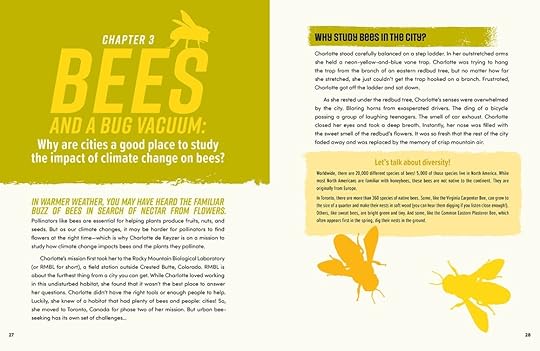
-Chasing Down Big Browns (bats in city green space) -Ratmobile to the Rescue (rats and spatial distribution) -Bees and a Bug Vacuum (why cities are a good place to study climate change and bees) -Backyard Bear Buffet (bears and human conflict) -Bold Coyote, Bashful Coyote (coyote and human conflict) -Microplastics, Major Problems (pollution and city animals) -Birdwatching Bias (citizen science reporters area bias) -A Bike to Beat the Heat (greener cities and heat)
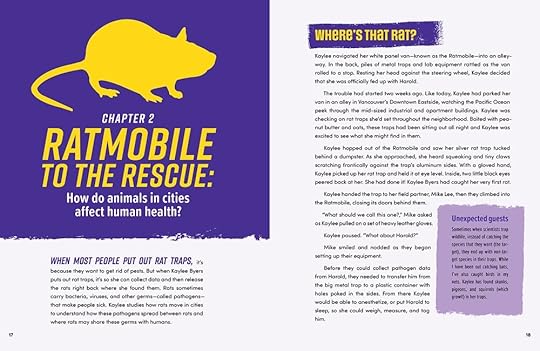
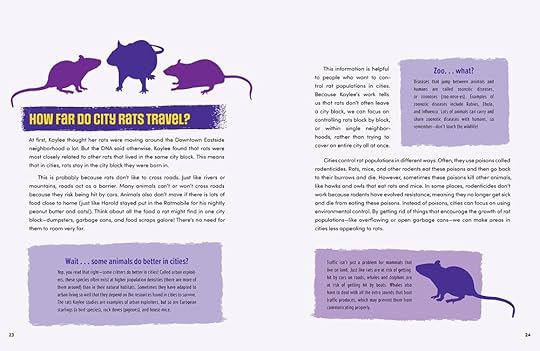
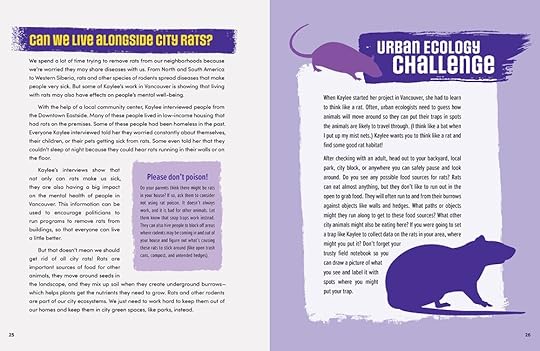
One thing that is odd about these chapters is the way it purports to be about a particular scientist's work, but then focuses on something else instead. For instance, the 'Ratmobile to the Rescue' chapter is subtitled 'How do animals in cities affect human health?' yet the first two pages cover an anectode about how one of the rats escaped and was living in the research van (also, kudos to the researcher for allowing her mobile lab to take center stage over her actual, you know, research). I'm a little fuzzy on the actual health connection to the rat DNA samples, as the biggest aspect of health discussed was mental impacts (and thus, whether or not rats were related by DNA and traveled really wouldn't matter, would it?) So my own science brain was rather puzzled about what the exact study was, and how the conclusions were drawn.
Format is equally scattered. Each chapter is told in a piecemeal way with the study broken down into sections and interrupted by information boxes. Try picking out the thesis in this opening paragraph on bat research in city spaces: "I bet the last time you played at the park, you saw some wildlife sharing it with you. Birds in trees. Squirrels running around. Turtles sunning themselves on rocks in a pond. Parks and green spaces are often the closest thing to the natural habitats of animals and plants in urban environments. So, we like to think of them as being good habitat for wildlife in the city. That's what I thought when I set out to study city bats in High Park--a large green space in Toronto, Canada. It seemed like the perfect habitat for city bats. High Park is full of tall old trees that bats might like to sleep in. It also has a large pond that bats could forage--or hunt--for insects."
It continues with a story about a police officer coming upon the scientist and her partner as they were researching, a section on why we should care about bats and how she figured out where they roost. Interestingly, there aren't any numbers or proportions in the reported results, except for the word 'most' ("most of the bats I caught in High Park were males--not females." and "And most of the bats I radio-tagged seemd to only feed in the park for part of the night before disappearing") which again leaves me with more questions.
Just not well written. I pity the kid that has to pick their way through that. I'm told the text is 6th to 8th grade-ish (I'd guess sixth by more rigorous standards). There's quite a few block-print/cartoon-style illustrations that accompany each section and mostly serve to highlight a particular issue in the story. The pictures are also used to illustrate the scientist in the scene, setting the story, if you will. In some cases, they take up an entire page, making the book skew younger.
Interestingly, the above scientist was stopped by a police officer demanding to know what they were doing in the park in the middle of the night (presumably, Researching While Black). The coyote and bird sampling ones have similar encounters with enforcement or the public, which brings attention to the supposedly 'impartial' issue of science and how bias can impact both how research is able to be done and who gets to carry it out. This is clearly one of the strengths of the book.
I've no doubt that the format is designed to appeal to those with short attention spans, with inset boxes about tools of research, insights about species, species diversity, how the reader can help and public perception. While I can understand the value of sidebars in giving inexperienced readers helpful or interesting background ("Sometimes when scientists trap wildlife, instead of catching the species they want [the target], they end up with non-target species in their traps..."), I feel like more thoughtful text could just have integrated that information. Surprisingly, the author has 'science communicator' listed on her jacket biography.
At any rate, I love the idea of both urban ecology and making scientific studies available to younger audiences. Personally, I checked it out because I've had my eye out for studies focusing on lives of urban wildlife--for instance, for all the neighbors complain about chipmunks, do we really have any idea how many live in an average yard? Or how big their burrows are?--so I got this hoping for more insight and maybe some studies I haven't heard of. These were pretty routine for the environmental/ animal wildlife field, although the rat one was new to me.
It's also worth noting the scientists involved in the studies are women and/or people of color and so can represent STEM to kids who may not see people who look like them in the sciences. With eight different studies, it also gives a wide perspective of what 'science' can look like, from animals to plastic to bike-riding. It also deserves kudos for being one of the first non-college books I've seen that actually describes both the research process and potential implications of the research. Because of that, and since I recognize I am absolutely not the target reading demographic, I'd recommend that all middle school librarians should absolutely buy this for their libraries. Adult learners who already know something about science? Just look through a recent copy of Nature.
Very cool premise. Profiles of scientists studying different urban animals (rats, bats, birds, bees, etc.): how they do their fieldwork, why their work is important and also challenging, why cities can be good for animals, plants, and humans. The book also offers suggestions for scientific work kids can do at home. Pedagogically impressive, and suffused with consciousness about race and class. (One scientist is Karenned for Birding While Black, for instance, and the author took care to find scientists of a variety of backgrounds to profile.) Very informative, if a little exclamation! point! heavy! I liked the busy layout — it kept my visual interest, though I didn't love the generic digital illustrations. Great for classrooms and families looking for home lessons; maybe a bit dense for most kids to want to read for fun on their own.
This is an excellent introduction to urban ecology for middle grade readers. The book provides an overview of key terminology along with a series of fascinating case studies that are shared in an accessible and engaging way alongside colorful illustrations. Each chapter offers a challenge or activity to encourage readers to learn more about urban wildlife firsthand. I also really appreciated how this book discusses environmental injustice, showing the complex ways that environmental issues intersect with racism from the discrimination ecologists of color face to the fact that poor and racialized communities have less access to green space. Highly recommend!
Loved the mix of urban ecology and social justice, and also thought the suggested activities at the end of each section were a good addition.
The layout of the book was also really good for younger readers. I’m excited to see it with final illustrations. This would be a great addition to an elementary school library or classroom.
* thanks to NetGalley and Annick Press for the eARC. Expected pub date: November 9, 2021.
I loved the combination of urban ecology and social justice found within this book. Too often we forget about the wildlife found in more developed areas and just how important they are to all forms of life. This is a great book for science lessons or to simply learn more for fun.
This unbiased review is based on a complimentary copy provided by the publisher.
The Publisher Says: Gripping narrative non-fiction with STEM and social justice themes that proves cities can be surprisingly wild places—and why understanding urban nature matters.
What can city bees tell us about climate change? How are we changing coyote behavior? And what the heck is a science bike? Featuring the work of a diverse group of eleven scientists—herself included!—Dr. Cylita Guy shows how studying urban wildlife can help us make cities around the world healthier for all of their inhabitants.
In the process, Guy reveals how social injustices like racism can affect not only how scientists study city wildlife, but also where urban critters are likelier to thrive. Sidebars include intriguing animal facts and the often-wacky tools used by urban ecologists, from a ratmobile to a bug vacuum. Cornelia Li’s engaging illustrations bring the scientists’ fieldwork adventures to life, while urban ecology challenges encourage readers to look for signs of wildlife in their own neighborhoods.
I RECEIVED A DRC FROM THE PUBLISHER VIA EDELWEISS+. THANK YOU.
My Review: Another book whose worldview and frame of reference I share, so I strongly recommend to you. This is #Booksgiving. We need young people...grandkid age for most of us, from 8 on up...to reframe their relationship with the urban world they live in. The best way to do that is to say, "you know how rats are talked bad and mean about? Here are some facts that you need to know about rats:" ...and lo! There's a fact file in front of the hateful messaging that has led to vital ecological members being abused and eliminated, with all the problems that always brings. (Remember what happened when we slaughtered the wolves in Yellowstone? Let's learn from our mistakes and pass it on to the kids whose world this is.)
Dr. Guy doesn't stint on the role of social oppression and stigmatization in the urban environmental crisis. We should all be scared about the bees being in ill health. Urban areas have, and need, bees as well as the countryside. The ways to help bees navigate the urban landscape, and what to look for in a healthy urban ecology, could stand explaining: A good book filled with the right kind of ideas about the world, its problems, and the best solutions we can think up to those problems. (In my opinion, of course.)
Great #Booksgiving gift for the still-single-digit aged budding scientist, or garden lover, or really anyone at all in that age range.
This book will answer some basic urban ecology questions such as:
why wildlife rely on city green spaces how do animals in cities affect human health what are cities a good place to study the impact of climate change on bees what happens when humans and wildlife in cities don’t get along how are humans changing animal behavior in cities how does the pollution we create affect city animals what happens when citizen science doesn’t tell us the whole story why are greener cities better for people Each chapter poses one of those questions and then seeks out to answer it. Backed up by illustrations and sidebars of information, children will get to know how city ecology works. The book is listed as ages 9-12 but I’d recommend 12+. I found it a bit hard to follow and I can’t imagine my 10 year old paying attention.
I love all Annick Press books, especially the nonfiction. Their nonfiction is always very informative. If city ecology is you’re thing, this is a good starter book for any age.
I received a copy of the book in exchange for an honest review
I received a copy of Chasing Bats and Tracking Rats by Cylita Guy and illustrations by Cornelia Li from Annick Press in exchange for an honest review.
This was a wonderful non-fiction title that explored urban ecology and all the species of life that shares the urban environment with humans. Many different scientists and urban ecologists shared their studies in this book and the book gives great insight into the work that they do and how their research can help humans understand the nature at work even in the busiest and most bustling of cities. I am particularly pleased that this book features Canadian cities as well - yes, Toronto! - and I will be using this book in the classroom with students.
Yes, note the subtitle. Because of the history of redlining, and because Black scientists still encounter angry racists, a city is not a monolith... and yet not all of it can be studied. But the scientists whose work is profiled here are doing an amazing job to collect valid data from diverse neighborhoods, using many different smart strategies.
An even better thing about the book is that it has v. cool projects kids & families can do.
Includes back matter.
Highly recommended to all, esp. families, whether or not they homeschool, and to all science teachers.
Excellent book! Lovely artwork. Each chapter introduces a scientist and the questions they are trying to answer, like how far do rats travel in the city. I enjoyed the way the information was shared in an anecdotal way. I also liked that each scientist explained the use of the scientific process in their work in an interesting manner, not dry. There is good information on what readers can do to study urban ecology themselves and how they may volunteer for a study.
Excellent content. Are "problem" wildlife really the problem? is an example of questions that are raised to get young people thinking about the relationship between animals and plants with the people who live in cities. The layout dropped the rating from 5 to 4. It wasn't engaging enough abs seemed text-heavy.
While I liked the information presented in this nonfiction book, I didn’t love the narrative woven throughout to demonstrate the facts. I also wasn’t a fan of the illustrations, but that’s just a personal preference. My seven year old enjoyed reading this with me although it would probably be better for older readers.
I LOVE this book! It's a beautiful, hopeful glimpse into the lives of urban ecologists and how to look at urban wildlife through a different lens. This is the perfect book to tuck into your bag for a day spent exploring green urban spaces.
Great book for older kids/young teens who are curious about the natural world! I wish I had been able to read this book as a kid. A wonderful introduction to urban ecology and the diverse scientists doing it.
Thank you to the Annick Press for the advanced electronic copy of this book. Overall, it is a great book with very informative content; however, the electronic ARC was difficult to read.
Excellent non fiction book. I really like how the author made each setting into a story to keep the reader's interest while giving a lot of facts about urban ecology.
This book follows scientist as they explore our cities and certain animals. Every chapter is based on a different scientist and all offer an exploration idea for little explorers/scientists.