Prominent author Arundhati Roy received the PEN English award of the year 2024 and delivered a marvelous lecture and condemned the Israeli war crimes against the Palestinian. She declared Ala Abd el Fattah, an Egyptian writer and activist, the writer of the courage of the year 2024.
Who is Ala Abdl Fattah?
Alaa Abdl Fattah is the son of Ahmed Seif el-Islam. Islam was a communist, human rights activist captured in 1980's by the government and sent to a dungeon on terrorism charges. His clients belonged to different communities that were less represented in the courts. Islam departed from the world in 2014 and his son was released from custody to be present at the last memorial ceremony.
Alaa Abdl Fattah played a crucial role in the revolution of 2011 and the removal of Hosni Mubarak. He was arrested during the revolution and kept in detention for several weeks. His arrest started in 2011 for several weeks and came out, and then in 2014, he was out on charges of protesting unconstitutionally and not getting permission from the government, and he is still under custody. These arrests and allegations are an inheritance of his whole family. His father's legacy played an enormous role in shaping his views and ideas about politics and society.
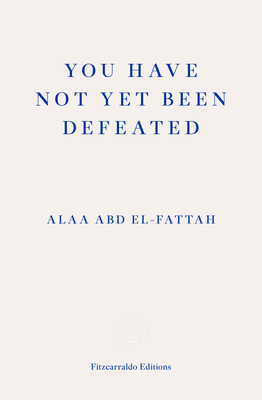
The editor of his book (You have Not Yet Been Defeated) portrays Alaa in the following words "He exists as multiple things at once; as an anti-capitalist considering how to bring the bourgeoisie into the balance of powers against a military authority; as a captive of a deaf, dysfunctional state, advising that state on how better to govern; as a prisoner who is always trying to look beyond the warden".
Commitment and dedication is the second name of Alaa Abdl Fattah. When there is brute force, there is Alaa to condemn and resist it. In the preface, Professor Naomi Klein describes Alaa in these words, "As a worker, the internet was Alaa’s day job; as an activist, it was one of his key weapons."
Alaa Abdl Fattah is still under custody and is being downtrodden by the state and oppressive apparatus and his case is thrown under the carpet by the judges. Force and violence are the main tools by which every government and authoritarian state tries to use against vocalists and dissent. The government legitimizes the use of force against marginalized communities and opposition by declaring them "terrorists", "intruders" and "aberrant".
Alaa Abdl Fattah and his colleagues were declared as spoilers and aberrant by the regime so that they must be sent to look up and keep them away from the masses so that they may not spoil the minds of the masses against the unconstitutional regime. The state of Egypt always remained a land where experience and civilization evolved. But these experiences spoiled and destroyed the life of the people and degraded the fertile land of Egypt.
You Have Not Yet Been Defeated is a collection of essays written by Alaa Abdl Fattah from 2011 to 2021. The book is written in prison and some chapters were written outside the jail and one interview of Alaa is also included in it. The book discusses the decayed state of Egypt and shares the sorrows of the revolutionaries and the masses. The experience of the jail changes him, and he becomes a mature, grown and quiet person and his choice of words tells the tale of how the time and difficulties changed him.
The Editor mentions the imprisonment of Alaa in these words "Alaa’s imprisonment is a lived and living metaphor for a country imprisoned." When an intellectual and thinking person becomes quiet and calm, it is a sign of alarm and destruction for the state. Sensible states learn lessons from calmness and alter it into eternal peace and the rest of the states become the headlines in the newspaper and TV. The unsensible state tries every tactic to keep the masses and the ground silent, but in Alaa's words. "Who convinced every government on earth that armed confrontation calms the masses down?". When impregnable calmness and silence occurs, it's a legible sign of a storm that will engulf the oppressor and eradicate the atrocious system.
But the other side of the book also displays a disclaimor that the way you are walking is not a piece of cake. On this journey you will be snuffed out without any indication and every step you take will cut out your roots and bases. As Naomi Klein notes, prison changed the life, behavior and words of Alaa, and he chooses words before speaking. In Alaa's own words, "Everyone in the prison is pale and miserable, even the cats, their movements slow, their eyes spent and broken". We also note in the chapter about Gaza where he rethinks why he had not fled to Gaza where his family would have been enjoying liberty, because at that time Gaza was a peaceful place for them as compared to Egypt.
Alaa also wrote about the brutality and barbarism of Israel in Gaza, and he portrays Palestinian, Gaza, and Palestine in the following lines. "The Palestinian is one who struggles to live a normal life under endlessly extraordinary conditions. The successive victories of the people of Gaza forced the occupation to withdraw. So the occupation decided to leave them prisoners to their own victory, to deprive them of the most important tool of struggle: the ability to live a normal life. For no matter how normal life seems on the surface of Gaza, the reality is the opposite as long as the vast majority of its people are unable to work for a living (estimates of unemployment range between 60 percent and 80 percent). The influx of money and goods from outside is not an alternative."
He further writes about Gaza: "An entire society behind bars, the sea fenced in, hovering robots that can kill you at any moment, airplanes roaring through the sound barrier at all hours, an economy of underground tunnels, and a mighty hidden enemy whose agents are concrete, iron and fire. You never see it, but it is always present."
The harshness and pains that he witnessed in his life feels like he reus to not flee Gaza and be away from these difficulties of life.
He wrote "If I were free in Gaza instead of locked up in Cairo, I would read books, play with children, enjoy the company of women, walk on the beach, work and make a living. I’d teach and I’d learn. I would live and be alive this moment. I would have breathed the dust-cloud of the whole national territory as it moved instead of trying to analyze it from afar. I regret not escaping to Gaza." But Alaa is safe and alive as he is in prison in Egypt and I think now he must be regreting those words he has written in his book.
While Gaza and Palestine are eradicated and lucky and unfortunate mothers (at the same time) are clueless about their laals (Precious Children). And mothers, parents and children of Palestine vanished from the world as fragrance dissipates from the body.
We also discover that Alaa is regretting it for a moment, but after a few minutes, he utters these words with courage. "We race towards the bullets because we love life, and we walk into prison because we love freedom". Hope, courage and love of freedom are the fundamentals of life, and we must not compromise on them.
Muhammad Saleem, محمد سلیم
November 23, 2024.