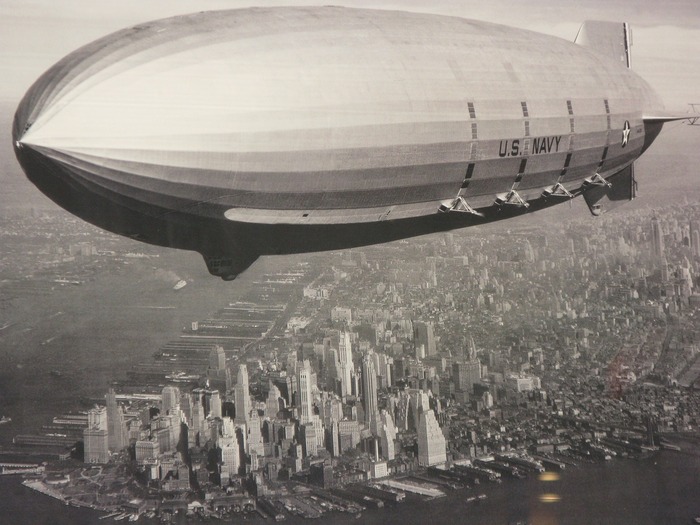
Nothing is accomplished by our society today. That little which seems like accomplishment is merely the sating of useless consumerist desires and the serving up of mental frippery and degradation. Apple is valued at trillions of dollars; that fact says all you need to know. Even something that could be thought an accomplishment, such as the rapid creation of vaccines to help counter the modest damage directly inflicted by the Wuhan Plague, is of dubious real value, and is moreover lost in wholly justified suspicion of our rulers. We have collectively marched, or been marched, into the dead end of a box canyon, and we hear the water rushing toward us. Not so long ago, however, as this book shows, the West was a civilization on the arc to glory. Maybe we can be again.
"Empires of the Sky" is the long, but compelling, story of the parallel development and adoption of rigid-frame airships, colloquially Zeppelins, and fixed-wing airplanes. The author, Alexander Rose (whose earlier book Washington’s Spies, about the Revolutionary War, was the basis for the very good AMC series Turn), writes with verve and grace, changing what might be simply a catalog of technical wizardry into a human-scale narrative. This is the story of men driven by an internal fire, who designed these machines and forced their development forward, taking insane risks. Why? Not so much for the possible material benefits to themselves, but for progress and glory, that of themselves and their people, and of all mankind.
Ferdinand von Zeppelin, father of airships, was born in 1838 in Mecklenburg, and took service with the Duke of Württemberg, as had his father. He rose in the military, but his primary focus was engineering, and among other assignments he was posted as an official Prussian military observer to Union forces in the Civil War, where he studied the early use of balloons for military observation. From his youth, Zeppelin did not suffer fools gladly, or anyone he thought of as a fool, which was most people. He also crashed into any obstacle head on; subtlety and politicking was not his forte. This sometimes helped him, as when in the Franco-Prussian war in 1870 he led a daring raid that got his name in the papers, but ultimately ended his military career, when in 1890 he was forced, humiliatingly, to retire, having offended the wrong people.
He needed something to do, he needed revenge, and he needed to prove he was a great man who could contribute to his society. Ever since his youth, he had been interested in balloons, pushing them during his military career. Balloons had advanced in fits and starts since the flight of the Montgolfier brothers in 1783, but their use for anything but tethered observation was obviated by an inability to control direction or to move against the wind. Steerable balloon-based craft with engines and rudders were proposed by various bright minds, but none had been successful, given the technical challenges, along with simple ignorance, such as of wind differences above the ground surface. Nonetheless, advances that would overcome the myriad difficulties were being made, primarily in Germany, including new aeronautical understandings and new technology, such as the ever-smaller and ever-more powerful internal combustion engines produced by Gottlieb Daimler. Zeppelin, like Steve Jobs and Elon Musk in the modern age, dismissed “experts” who said that what he desired, a fully-controllable airship, could not be done, and forged onward indefatigably.
As with many technological achievements, it was military demand and money that enabled Zeppelin to achieve his vision, although Prussian military interest waxed and waned with the international situation. Rose ably narrates the technical detail of Zeppelin’s work, interweaving it with descriptions of the world outside Zeppelin’s head. Part of that world was airplanes, slower to reach the air than balloons, and initially regarded as essentially unfeasible. So when Zeppelin flew his first machine, July 2, 1900, airplanes were not on his mind—his death was, given the flight was enormously risky, not that he was overly concerned. (Zeppelin was an unemotional man. He merely made basic plans for his death, consisting of a letter to his wife, and boarded his ship.) The first Zeppelin to fly, LZ-1 (for Luftschiffbau-Zeppelin), a rigid aluminum frame containing multiple hydrogen-filled internal balloons, was 420 feet long and flew, adequately though far from spectacularly. The rest of Zeppelin’s life was iterating this design.
As the century advanced and Zeppelin aged, his role as the public face and driving force of airships was taken over by Hugo Eckener, a sometime journalist who in 1906 had become captivated by Zeppelin and swept into his orbit. The other crucial man was Ludwig Dürr, a reclusive engineering genius responsible for much of the execution of Zeppelin’s vision. To be sure, as the Zeppelin team iterated their design, there were many accidents and problems, but in their methodical German way, Zeppelin’s team solved them all, and in general Zeppelins were regarded as very safe—even crashes almost never killed the passengers. Airplanes, on the other hand, which the Wright Brothers had first flown in 1903, were advancing at a slower rate, but killed people all the time. Moreover, they were far less comfortable for passengers; Zeppelins were much more stable, including from a passenger point of view, and could even fly through thunderstorms, though they avoided it.
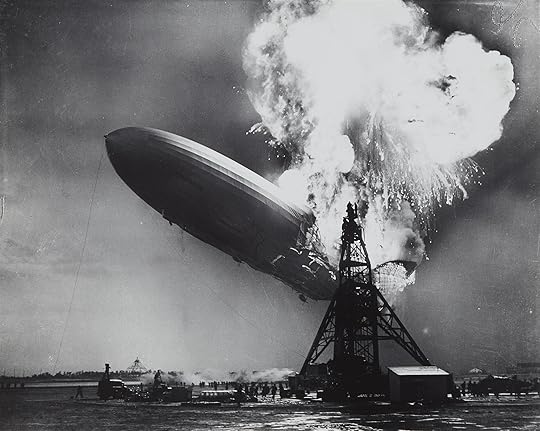
Because of later events, the technical detail that we associate most with Zeppelins is their being filled with hydrogen. But this was not nearly as dangerous as it seems; the hydrogen was contained within balloons of pure hydrogen, which cannot directly ignite. (I once almost built a factory to manufacture hairspray aerosols, and so I know a great deal about flammable gases, including that they have a “lower explosive limit” and an “upper explosive limit,” meaning that above and below certain concentrations in ambient air they will not ignite even if directly exposed to flame.) Thus, lightning strikes, which were not infrequent, did not ignite the hydrogen—but smoking was still sharply restricted, just in case there was a leak somewhere.
Eckener wanted to start a commercial passenger line, and did, in 1909—DELAG, the Deutsche Luftschifffahrts-Aktiengesellschaft, or German Airship Travel Corporation. This was quite successful—until 1914, when as part of an earlier arrangement Zeppelin had made for funding, the Germany military requisitioned all of the several airships Zeppelin and DELAG were operating, putting a temporary end to DELAG. Yet Zeppelin’s airships proved essentially worthless in war, because the French quickly learned how to shoot them down, tearing open the gas balloons with bullets and then igniting the released gas, and their construction cost was far greater than the miniscule bombing damage they were able to inflict on the enemy—even if, in time-honored fashion, propaganda lies about their great success were spread widely. Rose draws a compelling picture of the demise of L-48, shot down by French incendiary rounds in 1917. One officer survived (only four men survived a burning Zeppelin during the entire war). “The fire rolled forward from the stern as the men fled along the walkway to the control car, and the flames folded over it like a ‘purple canopy’ as black smoke enveloped everyone within. One man, lighting up his last cigarette, joked ‘No smoking allowed!’ ”
On the other hand, Dürr continued to continuously improve the design and materials for the airships. And Eckener, a showman, managed to send an airship to the Sudan and back, putatively for a military rescue, but mostly to show the great distances of which Zeppelins were safely capable, in preparation for postwar transatlantic flights. Still, after their victory the Allies confiscated the two remaining ships and forbade any more construction, so it appeared that Zeppelins were dead. As was Zeppelin himself, dying in 1917, before the end of the war.
Airplanes, by contrast, had been quite successful in the war and were getting better all the time, led by a wide range of men in the United States. This was the era of experimentation and barnstorming—pilots died every month. The men of Air Mail in the United States called themselves the “Suicide Club,” and twenty-nine of the original forty pilots died, while two hundred Air Mail planes were lost in accidents. These men were the type of men we could use now, but whom we don’t have now, or if we do, they are not allowed to take risks and to excel, ground down and suppressed by a combination of government smothering and mass feminization. We never even study such men of the past, such as the Wright Brothers (well, my children do); our children in most schools today only study Bessie Coleman, a wholly unimportant black woman novelty act flyer of the late 1920s, who soon enough died falling out of an airplane after she failed to secure her seatbelt. You get more of what you praise to the young, so don’t hold your breath expecting the current generation to fix our problems.
In parallel with his narrative of Zeppelins, Rose traces the rise of airplanes as airliners, and their eventual total replacement of Zeppelins. His frame is the rise to the top of the airline business of Juan Trippe, a protean, suave, driven member of the American upper crust. Or so he pretended; his background wasn’t as pedigreed as he claimed, and his first name, odd in this context and strongly disliked by Trippe himself, came from his grandfather, a Venezuelan Irishman. Whatever his personal demons, Trippe knew what he wanted, which was to be rich and powerful, and to do it through dominating air travel. He was the first to comprehensively study and plan air travel in light of other modes of transport throughout the ages.
By the point Trippe got started, in the mid-1920s, DELAG was back in operation, the Allies having relented, but the received wisdom was that Zeppelins would be the long-range flyers of the future, safe but slow and inflexible, and airplanes the short-range flyers, more dangerous but faster and flexible. Airships were better understood and it was known that making them somewhat bigger rapidly increased their capacity; this simplicity made them attractive. Airplanes were believed to have strict physical limits to their capabilities, requiring impossible wingspans to achieve anything near the passenger capacity of airships. Advocates for both existed, but airplanes had scores, if not hundreds, of different companies working on them, which led to fast innovation. Airships had only the Zeppelin Company and the United States Army, and the latter abandoned airships after a series of disasters. Thus, in the 1920s airplanes developed with startling rapidity, while airships, already closer to technological maturity, didn’t, though various technical advances were made.
The technical development of airplanes was also made possible by a massive American turn to aeronautical engineering. Thousands of students flowed into engineering programs; numerous companies sprang up to commercialize every aspect of airplane design and manufacture, since the entrepreneurial environment was wide open for airplanes. And as airplanes improved exponentially, Trippe was always there, working tirelessly to build an airline. Others also started passenger lines, but the supple Trippe was ruthless in dealing with both competitors and politicians, domestic and foreign. He went into business with Charles Lindbergh, too, whose unparalleled fame was invaluable to his efforts.
As with Zeppelins, money was a limiting factor in running a successful airplane company, whether making airplanes or running an airline. Trippe had an advantage here—he was able to raise money from his upper-crust friends, and with some greasing of palms, he obtained the exclusive landing rights in Cuba, giving him an important route that nobody else was allowed to fly. But even with his advantages, Trippe had many close calls and lucky breaks, and as every successful entrepreneur must, he turned to creative, high-risk solutions to existential problems. For example, he had to meet a crucial Post Office contract hurdle, which rigorously specified that to keep the contract he must take off from Key West and land in Cuba by a date certain. But then there was no airport in Key West. So the day before the contract expired he scoured the country for a seaplane to fly to, then land, in Key West and had it take off with minutes to spare; the contract said nothing about taking off from the Key West airport. The name Trippe gave his new airline? Pan American, something that means little to younger Americans, but is instantly recognizable to anyone over forty.
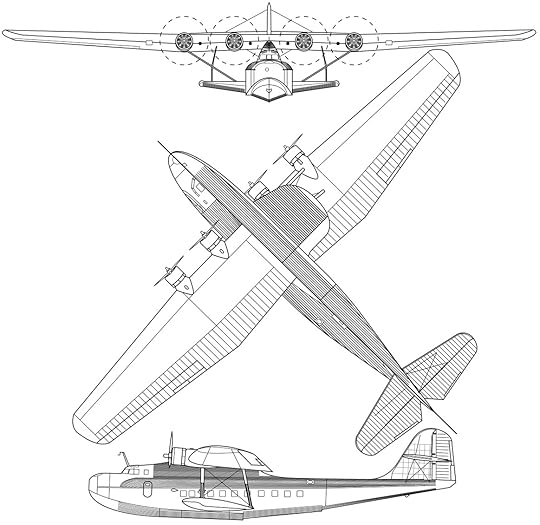
Pan Am expanded with great speed, and was soon flying all over America and into South America. It did not fly the Atlantic, and this was the Holy Grail of air travel—to replace transatlantic boats with a faster alternative. Trippe wanted to start transatlantic travel, but needed to stop in Newfoundland—and the British government wouldn’t cooperate unless their state-sponsored company, Imperial, operated part of the route. Imperial, however, trailed Pan Am on every front. (It’d be as if Elon Musk had to coordinate his every act for SpaceX with NASA.) So Trippe turned to the unexpected—flying across the Pacific first, using island-hopping, including finding obscure islands on which to land and refuel (not dissimilar to how Musk flew his first rockets off a speck of an island in the Pacific). He figured he’d get back to transatlantic travel. The Pacific flights lost massive amounts of money, however, giving even greater spur to Trippe’s efforts to construct a more lucrative Atlantic route.
Eckener, on the other hand, was already running transatlantic flights, and the Zeppelin Company, back in the airship business, had forged links with the United States, establishing a US-based affiliate. In 1929, Eckener flew a Zeppelin airship around the world, which in his mind proved that airships were a viable solution for global long-range travel (even if it turned out that transcontinental trips in America were uniquely hazardous due to weather patterns, something Eckener kept to himself). Zeppelins, in the public mind, seemed still very much in the running for dominance.
The Depression dented the business travel that paid the bills . . . [Review completes as first comment.]